The phone rang at 6:14 on a rainy Monday morning.
I almost ignored it.
Then I saw the name.
Michael.
My younger brother.
We hadn’t spoken in seven years.
Not one birthday.
Not one Christmas.
Not even when our father died.
For seven years, I’d told myself I didn’t care anymore.
But the moment I heard his voice, every lie I’d told myself disappeared.
“Anna?”
His voice was barely recognizable.
“Michael?”
There was a long silence.
Then he said the only thing he’d called to say.
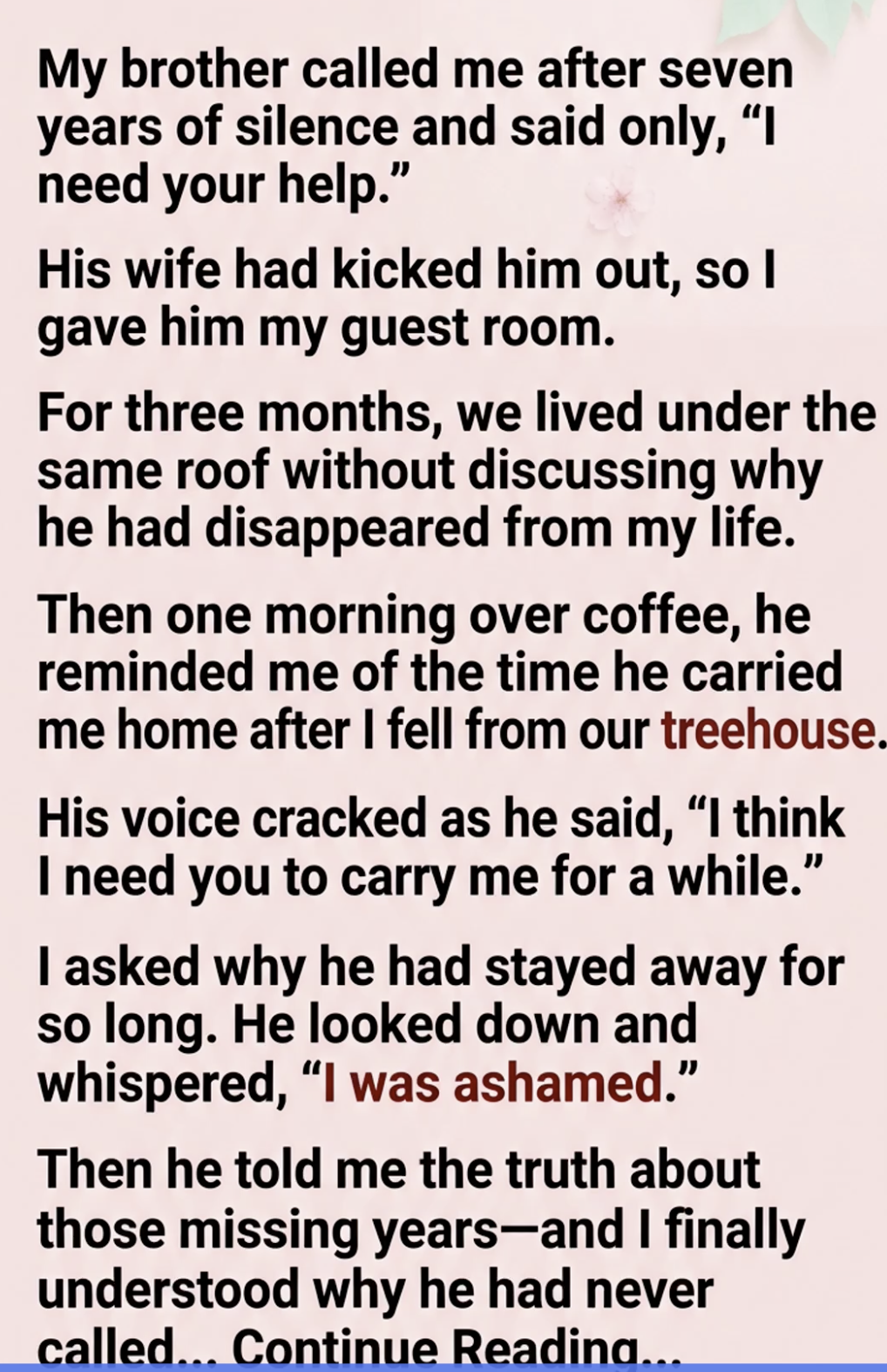
“I need your help.”
I sat up in bed.
“What happened?”
“My wife kicked me out.”
I closed my eyes.
Of all the things I expected to hear from my brother after seven years, that wasn’t one of them.
“Where are you?”
“In my car.”
“Come here.”
He arrived forty minutes later.
He was standing in my driveway with one suitcase, a backpack, and a face that looked ten years older than I remembered.
He hadn’t shaved.
His jacket was soaked.
He looked exhausted.
I opened the door.
He stood there awkwardly.
“Hi.”
I stepped aside.
“Come in.”
He did.
That was how seven years of silence ended.
Not with an apology.
Not with an explanation.
Just one exhausted brother carrying a suitcase into his sister’s guest room.
For three months, we lived under the same roof.
And we barely spoke about the past.
He found a job doing maintenance work.
He contributed what he could.
He cooked sometimes.
I cooked sometimes.
We watched television in separate rooms.
He never asked about my life.
I never asked about his.
It was strange.
We had once been inseparable.
When we were children, Michael followed me everywhere.
If I climbed a tree, he climbed it.
If I rode my bicycle, he rode behind me.
If someone bullied him at school, I was the one who showed up.
And there was one memory I could never forget.
We were thirteen and nine.
We had built a terrible treehouse behind our parents’ garage.
One afternoon, I climbed too high, slipped, and fell.
I wasn’t badly injured, but I’d twisted my ankle badly enough that I couldn’t walk.
Michael was only nine.
But he carried me home.
He struggled the whole way.
Every few steps, he had to stop.
“Put me down,” I’d said.
“No.”
“You can’t carry me.”
“Yes, I can.”
And somehow, he did.
He carried me all the way to the back door.
That memory came back three months after he moved in.
It was a Saturday morning.
We were drinking coffee.
Michael stared into his mug.
Then he said,
“Do you remember the treehouse?”
I smiled.
“You carried me home.”
He nodded.
“I remember.”
“You were nine.”
“I know.”
“You almost dropped me.”
He smiled for the first time in weeks.
“I didn’t.”
“No. You didn’t.”
His smile disappeared.
Then his voice cracked.
“I think I need you to carry me for a while.”
I looked at him.
“What happened, Michael?”
He stared at the table.
“Why did you stay away for so long?”
His fingers tightened around the mug.
Then he whispered,
“I was ashamed.”
I waited.
He took a breath.
And finally told me everything.
Seven years earlier, Michael had lost his job.
Not because he had done anything wrong.
His company had collapsed.
He’d been the primary income earner.
He had a mortgage.
Two children.
And a wife who had grown accustomed to a certain lifestyle.
At first, Michael thought the unemployment would last a few months.
It didn’t.
Three months became six.
Six became a year.
He started taking temporary jobs.
Then night shifts.
Then construction work.
He sold his car.
He borrowed money.
Eventually, he began falling behind on everything.
His wife, Rachel, became angry.
Then cruel.
“You’re not the man I married anymore,” she told him.
Michael never told me.
Instead, he started avoiding everyone.
Especially me.
“Why me?” I asked.
He looked at me.
“Because you were the person I was most ashamed to disappoint.”
I didn’t understand.
“You’re my brother.”
“I know.”
“You could have called.”
“I wanted to.”
“Then why didn’t you?”
He looked down.
“Because every time I thought about calling, I imagined you asking how I was doing.”
“And?”
“I didn’t have a good answer.”
I felt tears in my eyes.
“You could have told me you were struggling.”
“I didn’t know how.”
Then he told me about the night he left.
Rachel had thrown his suitcase onto the driveway.
Their children were asleep upstairs.
She told him she was done.
“You’ve failed this family,” she’d said.
Michael drove away.
He slept in his car for four nights.
Then a friend let him stay on a couch.
He found work.
But he couldn’t bring himself to call me.
His shame became a wall.
And the longer he stayed silent, the harder it became to break it.
Then something worse happened.
Their father died.
Michael didn’t come to the funeral.
I had been furious.
I thought he simply didn’t care.
“I wanted to come,” he whispered.
“Then why didn’t you?”
“Because Dad knew I’d failed.”
I stared at him.
“You didn’t fail Dad.”
Michael shook his head.
“You don’t understand.”
“I want to.”
He pulled a folded letter from his wallet.
It was old.
Very old.
He handed it to me.
It was from our father.
Michael had received it three days before Dad died.
The letter said:
Michael,
I know you’re struggling.
Your sister told me.
She didn’t tell me everything because she promised you she wouldn’t.
But I know enough.
Don’t be ashamed of needing help.
You carried your sister home when you were nine.
You don’t have to carry everyone forever.
Sometimes you get to be the one carried.
I read the letter twice.
Then I looked at my brother.
“You had this all along?”
He nodded.
“Why didn’t you show me?”
“Because I couldn’t.”
I put the letter on the table.
“Michael, Dad knew.”
“I know.”
“And I knew something was wrong.”
“I know.”
“And neither of us cared about your money.”
He laughed bitterly.
“I cared.”
That was the truth.
He had spent seven years believing that his worth depended on what he could provide.
His marriage had reinforced it.
His unemployment had destroyed his confidence.
And his shame had convinced him that everyone would see him differently.
Especially me.
Then he told me about the second secret.
Rachel hadn’t simply kicked him out.
She had emptied their joint savings.
She had taken the children’s college accounts and transferred much of the money to a personal investment account.
Michael discovered it after she filed for divorce.
He had confronted her.
She told him the money was hers because she had “earned the right to protect herself.”
Michael had been left with almost nothing.
He wasn’t asking me for money.
He was asking for somewhere to stand while he rebuilt his life.
I reached across the table.
“You don’t have to earn your place here.”
He looked at me.
“I don’t?”
“No.”
“What if I can’t pay rent?”
“Then don’t.”
“What if I can’t find a better job?”
“Then find the next job.”
“What if I fail again?”
I smiled.
“Then I’ll still be your sister.”
His eyes filled with tears.
He looked away.
For a long time, neither of us spoke.
Then he said,
“I missed you.”
I answered,
“I missed you too.”
That was the beginning.
Not the end.
The beginning.
Michael stayed with me for another five months.
During that time, he rebuilt his life slowly.
He found steady work with a property management company.
He started therapy.
He learned how to manage his finances.
He opened a new bank account.
He worked with a lawyer on the divorce and the disputed savings.
And he started calling his children every night.
Eventually, he rented a small apartment.
The first night he moved out, he stood at my door holding a cardboard box.
“I don’t know what to say.”
“You don’t have to say anything.”
He smiled.
Then he hugged me.
“I’ll call tomorrow.”
“You better.”
He laughed.
And he did.
The next day.
And the day after that.
Years passed.
Michael’s life changed completely.
He was never wealthy again.
But he didn’t care.
He bought a small house.
His children came to stay on weekends.
He planted a tree in his backyard.
One afternoon, he sent me a photograph.
It was a treehouse.
Not a good one.
The roof leaned slightly.
One wall was crooked.
I laughed when I saw it.
Under the photograph, he had written:
“Built one for the kids.”
I drove over that weekend.
His daughter showed me the inside.
His son proudly pointed out the ladder.
Michael stood nearby smiling.
“You remember ours?” he asked.
“Of course.”
He nodded.
Then he said,
“I thought I had to carry everyone.”
I looked at him.
“What changed?”
“You.”
I shook my head.
“No.”
He smiled.
“You reminded me that being carried doesn’t make you weak.”
I hugged him.
“You carried me first.”
He laughed.
“Guess we’re even.”
Years earlier, I had thought my brother disappeared because he didn’t love us anymore.
The truth was much sadder.
He disappeared because he thought he wasn’t good enough to come home.
He thought failure made him unworthy of family.
He thought we would measure him by his paycheck, his house, his job, or his marriage.
But family isn’t supposed to be a reward for success.
It’s supposed to be the place where you can show up when you’re not successful at all.
Michael once carried me home when he was nine years old.
Seven years of silence later, he finally admitted that he needed someone to carry him.
And I realized something that our father had understood long before either of us did:
Sometimes the strongest person in the family is the one brave enough to finally say,
“I can’t do this alone.”
And sometimes love means answering,
“Then you don’t have to.”