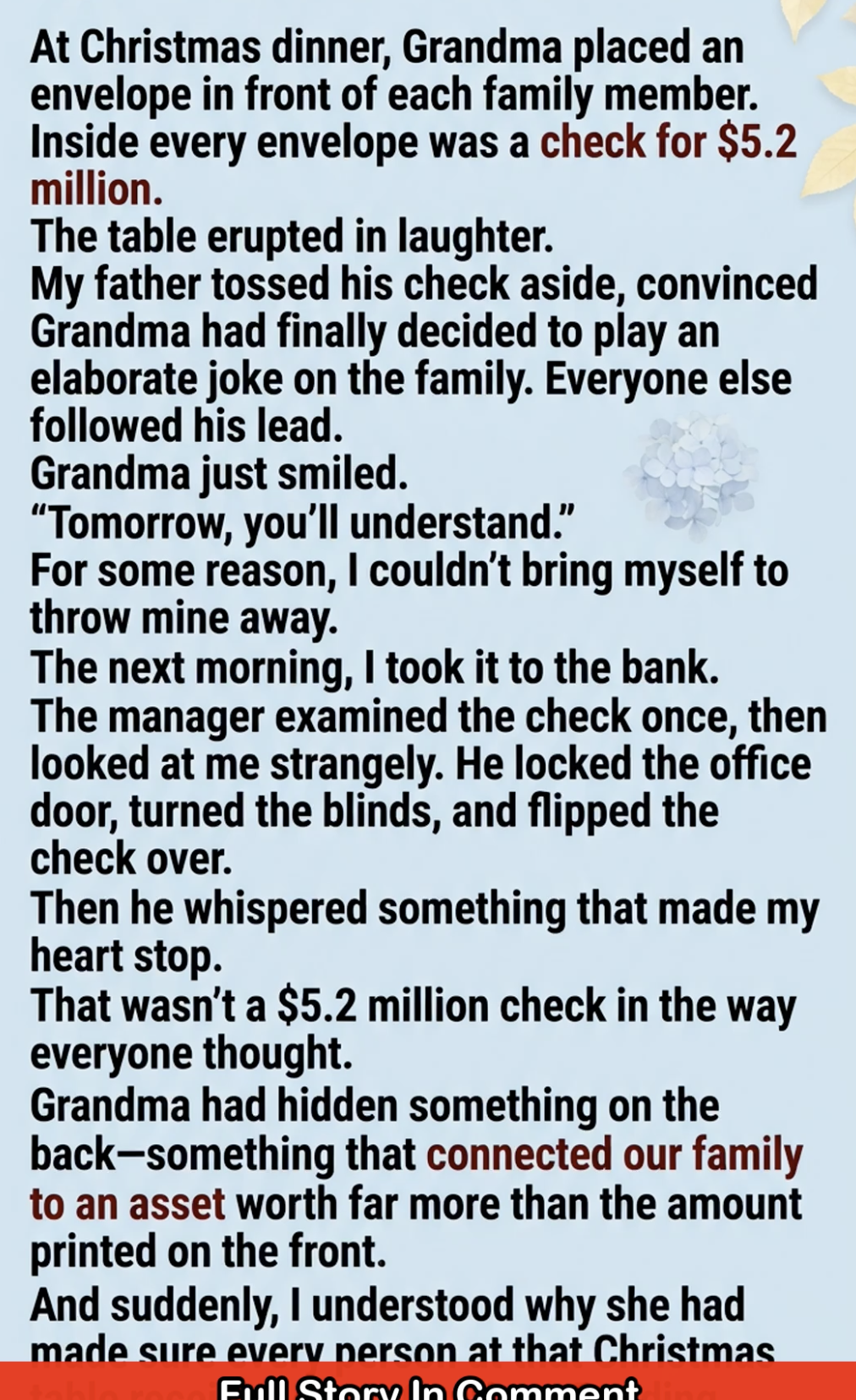
At Christmas dinner, Grandma placed an envelope in front of every person at the table.
“Open them.”
My father laughed.
“What’s this?”
Grandma smiled.
“Your Christmas present.”
We opened the envelopes.
Inside every one was a check for $5.2 million.
For several seconds, nobody spoke.
Then the table erupted in laughter.
My father tossed his check onto the table.
“Very funny, Mom.”
My uncle laughed.
My cousins took pictures.
Someone joked that Grandma had finally lost her mind.
Everyone assumed it was a joke.
Everyone except me.
I looked at Grandma.
She wasn’t laughing.
She simply took a sip of her tea.
“Tomorrow,” she said, “you’ll understand.”
I folded my check carefully and put it in my wallet.
The next morning, I went to the bank.
The manager examined the check.
His expression changed.
He looked at me.
“Where did you get this?”
“My grandmother gave it to me.”
He looked at the amount again.
Then he closed the office door.
He lowered the blinds.
And he turned the check over.
There was a small handwritten notation on the back.
The manager read it silently.
Then he looked at me.
“This isn’t intended to be deposited as a normal check.”
My heart started beating faster.
“What does it mean?”
He pointed to a series of numbers.
“They correspond to a trust account.”
I stared at him.
“A trust?”
He nodded.
“This check is a beneficiary certificate.”
I didn’t understand.
He explained that Grandma had established a private family trust decades earlier.
The $5.2 million printed on each check represented the estimated value of each beneficiary’s share.
But the check itself wasn’t the money.
It was a symbolic certificate confirming the beneficiary’s interest.
The real asset was something else.
Something much larger.
The manager turned to another page.
“The trust owns an interest in a commercial property portfolio.”
“How much is it worth?”
He hesitated.
“Approximately $41 million based on the most recent valuation.”
I stared at him.
Forty-one million dollars.
I suddenly understood why Grandma had given everyone the same check.
She wasn’t promising everyone $5.2 million in cash.
She was showing us how much our individual shares could be worth if the trust were distributed.
But there was more.
The manager pointed to another clause.
“There’s a condition.”
“What condition?”
He explained that Grandma had deliberately refused to distribute the trust while the family was arguing over control of the underlying properties.
Instead, the trust required every beneficiary to sign an agreement confirming that no individual family member could sell, transfer, or mortgage their interest without the others being informed.
The checks were a test.
Grandma wanted to know what we would do when we thought we had suddenly received millions.
Would we rush to cash them?
Would we fight over who deserved more?
Would we call lawyers?
Would we throw them away because we didn’t believe her?
Or would we actually read the documents?
I returned home.
Grandma was sitting in the living room.
“You went to the bank.”
“Yes.”
“And?”
I placed the check on the table.
“I know about the trust.”
She smiled.
“Good.”
“Why didn’t you tell everyone?”
“Because people behave differently when they think money is real.”
I understood immediately.
At Christmas dinner, my father had laughed.
My uncle had thrown his check away.
One cousin had complained that $5.2 million wasn’t enough.
Another had already joked about buying a new house.
Nobody had asked Grandma what the check meant.
Nobody except me.
That afternoon, Grandma called everyone back to the house.
She placed the original trust documents on the dining table.
“This family has spent years fighting over possessions,” she said.
“We argued over property, businesses, and investments.”
She looked at my father.
“I watched brothers stop speaking to each other.”
Then she looked at the rest of us.
“I don’t want my money to continue doing that after I’m gone.”
She explained that the family trust had been created with the help of her late husband.
They had purchased several commercial properties when they were still inexpensive.
Over the decades, those properties had appreciated dramatically.
The trust now held a diversified portfolio that generated rental income and had grown substantially in value.
The $5.2 million figure was based on the current valuation and the planned distribution formula.
But nobody was receiving a suitcase full of cash.
The family would receive income and eventual distributions under the trust’s terms.
My father looked embarrassed.
“So the check was fake?”
Grandma smiled.
“No.”
She tapped the paper.
“It was real enough to show you something.”
“What?”
“How quickly you decided what you deserved.”
The room became quiet.
My father looked at the check he had thrown away.
“Can I still have mine?”
Grandma laughed.
“Of course.”
Then she added,
“But only after you sign the agreement.”
One by one, the family members reviewed the documents.
Some apologized for their earlier behavior.
Others were embarrassed.
A few were still disappointed that the money wasn’t immediately available.
Grandma didn’t argue with them.
She simply reminded everyone that wealth was easier to divide than trust.
Months later, the trust began making distributions according to its terms.
Nobody became instantly rich.
There were no sports cars arriving in the driveway.
No extravagant vacations.
No overnight transformation.
Instead, each beneficiary received a steady income while the underlying assets continued to be managed.
And something unexpected happened.
The family stopped fighting over individual properties.
Because none of us could sell one piece without considering everyone else.
Grandma had designed the arrangement that way deliberately.
Years later, when I asked her why she had chosen Christmas to give us those checks, she smiled.
“Because Christmas is when people are supposed to remember what matters.”
I laughed.
“You could have just told us.”
“No,” she said.
“If I told you, you would have heard the number.”
She pointed toward the check.
“But when you thought it was real money, you showed me who you were.”
I kept my original check.
Not because it was worth $5.2 million.
It wasn’t.
I kept it because it reminded me of the lesson Grandma wanted us to learn.
The most valuable thing she left our family wasn’t the $41 million portfolio.
It was the structure that kept the money from destroying us.
And every Christmas after that, whenever someone mentioned the famous $5.2 million checks, Grandma would smile and say:
“The fortune was never the test. Your reaction to it was.”