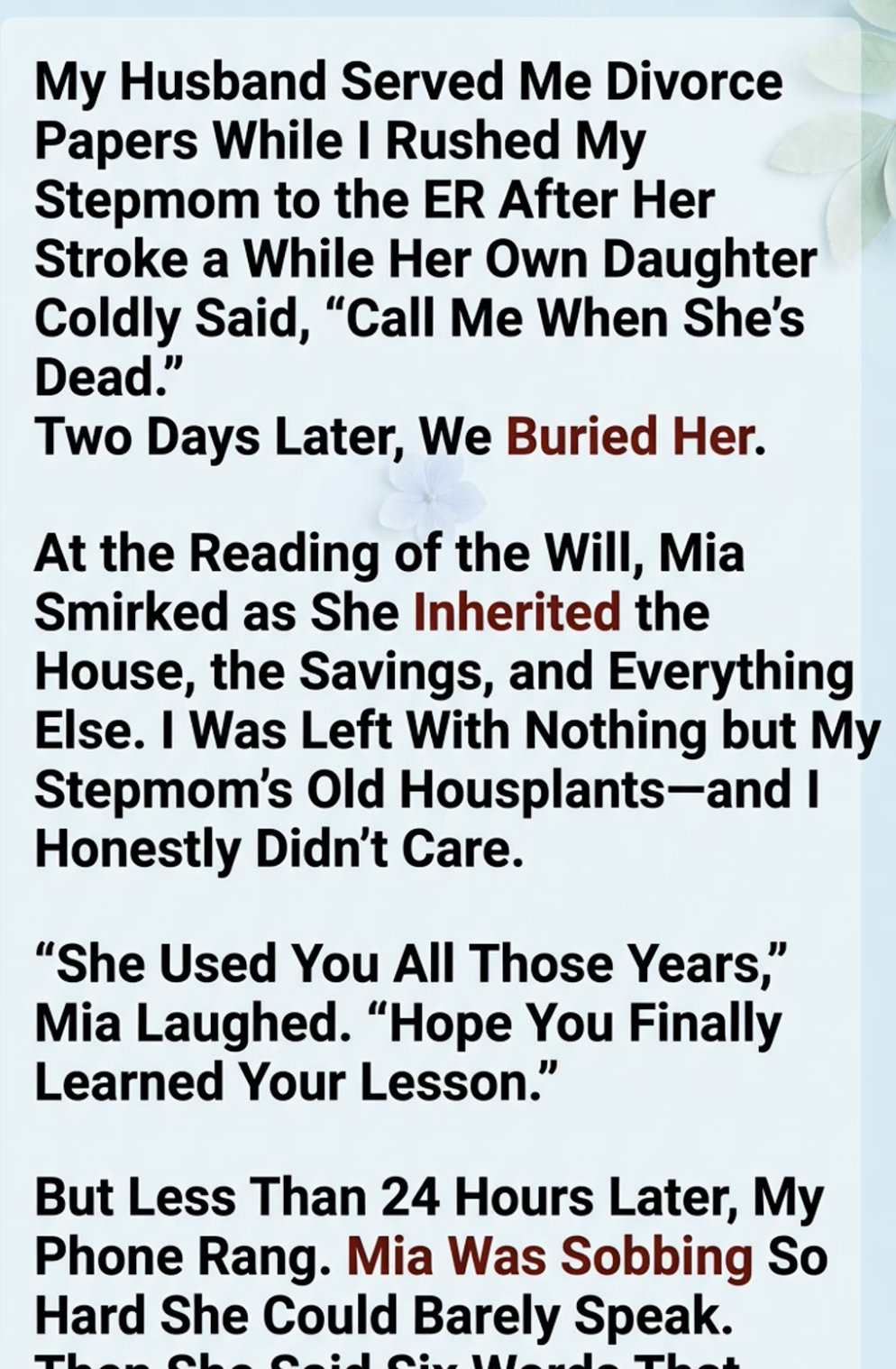
The phone rang at 2:17 in the morning.
I almost didn’t answer.
For three weeks, I’d barely slept.
First, my stepmother had suffered a stroke.
Then my husband had handed me divorce papers while I was standing outside the emergency room.
And two days after that, we buried the woman who had raised me after my father died.
So when the phone rang that night, I assumed it was the hospital.
Instead, it was Mia.
My stepmother’s biological daughter.
The same woman who had stood in the hospital hallway and said:
“Call me when she’s dead.”
Now she was crying so hard I could barely understand her.
“Claire…”
I sat up.
“What happened?”
She tried to speak.
Nothing came out.
Then, between sobs, she finally said six words that changed everything.
“Mom knew you would need this.”
I froze.
Because I knew exactly what she meant.
The old houseplants.
Three days earlier, I had been sitting beside my stepmother’s hospital bed.
Her name was Evelyn.
She wasn’t my biological mother.
But biology had never mattered to me.
My father married her when I was eleven.
She had walked into our chaotic little house carrying two grocery bags, a suitcase, and an expression that said she had no idea what she’d gotten herself into.
My father had two children from his first marriage.
Mia was eighteen.
I was eleven.
Mia never accepted Evelyn.
I did.
Not because Evelyn tried to replace my mother.
She never did.
Instead, she became the person who packed my lunches, attended school meetings, helped me with homework, and stayed awake when I had nightmares.
When my father died seven years later, Mia moved away.
Evelyn stayed.
And somehow, we became a family.
For the next twenty-five years, I was the daughter who called.
I took her to appointments.
I fixed things around the house.
I brought groceries.
I handled paperwork.
I visited on holidays.
Mia called occasionally.
Usually when she needed something.
Then Evelyn had the stroke.
I was the one who found her.
She had collapsed in the kitchen.
I called 911 and rode with her to the hospital.
By the time the doctors stabilized her, it was nearly midnight.
I was sitting beside her bed when my husband, Daniel, arrived.
He wasn’t alone.
His attorney was with him.
I looked at him in confusion.
“What are you doing here?”
He placed an envelope on the chair beside me.
“I’m sorry.”
I opened it.
Divorce papers.
I stared at him.
“Now?”
He avoided my eyes.
“You’ve been spending all your time here.”
“She had a stroke.”
“I know.”
“You’re serving me divorce papers while my stepmother is fighting for her life?”
He sighed.
“Claire, this marriage hasn’t worked for a long time.”
I looked at him.
Then at Evelyn lying unconscious in the hospital bed.
I felt something inside me go strangely quiet.
“Then go.”
He blinked.
“What?”
“Go.”
He left.
I didn’t cry.
Not then.
I had already spent too many years trying to save things that other people had decided to abandon.
Two days later, Evelyn died.
Mia arrived just before the funeral.
She hugged me once.
Then she stepped back.
“Mom left everything to me.”
I stared at her.
“What?”
“The house. Savings. Investments. Everything.”
I didn’t argue.
At the reading of the will, the attorney confirmed it.
Mia inherited the house.
The savings.
The investment accounts.
The furniture.
The family jewelry.
Everything of significant financial value.
I received one thing.
A collection of old houseplants.
I actually smiled.
The attorney looked uncomfortable.
“Claire, there is a letter addressed specifically to you.”
Mia laughed.
“Of course there is.”
I opened the envelope.
The letter was short.
Claire,
If you’re reading this, I’m sorry I couldn’t tell you everything myself.
Take the plants. Keep them alive. One of them contains something I want you to have.
You will know which one.
Love, Evelyn.
I looked at the row of plants.
There were seven.
Mia rolled her eyes.
“She’s still making you work for something.”
I carefully loaded the plants into my car.
Mia stood on the porch of the house she had just inherited.
She smiled.
“She used you all those years.”
I said nothing.
“Hope you finally learned your lesson.”
I looked at her.
“What lesson?”
“That being nice doesn’t get you anything.”
I smiled faintly.
“Maybe.”
Then I drove away.
That night, I placed the plants along the windowsill of my small apartment.
I had nowhere else to go.
My divorce was still being processed.
I had no house.
No husband.
And apparently no inheritance.
But strangely, I wasn’t angry.
Evelyn had spent twenty-five years giving me something money couldn’t measure.
She had taught me how to survive.
How to work.
How to love without expecting repayment.
How to start again.
I watered the plants.
Then I went to bed.
At 2:17 a.m., Mia called.
She was crying.
“Claire…”
“What happened?”
“Mom knew.”
“Knew what?”
“Everything.”
I sat up.
“What are you talking about?”
“She knew Daniel was leaving you.”
My heart stopped.
“What?”
“There are letters.”
“What letters?”
“I found them in the house.”
Her voice cracked.
“She knew about his affair.”
I closed my eyes.
For months, I’d suspected Daniel had been distant.
But I had never known why.
Mia continued.
“Mom hired someone to look into it.”
I didn’t speak.
“She knew he had been moving money.”
My hands went cold.
“Why didn’t she tell me?”
“Because she was afraid you’d stay with him just because you thought you had nowhere else to go.”
I stared at the plants on my windowsill.
Then I remembered the letter.
One of them contains something I want you to have.
“Mia,” I said quietly.
“Yeah?”
“Where did you find the letters?”
“In Mom’s study.”
“Don’t touch anything else.”
She started crying again.
“Claire, there’s more.”
“What?”
“The will isn’t what you think.”
My heart began pounding.
“What do you mean?”
“She left me the house and the accounts.”
“Yes.”
“But she left you the plants.”
“Yes.”
“She didn’t leave you nothing.”
I frowned.
“Then what did she leave me?”
Mia whispered:
“Everything she couldn’t put into the will.”
The next morning, I drove back to Evelyn’s house.
Mia was waiting for me.
She looked exhausted.
On the dining table were several documents.
“I found these after you left.”
I sat down.
The first was a property agreement.
The second was an investment statement.
The third was a letter from Evelyn’s attorney.
I read them slowly.
Then I understood.
Years earlier, Evelyn had created a trust.
The house and some liquid assets had been placed into it.
But the will only transferred certain personal assets to Mia.
The trust was separate.
And I was the beneficiary.
Mia stared at me.
“I didn’t know.”
“I believe you.”
She covered her face.
“So Mom gave me the house…”
“Apparently.”
“And you got the trust.”
“Yes.”
She started laughing through her tears.
“That’s why she gave you the plants.”
I looked at the plants I’d brought home.
One particular plant had always been Evelyn’s favorite.
A large jade plant.
She had kept it for more than twenty years.
Mia handed me another envelope.
“This was taped underneath the pot.”
Inside was a handwritten note.
Claire,
The plants are not valuable because of what’s hidden beneath them. They’re valuable because they remind you of home.
But if you ever need a home again, the paperwork will take care of that.
I know you. You will probably refuse help before you admit you need it. So I’ve made the decision for you.
I started crying.
For the first time since her death.
Mia sat beside me.
“She really knew you.”
“Yes.”
“She knew me too.”
I looked at her.
Mia wiped her eyes.
“I spent years thinking she loved you more.”
“She loved us differently.”
“I was cruel to her.”
I didn’t answer.
She continued.
“I told her to call me when she died.”
Her voice broke.
“I can’t take that back.”
“No.”
She nodded.
“I know.”
The trust gave me enough financial security to start over.
But the greatest surprise came a few weeks later.
Daniel’s attorney contacted me.
There were discrepancies in the financial records surrounding our marriage.
The documents Evelyn had collected showed that Daniel had transferred money into accounts I hadn’t known about.
Some of it was connected to the woman he had been seeing.
The divorce settlement changed significantly once those records were examined.
I didn’t become wealthy.
I didn’t need to.
I simply walked away with what was rightfully mine.
A few months later, my divorce was final.
I moved into a small house with a sunny back porch.
And seven houseplants.
The jade plant sat in the center.
Mia visited one Sunday afternoon.
She stood at the door holding a box.
“What is that?”
“Mom’s photographs.”
She handed me the box.
“I thought you should have them.”
I smiled.
“Thank you.”
She looked at the plants.
“They’re doing well.”
“I’m trying.”
She laughed.
Then she became quiet.
“Claire?”
“Yes?”
“Do you think Mom knew we’d eventually forgive each other?”
I looked at the jade plant.
“I think she hoped we would.”
Mia nodded.
Then she hugged me.
It wasn’t a perfect relationship.
It couldn’t erase twenty-five years of resentment overnight.
But it was a beginning.
And sometimes a beginning is enough.
I kept Evelyn’s final letter in the drawer beside my bed.
I still read it whenever life becomes difficult.
The last line says:
“Never confuse what someone leaves you with what they gave you while they were alive.”
Evelyn had technically left Mia the larger inheritance.
But she had given me something long before she died.
A home.
A childhood.
A mother.
And when everything else in my life fell apart, that gift was still there.
Growing quietly beside my window.
Sometimes the greatest inheritance isn’t what appears in a will. It’s the love, strength, and lessons someone leaves behind—and those things can’t be taken away by anyone.