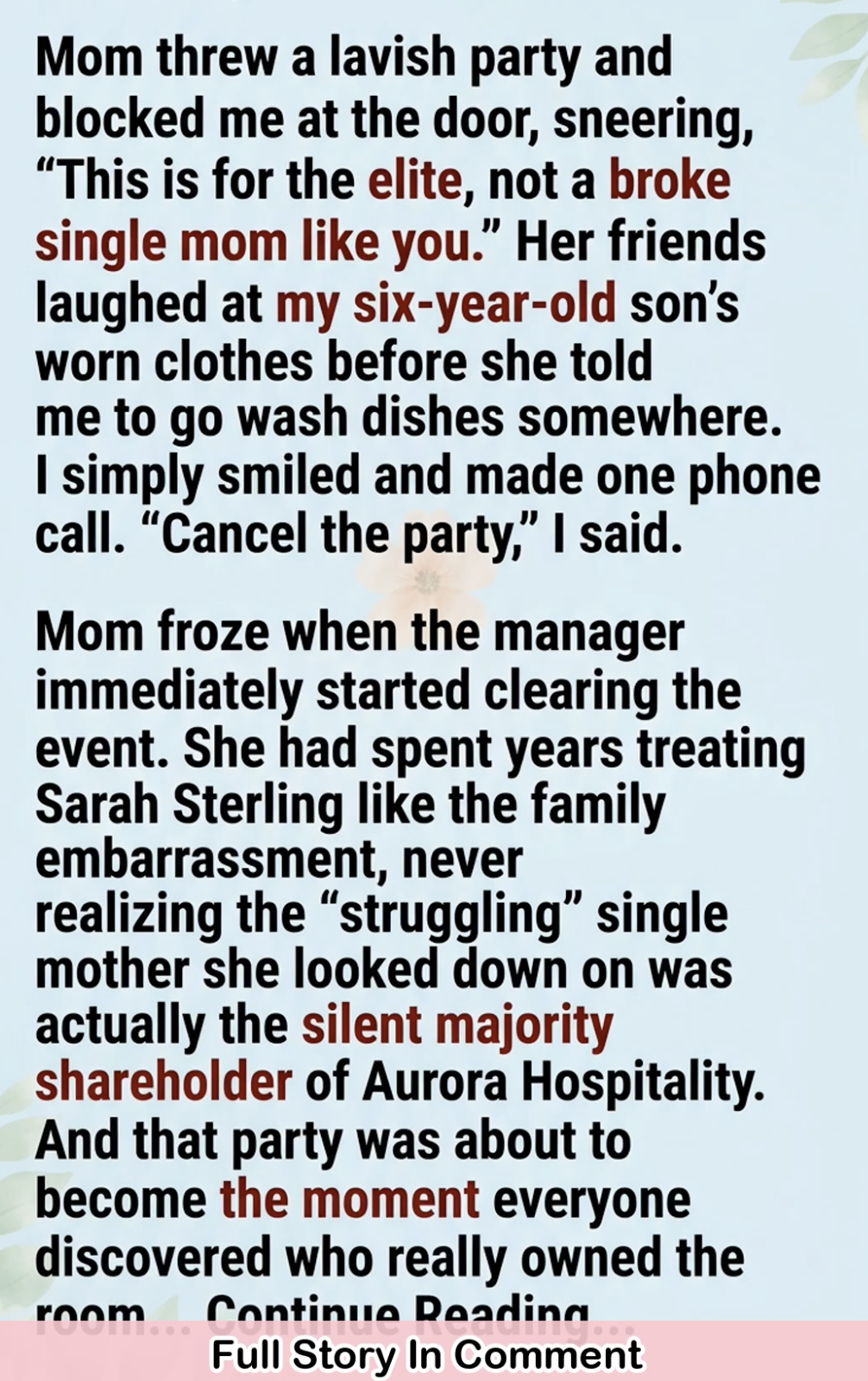
My mother blocked the doorway with one hand.
“This is for the elite,” she said.
Then she looked down at my six-year-old son.
“And certainly not for a broke single mother who can’t even dress her child properly.”
Behind her, several guests laughed.
My son lowered his head.
His little fingers tightened around mine.
I felt something inside me break—not because of what she had said about me, but because she had made my six-year-old feel ashamed of himself.
I looked at the expensive decorations behind her.
Crystal glasses.
Fresh flowers.
A string quartet.
Servers carrying trays of champagne.
The event had been advertised as my mother’s biggest business celebration of the year.
She had spent weeks talking about it.
And apparently, I wasn’t important enough to attend.
She pointed toward the service entrance.
“If you want to be useful, go wash dishes somewhere.”
One of her friends laughed.
“Maybe she can earn her dinner.”
My mother smiled.
I didn’t argue.
I simply looked at her.
Then I smiled.
And took out my phone.
“Cancel the party,” I said.
My mother frowned.
“What?”
I made one call.
“Hello, Mark? It’s Sarah.”
There was a pause.
“I’m standing outside the Aurora Grand Ballroom.”
Another pause.
“Yes. I want the event canceled.”
My mother stared at me.
Then she laughed.
“You can’t cancel my party.”
I looked at her.
“I know.”
“Then what exactly are you doing?”
I put my phone away.
“Calling the person who can.”
Her smile disappeared.
Because she didn’t know what I had spent the last five years quietly building.
Five years earlier, nobody would have believed that Sarah Sterling would ever have anything to do with a luxury hospitality company.
I certainly didn’t.
After my divorce, I was living in a small apartment with my son, Noah.
I worked long hours.
I clipped coupons.
I repaired things instead of replacing them.
I bought Noah’s clothes carefully because children grow faster than a budget can keep up with.
There was nothing glamorous about our life.
But we were happy.
My mother didn’t see it that way.
To her, being successful meant expensive clothes, impressive houses, and being photographed beside important people.
She had always been obsessed with appearances.
When I got divorced, she told relatives that I had “failed at marriage.”
When I took a modest job, she called it “temporary.”
When Noah wore hand-me-downs, she told me I was embarrassing the family.
I stopped explaining myself.
What she didn’t know was that I had started investing.
Not in luxury.
In businesses.
I had learned that the hospitality industry was changing rapidly.
Several years earlier, Aurora Hospitality had been a struggling regional company.
Its hotels were outdated.
Its management structure was inefficient.
The stock price had fallen sharply.
Most investors walked away.
I didn’t.
I studied the company.
Then I started buying shares.
Slowly.
Quietly.
A little at a time.
I never told my family.
Eventually, my investment firm became one of the company’s largest shareholders.
But because my ownership was held through a private investment structure, my mother had no idea.
She knew Aurora Hospitality.
She knew its executives.
She knew the luxury events.
She knew the hotels.
What she didn’t know was that I had become its silent majority shareholder.
And the Aurora Grand Ballroom—the place where she had just humiliated me—was one of its properties.
Back at the entrance, my mother crossed her arms.
“You’re embarrassing yourself.”
I looked at her.
“Maybe.”
“Do you really think you can walk in here and cause a scene?”
“No.”
“Then leave.”
I nodded toward the ballroom.
“I won’t be causing a scene.”
“What are you doing?”
“Waiting.”
“For what?”
I smiled.
“For Mark.”
She rolled her eyes.
“Who is Mark?”
Before I could answer, the ballroom doors opened.
Mark Bennett, Aurora’s regional operations director, walked quickly toward us.
He stopped when he saw me.
“Ms. Sterling.”
My mother blinked.
Mark looked at her.
“Is there a problem?”
My mother straightened.
“No problem. This is my daughter.”
Mark looked surprised.
“I know.”
My mother frowned.
“You know her?”
“Yes.”
“How?”
He hesitated.
Then said carefully:
“She is one of the principal owners of the company.”
Silence.
Nobody laughed.
The woman who had mocked my son’s clothes suddenly looked at me differently.
My mother stared at Mark.
“What did you just say?”
Mark glanced at me.
“Would you like me to explain?”
I nodded.
He turned toward the guests.
“Ladies and gentlemen, there has been a change to tonight’s event.”
My mother grabbed his arm.
“Wait.”
Mark gently stepped back.
“I’m sorry, but the event has been canceled.”
The room erupted in whispers.
“What?”
“Why?”
“Canceled?”
My mother looked at me.
“You did this?”
I nodded.
“Yes.”
“Why?”
I looked at Noah.
He was still holding my hand.
“Because you forgot something.”
“What?”
I answered quietly.
“This isn’t just your party.”
I pointed toward the ballroom.
“It belongs to the company.”
Then I looked at her.
“And the company has owners.”
Her face went pale.
The guests slowly began leaving.
The musicians packed their instruments.
Servers removed the untouched food.
The flowers were taken from the tables.
My mother stood motionless in the center of the ballroom.
Her friends avoided looking at her.
One of them approached me.
“Sarah, I had no idea.”
I smiled politely.
“You weren’t supposed to.”
Another woman whispered:
“So you’re actually wealthy?”
I shook my head.
“That isn’t really the point.”
“What is?”
I looked at Noah.
“The point is that people shouldn’t have to prove their worth before they’re treated with dignity.”
The woman became quiet.
My mother heard me.
She finally approached.
“You could have told me.”
I looked at her.
“I tried.”
“When?”
“Every time you told me I was a failure.”
She looked away.
“I didn’t mean—”
“You did.”
Her eyes filled with tears.
“I was trying to push you to do better.”
“No.”
I shook my head.
“You were trying to make me look successful enough for your friends.”
She didn’t answer.
The next morning, my mother called.
I almost didn’t answer.
“Sarah?”
“Yes?”
“I owe you an apology.”
I said nothing.
She continued.
“Not just for last night.”
Her voice was different.
Softer.
“I’ve been ashamed of you.”
I closed my eyes.
That sentence hurt more than the insults.
“I know.”
“I shouldn’t have been.”
“No.”
“I was wrong.”
I looked at Noah, who was eating cereal at the kitchen table.
“Mom, I’m not angry because you embarrassed me.”
“Then why?”
“Because Noah heard you.”
Silence.
“I saw his face when your friends laughed.”
My mother started crying.
“I didn’t think.”
“That’s the problem.”
She took a breath.
“Can I see him?”
I hesitated.
Then I said:
“You can ask him.”
I handed the phone to Noah.
He listened.
Then he said something that surprised me.
“Grandma, I don’t care if my clothes are old.”
My mother cried harder.
“I know, sweetheart.”
“I like them.”
“I know.”
“And Mom says clothes don’t make people.”
My mother didn’t answer.
Noah smiled.
“Can I show you my dinosaur?”
She laughed through her tears.
“Yes.”
A few weeks later, my mother asked me to meet her for coffee.
She didn’t mention business.
She didn’t mention money.
She didn’t mention the party.
She simply said:
“I want to learn how to be your mother again.”
That sentence stayed with me.
We talked for nearly two hours.
There was no dramatic reconciliation.
No magical forgiveness.
Just honesty.
She admitted that she had spent years comparing me to other people.
I admitted that I had stopped trying to earn her approval.
And somewhere between those two admissions, something changed.
Not completely.
But enough.
Months later, Aurora held another event.
This time, my mother called me personally.
“Sarah?”
“Yes?”
“Would you and Noah like to come?”
I smiled.
“Is it an elite event?”
She laughed.
“No.”
“What is it?”
“A family dinner.”
I looked at Noah.
He was wearing a simple blue shirt.
One of his favorite shirts.
“Then we’ll come.”
That evening, my mother greeted him at the door.
She crouched down.
“You look handsome.”
Noah grinned.
“Thanks, Grandma.”
Then she looked at me.
“You too.”
I smiled.
“Thank you.”
She didn’t ask about my investments.
She didn’t ask about the company.
She didn’t introduce me to anyone as a shareholder.
She simply introduced me as her daughter.
And somehow, that meant more than all the money in the world.
I never told my mother exactly how much my investments were worth.
I didn’t need to.
Because the lesson wasn’t that the woman she called “broke” was secretly wealthy.
The lesson was that she should never have needed to be wealthy to deserve respect.
A person’s worth isn’t determined by their clothes, income, or social status. The real measure is how they treat people who have nothing to offer them in return.