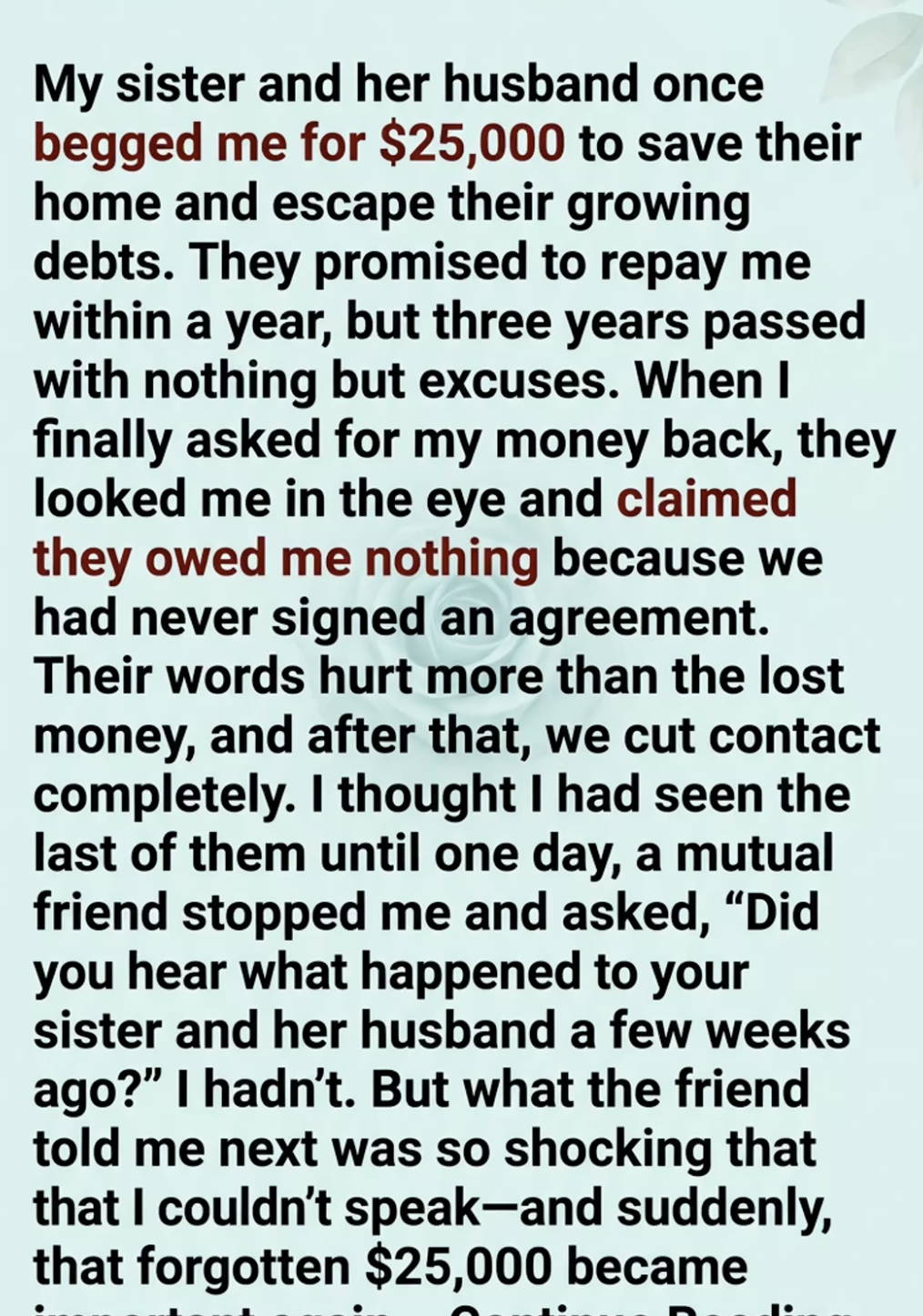
My sister and her husband once begged me for $25,000 to save their home and escape the debts that were piling up around them.
They promised they would repay me within a year.
I believed them.
A year passed.
Then two.
Then three.
Every time I asked about the money, there was another excuse.
When I finally told them I needed it back, they looked me straight in the eye and said something I never expected to hear from my own sister.
“We don’t owe you anything.”
I reminded them of the transfer.
The date.
The amount.
The messages they had sent promising to repay me.
My sister shrugged.
“There was never a contract.”
Her husband added, “You gave it to us.”
That sentence hurt more than losing $25,000.
I had helped them because they were family.
They had turned that kindness into something they could deny.
After that conversation, we stopped speaking.
For nearly four years, I heard nothing.
Then one afternoon, a mutual friend stopped me outside a coffee shop.
“Did you hear what happened to your sister and her husband a few weeks ago?”
I shook my head.
“No.”
She hesitated.
Then she told me.
And suddenly, the $25,000 I had tried to forget became important again.
My sister Rachel had always been more financially reckless than I was.
She loved expensive things.
Restaurants.
Weekend trips.
New furniture.
Designer clothes.
Her husband, Mark, was no better.
Together, they had purchased a beautiful house they could barely afford.
Then Mark’s business slowed down.
Credit cards multiplied.
Loans were refinanced.
Bills were moved from one account to another.
Eventually, they came to me.
Rachel was crying.
“We’re going to lose the house.”
I remember looking at her.
“How much do you need?”
“Twenty-five thousand.”
Mark sat beside her.
“If we can pay the overdue balances, we’ll be able to catch up.”
I hesitated.
That was a lot of money.
But they were my family.
I had savings.
I agreed.
Before transferring anything, I asked Mark one question.
“When will you pay it back?”
“One year,” he said.
Rachel reached across the table.
“I promise.”
I transferred the money.
The next morning, Rachel sent me a message.
Thank you. You saved us. We won’t forget this.
I saved that message.
I didn’t know how important it would become.
Twelve months later, I asked about repayment.
Mark said the business was still recovering.
“Give us another six months.”
I agreed.
Six months became another year.
Then another.
Eventually, I stopped asking.
Until I needed the money myself.
My daughter was starting graduate school.
I told Rachel I needed at least part of the $25,000 returned.
She became defensive.
“Now?”
“Yes. It’s been three years.”
Mark joined the conversation.
“You can’t suddenly turn this into a loan.”
I stared at him.
“What else was it?”
Rachel crossed her arms.
“You gave it to us.”
“No. I lent it to you.”
“Where’s the agreement?”
“There wasn’t one.”
“Then you can’t prove it.”
I felt my chest tighten.
“You promised.”
Rachel looked away.
Mark simply said:
“We don’t owe you anything.”
That was the end.
I stopped contacting them.
I deleted their numbers.
I packed away the old photographs.
And I told myself the money was gone.
Then came the coffee shop.
My friend Linda looked uncomfortable.
“Rachel and Mark had a serious problem.”
“What happened?”
She lowered her voice.
“They lost the house.”
I wasn’t surprised.
“But that’s not all.”
“What do you mean?”
“They filed for bankruptcy.”
I nodded slowly.
Then Linda said:
“During the bankruptcy proceedings, the trustee found something.”
My stomach tightened.
“What?”
“An account.”
I stared at her.
“What kind of account?”
“A private investment account.”
She explained that shortly after I had transferred the $25,000, Mark had moved money through several accounts.
Eventually, a portion ended up in an investment account opened in Rachel’s name.
The account had grown substantially.
But there was more.
The original transfer from me was included in the financial records.
And Rachel had described it differently.
Not as a gift.
As a loan.
My heart stopped.
“Where did you see that?”
“Court documents.”
Linda showed me a copy.
There it was.
My $25,000.
Listed in their financial records as:
Loan from family member.
I read it twice.
Then a third time.
They had told me there was no loan.
Yet when their finances were being examined formally, they had acknowledged it.
I contacted an attorney.
She reviewed the documents.
“This is useful evidence,” she said.
“Can I get my money back?”
“Possibly. But it depends on the bankruptcy proceeding, the available assets, and whether the debt is legally recognized.”
For the first time in years, I wasn’t thinking about revenge.
I wanted the truth documented.
My attorney obtained the relevant records.
Then we discovered something else.
Rachel and Mark had not simply forgotten about my money.
They had been making payments on other debts while maintaining the investment account.
They had also withdrawn money from it shortly before filing for bankruptcy.
That became part of the trustee’s review.
I was eventually contacted by the bankruptcy trustee.
He asked me to provide evidence of the original transfer.
I gave him everything.
Bank records.
Messages.
The original text where Rachel said, “We’ll repay you within a year.”
And the message from Mark thanking me for the “loan.”
The trustee reviewed everything.
Several months later, I received a letter.
The $25,000 debt had been recognized in the proceeding.
But I wasn’t getting all of it immediately.
The process took time.
Some assets were liquidated.
Some debts were settled according to the court’s rules.
Eventually, I recovered a substantial portion of the money.
Not everything.
But enough to know that the truth had mattered.
Rachel eventually called.
I almost didn’t answer.
“Why are you calling?”
She was crying.
“I was wrong.”
I said nothing.
“We should never have said you gave us the money.”
“No.”
“We were desperate.”
“That doesn’t make it right.”
“I know.”
There was a long silence.
Then she said:
“I’m sorry.”
I believed that she was sorry.
But forgiveness didn’t mean rebuilding the relationship.
“I hope things get better for you,” I said.
“Can we talk again someday?”
I thought about the three years of excuses.
The accusation.
The sentence that had hurt more than losing the money.
We don’t owe you anything.
“I don’t know,” I said honestly.
And that was enough.
Years later, I still have the original transfer receipt.
Not because I obsess over the $25,000.
Because it reminds me of something I learned the hard way.
Helping family doesn’t require paperwork when everyone is honest.
But when money is involved, love and trust shouldn’t replace clear agreements.
My sister once told me that because there was no contract, I had no claim.
In the end, her own financial records told a different story.
The money wasn’t the most painful part of losing my sister. It was discovering that someone I trusted was willing to deny a promise simply because they thought I couldn’t prove it.