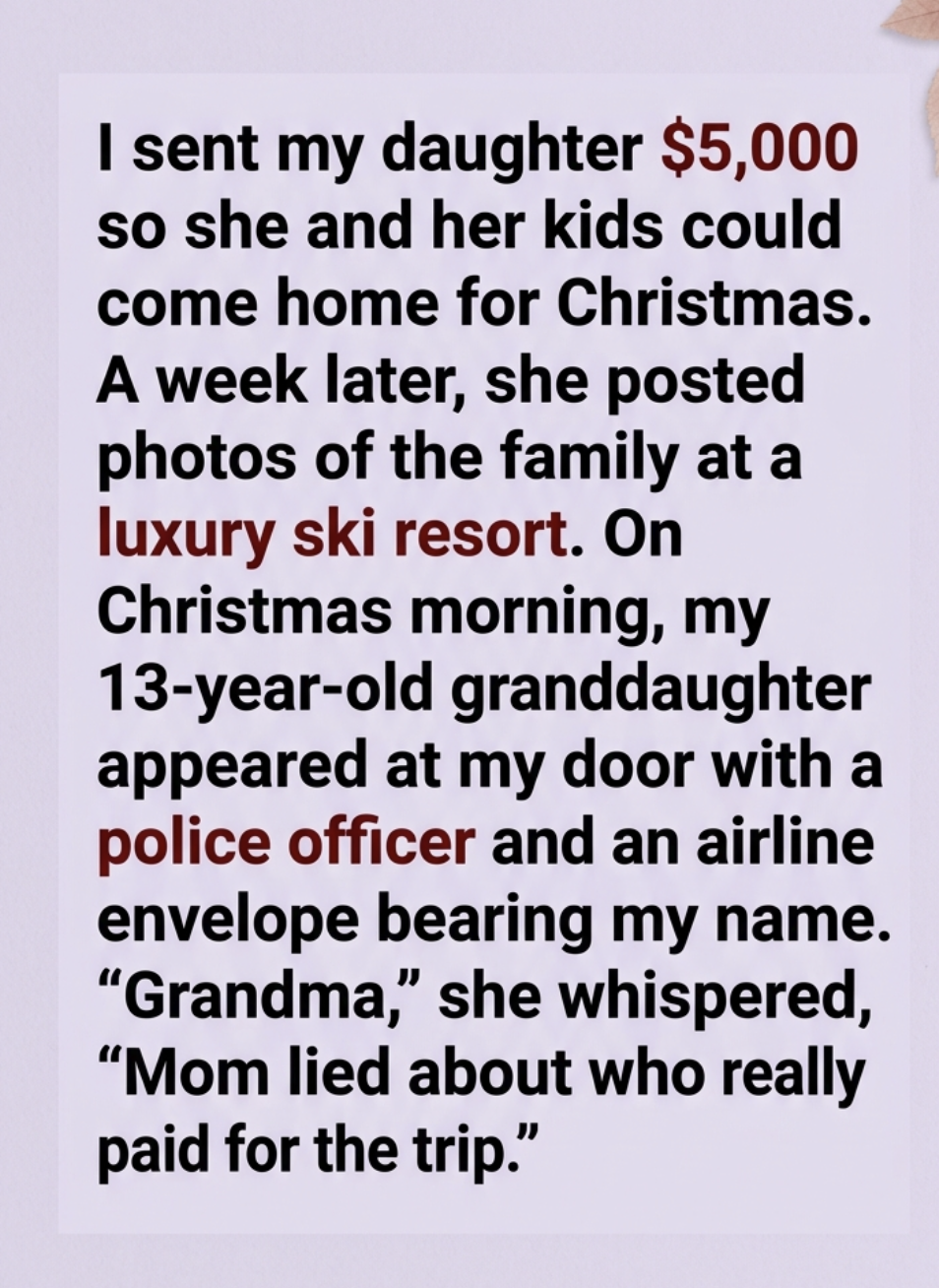
I sent my daughter, Rachel, $5,000 so she and her two children could come home for Christmas.
She told me the money would cover their flights, a rental car, and a few extra expenses. After all, she had recently lost her job, and I didn’t want my grandchildren spending another holiday away from their family.
“Thank you, Mom,” she said over the phone. “The kids are going to be so happy.”
I believed her.
A week later, I opened Facebook and found photographs of Rachel, her husband, and the children at a luxury ski resort. They stood in front of a magnificent lodge, dressed in expensive winter clothes, with snow-covered mountains behind them.
The caption read: The Christmas getaway we desperately needed.
I stared at the screen.
There was no mention of visiting me. No explanation. No message saying their plans had changed.
I called Rachel immediately.
“Mom, we needed a break,” she said. “I’ll explain everything later.”
“Did you use the money I sent you for the trip?”
She sighed. “Please don’t start.”
Then she ended the call.
I spent the next several days trying to convince myself there was a reasonable explanation. Perhaps someone had paid for the resort. Perhaps the photographs were old.
But Christmas morning arrived, and my grandchildren were still nowhere to be seen.
At 8:17 a.m., someone knocked on my front door.
When I opened it, my thirteen-year-old granddaughter, Lily, stood on the porch beside a uniformed police officer. Her cheeks were red from the cold, and she held a large envelope against her chest.
“Lily?” I whispered. “What are you doing here?”
She looked over her shoulder at the officer before stepping inside.
“Grandma, I need to tell you something about the money Mom said she used for our Christmas trip.”
The officer introduced himself and explained that he was there to make sure Lily arrived safely. He would not discuss the family’s private matters, but he confirmed that she had asked to come to my home.
Lily placed the envelope on my kitchen table.
My name was printed across the front.
“I found this in Mom’s suitcase,” she said. “She told Dad that nobody would ever find out.”
My hands began to shake as I opened it.
Inside was an airline itinerary, a payment receipt, and a folded document bearing my name.
The airline receipt showed that the tickets had been purchased before I sent Rachel the $5,000.
I looked up at Lily.
“Then what did your mother use my money for?”
Lily swallowed hard.
“She said the resort was a gift from someone. But Grandma, that isn’t what happened.”
She pulled a second paper from the envelope.
It was a bank transfer confirmation.
The money had gone into an account I didn’t recognize. The recipient’s name was unfamiliar, but the transfer description made my stomach tighten.
It read: Christmas repayment.
“Who is that?” I asked.
Lily shook her head.
“I don’t know. But I heard Mom arguing with Dad about it. She said she had to pay him back before Christmas, and that you would never ask for proof.”
I sat down slowly.
My daughter had told me she needed help bringing her children home. Instead, she had taken money I sent for that purpose and used it to settle a debt I knew nothing about.
But the document with my name on it was even more troubling.
It appeared to be a loan agreement.
According to the document, I had agreed to guarantee a substantial debt for Rachel’s husband, Mark. My signature was printed at the bottom.
I had never signed it.
“Lily,” I said carefully, “did your mother tell you anything about this paper?”
“She said you had already agreed to help them. But when I asked why you didn’t know about it, she got angry.”
The officer asked whether I wanted to report the suspected unauthorized use of my signature. I told him I needed to make copies and speak with my attorney, but I wanted the matter documented.
After he left, Lily sat beside me, her eyes filling with tears.
“Are you mad at me?”
I took her hand.
“Never. You didn’t do anything wrong.”
“But Mom said I was ruining Christmas.”
“No, sweetheart. You came here because you were worried. That’s not ruining anything.”
I made us breakfast, then called my attorney. We photographed the documents, saved the transfer information, and contacted the bank to ask whether the alleged guarantee had ever been presented or relied upon.
The bank could not resolve the question over the phone. It opened a review and requested additional documentation.
That afternoon, Rachel called.
“Where is Lily?” she demanded.
“She’s safe with me.”
“You had no right to let her bring those papers!”
“Did you sign my name to a loan agreement?”
Silence.
“Rachel?”
“You don’t understand the situation,” she finally said. “Mark was in trouble. We needed to settle things before the end of the year.”
“So you asked me for money to bring your children home, then used it to pay a debt?”
“We were going to pay you back.”
“That isn’t what I asked.”
She began crying. She said Mark had accumulated debts she hadn’t known about until recently. She claimed she had used the money to prevent a financial crisis and planned to explain everything after Christmas.
I wanted to believe her.
But I couldn’t ignore the document bearing my name.
“Did you sign it?”
“I handled the paperwork,” she whispered.
“That isn’t an answer.”
She hung up.
Over the following weeks, the bank’s review and my attorney’s investigation established that I had not authorized the guarantee. The lender was notified, and the disputed document was referred for further examination. The investigation into who had prepared and submitted it continued.
Rachel eventually admitted that she had signed my name herself. She insisted she had intended to repay the debt and never expected the document to become a problem.
Her explanation did not undo what she had done.
I also learned that the resort trip had been partly paid for with money from Mark’s relatives. The $5,000 I sent had gone toward his outstanding debt, not the children’s travel expenses.
The photographs had shown a happy family vacation.
They had hidden a much more complicated reality.
Rachel apologized, but I told her that an apology could not be the only step toward repairing our relationship. She would need to repay the money, cooperate with the investigation, and stop using my name or financial information without permission.
I also made it clear that any future help would be paid directly to the airline, school, landlord, or other service provider—not transferred into her account.
For a while, our relationship was strained. I missed my daughter, and I worried about my grandchildren. But I did not regret setting those boundaries.
Lily stayed with me for the rest of Christmas break. We baked cookies, watched old holiday movies, and put the presents under the tree that I had bought weeks earlier.
On Christmas night, she handed me a small card.
Inside, she had written:
Thank you for believing me, Grandma. I was scared you would think I was lying.
I hugged her tightly.
“I will always listen to you,” I told her.
That Christmas, I had expected the best gift to be having my family home.
Instead, I learned that love sometimes means helping someone—and sometimes means refusing to let them keep hurting the people who trust them.
The money could be repaid, and the paperwork could be investigated. Rebuilding trust would take much longer.