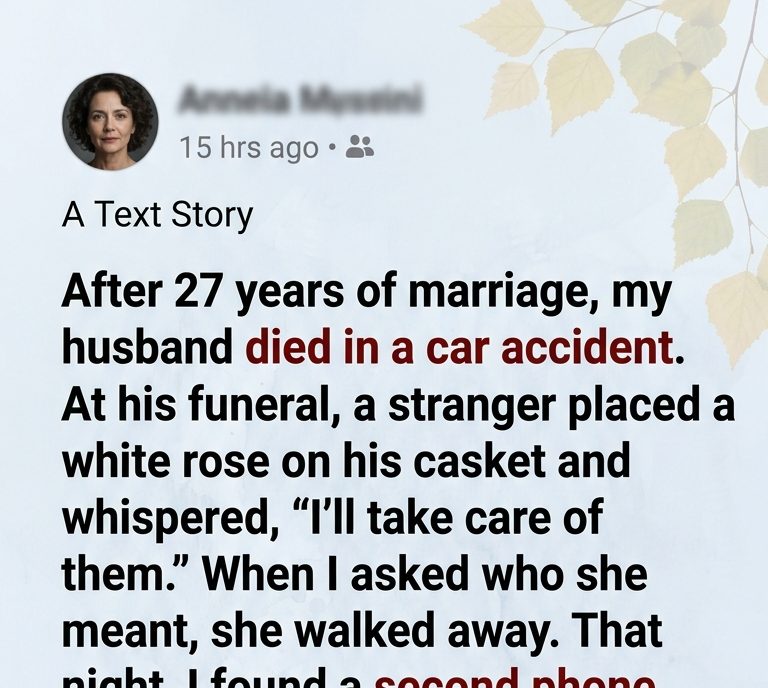
After twenty-seven years of marriage, I believed I knew everything about my husband.
Then a car accident took him from me in a single afternoon.
His name was Daniel. He was fifty-six, a quiet man who remembered birthdays, fixed broken appliances without being asked, and never left the house without kissing me goodbye.
At least, that was the man I thought I knew.
At his funeral, I noticed a woman standing alone near the back of the chapel. She looked to be in her early forties, with dark hair pulled into a loose bun and a little girl holding her hand.
When the service ended, she approached the casket and placed a single white rose on top.
Then she leaned forward and whispered something.
“I’ll take care of them.”
I was close enough to hear her.
Before I could ask what she meant, she turned and walked away.
I watched her disappear through the chapel doors.
“Who was that woman?” I asked Daniel’s brother.
He frowned. “I don’t know. Maybe someone from work.”
But something about her expression stayed with me. She hadn’t looked like a casual acquaintance saying goodbye to a colleague.
She had looked like someone who had lost the center of her world.
That night, I went into Daniel’s garage to find the paperwork for his insurance policy. His toolbox sat beneath the workbench, exactly where he had left it.
As I opened the top drawer, I noticed a small black phone tucked beneath a folded work jacket.
Daniel had always used the same phone for as long as I could remember.
I picked it up.
The screen lit immediately.
There was no password.
The first message I saw was dated fourteen years earlier.
The children are asking when you’ll come home.
I sat down on the garage floor.
The next message was from Daniel.
Tell them Sunday. I’ll make it work.
I kept scrolling.
There were photographs of three children. A boy with Daniel’s familiar crooked smile. A teenage girl wearing his old baseball cap. And a little girl who looked no older than four.
There were birthday messages, school updates, photographs of Christmas mornings, and conversations about doctor appointments.
Fourteen years of another family.
I searched the phone for the woman’s name.
Claire.
The messages made it clear that she and Daniel had been together for years. They discussed money, holidays, and plans for the children. There were references to a house in Portland and to a property worth approximately $1.4 million.
I found the deed information in a message thread with a real estate agent. The property was held in Claire’s name.
My hands began to shake.
Fourteen years.
I took out a calculator.
Our anniversary trip to Hawaii had been fourteen years earlier.
I remembered that vacation perfectly. Daniel had surprised me with a room overlooking the ocean. We had celebrated twenty-seven years together by the time he died, but that trip had marked our thirteenth anniversary.
During those seven days, he had seemed distracted.
He said work was complicated. He took several calls outside. One evening, he told me he needed to check on a project back home.
I had believed him.
Now I wondered whether he had been speaking to Claire.
I returned to the messages.
One conversation stopped me cold.
Claire had written:
You promised you would tell her.
Daniel replied:
I will. Just not yet.
That exchange was dated thirteen years earlier.
He had been promising to tell me for more than a decade.
I spent the rest of the night reading.
By sunrise, I understood that Daniel had built two separate lives. He had attended our family dinners, paid our mortgage, and helped our daughter move into her first apartment. At the same time, he had raised three children with another woman.
I couldn’t decide what hurt more: the betrayal itself or the realization that so many ordinary moments had been happening alongside a secret I knew nothing about.
At nine the next morning, I called Claire.
She answered on the first ring.
“Hello?”
“My name is Margaret. I was Daniel’s wife.”
Silence.
Then she whispered, “I’m so sorry.”
I gripped the edge of the kitchen counter.
“You knew he was married?”
“Yes.”
“For fourteen years?”
She began to cry.
“I knew he had a wife. But he told me you were…”
She stopped.
“Told you I was what?”
There was a long pause.
“He told me you were separated. He said you lived in different parts of the house and that the marriage was over. He said you were only staying together until your youngest finished school.”
I closed my eyes.
“That is not true.”
“I know that now,” she said. “I’m beginning to understand how much he lied to both of us.”
I wanted to hate her. Part of me did.
But the children in those photographs were innocent. They had not asked to be born into a secret, and they had not chosen the circumstances of their family.
“Did the children know about me?” I asked.
“No. They thought their father lived nearby because of work. The older two knew he had another home, but he told them it was a complicated family arrangement.”
“And the property in Portland?”
“He bought it for us. He said it was part of his plan to make sure the children were secure.”
“Where did the money come from?”
Claire hesitated.
“He said it came from investments and a business account.”
That answer frightened me more than anything else she had said.
Daniel and I had shared finances. We owned a house, had retirement accounts, and had spent years saving for the future. I had no idea how much money he had moved, what obligations he had taken on, or whether any of our shared assets were involved.
“I need to understand what happened,” I told her.
“So do I,” she replied.
For the first time, we were not arguing over Daniel.
We were two women trying to understand the same man.
Over the next several weeks, I gathered bank statements, insurance documents, property records, and the contents of the second phone. My attorney helped me identify which assets belonged to our marital estate, which accounts were solely in Daniel’s name, and whether any transfers required further investigation.
The Portland property was indeed registered to Claire. But the records also showed that Daniel had made substantial payments toward it over the years.
That did not automatically determine who had a legal claim to the property or whether any money could be recovered. The answers depended on the source of the funds, the ownership documents, and the applicable law.
The financial review revealed something else.
Daniel had maintained a separate account from which he paid household expenses for Claire and the children. Some deposits appeared to come from his earnings. Others required further tracing.
I discovered that he had also borrowed against an investment account we had both contributed to.
I had never approved the loan.
My attorney contacted the financial institution, requested the underlying documents, and began examining whether the transaction had been authorized.
Meanwhile, Claire and I spoke several more times.
She told me about the children’s lives: the oldest was preparing for college, the middle child played soccer, and the youngest still slept with a stuffed rabbit Daniel had bought her.
I told her about our daughter, Emily, and our son, Thomas. I described Daniel’s habit of making pancakes on Sunday mornings and the way he always sang the wrong lyrics to old songs.
We discovered that the same man had created different memories for different families.
Neither of us knew the whole person.
A month after the funeral, Claire asked if I would meet the children.
I wasn’t ready.
“I don’t blame them,” I told her. “But I need time.”
She understood.
The financial investigation continued for months. Some questions were resolved through records. Others remained disputed. I did not make promises about what Claire or the children would receive, and she did not ask me to.
Eventually, we agreed that any questions involving the property, Daniel’s estate, or the children’s future would be handled through the proper legal process.
The children deserved stability. My own children deserved honesty. And I deserved to know what had happened to the life I thought I had built.
Nearly a year after Daniel’s death, I finally met Claire’s youngest daughter.
She was shy and held tightly to her mother’s hand.
“Are you the lady from Daddy’s other house?” she asked.
The question broke my heart.
“I was your daddy’s wife,” I said gently. “And I know he loved you.”
She looked down at her shoes.
“Mom says he loved us.”
“I believe he did.”
I did not tell her what I thought of her father’s choices. She was four years old. She needed adults who could let her love him without making her carry the weight of his lies.
Later, Claire and I stood together outside the house.
“I used to think you knew,” she admitted. “I thought you had chosen to stay.”
“I used to think he was faithful,” I replied.
Neither of us had much else to say.
I never found a way to make the betrayal feel acceptable. Daniel had taken fourteen years from me—not the years themselves, but the truth I should have been allowed to know while I was living them.
I had loved him. That was real.
So was what he had done.
Both truths had to exist together.
The white rose from his funeral stayed in my memory long after the flowers had faded. At first, I thought it was a symbol of a secret life that had taken something from me.
Eventually, I understood it differently.
It was a promise made by a woman who believed she had to protect three children. I had made my own promise that day, though I had not known it yet: I would not let Daniel’s choices turn those children into enemies.
I could hold him accountable without punishing them.
And I could grieve the husband I had loved while accepting that I had never known all of him.
Sometimes, the truth does not erase the love we gave. It changes what we understand that love was built upon.