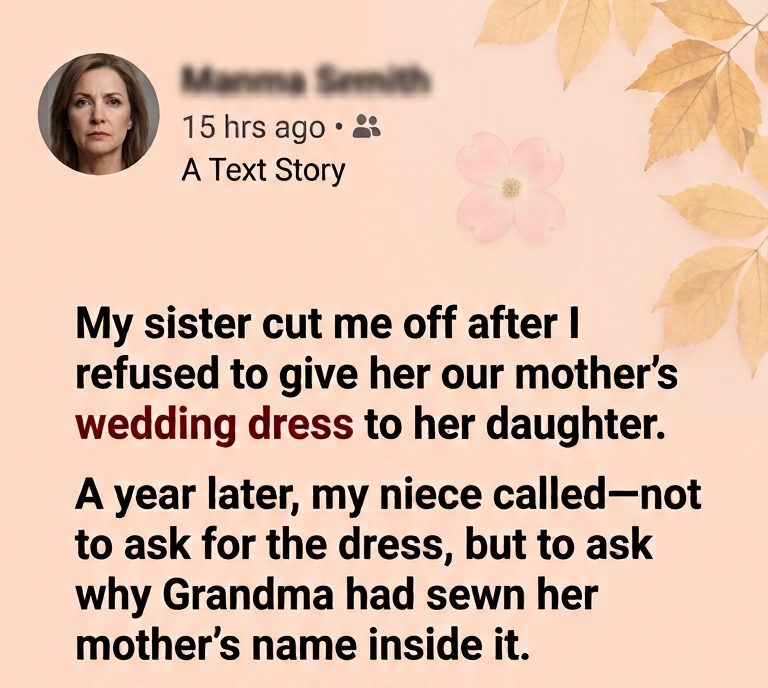
When my sister, Caroline, demanded our mother’s wedding dress for her daughter, I refused.
It wasn’t because I wanted to keep it for myself. I simply couldn’t bear the thought of watching the dress disappear into another family’s closet. Mom had worn it for fifty years of anniversaries, family photographs, and quiet evenings when she would take it from its box just to smooth the lace.
After she died, I promised myself I would preserve it.
Caroline didn’t see it that way.
“You’re being selfish,” she said over the phone. “It should go to my daughter. She’s the only one of us who’s getting married.”
“I’m not giving it away,” I replied. “Not yet.”
She hung up.
For the next year, my sister refused to speak to me. She ignored my messages, skipped the family dinner I hosted, and even blocked my number. I told myself the silence would eventually pass.
Then, one rainy afternoon, my niece, Emily, called.
“Can I ask you something about Grandma’s wedding dress?”
I sighed. “If this is about your mother wanting it, my answer hasn’t changed.”
“It’s not that,” Emily said. Her voice sounded strange. “I found an old photograph of Grandma wearing it. There’s something written on the back. It says the dress was altered for someone named Margaret.”
I frowned. “Margaret who?”
“I don’t know. But Auntie, when Grandma gave you the dress, did you check inside the lining?”
“No. Why?”
“Because I found a note in Grandma’s sewing box. It says my mother’s name was sewn into the dress.”
I stared at the box on the shelf across the room.
“That doesn’t make sense,” I said. “Your mother’s name is Caroline. Grandma made that dress decades before you were born.”
“I know. But the note says there’s a date beside it. A date two years before I was born.”
After we hung up, I carried the dress to the dining table and carefully opened its storage box.
The ivory satin had yellowed slightly with age, but the lace remained beautiful. I turned the dress inside out and examined the lining. Near the waist, hidden beneath a fold of fabric, I found a small line of stitching.
Caroline.
Beside it was a date.
It was two years before Emily’s birth.
My hands went cold.
I called my sister.
She answered on the first ring.
“So you finally found it,” she said.
I gripped the phone. “What does this mean?”
“Look beneath the second layer of lace,” Caroline replied. “There’s another name. It was sewn in a different color.”
I found the seam she meant. The stitches were smaller, darker, and clearly made by a different hand.
The name was Margaret Ellis.
Underneath it was another date.
This one was nearly thirty years older than the date beside Caroline’s name.
“Who is Margaret Ellis?” I asked.
For several seconds, my sister said nothing.
Then she whispered, “She was supposed to be my mother.”
I sat down.
Caroline explained that, when she was twenty-one, she had discovered a bundle of letters in Grandma’s bedroom. They were addressed to a woman named Margaret, and several mentioned a baby girl born in the late 1960s.
The letters suggested that Margaret had been pregnant before Grandma married our father.
According to the letters, Margaret had given birth to a daughter but was unable to raise her. Grandma had taken the baby in and raised her as her own.
That baby was Caroline.
I shook my head. “Why didn’t you tell me?”
“Because I didn’t know what to believe,” she said. “Mom told me Margaret was a cousin who had helped her with the dress. She said the name was just a reminder of someone who had passed away.”
“But you found the letters.”
“Yes. And I found a photograph of Margaret holding a newborn. The baby had the same birthmark I have on my shoulder.”
I remembered the small, crescent-shaped mark Caroline had carried since childhood.
“Did you ever find Margaret?” I asked.
“No. I was angry with Mom. I thought she had lied to me my entire life. When I asked her about it, she cried and said she’d explain when she was ready.”
“But she never did.”
“She died before she could.”
I looked again at the dress. The two names seemed to tell a story that our family had spent decades trying to bury.
“Why did you want the dress so badly?” I asked.
Caroline’s voice broke.
“Because I thought it was the only thing Mom had left me that connected me to the truth.”
I felt the anger I had carried for a year begin to soften.
“You could have told me that.”
“I was ashamed,” she admitted. “And when you refused, I convinced myself you were trying to keep the secret from me.”
“I wasn’t. I didn’t even know there was a secret.”
“I know that now.”
We stayed on the phone for a long time, talking about our mother, the letters, and the things neither of us had understood when we were younger.
The next morning, Caroline came to my house.
For the first time in a year, we sat across from each other without arguing.
I laid the wedding dress on the table between us.
“Let’s find out who Margaret was,” I said.
We began with the letters Caroline had kept. One included an old address and the name of a small town several hours away. Another mentioned a church where Margaret had volunteered.
After weeks of searching public records and making careful inquiries, we found a possible match: Margaret Ellis, who had lived in that town for decades before moving to an assisted-living community.
Caroline hesitated before calling.
“What if she doesn’t want to see me?” she asked.
“Then we’ll respect that,” I said. “But you deserve the chance to ask.”
Margaret agreed to meet us.
She was a small, silver-haired woman with gentle eyes. When Caroline walked into the room, Margaret stared at her for a long moment.
Then she covered her mouth.
“You have your father’s eyes,” she whispered.
Caroline sat down, trembling.
“Are you my mother?”
Margaret nodded through her tears.
She explained that she had been young and unmarried when she gave birth. Her family had pressured her to give up the baby, and Grandma—then a close friend—had offered to raise the child. Margaret had believed it would give her daughter a more secure life.
She had never stopped thinking about Caroline.
Grandma had kept in touch with Margaret for years, though the details of their arrangement were complicated. The wedding dress had originally belonged to Margaret’s own mother. When Margaret gave it to Grandma, she asked her to preserve the name stitched inside as a reminder of where the dress had come from.
Years later, after Caroline was born, Grandma added her name to the lining.
The dress had carried both names all along.
“Why didn’t Grandma tell me?” Caroline asked.
Margaret lowered her eyes.
“She was afraid you would feel that your whole life had been a lie. She wanted you to know that she loved you as her daughter. But she made a mistake by believing silence would protect you.”
Caroline cried then—not loudly, but with the quiet grief of someone finally meeting the truth she had spent years imagining.
I sat beside her and held her hand.
Before we left, Margaret asked to see the dress.
I had brought it with us.
She ran her fingers over the lace, then found the two names inside the lining.
“I never thought I would see this again,” she said.
Caroline looked at me.
“I’m sorry I blamed you.”
“I’m sorry I didn’t understand why it mattered so much.”
We decided not to give the dress away or lock it back in its box. Instead, we arranged for a seamstress to preserve the lining exactly as it was, protecting both names and the dates beside them.
On the day we collected it, Caroline brought Emily with her.
My niece stood quietly as we showed her the hidden stitching.
“Grandma’s dress kept the secret,” Emily said, “even when the people who knew it couldn’t.”
Caroline smiled sadly. “Maybe. But I don’t want our family to keep secrets like that anymore.”
The dress remained with me, but it no longer felt like something I had to guard. It had become a piece of our family’s history—one that belonged to all of us.
I had spent a year believing my sister had cut me off over a wedding dress.
The truth was that she had been fighting to understand who she was.
And beneath the lace, two names had waited decades to be seen together.
Sometimes, the things we inherit are not just possessions. They are unanswered questions—and the courage to finally ask them.