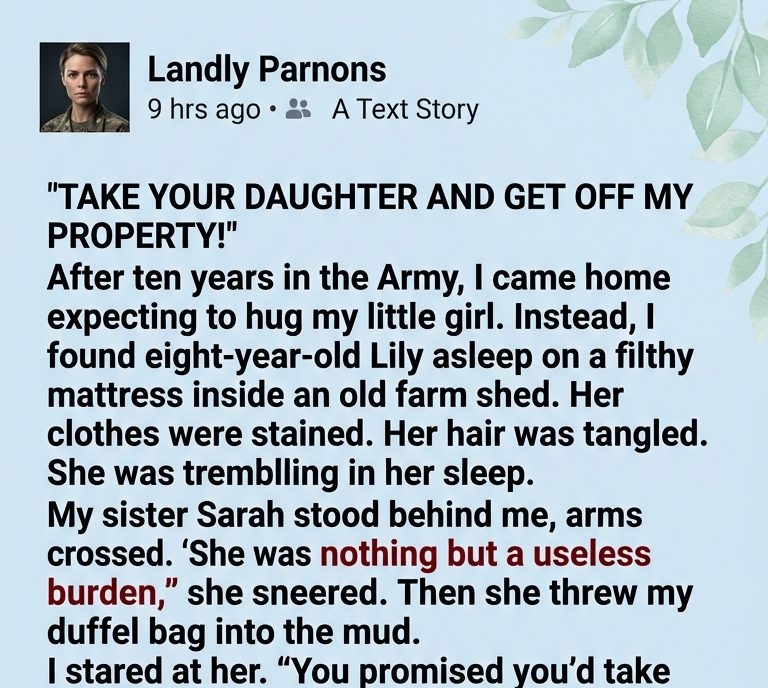
“TAKE YOUR DAUGHTER AND GET OFF MY PROPERTY!”
My sister Sarah screamed the words from the farmhouse porch, her face twisted with anger.
For a moment, I simply stood there, unable to understand what I was seeing.
I had spent ten years in the Army. Ten years of deployments, long nights, missed birthdays, and phone calls that ended before I was ready to hang up.
Through all of it, one thought had kept me going.
Someday, I would come home to my daughter.
Lily had been two years old when I left her in Sarah’s care. My wife, Emily, had died unexpectedly, and I had no other family member I trusted enough to raise my little girl while I served.
Sarah had promised me everything.
“She’ll have her own bedroom,” she’d said. “I’ll make sure she’s loved. You don’t need to worry about a thing.”
I had believed her.
Every month, I sent money for Lily’s food, clothes, school supplies, and anything else she needed. Whenever I could, I sent gifts. I called as often as my duties allowed.
Sarah always told me the same thing.
“Lily is doing great. She misses you, but she’s happy.”
I held on to those words through some of the hardest days of my life.
Then, after ten years, my service ended.
I packed my belongings, arranged my return, and drove straight to the farm where Sarah lived.
I imagined Lily running toward me, throwing her arms around my neck.
Instead, I found her in a shed.
And nothing about my life would ever be the same again.
Chapter One: The Girl in the Shed
The shed stood behind the farmhouse, near a rusted tractor and a stack of broken wooden pallets.
Its roof sagged in the middle. One window had been covered with cardboard, and the door hung crookedly from its hinges.
At first, I thought it was being used for storage.
Then I heard a small cough.
I stepped inside.
The smell hit me immediately: damp wood, mildew, and old bedding.
In the far corner lay a thin mattress on the concrete floor. A little girl was curled beneath a dirty blanket.
Her hair was tangled. Her cheeks were pale. Her clothes looked as though they had been worn for days.
I knew her instantly.
“Lily?”
Her eyes opened slowly.
For several seconds, she only stared at me.
Then she whispered, “Daddy?”
I dropped to my knees.
“Yes, sweetheart. It’s me.”
She scrambled toward me, but instead of throwing her arms around my neck, she hesitated.
That hesitation hurt more than anything I had experienced in the Army.
“Are you really home?” she asked.
“I’m really home.”
She touched my face with a trembling hand, as if she needed to make sure I was real.
Then she began to cry.
I pulled her into my arms and held her tightly.
“I’m here,” I whispered. “I’m never leaving you like this again.”
Behind me, footsteps approached.
Sarah appeared in the doorway.
“What are you doing in there?”
I slowly turned toward her, still holding Lily.
“What is this?”
Sarah rolled her eyes.
“She’s been difficult lately. I put her here so she’d stop bothering everyone.”
“She’s eight years old.”
“And I have a life, too!” Sarah snapped. “You think raising someone else’s child is easy?”
I looked around the shed.
There was no proper bed. No clean clothing. No books or toys. A plastic cup sat beside the mattress, and an old jacket had been folded into a pillow.
“How long has she been sleeping here?”
Sarah said nothing.
I looked down at Lily.
“Sweetheart, how long have you been staying here?”
She pressed her face against my chest.
“Since Christmas.”
It was September.
My hands tightened around her.
“Since Christmas?” I repeated.
Sarah shrugged.
“She wouldn’t listen. She kept making messes in the house.”
“You left her in a shed for nine months?”
“Don’t make it sound worse than it is.”
I stood up.
For ten years, I had trusted my sister with the most precious thing in my life.
Now I was looking at the child she had promised to protect.
Sarah pointed toward the driveway.
“Take your daughter and get off my property.”
I stared at her.
“You’re right about one thing. I am taking my daughter.”
I picked up my duffel bag with my free hand.
“But before I go, there’s something you should know.”
Sarah smirked.
“What?”
“I made a phone call.”
She laughed.
“Who are you going to call? The police? Go ahead. You have no idea what you’re getting yourself into.”
I didn’t answer.
I carried Lily toward my truck.
Behind me, Sarah shouted that I would regret embarrassing her.
I placed Lily in the passenger seat, wrapped my jacket around her shoulders, and buckled her in.
Then I made the call I had been planning to make since I first stepped into that shed.
“It’s Daniel,” I said. “I’m back. We need to finish what my father started.”
The man on the other end was silent for a moment.
Then he replied, “Understood. We’ll be there shortly.”
I ended the call.
Lily looked at me.
“Daddy, are we in trouble?”
I turned toward her.
“No, sweetheart. Not anymore.”
Chapter Two: Five Black SUVs
We had barely reached the end of the driveway when the first black SUV appeared on the road.
Then a second.
A third followed.
By the time I pulled to the side, five vehicles were approaching the farmhouse.
Sarah had come out onto the porch.
At first, she looked annoyed.
Then she noticed the men stepping out of the SUVs.
Her expression changed.
The men wore dark suits. One carried a leather briefcase. Another spoke quietly into a phone.
The tallest man walked directly toward me.
He was in his late fifties, with silver hair and a serious expression.
“Daniel?”
I stepped out of the truck.
“Mr. Collins.”
He extended his hand.
“Welcome home.”
Then he leaned closer and whispered the words I had been waiting years to hear.
“Sir, we found it.”
Sarah hurried down the porch steps.
“What is this? Who are these people?”
Mr. Collins turned toward her.
“Mrs. Sarah Bennett?”
“Yes. Who wants to know?”
“My name is Robert Collins. I represent the estate of your late father, Thomas Bennett.”
Sarah went still.
I watched her carefully.
Our father had died ten years earlier, shortly before I deployed overseas. His death had been sudden, and the family had been left in confusion.
I had been informed that he had left behind debts, a struggling farm, and little else.
Sarah had handled most of the paperwork.
She told me the estate had been settled.
She told me there was nothing left.
And because I was preparing to leave for the Army, I accepted her explanation.
Mr. Collins opened his briefcase.
“Your father’s estate was never fully settled,” he said. “Several assets were concealed, and documents submitted during the original administration appear to have been falsified.”
Sarah’s face drained of color.
“That’s ridiculous.”
Mr. Collins removed a folder.
“We have the original will, financial records, property documents, and correspondence from your father.”
Sarah looked at me.
“What did you do?”
“I didn’t do anything,” I replied. “I came home to my daughter.”
Mr. Collins continued.
“Your father established a trust for Daniel and his daughter, Lily. The trust was intended to provide for Lily’s upbringing and education.”
Sarah shook her head.
“No. That’s impossible.”
“It is documented in the original trust agreement.”
He handed her a copy.
I had never seen the document before.
My father had been a quiet man. He rarely spoke about money, and he never discussed his estate with me in detail.
But I remembered one conversation we had shortly before he died.
He had been sitting at the kitchen table, holding an old envelope.
“Daniel,” he had said, “if anything ever happens to me, make sure Lily is taken care of. Promise me.”
“I promise, Dad.”
He had looked as though he wanted to say more.
Instead, he placed the envelope in a drawer and told me to focus on my future.
At the time, I thought he was simply worried about his granddaughter.
Now I understood that he had been trying to protect her in a way I could not yet see.
Mr. Collins turned another page.
“According to the trust records, funds were allocated for Lily’s care throughout the period you were serving overseas.”
I looked at Sarah.
She avoided my eyes.
“How much?” I asked.
Mr. Collins gave me a figure.
It was more than enough to provide Lily with a comfortable home, proper clothing, healthcare, and a good education.
The money had been transferred into an account controlled by Sarah.
And the records showed that much of it had been withdrawn.
I felt sick.
“Where did it go?” I asked.
Mr. Collins closed the folder.
“That is what we have been investigating.”
Sarah suddenly raised her voice.
“This is a family matter! You can’t just show up here and accuse me of stealing.”
“We are not here to make accusations without evidence,” Mr. Collins replied. “We are here because the original trust documents and financial records raise serious questions. Those questions will be addressed through the appropriate legal process.”
Sarah turned to me.
“You’re really going to do this to your own sister?”
I looked at Lily, who was watching us through the truck window.
“No,” I said quietly. “You did this to your own niece.”
Chapter Three: The Secret in the Wall
That afternoon, I took Lily to a nearby hotel.
I wanted her somewhere clean and warm, with a proper bed and a bathroom of her own.
She stood in the doorway of the room, staring at the white sheets.
“Is this really for us?”
“Yes, sweetheart.”
“Can I sleep here?”
I knelt beside her.
“You can sleep wherever you feel safe.”
She touched the blanket.
“Even if I get it dirty?”
My heart broke.
“Lily, you don’t have to earn a clean bed. You don’t have to be perfect to deserve a home.”
She looked down.
“Okay, Daddy.”
I helped her wash her hair. We ordered dinner, and she ate slowly, as though she expected someone to take the plate away.
That night, she fell asleep holding my hand.
I stayed awake long after she was asleep.
The image of her on that mattress kept returning to me.
I had spent years believing I was protecting her by sending money and trusting Sarah.
I had been wrong.
The next morning, Mr. Collins called.
“Daniel, we located something else at the farmhouse.”
“What?”
“Your father left a sealed packet with instructions that it should only be opened if the estate records were challenged or if the trust’s assets could not be accounted for.”
“Where was it?”
“Inside a false panel in the old study.”
I remembered that room.
It had been my father’s favorite place in the house. The walls were lined with books, and an old wooden desk sat beneath the window.
Mr. Collins explained that a contractor had discovered the panel while inspecting the property years earlier. The packet had been overlooked during the initial estate proceedings.
Inside were letters, bank statements, and a small notebook in my father’s handwriting.
Most importantly, there was a letter addressed to me.
Mr. Collins read it over the phone.
“Daniel, if you are reading this, something has gone wrong. I hope I am mistaken, but I have reason to believe that someone close to the family intends to take control of the farm and the money I set aside for Lily.”
I closed my eyes.
The letter continued.
“I have made arrangements to protect the property and the trust. The original documents are with my attorney. Do not accept any claim that the estate has no remaining assets without independent verification.”
I sat down.
My father had suspected something.
And I had never known.
Mr. Collins told me the records indicated that the farm had been transferred into a separate holding company before my father’s death. The company’s ownership was governed by documents that Sarah had not been authorized to alter.
The transfer paperwork submitted after his death appeared inconsistent with the original records.
There was also evidence of a separate investment account that had never been disclosed during the estate administration.
The five SUVs had not come to threaten Sarah.
They had come because the investigation had finally uncovered the records needed to understand what had happened.
“Can she lose the farm?” I asked.
“That depends on the findings and the legal proceedings,” Mr. Collins replied. “The immediate priority is to preserve the assets and ensure Lily’s trust is protected.”
I looked toward the bed.
Lily was sitting cross-legged, drawing on the hotel stationery.
“What happens now?” I asked.
“Now,” he said, “we let the evidence speak.”
Chapter Four: What Sarah Had Been Hiding
Over the following weeks, the truth emerged piece by piece.
Sarah had not simply spent the money intended for Lily.
She had used some of it to pay personal debts, renovate parts of the farmhouse, and purchase a vehicle.
Other withdrawals had been transferred into accounts connected to her husband, Mark.
The records also showed that Sarah had repeatedly told the trust administrator that Lily was living in the main farmhouse and receiving proper care.
Those statements were contradicted by the dates on the receipts, photographs, and other records.
The shed had not been a temporary arrangement.
It had become Lily’s home for months.
Investigators also discovered that Sarah had submitted documents claiming I had authorized her to use some of the trust funds for household expenses.
I had never signed those documents.
A handwriting specialist was asked to examine them, and the findings became part of the investigation.
Sarah insisted that she had done nothing wrong.
She claimed the money was compensation for raising Lily.
She said the farm had required repairs and that the family had expenses.
But the trust agreement was clear about its purpose: Lily’s care, education, and welfare.
The money was not Sarah’s personal income.
The legal process took time.
There were meetings, requests for records, formal notices, and difficult conversations.
I learned that finding evidence and resolving an estate were not the same thing. Documents had to be verified, claims had to be reviewed, and the court had to determine the consequences.
Throughout it all, I focused on Lily.
I enrolled her in a new school.
I took her to a doctor for a checkup and arranged for her to speak with a child counselor who could help her process what had happened.
At first, she barely spoke about the shed.
She worried about little things.
Whether she was allowed to have seconds at dinner.
Whether she could leave a light on.
Whether I would be angry if she spilled something.
Every time she asked, I gave her the same answer.
“You’re safe. We’ll handle it together.”
One evening, while we were eating pizza on the living room floor of our new rental home, she asked me a question that stopped me cold.
“Daddy, did Aunt Sarah hate me?”
I put down my slice.
“I don’t know what was in her heart, sweetheart.”
“Then why did she put me in the shed?”
I took a breath.
“Whatever her reasons were, they were not your fault. You were a child. You deserved to be cared for.”
Lily looked at her plate.
“Did you know?”
“No,” I said. “I believed she was taking care of you. I’m sorry I didn’t know what was happening.”
She was quiet for a moment.
Then she reached across the floor and took my hand.
“I’m glad you came home.”
I squeezed her fingers.
“So am I.”
Chapter Five: The Meeting at the Farm
Three months later, the lawyers arranged a meeting at the farmhouse.
I almost refused to go.
But Mr. Collins explained that there were still questions about the property and the trust. Sarah had requested a meeting, and her attorney had agreed to discuss the disputed records.
I decided to attend.
Lily stayed with a family friend.
When I arrived, Sarah was waiting in the dining room.
She looked different. The confident expression she had worn that day at the shed was gone.
Her husband, Mark, sat beside her.
A lawyer sat across from them.
Mr. Collins placed several folders on the table.
Sarah looked at me.
“Are you happy now?”
I didn’t answer immediately.
“Happy about what?”
“You’ve destroyed my life.”
I looked around the dining room.
The same room where we had celebrated birthdays when we were children.
The same table where our father had taught us to play cards.
“I didn’t put Lily in that shed,” I said.
Sarah’s eyes filled with tears.
“I was overwhelmed. You were gone for ten years. I had to do everything.”
“You agreed to take care of her.”
“I didn’t know it would be so difficult.”
“You could have told me.”
She looked away.
“You would have brought her home.”
“Yes,” I said. “I would have.”
For the first time, Sarah seemed to understand what that meant.
She had not been trapped in an impossible situation.
She had had choices.
She could have asked for help. She could have told me the truth. She could have contacted the trust administrator.
Instead, she had hidden Lily away and concealed what she was doing with the money.
Mark shifted uncomfortably in his chair.
“Sarah said the funds were hers to manage.”
“They were intended for Lily,” Mr. Collins replied. “The records make that distinction clear.”
Sarah began to cry.
“I did care about her.”
I wanted to believe that some part of it was true.
But caring about someone is not merely a feeling. It is also what you do when that person depends on you.
“You may have cared about her in your own way,” I said. “But you did not protect her.”
She wiped her face.
“Can’t we just settle this as a family?”
I shook my head.
“This stopped being a private family disagreement when you concealed the money and left an eight-year-old child living in a shed.”
The meeting continued for another hour.
No dramatic confession came.
No one suddenly admitted to every wrongdoing.
Instead, the lawyers reviewed the records and discussed the next steps.
The trust’s remaining assets were secured. The disputed transfers were referred for further legal review. The property claims would be resolved through the proper process.
Sarah would have to answer for the documents and transactions connected to her.
For the first time in years, the truth was no longer controlled by the person telling the story.
It was in the records.
Chapter Six: The Last Letter
Several months later, Mr. Collins delivered another letter from my father.
It had been found among the papers recovered from the study.
The envelope was yellowed with age.
My name was written across the front in his familiar handwriting.
I waited until Lily was asleep before opening it.
Daniel,
If this letter has reached you, then I was right to worry about the future.
I wish I could have done more while I was alive. I know you have always carried the responsibility of protecting everyone you love. Sometimes, that makes it difficult for you to recognize when someone else has failed you.
Your sister has always wanted to be seen as the one who holds the family together. I hope she grows into that responsibility. But never confuse keeping the peace with doing what is right.
I have set aside what I can for Lily. It is not meant to make her rich. It is meant to give her choices. An education. A safe home. The freedom to build a life without being dependent on someone who might use that dependence against her.
If the money is gone, fight for what remains. If the property is lost, do not let that be the end of your family’s story.
Your daughter is more important than any building, any account, or any inheritance.
Raise her to know that she deserves kindness. Teach her to be strong, but never teach her that she must endure cruelty to prove it.
And Daniel, remember this: you cannot protect someone from every hardship. But when you discover that they have been hurt, you can choose what happens next.
I love you, Son.
Dad.
I read the letter twice.
Then I folded it carefully and placed it in my desk.
My father had not left me a fortune.
He had left me something more useful: a warning, a record of the truth, and a reminder of what mattered.
Chapter Seven: The Consequences
The legal proceedings continued for several more months.
The financial review established that money intended for Lily had been diverted for purposes not permitted under the trust. Some of the transactions were disputed, and the parties negotiated over the amounts that could be recovered.
The court ultimately ordered Sarah to repay a substantial portion of the funds that had been improperly used.
The remaining questions about the estate and the property were resolved through a separate agreement.
The farm was not simply handed to me because I had arrived with five black SUVs. The documents, ownership records, and court process determined what happened.
The trust was restored with the recovered funds and the assets that remained.
Lily’s education and living expenses were placed under independent administration, with clear safeguards and regular accounting.
Sarah was no longer permitted to manage the trust.
The investigation into the falsified documents proceeded separately. I did not need to decide her punishment myself. That was a matter for the authorities and the courts.
As for the farmhouse, I chose not to make it the center of my life.
I had spent too many years believing that if I worked hard enough, endured enough, and trusted the right people, everything would eventually fall into place.
Now I understood that some things had to be rebuilt deliberately.
I sold my interest in the disputed property after the legal issues were resolved and used the proceeds, together with my own savings, to establish a stable home for Lily.
I also set aside money for her education.
Not because money could undo what had happened.
But because my father had been right.
She deserved choices.
Chapter Eight: Learning to Feel Safe
The hardest part of coming home was not the legal battle.
It was helping Lily understand that her life had changed.
At first, she kept her belongings in one small bag.
Even after we moved into our own house, she refused to unpack everything.
“What if we have to leave?” she asked.
“We won’t,” I told her.
“But what if someone says we have to?”
I sat beside her on the bedroom floor.
“This is our home. No one is going to send you away because you make a mistake or ask for something you need.”
She studied my face.
“Promise?”
“I promise I’ll do everything I can to keep you safe. And if something difficult happens, I’ll tell you the truth. You won’t have to figure it out alone.”
That answer seemed to comfort her more than a promise that nothing bad would ever happen.
We established routines.
Breakfast together before school.
A walk after dinner.
A bedtime story, even when she insisted she was too old for one.
Some nights, she slept peacefully.
Other nights, she woke from dreams about the shed.
When that happened, I sat beside her until she was ready to lie down again.
Slowly, the little things began to change.
She started leaving her toys scattered across the living room.
She asked for a second helping without looking at me first.
She laughed loudly at cartoons.
One Saturday, I found her painting a picture at the kitchen table.
It showed a small house with a red roof, a blue door, and two people standing in the garden.
“Who are they?” I asked.
“That’s me,” she said, pointing to the smaller figure. “And that’s you.”
“What are we doing?”
“Going home.”
I looked at the picture for a long time.
Then I hung it on the refrigerator.
Chapter Nine: Sarah’s Apology
Almost a year after I returned, Sarah sent me a letter.
It was three pages long.
She wrote about the pressure she had felt, the resentment she had carried, and the financial problems she had hidden from the family.
She admitted that she had used money intended for Lily to cover expenses of her own.
She admitted that she had lied about where Lily was sleeping.
She wrote that she regretted the way she had treated her niece.
At the end, she asked whether she could see Lily.
I read the letter several times.
Part of me wanted to throw it away.
Another part remembered the sister I had grown up with—the girl who had once helped me build a treehouse, who had sat beside me when our mother died, who had promised our father she would look after the family.
But the sister I remembered was not the person who had stood outside that shed.
I spoke with Lily’s counselor about how to handle the request.
Then I wrote back.
I told Sarah that any contact with Lily would have to be gradual and guided by what was best for my daughter.
There would be no unsupervised visits.
There would be no pressure on Lily to forgive.
And Sarah would have to accept that rebuilding trust was not something she could demand.
Months later, Lily agreed to meet her aunt in a supervised setting.
Before the meeting, she asked me a question.
“Do I have to hug her?”
“No,” I said. “You don’t have to do anything you’re uncomfortable with.”
“Can I leave if I want?”
“Yes.”
She thought about it.
“Okay. I want to see what she says.”
The meeting lasted twenty minutes.
Sarah cried when she saw Lily.
“I’m sorry,” she said. “I should never have treated you that way.”
Lily sat quietly.
“Why did you put me in the shed?”
Sarah looked down.
“I made choices that hurt you. You didn’t deserve them.”
“Did you spend my money?”
Sarah hesitated.
Then she admitted that she had.
Lily looked at her for a long moment.
“I needed a bed,” she said.
Sarah began to cry harder.
“I know.”
Lily did not hug her.
She did not say she forgave her.
She simply stood up and walked over to me.
“Can we go home now, Daddy?”
I took her hand.
“Of course.”
And we left.
It was not a dramatic ending.
But it was an important one.
For the first time, Lily had been able to ask the questions she wanted to ask—and leave when she was ready.
Chapter Ten: What My Father Really Left Us
Two years after I returned from the Army, Lily stood on a stage at her school and read a short story she had written.
It was about a little bird that had lived in a dark place for a long time.
One day, the bird discovered that the door was open.
At first, it was afraid to fly out.
It had become so used to the darkness that the sunlight frightened it.
But someone waited outside.
Someone who did not force the bird to leave.
Someone who simply stayed nearby until it was ready.
When Lily finished reading, the room filled with applause.
She looked toward me in the audience.
I smiled.
Afterward, she ran into my arms.
“Did you like it?”
“I loved it.”
“It’s about being brave,” she explained.
“I know.”
“And about having someone who stays.”
I hugged her tightly.
“That’s a beautiful story, sweetheart.”
That evening, we visited my father’s grave.
Lily placed a small flower beside his headstone.
“Thank you for helping Daddy find me,” she whispered.
I stood behind her, unable to speak for a moment.
My father had been gone for years before I discovered the truth about his final arrangements.
He had not been able to protect Lily himself.
But he had tried to make sure she would have a chance at a safe future.
And when the records were finally uncovered, that chance became real.
As we walked back to the car, Lily slipped her hand into mine.
“Daddy?”
“Yes?”
“Are we going to be okay?”
I looked at her.
The little girl who had once slept on a filthy mattress was now wearing a bright yellow jacket, her hair neatly brushed, her backpack bouncing against her shoulders.
“We’re already getting there,” I said.
She smiled.
Then she ran ahead toward the car, calling for me to hurry.
I followed her.
For years, I had believed that coming home meant returning to the place where I had grown up.
Now I knew better.
Home was not the farmhouse.
It was not the money my father had left.
It was not the property Sarah had tried to control.
Home was the place where Lily could sleep without fear, ask for what she needed, and know that she would not be punished for being a child.
The five black SUVs had arrived because my father’s hidden records had finally been found.
They had exposed the truth about the money and the property.
But the most important thing they uncovered was the fact that Lily had never been a burden.
She had been a little girl who needed someone to care for her.
And this time, I was there.
The End.