Dr. Bennett stared at the service records for a long moment.
Then he placed them carefully on his desk and looked directly at me.
“One more week without oxygen could have caused permanent damage to your heart and brain,” he said. “Depending on how low your oxygen levels became, it could have been fatal.”
I felt the room tilt around me.
For three years, I had trusted my daughter, Laura, with almost every part of my life. She scheduled my appointments, collected my prescriptions, paid my bills, and handled the paperwork I found too confusing.
After my husband died, I had been grateful for her help.
Now I was sitting in a doctor’s office, learning that the person I trusted most had canceled the equipment that helped me breathe.
“How could she do this?” I whispered.
Dr. Bennett didn’t pretend to know the answer.
“What matters right now is making sure you’re safe. We’ll review your oxygen needs, restore the service, and make a plan so this doesn’t happen again.”
He called the oxygen company while I sat beside his desk. By that afternoon, my equipment had been restored, and a respiratory therapist came to my home to check the system.
For the first time in weeks, I could breathe without feeling as though every breath required a battle.
But the question of why my daughter had done this remained.
My name is Margaret Ellis. I was seventy-two years old, and until that winter, I believed I had raised a daughter who would never knowingly put me in danger.
Laura was forty-three. She had two children, a husband named Robert, and a busy household of her own. After my husband, Thomas, passed away, she began visiting more frequently.
At first, her help seemed like a blessing.
She organized my medications, took me to medical appointments, and insisted on managing my monthly benefit of $2,300.
“You shouldn’t have to worry about bills, Mom,” she told me. “Let me handle everything.”
I agreed because I loved her and because my breathing problems made ordinary tasks exhausting.
I never imagined that my trust would become something she could use against me.
The trouble began about two months before I discovered the delivery card.
Laura told me that the oxygen service had become too expensive.
“Those tanks cost a fortune,” she said one morning while making coffee in my kitchen. “The company keeps raising the price. You barely use them anyway.”
I was sitting at the table, struggling to catch my breath after walking from the bedroom.
“But Dr. Bennett said I need them.”
“He always says that. Doctors want you to keep buying equipment.”
Her answer unsettled me, but I didn’t argue.
A few days later, the oxygen company stopped delivering.
When I asked Laura about it, she told me she had arranged a cheaper option.
“It’s all taken care of,” she said.
I believed her.
Then my breathing worsened.
I became exhausted walking to the bathroom. Sometimes I woke in the middle of the night feeling frightened and short of breath. I thought my condition was getting worse, and I blamed myself for being unable to manage even the simplest things.
Laura visited less often during that period.
When she did come, she seemed impatient.
“Mom, you need to stop worrying about every little thing,” she said whenever I mentioned my breathing.
I wanted to believe her.
Then my granddaughter, Sophie, came over on a Saturday afternoon.
Sophie was sixteen, observant, and far more thoughtful than she realized. She had always been close to me, and she noticed things other people overlooked.
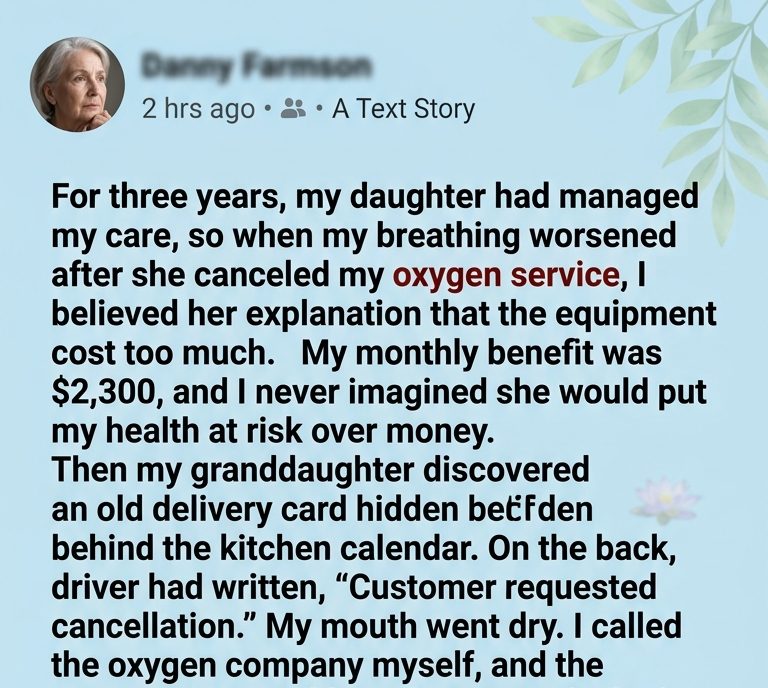
While helping me clean the kitchen, she moved the calendar hanging beside the refrigerator.
A small delivery card slipped from behind it and landed on the floor.
“What’s this, Grandma?”
I picked it up.
It was from the oxygen company. The date was nearly two months old.
On the back, someone had written:
Customer requested cancellation.
I read the words twice.
“Grandma, didn’t Mom say they were switching you to another service?”
I stared at the card.
“Yes,” I whispered. “She did.”
Sophie looked worried.
“Should we call them?”
For the first time in weeks, I felt a small spark of determination.
“Yes. I think we should.”
We called the company together.
After verifying my identity, the representative reviewed my account. She explained that the service had been canceled at Laura’s request and that six oxygen tanks had been returned unopened.
“Was there a problem with the equipment?” I asked.
“No, ma’am. The cancellation was recorded as a customer request. The returned tanks were marked as unused.”
I gripped the edge of the table.
“What happened to the payments?”
The representative explained that the account had been closed and that she could send me the service history, including the payment records available to her.
I asked her to mail everything directly to me.
When I hung up, Sophie took my hand.
“Grandma, you should tell your doctor.”
“I will,” I said.
But first, I needed to speak to Laura.
She arrived that evening carrying groceries.
I placed the delivery card on the kitchen counter.
“Why did you cancel my oxygen?”
She looked at the card, then at me.
“I told you. It was too expensive.”
“You said you were arranging a cheaper service.”
“I changed my mind.”
“You returned six tanks. I was supposed to be using those.”
Laura set the grocery bag down.
“You don’t need all that machinery.”
The words were so cold that, for a moment, I couldn’t respond.
“My doctor prescribed it.”
“Your doctor doesn’t pay the bills.”
“I do. It’s my benefit.”
Laura folded her arms.
“Your money barely covers anything. Robert and I have been helping you for years. You have no idea how much it costs us.”
I stared at her.
“Then why didn’t you tell me?”
“Because you would have made a fuss.”
I felt tears gathering in my eyes.
“I was struggling to breathe, Laura.”
She looked away.
“You always think the worst of me.”
“No,” I said quietly. “I trusted you.”
For a moment, her expression softened. I thought she might apologize.
Instead, she picked up her purse.
“I’m not doing this tonight.”
Then she walked out.
I barely slept.
The next morning, I called Dr. Bennett’s office and explained what had happened. His nurse arranged an appointment as soon as possible.
I brought the delivery card and the notes Sophie and I had made during the call.
Dr. Bennett listened carefully. He checked my oxygen levels and reviewed my recent symptoms.
His concern was immediate.
He explained that oxygen therapy is prescribed for specific medical reasons, and stopping it without medical guidance can be dangerous for someone who depends on it.
He arranged for my service to be restored and instructed me to follow my prescribed treatment plan.
Then I showed him the cancellation card.
He asked me to send a copy to his office and encouraged me to keep a record of everything that had happened.
A few days later, the service records arrived.
I opened the envelope at my kitchen table, with Sophie sitting beside me.
The first pages listed delivery dates and returned equipment.
The next pages contained cancellation forms.
Laura’s signature appeared beside each request.
I felt sick.
Then I reached the final page.
The payment records showed that the payments associated with the service had been redirected to an account shared by Laura and Robert.
I read the page again, hoping I had misunderstood.
But the account information was clear.
I called the oxygen company to ask for clarification. The representative explained what the records showed and advised me to contact my bank about any payments that might have been made without my authorization.
That afternoon, I brought the documents to Dr. Bennett.
He studied the dates, looked up at me, and said, “One more week without oxygen could have caused permanent harm. I’m very glad you came in when you did.”
His words stayed with me.
For years, I had thought of Laura as the person protecting me.
Now I understood that I needed protection from decisions she had been making on my behalf.
I contacted my bank and changed my account access. I asked them to review the transfers and remove Laura’s ability to manage my money without my direct approval.
I also contacted an attorney, who helped me understand my rights and review the financial arrangements I had made with my daughter.
The attorney advised me to preserve the service records, bank statements, and every message related to the cancellation.
I followed her advice.
Then I made one more decision.
I would no longer allow Laura to manage my medical care.
When she called a few days later, I asked her to come over.
She arrived with Robert.
I had expected an argument, but I was determined to speak calmly.
I placed the service records on the table.
“I know about the cancellations,” I said. “I know about the returned tanks. And I know where the payments went.”
Robert glanced at the papers.
Laura’s face turned pale.
“You went through our bank information?” she demanded.
“These are records from my oxygen account.”
“You don’t understand how complicated things were.”
“Then explain them.”
She sat down.
For several seconds, she said nothing.
Finally, she told me that she and Robert had been struggling financially. Their mortgage payments had increased, and Robert’s work had become less reliable.
She claimed they had intended to repay the money.
“We were going to put it back,” she said. “We just needed some time.”
I looked at her.
“Did you intend to repay the oxygen I needed to breathe?”
She began crying.
“Mom, I never wanted you to get hurt.”
“But you canceled the service.”
“I thought you could manage without it.”
“Did your doctor tell you that?”
She didn’t answer.
I waited.
Finally, she whispered, “No.”
The room fell silent.
Robert tried to explain that they had been overwhelmed and had made a series of bad decisions.
I listened, but I would not let their financial problems become an excuse for putting my health at risk.
“You should have asked me for help,” I said. “You should have told me the truth. You had no right to make that decision for me.”
Laura wiped her eyes.
“Can you ever forgive me?”
I looked at my daughter—the little girl I had once carried to bed, the teenager whose scraped knees I had bandaged, the woman I had trusted with my life.
“I don’t know,” I said honestly. “But forgiveness cannot mean pretending this never happened.”
I told her that she would no longer manage my finances or medical arrangements. Any future help would have to be transparent, limited, and handled in a way that protected my independence.
She left that evening without another argument.
The following weeks were difficult.
Some relatives said I was being too harsh. They reminded me that Laura had helped me for years and that everyone makes mistakes.
Others understood why I could no longer trust her.
I stopped trying to convince everyone.
My health needed attention, and I needed to rebuild a life in which I could make my own decisions.
With help from my doctor, I established a direct arrangement with the oxygen company. My medical appointments were scheduled through the clinic, and my bills were paid from accounts only I could access.
Sophie continued visiting every weekend.
She helped me organize my paperwork and taught me how to use online banking. More importantly, she never treated me as though I were incapable of understanding my own life.
One afternoon, while we were sitting on the porch, she asked me a question I had been avoiding.
“Do you hate Mom now?”
I thought about it.
“No,” I said. “I love your mother. But loving someone doesn’t mean trusting every decision they make.”
Sophie nodded.
“Will you ever talk to her again?”
“I hope so. But it will have to be different.”
Months passed.
Laura sent me a letter. She apologized for canceling the oxygen service and admitted that she had allowed her financial problems to influence decisions that were never hers to make.
She wrote that she had started working with a financial counselor and was trying to repay the money.
I read the letter several times.
I wasn’t ready to restore the relationship we once had. But I was willing to leave the door open to a different one—one built on honesty rather than dependence.
The financial review took longer. I worked with my bank and attorney to determine what had happened to the redirected payments and what steps were available to recover any money taken without authorization.
I also made sure my medical records reflected the interruption in service, so my doctors could continue monitoring my condition.
My breathing gradually became more stable under my prescribed treatment plan.
One morning, I stood by the kitchen window and watched the sunlight spread across the garden.
The old delivery card was still in my drawer.
I kept it not because I wanted to remember my daughter’s worst decision, but because it reminded me how close I had come to accepting a dangerous situation simply because it had been explained to me by someone I loved.
I had mistaken dependence for trust.
I had mistaken silence for peace.
And I had believed that being a good mother meant making excuses for my child, even when those excuses put me in danger.
I no longer believed that.
My daughter was still my daughter. I still hoped she would become someone I could trust again.
But my life belonged to me.
My health was not a bargaining chip. My money was not hers to redirect. And my love was not permission for anyone to make decisions that could cost me my life.
That winter, I learned something I wish I had understood years earlier:
Accepting help should never mean surrendering your right to be safe.
And sometimes, the person who helps you find your voice is the one person in the family who is brave enough to ask, “Grandma, is this really okay?”
For me, that person was Sophie.
I will always be grateful that she moved the calendar.
Because behind it was a small card—and the truth that finally gave me my life back.
The End.