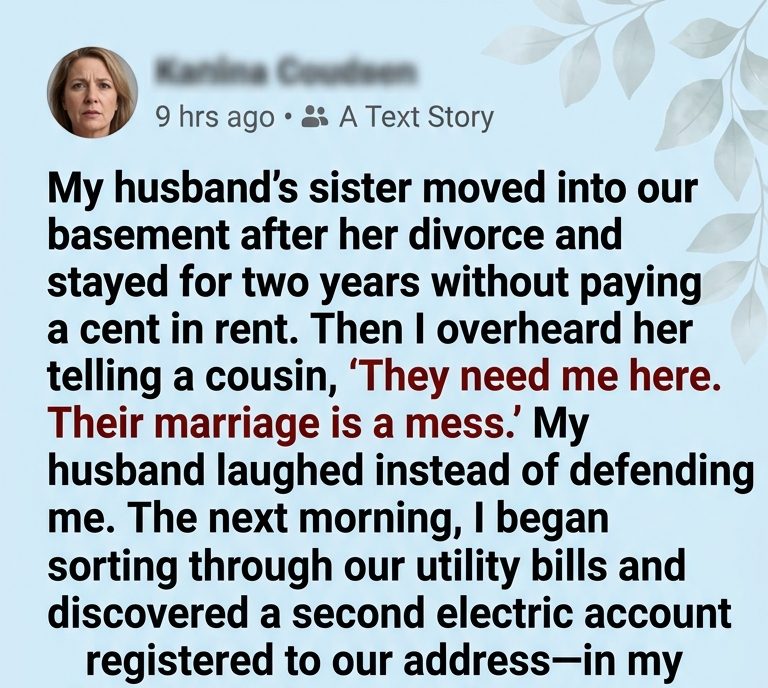
For two years, my husband’s sister lived in our basement without paying a single dollar in rent.
When Vanessa’s marriage ended, my husband, Mark, insisted we take her in. She had nowhere to go, he said. She needed time to recover, find a job, and rebuild her life.
I agreed because I loved my husband, and because I believed helping family was part of building a life together.
At first, Vanessa seemed grateful.
She moved into the finished basement with three suitcases, a television, and a collection of framed photographs from her former marriage. I stocked the refrigerator with her favorite food, bought extra towels, and even gave her the parking space closest to the house.
But weeks became months.
Months became a year.
And eventually, two years passed.
Vanessa never found a permanent job. She contributed nothing toward the mortgage, electricity, water, or groceries. She left dirty dishes in the sink, borrowed my things without asking, and treated the entire house as though she had inherited it.
Whenever I raised the subject with Mark, he gave me the same answer.
“She’s my sister. How can you put a price on family?”
I tried to explain that I wasn’t asking her to pay market rent. I simply wanted her to contribute something and respect the fact that this was our home.
Mark would sigh, kiss my forehead, and promise to talk to her.
He never did.
The first real crack appeared on a Saturday afternoon.
I was carrying a basket of clean laundry upstairs when I heard Vanessa talking on the back patio. She was on the phone with our cousin Rachel, and her voice carried through the open kitchen window.
“I’m telling you, they need me here,” Vanessa said.
I stopped walking.
Rachel laughed. “Need you? For what?”
“Their marriage is a mess. Mark works all the time, and his wife is constantly complaining. If I weren’t here, he’d have nobody to talk to.”
I stood perfectly still.
Then Vanessa said something that made my fingers tighten around the laundry basket.
“Honestly, I think he’s happier with me around. She acts like she owns him.”
Rachel said something I couldn’t hear.
Vanessa laughed.
“Please. She wouldn’t kick me out. Mark would never let her. Besides, this house would fall apart without me.”
I waited for Mark to defend me.
He was sitting at the kitchen table, scrolling through his phone. He had heard every word.
Instead of confronting his sister, he chuckled.
“Vanessa always has something to say,” he muttered.
I looked at him.
“You heard that?”
“Of course.”
“And you think it’s funny?”
He finally glanced up. “Don’t start. She’s just venting.”
I wanted to ask him when my humiliation had become entertainment.
But I swallowed the words.
I carried the laundry upstairs, closed our bedroom door, and sat on the edge of the bed.
For two years, I had made excuses for Vanessa.
For two years, I had made excuses for Mark.
That afternoon, I stopped making them.
The next morning, I began reviewing our household expenses.
It wasn’t something I normally did in detail. I paid the mortgage, managed most of the bills, and kept our financial records organized. Mark handled investments and taxes, while I took care of the everyday expenses.
I started with the electricity statements.
Our monthly bill had risen sharply over the past year. I had assumed it was because Vanessa was living downstairs, running a television, a space heater, and a small refrigerator.
But when I compared the bills, the increase didn’t make sense.
Our usage had nearly doubled.
I checked the account online and noticed a line I had never seen before.
Additional service account associated with this property.
I clicked it.
A second electric account appeared, registered to Vanessa.
The service address was our home.
I stared at the screen.
Why would Vanessa have a separate electric account when the basement was part of our house?
I checked the usage history.
The account was consuming almost as much electricity as our entire household.
I read the address again, wondering whether it was a mistake.
Then I called the power company.
After verifying my identity and explaining the situation, I asked the representative why a second account was registered to our property.
There was a pause as she checked the records.
“Ma’am,” she said carefully, “this account is associated with a separate meter listed as a commercial service.”
My stomach tightened.
“A commercial meter?”
“Yes. The records indicate that it’s located in a detached garage on the property.”
I stared through the kitchen window toward the backyard.
We had a detached garage.
It had been there when we bought the house, an old structure with a concrete floor, two narrow windows, and a side door that had always been locked.
Mark told me the previous owner had used it for storage.
We had never installed a commercial meter.
At least, I had never been told about one.
“Can you tell me what the meter is powering?” I asked.
“I can tell you the service classification and the recorded usage, but I can’t determine what equipment is connected to it from here. An authorized technician would need to inspect the installation.”
“Who opened the account?”
“Vanessa Miller.”
“Is there any way to tell when the service began?”
She gave me the date.
My hands went cold.
The account had been opened almost exactly two months after Vanessa moved in.
I thanked the representative, wrote down the information, and ended the call.
For several minutes, I sat motionless.
Then I looked out the window again.
The garage suddenly seemed different.
That afternoon, I waited until Vanessa left to visit a friend. Mark was at work, and I took the spare key from the kitchen drawer.
The lock turned with a stiff click.
When I opened the door, a wave of warm air rolled over me.
The garage was not being used for storage.
It had been transformed into a small commercial workspace.
Along one wall stood industrial refrigerators and chest freezers. Metal shelving held boxes of packaged ingredients, disposable containers, and cleaning supplies. A stainless-steel worktable occupied the center of the room.
At the back, behind a temporary partition, I found a sink, a second refrigerator, and several large appliances I couldn’t immediately identify.
The space was clean and organized.
It was also clearly being used for something that required far more electricity than a few household tools.
On the worktable lay a clipboard covered in handwritten orders.
Beside it sat a stack of printed invoices.
The business name at the top was Vanessa’s Kitchen.
I picked up one invoice.
It listed dozens of prepared meals, delivery fees, and weekly catering orders. Another page showed payments from customers. There were orders for office lunches, birthday parties, and weekend events.
I turned another sheet over.
It was a monthly revenue summary.
The total was more than I earned in several weeks at my job.
I felt a strange mixture of disbelief and anger.
Vanessa had spent two years telling us she couldn’t afford rent.
Meanwhile, she had been running a business from our property.
I took photographs of the room, the invoices, and the account information. Then I put everything back exactly where I had found it and locked the door.
When Mark came home, I was waiting at the kitchen table.
“We need to talk about your sister.”
He sighed before he even sat down.
“What happened now?”
I slid a printed copy of the electric account across the table.
“Do you know about this?”
He glanced at it.
For one brief moment, his expression changed.
Then he looked away.
“Vanessa’s business.”
I felt as though the room had tilted.
“You knew?”
He rubbed his forehead. “I knew she was doing some catering.”
“Some catering? She has industrial refrigerators, commercial appliances, and a separate electric account.”
“She needed somewhere to work.”
“So you knew she was running a business in our garage?”
“I knew she was using the space.”
“And you didn’t think to tell me?”
Mark leaned back in his chair.
“I didn’t think it was a big deal.”
I stared at him.
“Who paid for the equipment?”
“Vanessa bought most of it.”
“With what money?”
He didn’t answer.
I pushed the revenue summary toward him.
“She’s been earning thousands of dollars while telling us she can’t contribute to the household. Did you know that, too?”
Mark’s silence answered me.
I felt something inside me settle into a quiet, unfamiliar certainty.
“How long have you known?”
“Since last summer.”
“Last summer?”
“She asked me not to tell you until the business was stable.”
“And you agreed?”
“She was embarrassed about the divorce. I didn’t want to make things harder for her.”
I let out a short, disbelieving laugh.
“So you protected her embarrassment by letting me pay her expenses.”
“That’s not fair.”
“Then explain what’s fair about it.”
He stood up.
“I was trying to help my sister.”
“And I was trying to help your sister, too. The difference is that I thought we were making that decision together.”
Mark walked toward the refrigerator, opened it, and closed it again without taking anything out.
“Vanessa is finally getting back on her feet,” he said. “Why can’t you be happy for her?”
I looked at him for a long moment.
“Because she has been lying to us, and you helped her.”
He turned around.
“She didn’t lie about everything.”
“Did she tell you she was paying for the electricity herself?”
“Yes.”
“Did you check?”
He looked down.
That was when I understood the second account wasn’t the only secret.
Mark had known Vanessa was operating a business. He had known she was using our property. He had even known she was paying for a separate electric service.
But he had never checked whether the arrangement was legal, safe, or properly documented.
And he had never asked me whether I agreed.
“Does she have permission to run a commercial kitchen here?” I asked.
Mark hesitated.
“I don’t know.”
“Does our insurance cover it?”
“I don’t know.”
“Are there permits?”
“I assume so.”
“You assume?”
His voice hardened.
“I’m not going to interrogate my sister like she’s a criminal.”
“Neither am I. But this is our property, Mark. If something goes wrong, it could affect both of us.”
He had no answer.
That evening, I did something I should have done months earlier.
I contacted our homeowners’ insurance company and asked whether a commercial food business operating in a detached garage would affect our coverage.
The representative couldn’t give me a definitive answer without reviewing the policy and the details of the operation. She did, however, advise me to disclose the business promptly and arrange an inspection if necessary.
I also contacted the local permitting office to ask what approvals might be required for a food business operating from a residential property.
The answers were more complicated than I expected.
Requirements depended on the type of food being prepared, how it was stored, where it was sold, and whether customers or employees visited the property. The garage might need to meet specific building, fire, sanitation, and zoning requirements.
I made notes.
Then I called an electrician and arranged for a licensed professional to inspect the electrical installation.
I wasn’t going to make accusations before I knew the facts.
But I wasn’t going to ignore them anymore.
The next morning, I told Mark that the garage would need to be inspected and that Vanessa couldn’t continue operating there until we understood what was permitted and what changes were required.
He reacted as though I had announced that I was selling the house.
“You can’t just shut her down!”
“I haven’t shut anything down. I’ve asked for an inspection.”
“She’s going to lose customers.”
“Then she needs to find a compliant place to work.”
“She built this business from nothing!”
“And she built it on property she doesn’t own, without asking me.”
Mark’s face reddened.
“You’re making this personal.”
“It became personal when you decided my opinion didn’t matter.”
He left for work without saying goodbye.
Vanessa arrived home that afternoon carrying a paper bag of groceries.
I was in the kitchen when she came through the door.
“Mark says you’re making trouble about the garage,” she said.
I put down my mug.
“Mark shouldn’t have described it that way.”
She set the bag on the counter.
“I don’t understand what your problem is. I’m paying for the electricity.”
“Your account is paying for the electricity recorded on that meter. That doesn’t answer whether the business is permitted to operate there.”
Her expression tightened.
“You went through my things?”
“I opened the garage. It’s on our property.”
“You had no right to look through my business papers.”
“I didn’t take anything. I looked at the invoices on the table.”
She folded her arms.
“You’re acting like I’ve been stealing from you.”
“Have you been contributing to the household?”
“I’ve been taking care of myself.”
“That’s not what I asked.”
Her eyes narrowed.
“Mark said I could stay.”
“Mark and I agreed you could stay temporarily. We never agreed that you could operate a business here indefinitely.”
Vanessa shook her head.
“You’ve always resented me.”
I felt the familiar urge to defend myself, to explain every meal I’d cooked, every bill I’d paid, every time I’d tried to make her feel welcome.
Instead, I said, “This isn’t about whether I like you. It’s about what is happening in our home.”
She laughed bitterly.
“Your home. You always have to say it like that.”
“Because it is my home, too.”
For a moment, neither of us spoke.
Then she picked up her grocery bag and headed downstairs.
That night, Mark slept in the guest room.
For the next several days, the house felt divided.
Vanessa barely spoke to me. Mark answered my questions with clipped replies. Every ordinary sound—the washing machine, the refrigerator, the garage door—seemed to remind me that a second life had been operating just beyond my awareness.
The electrician came on Thursday.
He inspected the service panel, the meter, and the wiring inside the garage. He explained that the separate meter had been installed before we purchased the property, but the current business had added electrical demand that needed to be assessed.
He found a few issues that required correction before the setup could be considered safe for the equipment Vanessa was using.
He didn’t declare the entire installation illegal, and I didn’t ask him to. I wanted an accurate report, not a dramatic accusation.
The permitting office also confirmed that Vanessa would need to provide details about her food preparation and sales before they could determine which requirements applied.
When I gave her the information, she looked genuinely frightened for the first time.
“I didn’t know all of this,” she said quietly.
“Then you need to find out.”
“I thought the garage was already set up for business.”
“Who told you that?”
She hesitated.
“Mark said the previous owner used it for commercial work.”
I turned toward my husband.
“Is that true?”
Mark stared at the floor.
“The previous owner had a workshop. I don’t know exactly what kind.”
“Did you tell Vanessa she could run a food business here?”
“I told her she could use the garage.”
“That isn’t the same thing.”
He said nothing.
Later that evening, Vanessa came upstairs without her usual defensive expression.
“I owe you an apology,” she said.
I waited.
“I should have talked to you before I started the business here. I thought Mark had already handled it.”
“He didn’t.”
“I know that now.”
She looked toward the backyard.
“I wasn’t trying to take advantage of you.”
I wanted to believe her.
But good intentions did not erase two years of decisions made without my consent.
“Why did you tell Rachel that Mark needed you because our marriage was a mess?”
Her face went pale.
“You heard that?”
“Yes.”
She looked away.
“I was angry.”
“At me?”
“At everyone. My divorce was humiliating. I moved into my brother’s house, and I felt like a failure. The business was the first thing I’d done that made me feel capable again.”
“So you made me the villain.”
She swallowed.
“I suppose I did.”
“Why did Mark laugh?”
Her eyes filled with tears.
“Because he always tries to keep everyone happy. He thought if he laughed it off, you wouldn’t confront me.”
I looked at her.
“That isn’t keeping everyone happy. It’s making me carry the discomfort so neither of you has to.”
Vanessa nodded slowly.
For the first time, she didn’t argue.
The next morning, Mark asked me to sit down with him.
He looked exhausted.
“I should have told you,” he said.
“Yes.”
“I thought the business would be temporary. I thought she’d save enough money to get her own place.”
“And when she didn’t?”
“I kept putting it off.”
“Why?”
He took a long breath.
“Because every time I imagined telling her to leave, I pictured her going back to that apartment after the divorce. She was miserable. I didn’t want to be another person who abandoned her.”
I understood the fear behind his decision.
But understanding wasn’t the same as accepting it.
“You could have helped her without making decisions for me,” I said. “You could have helped her find a workspace, helped her budget for rent, or helped her understand the permits. Instead, you made our house the solution to every problem and expected me to stay quiet.”
He nodded.
“I know.”
“Do you?”
He looked at me.
“I think I do now.”
We agreed on three things.
First, Vanessa would stop using the garage for commercial food preparation until the required inspections and approvals were complete.
Second, she would begin paying a fair share of household expenses while she remained in the basement, with a written agreement that clearly stated the arrangement and its end date.
Third, she would have ninety days to move into her own place. If the business could operate legally from a suitable rented kitchen, she could pursue that option. But the garage would no longer be available as an open-ended arrangement.
Vanessa accepted the terms, though not happily.
Over the following weeks, she worked with the local authorities to understand what her business needed. She found a shared commercial kitchen that rented space by the hour. It cost money, but she could afford it.
The move forced her to reorganize her schedule and reduce some of her orders.
It also gave her something she hadn’t had in years: a business that belonged to her, separate from her brother’s household.
By the end of the ninety days, she had rented a small apartment across town.
On moving day, she carried her last suitcase up the basement stairs and set it beside the front door.
“I know you’re still angry with me,” she said.
“I am.”
She nodded.
“I would be, too.”
For a moment, I thought she might leave without another word.
Instead, she turned back.
“Thank you for letting me stay when I had nowhere to go.”
I looked at her.
“I meant it when I said you could stay. I just never agreed to everything that came afterward.”
“I know.”
She gave me a small, uncertain hug.
I returned it, but I didn’t pretend everything was repaired.
After she left, Mark and I stood together in the quiet kitchen.
The basement door was closed. The garage was empty. For the first time in two years, the house felt like ours again.
But the biggest change wasn’t the extra space or the lower electricity bill.
It was the conversation we finally had.
Mark admitted that he had confused loyalty with silence. He had believed that protecting his sister meant shielding her from consequences, even when those consequences fell on me.
I told him that I couldn’t build a marriage in which my voice mattered only when it didn’t inconvenience his family.
We began seeing a marriage counselor. The first few sessions were uncomfortable. Mark had to learn to stop treating every disagreement as a problem he could solve by asking me to be more patient. I had to learn to speak up before resentment hardened into silence.
It wasn’t an instant transformation.
But it was a beginning.
Six months later, Vanessa invited us to a small opening celebration for her catering business in a rented commercial kitchen.
Her orders had grown again, and she had hired a part-time assistant. The business was no longer hidden behind our house or dependent on an arrangement I had never approved.
During the celebration, she approached me with a small envelope.
Inside was a handwritten note.
I thought needing help meant everyone owed me patience forever. You helped me when I needed it, but you also showed me that gratitude has to include respect.
I folded the note and slipped it into my purse.
“Thank you,” I told her.
She smiled.
“I meant it.”
On the drive home, Mark reached for my hand.
“I should have defended you that afternoon,” he said. “When she told Rachel our marriage was a mess.”
“Yes,” I replied. “You should have.”
He didn’t offer an excuse.
That mattered more than any promise he could have made.
We still had work to do, but we were finally doing it honestly.
And I learned something I wished I had understood two years earlier:
Helping someone through a difficult season does not mean surrendering your home, your money, or your right to be respected.
Vanessa had needed a place to begin again.
I had given her one.
What I would never give her—or anyone else—was permission to make me a stranger in my own home.