The first Christmas I spent alone, I set the dining table for four out of habit.
Forty-two years of marriage had trained me to prepare for a full house. My late husband, Richard, always insisted that Christmas dinner should have enough food for unexpected guests. Our three children grew up knowing that there would always be another chair, another plate, and another reason to stay a little longer.
But that Christmas, the house was silent.
My eldest son, Carter, had sent a message that morning.
Sorry, Mom. We’re keeping Christmas quiet this year. The kids have been busy.
My daughter, Melissa, called briefly while I was peeling potatoes.
“Happy Christmas, Mom! We’re heading to Jason’s parents’ house. I’ll call you tomorrow, okay?”
My youngest, Jason, didn’t call at all.
I told myself they were busy. They had jobs, spouses, children, and lives of their own. I had never expected them to spend every holiday with me.
Still, I sat at the table that evening with four untouched place settings and a roast that could have fed eight people.
At seven o’clock, I finally put the food away.
Then I turned off the dining room lights and ate a piece of toast in the kitchen.
My name is Eleanor Whitmore. I was seventy-one years old, and until recently, I had believed that being a good mother meant making sure my children never had to worry about money.
My husband, Richard, had believed the same thing.
For forty-two years, we worked, saved, and built a comfortable life. Richard managed a construction supply company, and I worked as a bookkeeper before leaving my job when our youngest was born. We weren’t born wealthy. Every dollar we had came from long hours, careful planning, and the occasional sacrifice.
Our greatest achievement was our home.
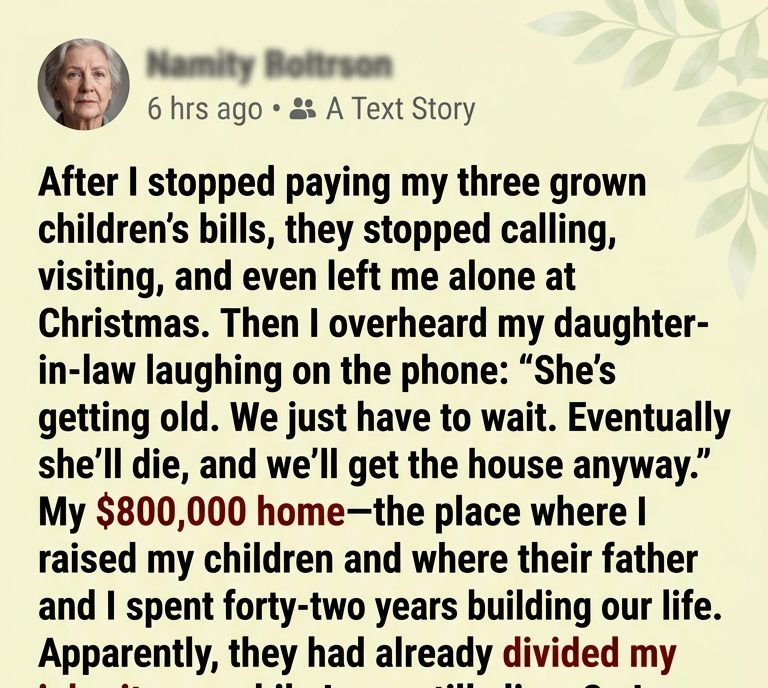
It was a large brick house on a quiet street, with four bedrooms, a wide front porch, and a maple tree Richard had planted the year Carter was born. The house had been worth around $800,000 when we last had it professionally appraised.
But to me, its value was never about the money.
It was where I had watched my children take their first steps. Where Richard and I celebrated our twenty-fifth anniversary. Where we gathered around the kitchen table to help with homework, argued over family vacations, and stayed up late waiting for teenagers who promised they would be home by ten.
It was where Richard took his last breath.
After he died, I kept the house because I couldn’t imagine leaving it.
For a while, my children seemed to understand.
They visited during the first few months. Carter repaired a loose railing. Melissa brought casseroles. Jason helped me sort through Richard’s tools.
Then the requests began.
At first, they were small.
Carter needed help covering an unexpected car repair. Melissa was short on money after her husband, Daniel, changed jobs. Jason wanted help paying off a credit card before the interest increased.
I helped them.
I told myself that Richard would have wanted me to.
Then the requests became regular.
Carter needed help with his mortgage after his company reduced his hours. Melissa asked me to cover a private school deposit for her son. Jason wanted me to contribute to a business idea that never seemed to get beyond the planning stage.
Each time, they promised it was temporary.
Each time, I believed them.
I began paying bills directly. Mortgage payments, insurance premiums, school fees, car payments, and occasional credit card balances.
I didn’t mind helping when there was a genuine need. What troubled me was how quickly my help became an expectation.
If I hesitated, they reminded me of what Richard and I had saved.
“You have plenty, Mom,” Carter said once. “You’re not exactly struggling.”
He said it casually, while looking at his phone.
I had been sitting across from him at the kitchen table, holding a stack of my own bills.
“I have enough to live comfortably,” I replied. “That doesn’t mean I should pay everyone’s expenses forever.”
He sighed.
“I’m not asking you to do it forever.”
But the next month, he asked again.
Melissa was more subtle. She would call to ask how I was feeling, ask whether I had been sleeping well, and then mention that something had gone wrong financially.
Jason usually sent a message.
Mom, could you help me out this month? I’ll pay you back when things improve.
The money rarely came back.
I never kept a strict record of what I gave them. I trusted my own children. I believed that when they were in a better position, they would remember what I had done.
Then, one afternoon, my financial adviser asked me a question that changed how I looked at everything.
“Eleanor, have you calculated how much you’re spending on your children’s expenses?”
I shook my head.
“Not exactly.”
He recommended that I review the previous two years of payments.
I did.
The total shocked me.
I had paid tens of thousands of dollars toward my children’s mortgages, tuition, vehicles, and other expenses. The exact amount was less important than what I saw when I reviewed the transactions.
My own retirement savings had barely grown since Richard died.
I was living comfortably, but I was no longer making decisions based on what I wanted. I was making decisions around whatever problem one of my children presented next.
I thought about the trips Richard and I had postponed. The bathroom renovation I had delayed. The money I wanted to set aside for emergencies.
I thought about how often I had said no to myself because one of my children had said they needed help.
That evening, I made a decision.
I would stop paying their bills.
Not because I wanted them to suffer, but because I needed to know whether they wanted a relationship with me—or simply the security of knowing I would always cover the shortfall.
The following Sunday, I invited all three children to lunch.
They arrived separately.
Carter came first, carrying a bottle of wine. Melissa arrived twenty minutes later with her husband, Daniel. Jason showed up last, complaining about traffic.
We ate roast chicken and talked about ordinary things.
After lunch, I put the coffee on the table.
“I need to talk to you about something,” I said.
Carter leaned back.
“What’s wrong?”
“Nothing is wrong. But I’ve reviewed my finances, and I need to make some changes.”
Melissa looked concerned.
“What kind of changes?”
“I’m no longer going to pay your monthly bills.”
The room became quiet.
Jason laughed as though I had made a joke.
“You’re serious?”
“Yes.”
Carter frowned.
“Mom, is this about the mortgage?”
“It’s about all the bills. I love you, and I will help when there’s a genuine emergency and I’m able to. But I won’t continue paying your regular expenses.”
Melissa put down her coffee.
“Why didn’t you tell us you were struggling?”
“I’m not struggling.”
“Then why stop?”
“Because I need to plan for my own future. And because you’re all adults.”
Carter shook his head.
“That seems unfair. Dad would never have wanted us to worry about money.”
I felt a sharp ache at the mention of Richard.
“Your father worked hard so we could have a secure future. He didn’t work so I could spend the rest of my life paying bills you can manage yourselves.”
Jason’s expression hardened.
“So that’s it? We’re on our own?”
“You have jobs. You have spouses. You have the ability to make decisions about your own spending.”
Daniel looked uncomfortable. Melissa stared at the table.
Carter stood.
“Fine. If that’s how you want to do things.”
He left without finishing his coffee.
Melissa followed after telling me I was making a mistake.
Jason didn’t say goodbye.
For the first time in my life, I had told my children no.
And they treated it like a betrayal.
At first, I expected things to settle down.
I thought they would be upset for a few days, then adjust. I thought they might even realize that I had been doing too much for too long.
Instead, the calls stopped.
The visits stopped.
When I called Melissa, she answered politely but sounded distracted. Carter sent short messages about practical matters. Jason stopped responding altogether.
Weeks passed.
I celebrated my birthday with a neighbor and her husband. I attended church alone. I went to the grocery store, cooked for one, and learned to enjoy the quiet without feeling guilty about it.
But the loneliness was difficult.
I missed the sound of my grandchildren running through the house. I missed the chaos of Sunday dinners. I missed the way Richard used to sit in his chair and pretend to complain about the noise while secretly enjoying every minute.
Some evenings, I wondered whether I had been too harsh.
Then I remembered the money I had given, the years I had spent trying to make life easier for my children, and the way they had reacted when I asked for a little independence.
I reminded myself that love could not mean saying yes to everything.
Still, I was not prepared for what happened one Thursday afternoon.
I had gone to the local pharmacy to collect a prescription. On the way home, I stopped at a small café near the shopping center.
I ordered tea and sat near the window.
A few minutes later, I heard a familiar laugh.
It came from the table behind me.
Melissa.
I turned slightly, careful not to draw attention.
She was sitting with her sister-in-law, Vanessa, who was married to Carter. Their voices were low, but the café was quiet enough for me to hear them.
Vanessa was talking about the house.
“Has she changed her mind yet?”
Melissa sighed.
“Not really. She’s still acting like she’s going to live forever.”
Vanessa laughed.
“Well, she’s getting old. We just have to wait. Eventually she’ll die, and we’ll get the house anyway.”
My fingers tightened around the teacup.
I sat completely still.
Melissa lowered her voice.
“Don’t say that so loudly.”
“Why? It’s true. Carter says the house is worth eight hundred thousand. Once everything is settled, you and Jason can work out the rest.”
I felt as though the floor had dropped beneath me.
They were discussing my death.
Not my health. Not my future. Not how to make sure I was comfortable as I grew older.
My death.
And they were already dividing my house.
Melissa said something I couldn’t hear.
Then Vanessa replied, “You know Carter already has that folder. He’s been looking into the estate stuff.”
I placed money on the table, stood, and walked out of the café.
I didn’t confront them.
I didn’t want to hear another word.
I drove home slowly, parked in the driveway, and sat behind the steering wheel.
The maple tree stood over the front lawn. Richard had planted it when Carter was born, and every autumn it turned a brilliant gold.
I looked at the windows of the house.
My house.
The place where I had raised my children, cared for my husband, and built a life I had every intention of continuing to enjoy.
I went inside, walked to the living room, and sat in Richard’s old chair.
For the first time since his death, I cried until my chest hurt.
I cried because I was lonely.
I cried because my children had stopped visiting when the money stopped.
And I cried because I had heard my own daughter discuss my death as though it were an inheritance schedule.
But after a while, the tears stopped.
I sat up, wiped my face, and looked at the family photographs on the mantel.
I loved my children.
That had never changed.
But love did not require me to surrender my home while I was still alive.
I reached for the telephone and called my attorney.
Her name was Margaret Ellis. Richard and I had worked with her for years on our wills, property documents, and estate planning.
When she answered, I said, “Margaret, I need to review my estate plan. And I need to discuss something urgent about my house.”
She heard the seriousness in my voice.
“Of course, Eleanor. Can you come in tomorrow morning?”
“I’ll be there.”
That night, I slept better than I had in weeks.
For the first time, I had a plan.
The next morning, Margaret listened while I explained everything.
I told her about the financial support I had been giving my children, the way they had withdrawn after I stopped, and the conversation I had overheard in the café.
She didn’t interrupt.
When I finished, she folded her hands on the desk.
“First, I want you to understand something. Your children do not automatically own your home simply because they may inherit from you one day.”
“I know.”
“Good. And you are not obligated to preserve your estate at the expense of your own life.”
She opened my file.
The house was in my name. Richard’s estate had been settled years earlier, and the property transfer had been completed according to the documents we had prepared.
My will named my three children as beneficiaries of my remaining estate, with the house to be divided according to the terms we had previously established.
Margaret explained that I could revise my estate plan, provided I had the legal capacity to do so and followed the proper formalities.
We discussed several options.
I could leave the house to my children equally.
I could leave it to one child and provide other assets to the others.
I could sell the property and use the proceeds to fund my retirement.
I could also make arrangements to protect my ability to remain in the home for as long as I wished.
“I don’t want to make a decision out of anger,” I told her.
“That’s wise.”
“I want to make a decision based on what I need, not on what they expect.”
Margaret nodded.
“Then let’s start there.”
Over the next two weeks, we reviewed my finances, my long-term care needs, and the costs of maintaining the house.
I realized that I had been so focused on what my children might inherit that I had barely considered what I wanted to do with the money I had spent a lifetime earning.
I wanted to travel.
I wanted to renovate the kitchen.
I wanted to help my grandchildren with education, but in ways that would benefit them directly rather than simply subsidizing their parents’ budgets.
And I wanted to stay in my home without feeling that I was living inside an estate plan designed by people waiting for me to disappear.
Margaret helped me update my will and prepare a separate set of property and estate documents.
The details were private, and I didn’t share them with my children.
Three weeks after I had overheard Vanessa, I invited Carter, Melissa, and Jason to dinner.
I invited their spouses too.
The response was immediate.
Carter called within ten minutes.
“What’s the occasion, Mom?”
“Just dinner. I haven’t seen everyone in a while.”
There was a pause.
“Are you ready to talk about the estate?”
I looked out the kitchen window.
“I thought we’d have dinner first.”
He laughed.
“Of course. We’ll be there.”
Melissa sent a message asking whether she should bring dessert.
Jason asked what time.
They all accepted.
For the first time in months, my children were eager to visit.
I knew why.
They believed I was finally ready to discuss the inheritance.
I spent the afternoon preparing the meal. I made Richard’s favorite pot roast, roasted vegetables, and an apple pie from the recipe my mother had taught me.
I set the table with the good china.
Then I placed one envelope beside my plate.
It contained the documents Margaret had prepared, along with a short letter explaining my decision.
At six o’clock, the doorbell rang.
Carter arrived with Vanessa. He was carrying a leather folder.
The words MOM’S ESTATE were printed on a label across the front.
I stared at it for a moment.
“What’s that?”
Carter smiled.
“Just some things I’ve been organizing. I thought it might help us discuss the future.”
I stepped aside.
“Come in.”
Melissa and Daniel arrived next. Jason came with his wife, Rachel.
They were all unusually cheerful.
Vanessa complimented the house. Melissa asked whether I had been sleeping better. Carter offered to pour the wine.
For the first time in months, they behaved as though we were a close family again.
I knew better than to confuse politeness with concern.
We sat down to dinner.
They talked about work, the grandchildren, and a vacation Carter was considering. No one mentioned the bills I had stopped paying.
No one asked whether I was lonely.
No one asked what I had been doing with my days.
They were waiting.
After dessert, Carter placed his folder on the table.
“Mom, I think this is a good time to talk about your estate.”
Jason nodded.
“We’ve been meaning to discuss it for a while.”
Melissa looked at me carefully.
“We just want to make sure everything is organized. You know, so there won’t be confusion later.”
I looked around the table.
Three grown children.
Three spouses.
Eight people waiting to discuss what would happen when I was gone.
I reached for the envelope beside my plate.
“Before anyone discusses my death,” I said, “there’s something you need to know about this house.”
Carter’s smile faded slightly.
“What do you mean?”
I opened the envelope and removed the first document.
“I’ve changed my estate plan.”
The room went quiet.
Vanessa stopped smiling.
Carter leaned forward.
“What have you done?”
I placed the document on the table.
“I’ve made arrangements to protect my ability to live in this house for the rest of my life. No one will be able to pressure me into selling it or moving out simply because they expect to inherit it.”
Carter stared at the page.
“Mom, that’s not what we were asking.”
“Isn’t it?”
He glanced at Vanessa.
She looked down at her plate.
I continued.
“I’ve also revised my will. The house will not be divided according to the plan you were expecting.”
Jason’s face tightened.
“You’re cutting us out?”
“No. I’m making decisions about my own property.”
“That’s basically the same thing.”
“No, Jason. It isn’t.”
I took out the next document.
“I intend to remain in this house as long as I choose. If I eventually decide to sell it, the proceeds will be used for my care, my needs, and the things I want to do while I’m alive. Any inheritance will be determined by my final estate plan, not by assumptions made around this table.”
Carter pushed his chair back.
“You can’t just change everything because you’re upset.”
“I can change my estate plan within the law. And I have.”
He looked at the documents again.
“What does this mean for us?”
“It means you should plan your lives around your own income, not around my death.”
No one spoke.
Then Vanessa gave a short, nervous laugh.
“Well, I think there’s been a misunderstanding. We were only trying to help you organize things.”
I turned toward her.
“Really?”
She swallowed.
I looked at Melissa.
“Because three weeks ago, I heard you and Vanessa talking at the café.”
Melissa went pale.
Carter turned toward his wife.
“What café?”
I kept my eyes on Vanessa.
“I heard someone say I was getting old, and that you only had to wait until I died to get the house.”
The room became utterly still.
Vanessa’s mouth opened, but no words came out.
Melissa stared at me.
“Mom, I—”
“I heard the entire conversation.”
Carter’s face reddened.
“Vanessa, did you say that?”
She shook her head.
“I was joking.”
I looked at her.
“About my death?”
“It wasn’t meant like that.”
“How was it meant?”
She looked toward Carter, hoping he would rescue her.
He didn’t.
Melissa finally spoke.
“Mom, we weren’t planning anything. We were just talking about the future.”
“Then why did you discuss my death as though it were a date on a calendar?”
She started crying.
I felt no satisfaction in seeing it.
I had not invited them there to humiliate anyone. I had invited them because I wanted them to understand that the life they were treating as a future inheritance was still my life.
Carter opened his folder.
“Mom, look. I’ve put together a list of the assets, the house value, and some things we need to consider.”
I looked at the label.
“Why did you make this?”
“Because someone has to organize everything.”
“I’m alive, Carter.”
He flinched.
“I know that.”
“Then why does your folder look like you’re preparing for an estate meeting without me?”
He closed it slowly.
Jason rubbed his face.
“This has gotten out of hand.”
“No,” I said. “It has finally been brought into the open.”
Melissa reached for my hand.
“Mom, please. We love you.”
I looked at her.
“Then why did you stop calling when I stopped paying your bills?”
She began to cry harder.
No one answered.
I waited.
I had spent months wondering whether I was being unfair. I had questioned whether I had made my children too dependent on me. I had worried that I was turning money into a test of love.
Now, sitting at my own dining table, I understood that I had not created the problem by saying no.
I had simply stopped covering it up.
Carter finally spoke.
“We didn’t mean to make you feel unwanted.”
“But you did.”
“We’ve all been under pressure.”
“So have I.”
He looked down.
I continued.
“I lost your father. I had to learn how to live alone. I had to manage the house, the bills, and every decision he used to help me make. And while I was doing that, I kept paying your expenses because I thought helping you was what a mother should do.”
My voice shook, but I continued.
“I never expected you to repay me. I never expected you to spend every holiday with me. But I did expect you to care whether I was happy, whether I was lonely, and whether I felt safe in the home your father and I built.”
I looked at each of them.
“Instead, when I stopped paying your bills, you stopped coming around. And when you finally returned, you brought a folder about my estate.”
The silence that followed was heavier than any argument.
Then Jason stood.
“I think we should go.”
I nodded.
“That may be best.”
Melissa stayed seated, wiping her eyes. Daniel put a hand on her shoulder.
Carter gathered his folder.
At the door, he turned back.
“Mom, you’re making a mistake.”
I looked at him.
“Perhaps. But it will be my mistake to make.”
He left.
The others followed.
When the door closed, I stood in the hallway and listened to their cars pull away.
Then I returned to the dining room.
The food was still on the table. The candles had burned low. Eight plates sat beneath the warm light.
I began clearing them one by one.
For years, I had feared that setting boundaries would cost me my family.
That evening, I understood that the family I wanted could not be built on fear, obligation, or the expectation of inheritance.
If my children wanted a relationship with me, they would have to want me—not the house, not the money, and not the promise of what they might receive when I was gone.
I didn’t know whether they would ever understand that.
But I knew I had done the right thing by protecting my future.
The following weeks were quiet.
Carter sent a message saying he needed time to process everything. Jason didn’t contact me. Melissa called once, but the conversation was brief and uncomfortable.
I didn’t chase them.
I used the money I had once spent on their bills to renovate the kitchen. I hired someone to repair the porch railing. I booked a trip to the coast with a friend from church.
For the first time in years, I made plans without checking whether one of my children needed something first.
I also began meeting regularly with a group for people who had lost their spouses. I discovered that loneliness was not something I had to endure silently. There were other people rebuilding their lives, learning new routines, and finding reasons to look forward to ordinary days.
Six months later, Melissa came to visit.
She arrived alone, carrying a small box of pastries.
I opened the door and stepped aside.
“Hello, Mom.”
“Hello, sweetheart.”
She looked nervous.
We sat in the kitchen. For a while, we talked about her children and my trip to the coast.
Then she put down her cup.
“I owe you an apology.”
I waited.
“What Vanessa said at the café was cruel. I should have stopped her. Instead, I joined in the conversation.”
She looked down.
“I’ve been thinking about it a lot.”
I didn’t rush to comfort her.
She continued.
“I think I started seeing your house as something we’d eventually inherit. I didn’t think about what it meant to you. I didn’t think about how it would feel to hear us talking that way.”
“Thank you for saying that.”
“And I was wrong to stop visiting because you stopped helping me financially.”
I nodded.
“Yes, you were.”
She took a breath.
“Can we start over?”
I looked at my daughter.
I loved her. That had never changed.
But I also knew that forgiveness did not mean pretending nothing had happened.
“We can start by having lunch next Sunday,” I said. “No money, no estate discussions. Just lunch.”
She smiled through her tears.
“I’d like that.”
She came the following Sunday.
Then she came again.
Carter took longer. He eventually called to ask whether I needed help fixing a loose fence panel. I told him I had already arranged for someone to do it, but invited him for coffee.
He arrived without his folder.
We talked awkwardly for an hour. He didn’t apologize directly, but he admitted that he had been treating my financial help as something he was entitled to.
It was a beginning.
Jason remained distant for nearly a year. When he finally reached out, it was because he wanted to talk about his business—not because he needed money. I listened, asked questions, and wished him well.
I didn’t offer to invest.
He didn’t ask.
Our relationship was not suddenly perfect. There were still uncomfortable conversations, missed visits, and old habits that took time to change.
But slowly, we began to build something different.
Not a relationship based on what I could provide.
A relationship based on whether we genuinely wanted to be part of one another’s lives.
I still live in the brick house Richard and I built our future around.
The maple tree is taller now. The porch railing has been repaired. The kitchen is brighter, and I finally bought the comfortable armchair I had wanted for years.
My estate plan remains private.
My children know that I have made arrangements for my future, and they know that I will not discuss inheritance as though my life is already over.
The house may one day be sold. It may eventually pass to someone else. That decision will be made when the time comes, according to my wishes and the law.
But I am not waiting for that day.
I am seventy-two now. I have places I want to see, books I want to read, friends I want to make, and mornings I want to spend sitting on my porch with a cup of coffee.
My life did not end when Richard died.
It did not end when my children stopped calling.
And it certainly did not become less valuable because someone began calculating what it would be worth after I was gone.
The greatest lesson I learned was not about inheritance or property.
It was that being a mother does not mean giving until there is nothing left for yourself.
I can love my children without paying their bills.
I can forgive them without giving them control over my future.
And I can leave them an inheritance—or not—without owing them an explanation for every dollar I earned.
The house is still mine.
So is my life.
And I intend to live it.