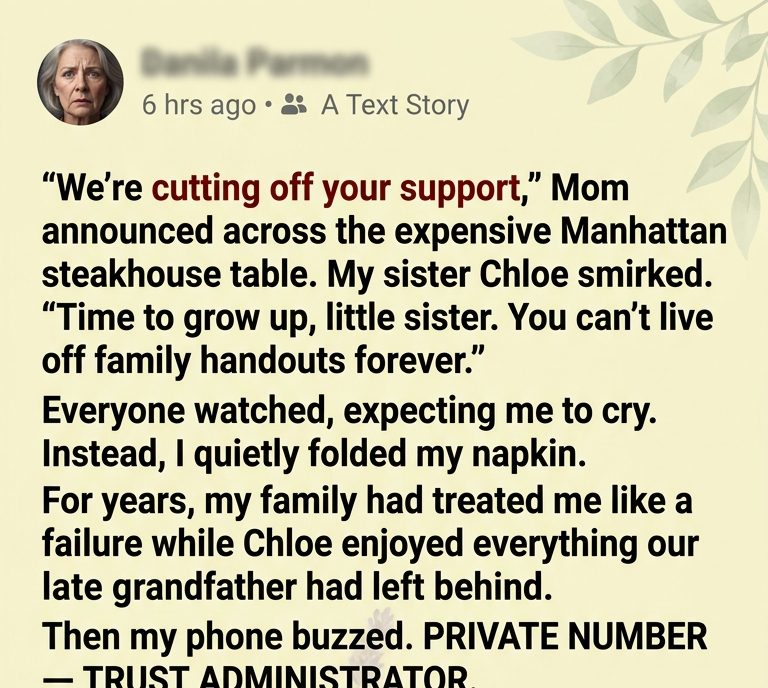
“We’re cutting off your support,” my mother announced across the expensive Manhattan steakhouse table.
She said it loudly enough for the neighboring tables to hear.
My sister Chloe leaned back in her chair, swirling the red wine in her glass. A satisfied smile spread across her face.
“Time to grow up, little sister,” she said. “You can’t live off family handouts forever.”
My father kept his eyes on his steak.
My mother folded her hands beside her plate, looking at me as though she were delivering a long-overdue lesson.
“You’re twenty-nine years old, Evelyn. Your sister has built a career, bought an apartment, and made something of herself. Meanwhile, we’re still paying your rent, your bills, and your health insurance. It has to end.”
I felt the eyes of everyone at the table settle on me.
For years, my family had treated me like the disappointing child. Chloe was the successful one—the polished daughter who knew which wine to order, which people to impress, and exactly how to turn a casual conversation into a story about her latest achievement.
I was the one who had supposedly failed.
What my family never mentioned was that I had spent the past three years working toward a career in architectural preservation. I had turned down a lucrative position in commercial development because I wanted to restore historic buildings. I worked long hours, earned a modest salary, and lived in a small apartment in Brooklyn.
My parents had offered to help with my expenses after I left my previous job.
At the time, they called it temporary support.
Somehow, that temporary arrangement had become a weapon they could use whenever I disagreed with them.
And Chloe had always been happy to help them swing it.
“Honestly,” she continued, “I don’t know why you’re so upset. You should be grateful they’ve helped you this long.”
I looked at her.
“Did I say I wasn’t grateful?”
Her smile tightened.
“No. You just act like everyone owes you something.”
My mother gave a small, approving nod.
That was how these dinners always went. Chloe would provoke me, my mother would agree with her, and my father would remain silent until the subject changed.
If I defended myself, I was ungrateful.
If I stayed quiet, they considered it an admission that they were right.
That evening, however, I had no intention of giving them the reaction they wanted.
I quietly folded my napkin and placed it beside my plate.
“Okay,” I said.
My mother blinked.
“Okay?”
“Yes. If you’re ending the support, I understand.”
Chloe looked disappointed.
“That’s it?”
“What else would you like me to say?”
She opened her mouth, then closed it.
My mother’s expression hardened.
“We’re trying to teach you responsibility, Evelyn. This is for your own good.”
I nodded, though I no longer believed that was the reason.
My phone buzzed against the table.
An unfamiliar number appeared on the screen.
PRIVATE NUMBER — TRUST ADMINISTRATOR
I almost ignored it. I was in the middle of a family dinner, and I assumed it was another call from a bank or insurance company.
But something made me answer.
“Hello?”
“Ms. Evelyn Hart?”
“Yes.”
“My name is Daniel Mercer. I’m an administrator with the Whitmore Family Trust. I apologize for calling during dinner, but I’ve just received a message from your mother regarding the termination of your financial support.”
I glanced at my mother.
She was watching me now.
“Yes,” I whispered. “That’s correct.”
There was a pause.
Then Daniel asked a question that made the restaurant seem suddenly silent.
“Did your family ever explain what your grandfather actually left you?”
My fingers tightened around the phone.
Across the table, Chloe stopped laughing.
My mother’s face changed so quickly that I almost missed it.
“What did you say?” I asked.
Daniel lowered his voice.
“Your grandfather, Edward Whitmore, established a trust for you shortly before his death. According to our records, you were supposed to receive a formal explanation of its terms when you turned twenty-five.”
I stared at the tablecloth.
“My grandfather died when I was twenty-two.”
“Yes. And the trust became irrevocable upon his death. Your mother was named as a temporary administrative contact, but she was never the beneficiary.”
I looked directly at my mother.
She had gone pale.
“Daniel,” I said carefully, “my mother told me Grandpa left everything to the family. She said there was nothing specifically for me.”
Another pause.
“I’m afraid that is not what the trust documents say.”
My heart began to pound.
“What did he leave me?”
“I would prefer to discuss the details privately after verifying your identity. But I can tell you that the trust contains a substantial investment portfolio, a property interest, and instructions that are independent of your parents’ financial arrangements.”
I could barely breathe.
“How substantial?”
“I don’t want to give you an incomplete figure over the phone. The current statement and original trust instrument will answer that question.”
My mother abruptly reached across the table.
“Evelyn, give me the phone.”
I moved it away from her.
“Why?”
“Because this is a private family matter.”
Daniel heard her.
“Mrs. Hart,” he said, his tone suddenly formal, “the trust is a private legal arrangement, but Evelyn is the named beneficiary. I can discuss her rights directly with her.”
My mother froze.
Chloe sat forward.
“Mom, what is he talking about?”
My father finally looked up.
For the first time that evening, he seemed genuinely frightened.
“Evelyn,” he said, “hang up. We’ll explain everything at home.”
I looked at him.
“You’ve had seven years to explain it.”
Nobody answered.
Daniel continued, “Ms. Hart, I recommend that you schedule a meeting with our office. Please bring identification. I’ll also arrange for you to receive copies of the documents you’re entitled to review.”
“Thank you,” I said.
Then I ended the call.
For several seconds, the only sound at our table was the quiet clink of silverware from the surrounding diners.
Chloe was the first to speak.
“What trust?”
My mother reached for her water glass, but her hand trembled enough that the ice rattled.
“It’s complicated,” she said.
“Then explain it.”
“Not here.”
I looked at her.
“You had no problem discussing my finances here.”
Her lips pressed together.
My father set down his fork.
“Evelyn, your grandfather’s estate was handled a long time ago. There were arrangements. Your mother took care of them.”
“What arrangements?”
He looked at my mother.
That was when I understood something important.
My father might not have known every detail, but he knew there was something they had never told me.
I stood, picked up my coat, and placed a few bills beneath my water glass.
“I’ll pay for my own dinner.”
“Don’t be dramatic,” my mother snapped.
“I’m not.”
I slipped my phone into my pocket.
“I’m just finished discussing my life with people who apparently know more about it than I do.”
Then I walked out.
The September air hit my face as I stepped onto the Manhattan sidewalk.
For a moment, I stood beneath the restaurant’s awning, watching taxis glide past and people hurry through the evening.
I had no idea what my grandfather had left me.
I didn’t know whether the trust held ten thousand dollars or ten million. I didn’t know what property interest Daniel had mentioned, or why my mother had looked as though she had just seen a ghost.
But I knew one thing.
Whatever the truth was, I would hear it from the documents—not from my family.
And for the first time in years, that felt like freedom.
The following morning, I took the earliest subway into Manhattan.
Daniel Mercer’s office occupied the twenty-first floor of a building near Bryant Park. It was quiet and understated, with glass walls, pale wood furniture, and framed photographs of old New York buildings.
A receptionist greeted me by name.
“Mr. Mercer is expecting you.”
He was in his early fifties, with silver at his temples and the careful manner of someone accustomed to delivering information that could change a person’s life.
He shook my hand and offered me a seat.
“Before we begin,” he said, “I want to make something clear. I can explain the trust documents, but if we discover that funds were mishandled, you may need independent legal counsel. Our office administers the trust. We are not your personal attorneys.”
I appreciated his honesty.
“Understood.”
He opened a folder.
“Your grandfather, Edward Whitmore, created the trust three months before his death. He had become concerned that the family’s financial arrangements were too dependent on informal promises.”
That sounded like Grandpa.
He had been a quiet man with a dry sense of humor. He wore the same brown wool coat every winter, repaired his own watches, and believed that money should give people choices rather than control them.
When I was a child, he took me to museums and taught me how to recognize the details that made old buildings worth saving.
“Look at the windows,” he would say. “Someone chose those proportions for a reason. If you destroy them without understanding them, you lose more than glass and wood.”
He was the first person who encouraged me to study architecture.
When I told my parents I wanted to work in preservation rather than commercial development, they called it an expensive hobby.
Grandpa called it a profession.
He had died before I could show him the first building I helped restore.
I swallowed the memory.
“What exactly did he leave me?”
Daniel turned the first page toward me.
“The trust was funded with a combination of marketable securities, municipal bonds, and shares in a property holding company. At the date of your grandfather’s death, the assets were valued at approximately $2.4 million.”
I stared at the number.
“Two point four million?”
“Yes. The portfolio has fluctuated over the years. Its current value is higher, though I want you to review the statement before relying on any preliminary figure.”
My mind struggled to catch up.
“My mother said Grandpa left everything to my father.”
“He left certain assets to your father. He also established separate trusts for each of his grandchildren.”
“Each of us?”
“Yes. Your sister’s trust was funded separately.”
That explained why Chloe had enjoyed advantages I had never understood. She had purchased her apartment with what my parents described as a family gift. She had launched her consulting business with money they said they had saved for her.
I had assumed Grandpa’s estate had been divided according to some arrangement I was too young to understand.
Daniel slid another document across the desk.
“This is the section specifically concerning you.”
I read slowly.
The trust had been designed to support my education, housing, professional development, and general well-being. At twenty-five, I was entitled to receive regular distributions, subject to the trust’s terms. At thirty, I could request a partial distribution of principal. Additional provisions governed the remaining assets.
I was twenty-nine.
In less than a year, I would reach the age at which I could request access to a substantial portion of the principal.
I looked up.
“Why didn’t I receive any of this?”
Daniel folded his hands.
“That is what we need to establish.”
He showed me the account history.
For the first two years after Grandpa’s death, the trust had made several payments toward my education and living expenses. Then the payments had stopped.
A note in the file stated that I had requested the suspension.
“I never requested that.”
“I understand.”
“Who did?”
Daniel pointed to the next page.
“My mother?”
“She was listed as the family contact. But she did not have authority to terminate your beneficiary status. The payments could be adjusted under certain conditions, but there should have been documentation from you if the suspension was requested on your behalf.”
I read the note again.
Beneficiary elects to defer distributions until further notice.
Below it was a signature.
It looked like mine.
But I knew I had never signed it.
“Can you verify this signature?”
“We can arrange a document examination if necessary. For now, I can tell you that the signature was submitted with a letter from your mother.”
“What did the letter say?”
Daniel opened another section.
“It stated that you had accepted a position overseas and wanted your distributions held until you returned.”
I shook my head.
“I’ve never worked overseas.”
“I see that.”
“Where did the money go?”
“Some of the assets remained invested. Other funds were distributed according to instructions we received at the time. I want to be careful here: we have not concluded that any funds were misappropriated. We need to review the authorizations, the trust’s governing terms, and the supporting records.”
That was fair.
I didn’t want a dramatic accusation. I wanted the truth.
“Can I have copies of everything?”
“Of the documents you are entitled to receive, yes. I’ll also provide a written accounting and a list of any distributions that require further explanation.”
I looked down at the signature again.
My name had been written in a familiar slant, with the same long tail on the final letter.
Someone had copied it carefully.
But there was one detail they had missed.
I had never written my middle initial that way.
Grandpa had taught me to sign my full name when I was twelve. I had used the same signature ever since.
This one was close.
Not mine.
I looked at Daniel.
“I want an independent attorney to review this.”
“I think that is sensible.”
He handed me a business card for a firm that did not represent the trust.
Before I left, he gave me one more envelope.
“This was retained with your grandfather’s original papers. It was marked to be delivered to you personally when you reached thirty, but given the questions surrounding the trust, I believe you should have it now.”
My name was written across the front in Grandpa’s unmistakable handwriting.
For Evelyn, when she is ready to stand on her own.
I held it carefully.
“Did you read it?”
“No.”
I thanked him and stepped into the hallway.
I didn’t open the envelope until I reached a small park across the street.
Inside was a single handwritten letter.
My dear Evelyn,
If you are reading this, you are old enough to understand that being loved and being controlled can sometimes look surprisingly similar.
I have watched this family confuse the two for years.
Your mother believes that protecting someone means making decisions for them. Your father often mistakes silence for peace. And Chloe has learned that being praised is the same thing as being right.
I love them all. But love does not make every choice acceptable.
I have left you resources because I want you to have choices. Not because I expect you to live extravagantly, and not because I want you to prove anyone wrong.
Use what you need to build a life that belongs to you.
If someone tells you that you owe them obedience because they helped you, remember this: a gift is not a gift if it comes with a leash.
You do not have to become hard to become independent. You only have to learn where your responsibilities end and someone else’s control begins.
I wish I could have told you this in person.
With all my love,
Grandpa
I read it twice.
Then a third time.
I cried quietly on the park bench, not because of the money, but because the person who had understood me best had anticipated exactly what I would need to hear.
For years, I had believed my family’s version of me.
Unfocused.
Unsuccessful.
Dependent.
Now I wondered how much of that story had been built to keep me in a position where I would never ask questions.
My independent attorney was named Rachel Kim.
She was direct, meticulous, and unimpressed by family drama.
After reviewing the trust documents, she explained that the next step was to obtain a complete accounting and determine who had authorized the disputed transactions.
“We’re not going to assume wrongdoing based on a suspicious signature,” she told me. “But we’re also not going to ignore it. We’ll request the originals, identify who submitted them, and compare the records with the trust’s requirements.”
I agreed.
For the next several weeks, my life became a collection of documents, phone calls, and carefully organized folders.
Rachel requested records from the trust administrator.
Daniel cooperated, providing statements and copies of correspondence.
The evidence began to form a pattern.
My mother had submitted the letter claiming I wanted my distributions suspended.
She had also provided the disputed signature.
Several payments that should have supported my education and housing had instead been transferred to accounts associated with a family investment company.
Some transfers appeared to have been authorized under separate provisions of the trust. Others required additional explanation.
The total amount under review was significant, but Rachel warned me not to confuse money that had been invested on my behalf with money that had actually left the trust.
“We’ll establish what happened,” she said. “Then we’ll decide what needs to be corrected.”
Meanwhile, my family began calling.
My mother left a voicemail saying she was worried about me.
My father sent a text asking if we could talk privately.
Chloe sent a message that began with I don’t know what Daniel told you, but…
I didn’t respond immediately.
I was learning that silence could be a boundary rather than a surrender.
Eventually, I agreed to meet my parents at their apartment.
Rachel advised me not to sign anything or accept any new financial arrangement during the conversation.
I promised I wouldn’t.
When I arrived, my mother had prepared tea and placed a plate of untouched pastries on the coffee table.
My father stood near the window.
Chloe was already there.
“Thank you for coming,” my mother said.
“I’m here to listen.”
She took a breath.
“Your grandfather’s estate was complicated. There were taxes, legal fees, and obligations to manage. We did what we thought was best.”
“Then why did you tell me he left everything to Dad?”
“We were trying to protect you from financial pressure.”
“By telling me there was no trust?”
She looked away.
My father finally spoke.
“Your mother thought you weren’t ready to handle a large amount of money.”
“I was twenty-two when Grandpa died. I understand that. But I was twenty-five when the distributions were supposed to begin.”
“You were still finding your way,” he said.
“So you decided I didn’t deserve to know?”
“No,” he replied quickly. “That’s not what I’m saying.”
Chloe crossed her arms.
“Can we stop pretending this is some conspiracy? Mom helped manage things. You were living on her support. It’s not as though you were starving.”
I turned toward her.
“Did you know about my trust?”
She hesitated.
That hesitation answered more than her words could have.
“I knew Grandpa had set something aside,” she said. “I didn’t know the details.”
“Did you know I was told I had no inheritance?”
“No.”
“Did you know Mom was paying my rent while telling me I had to be grateful for every dollar?”
Chloe’s face flushed.
“That’s different.”
“How?”
“Because you needed help.”
“And you didn’t?”
She fell silent.
My mother stepped between us.
“Evelyn, your sister’s circumstances were different. She had a business to establish. She had responsibilities.”
“So did I.”
“You chose a career that doesn’t pay much.”
“I chose a career I care about.”
“And that is exactly why we worried,” she said. “We wanted you to have stability.”
I looked at her for a long moment.
“Stability isn’t the same as control.”
Her eyes filled with tears.
“You think I wanted to hurt you?”
“I think you wanted to decide what I was allowed to know.”
My father sat down.
For the first time, he looked older than I remembered.
“Your grandfather and I argued about the trust,” he admitted. “He thought you should have control over your own money. Your mother believed it should be managed by the family until you were settled.”
“And the false letter?”
He didn’t answer.
My mother began to cry.
“I didn’t forge anything,” she said. “I filled out paperwork based on what I believed you wanted.”
“I never told you I wanted the payments stopped.”
“You said you wanted to make it on your own.”
“I said I wanted to make my own decisions.”
She covered her face.
For a moment, I felt the old instinct to comfort her—to tell her it was all right, to soften my words, to take responsibility for her pain.
I resisted.
Her feelings were real.
But they did not erase what had happened.
Rachel had told me that an apology, if one came, should not be confused with an accounting.
And an explanation was not the same as a correction.
“I’m not here to decide whether you meant to hurt me,” I said. “I’m here because my name was used on a document I never signed, and I was denied information about a trust that belongs to me.”
My mother wiped her eyes.
“What do you want from us?”
“The records. The truth. And no more decisions made on my behalf.”
Chloe gave a short, bitter laugh.
“So now you’re going to take us to court?”
“I haven’t decided what legal steps are necessary. Rachel is reviewing everything.”
“You’re really going to do this to your own family?”
I met her eyes.
“You keep saying that as if family means I’m supposed to accept anything.”
Nobody spoke.
I stood.
“When the review is complete, I’ll deal with whatever needs to be dealt with. Until then, I’m not discussing money with any of you.”
My father walked me to the door.
“Evelyn,” he said softly, “I’m sorry.”
I believed he was sorry.
I just didn’t know yet what his apology was worth.
The accounting took nearly four months.
During that time, I continued working.
I restored a nineteenth-century brownstone in Brooklyn, helped prepare a preservation proposal for a former library, and finally received a promotion I had been working toward for two years.
I paid my own bills.
I stopped accepting money from my parents.
It was difficult at first. My apartment was small, and I had to be careful with every expense. But the fear I had expected never arrived.
Instead, I felt lighter.
I had spent years believing that independence was something my family could grant or withdraw.
Now I understood that independence was a series of decisions I could make for myself.
The trust review eventually established that the disputed signature had not been authenticated as mine. The administrator could not treat the letter as a valid personal instruction without further verification.
Several transactions were supported by legitimate trust provisions, but others had been directed to the family investment company without the documentation required by the trust.
Rachel negotiated with the trust’s counsel and the parties involved.
Some funds were returned to the trust. Other amounts were accounted for as expenses or investments, and the remaining disputed items were handled through a formal settlement.
There was no dramatic courtroom scene.
No one was led away in handcuffs.
The process was slower and more complicated than that.
But the trust’s records were corrected, my beneficiary rights were formally recognized, and future distributions would be made according to the governing documents—with no family member acting as an informal gatekeeper.
The final statement showed that the trust held approximately $3.1 million in assets.
The property interest Daniel had mentioned was a share in a small commercial building in lower Manhattan. It generated rental income and had been held through the family property company.
I was not suddenly the owner of a skyscraper.
I did not buy a mansion or quit my job.
I used a portion of the funds to establish an emergency reserve, paid off my remaining student loans, and met with a financial adviser who had no connection to my family.
Then I did something that surprised everyone.
I kept working.
The money gave me room to breathe. It did not tell me what kind of life to build.
At thirty, I requested the distribution permitted under the trust and invested most of it conservatively. I also set aside money for further training in historic preservation.
My career continued to grow.
The following spring, I was appointed project manager for the restoration of a neglected public library in Queens.
On the day the city approved the project, I stood inside the empty building and ran my hand along the worn oak banister.
Sunlight fell through the tall windows.
For a moment, I could almost hear Grandpa beside me.
Look at the windows, he would have said. Someone chose those proportions for a reason.
I smiled.
I wished he could have seen it.
My mother called six months after the accounting was completed.
I almost let it go to voicemail.
Instead, I answered.
“Hello?”
“Evelyn.”
Her voice sounded smaller than I remembered.
“I was hoping we could have lunch.”
I didn’t answer immediately.
“I’m not ready to pretend everything is normal,” I said.
“I know.”
“And I don’t want to discuss the trust.”
“I understand.”
“Then why do you want to meet?”
She was quiet for a moment.
“Because I miss you. And because I know I damaged our relationship.”
That was the first time she had said it without adding but.
We met at a small café near my office.
She looked tired. There were new lines around her eyes, and she kept turning her cup between her hands.
“I thought I was protecting you,” she said. “Your grandfather had always believed you should make your own decisions. I thought he was being unrealistic.”
“You didn’t have to agree with him.”
“No. I didn’t.”
She took a breath.
“I was afraid you would make mistakes. I was afraid you would waste what he left you. And I was afraid that if you didn’t need us, you wouldn’t want us.”
I listened.
It was the first explanation she had offered that sounded more like fear than authority.
But understanding her fear did not make the choices she had made acceptable.
“You could have told me the truth,” I said.
“I should have.”
“You could have let me learn from my own mistakes.”
“Yes.”
“And you could have helped me without making me feel small.”
Her eyes filled.
“Yes.”
I looked out the window.
“I don’t know when I’ll be able to trust you again.”
“I understand.”
“I need you to stop treating my decisions as proof that I’m either succeeding or failing. I’m allowed to have a life you wouldn’t choose.”
She nodded.
“I’ll try.”
“Trying is a beginning.”
We finished lunch without discussing money.
It was not a reconciliation.
It was a first conversation.
That was enough.
My father apologized a few weeks later. His apology was quieter, but he admitted that his silence had helped the situation continue. I told him I was willing to rebuild our relationship slowly, provided he stopped asking me to keep the peace at my own expense.
Chloe took longer.
For months, she insisted that I had turned a family misunderstanding into a legal battle. She complained that I had made our parents look bad and that the trust had become a source of tension.
Eventually, she asked to meet.
We sat in a coffee shop in Midtown.
“I didn’t know everything,” she said.
“But you knew enough to believe I was being supported while you were being rewarded.”
She looked down.
“I guess I did.”
“You called me a failure at dinner.”
“I was angry.”
“You were enjoying it.”
She flinched.
For the first time, she didn’t deny it.
“I’m sorry,” she said.
I studied her face.
“I accept that you’re sorry. But I’m not going to pretend those years didn’t happen.”
“I know.”
“I want a relationship with you, Chloe. But not one where you get to make me feel smaller so you can feel bigger.”
She nodded slowly.
“I don’t know how to fix that.”
“Then start by not doing it again.”
We left without hugging.
It was awkward and imperfect.
But it was honest.
And honesty, I had learned, was worth more than a beautiful family photograph.
The following December, I returned to the Manhattan steakhouse.
Not for a family dinner.
For a meeting with the preservation board.
The restaurant was hosting a small reception after the board approved funding for the library restoration. I had spent months preparing the proposal, coordinating engineers, and persuading officials that the building could be saved without losing its historic character.
The project had become the most meaningful work of my career.
After the reception, I sat alone at a table near the window and ordered a modest dinner.
My phone buzzed.
A message from my mother appeared.
I saw the announcement about the library. Grandpa would have been proud of you.
I read it twice.
Then I typed:
Thank you.
I didn’t add anything else.
Outside, the city glittered beneath the winter sky. Cars moved through the intersection, and people hurried past the windows with their collars turned up against the cold.
I thought about the dinner a year earlier.
My mother announcing that she was cutting me off.
Chloe telling me to grow up.
My father staring at his plate.
They had expected me to cry because they believed money was the thing holding my life together.
They were wrong.
The money mattered. It gave me security, choices, and the ability to pursue work I loved without living in constant fear of the next bill.
But the most important thing my grandfather had left me was not the portfolio, the property interest, or the right to request a distribution.
It was the reminder that I did not have to earn the right to make my own decisions.
I could be grateful without being obedient.
I could love my family without allowing them to control me.
And I could build a life that was mine, even if the people closest to me didn’t understand it.
When the check arrived, I paid it myself.
Then I stepped into the cold Manhattan evening and walked toward the subway.
For the first time, I wasn’t walking away from my family in anger.
I was walking toward a life I had finally been allowed to choose.
And that was the inheritance I intended to keep.


