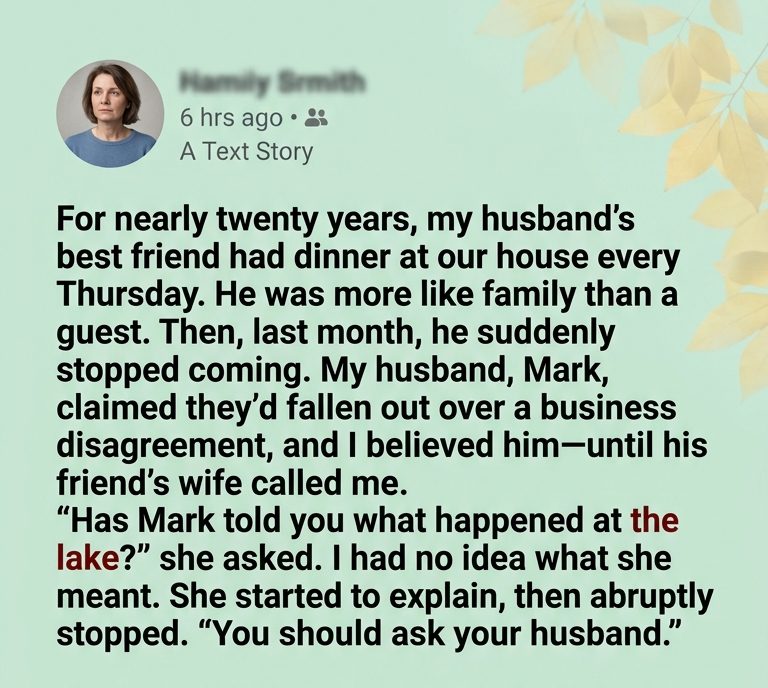
For nearly twenty years, my husband’s best friend, Daniel, came to our house every Thursday evening for dinner.
He never needed an invitation.
At six-thirty, I would hear his old truck pull into the driveway. At six-forty, he would knock twice, walk into the kitchen, and announce that he had brought dessert—even when the only thing in his hands was a bag of oranges.
My husband, Mark, always pretended to be annoyed.
“You know you could call before showing up,” he would say.
Daniel would grin. “And miss the chance to eat your wife’s cooking? Never.”
I would roll my eyes and set another plate on the table.
That was how it had always been.
Daniel had known Mark since they were teenagers. They had grown up in the same small town, worked their first jobs together, and survived the kind of youthful trouble that became funny only after everyone involved was old enough to know better.
When Mark and I married, Daniel was his best man.
When our daughter, Sophie, was born, Daniel stood beside Mark in the hospital corridor, crying harder than either of us.
When my father died, Daniel drove Mark to the funeral home because Mark was too upset to trust himself behind the wheel.
He wasn’t just my husband’s friend.
He was family.
His wife, Laura, was part of our lives, too. We celebrated birthdays together, exchanged Christmas gifts, and took weekend trips whenever our schedules allowed.
For years, I never questioned the closeness between the two men.
Then, last month, Daniel stopped coming.
At first, I assumed he was busy.
The first Thursday passed without his familiar knock.
The second Thursday came and went.
By the third, I began to worry.
“Have you heard from Daniel?” I asked Mark as I cleared the dinner plates.
Mark kept his eyes on the television.
“We had a disagreement.”
“About what?”
“Business.”
“What kind of business?”
“The kind that isn’t worth discussing over dinner.”
His answer felt unusually sharp.
I let it go.
Mark had recently been involved in a small property investment with Daniel. They had discussed buying an old commercial building and renovating it, but the deal had fallen apart.
I assumed that was what had happened.
Still, I missed Daniel.
The house seemed quieter without him. Even Mark appeared different, spending more time alone in his study and becoming irritated whenever his phone rang.
Then, one Tuesday afternoon, Laura called me.
We hadn’t spoken in weeks.
“Emily,” she said, her voice low, “can I ask you something?”
“Of course. Is everything okay?”
“Has Mark told you what happened at the lake?”
I stopped folding the laundry.
“What lake?”
There was a long silence.
“Laura?”
“I thought he might have told you.”
“Told me what?”
She exhaled shakily.
“I shouldn’t be the one to explain this. You need to ask your husband.”
“Laura, you’re frightening me. What happened?”
“I can’t do this over the phone.”
Then she hung up.
I stood in the laundry room, holding one of Mark’s shirts, trying to make sense of the conversation.
The lake?
Mark and Daniel had gone fishing together occasionally, but their last trip had been months earlier. I remembered Mark returning from that weekend with a scraped hand and a torn jacket.
He had told me he’d slipped on a muddy bank.
I had believed him.
That evening, I waited until Sophie had gone upstairs before approaching Mark.
He was sitting at the kitchen table, looking through paperwork.
“Laura called today.”
His pen stopped moving.
“Why?”
“She asked whether you’d told me what happened at the lake.”
Mark put the pen down.
“What did you say?”
“I asked her what she meant. She told me to ask you.”
He stood and walked to the refrigerator.
“There’s nothing to tell.”
“Then why did she call?”
“Because Daniel’s marriage is falling apart, and Laura wants someone to blame.”
“Mark, what happened?”
“Nothing.”
I watched him carefully.
“Did someone get hurt?”
He turned toward me.
For a brief moment, his expression changed.
Then he looked away.
“No.”
“Did you and Daniel have an accident?”
“No.”
“Then tell me why he hasn’t been here for a month.”
Mark rubbed both hands over his face.
“I didn’t cheat, Emily.”
I hadn’t accused him of anything.
The words hung between us.
He seemed to realize what he had said.
His shoulders slumped.
“Forget it.”
He walked past me toward the bedroom.
I followed him.
“Mark, you can’t say something like that and expect me to forget it.”
He stopped at the closet.
For a moment, I thought he was going to pull out a suitcase.
Instead, he reached to the back of the top shelf and brought down a small cardboard box.
He carried it to the bed and opened it.
Inside were old photographs, letters, and a few documents yellowed with age.
He searched through them until he found a photograph inside a clear plastic sleeve.
The picture was badly damaged. Its edges were curled, and a brown water stain obscured much of the image.
He held it in both hands.
“This is why Daniel can’t come here anymore.”
I took the photograph.
At first, I saw only two young men standing beside a lake.
One was Mark.
The other was Daniel.
They looked barely twenty. Mark wore a baseball cap, and Daniel had one arm draped across his shoulders.
Behind them, near the water, stood a third person.
A woman.
Her face was almost completely hidden by the water damage.
But I recognized the jacket.
It was mine.
I had owned that red windbreaker for years. I remembered wearing it on a camping trip shortly after Mark and I began dating.
I looked at the date written on the back.
October 14.
The year Mark and I had met.
My mouth went dry.
“Why am I in this photograph?”
Mark sat on the edge of the bed.
“Because you were there.”
I stared at him.
“I don’t remember going to that lake with you.”
“You were there, Emily.”
“No, I wasn’t.”
He looked up at me.
“You were. You just don’t remember what happened afterward.”
A strange chill moved through my body.
“What does that mean?”
Mark took the photograph from me and placed it on the bed.
“Twenty-six years ago, before we got married, you and I went to Miller’s Lake with Daniel. We were all drinking. You fell near the water.”
I shook my head.
“I remember the lake. I remember the camping trip. But I don’t remember falling.”
“You hit your head.”
“Why didn’t you tell me?”
“You were taken to the hospital. You were checked over and released. The doctor said you had a concussion. You were confused for a while.”
I sat down beside him.
“I remember having headaches. I remember missing a few days of work. But I thought I’d fallen down the stairs.”
Mark closed his eyes.
“I told you that.”
The room seemed to tilt.
“You lied to me?”
“I was trying to protect you.”
“From what?”
He didn’t answer.
I stood up.
“Mark, I want the truth. All of it.”
He looked at the photograph for a long time.
Then he finally began.
Twenty-six years earlier, Mark, Daniel, and I had gone to Miller’s Lake to celebrate Daniel’s engagement.
I had been dating Mark for only a few months. Daniel was engaged to a woman named Rachel, and the three of us had spent the afternoon drinking beer beside the water.
By sunset, Daniel and Rachel had argued over the phone.
He was angry and embarrassed. Mark tried to calm him down, but Daniel stormed away toward the old wooden dock.
I followed because I thought he needed someone to talk to.
Mark stayed behind to pack the cooler.
Daniel and I argued.
He accused me of encouraging Mark to leave town for a job opportunity, which he believed would end their friendship. I told him I had nothing to do with Mark’s decision.
He was drunk and upset.
I turned to leave.
My foot slipped on the wet boards.
I fell hard, striking my head against the edge of the dock before plunging into the water.
I remembered none of this.
According to Mark, he heard the splash and ran toward the lake.
Daniel had already jumped in.
He pulled me toward the bank while Mark called for help.
When they reached me, I was unconscious.
Mark said he had never been more frightened in his life.
At the hospital, the doctors diagnosed a concussion and warned them that I might have memory gaps.
But that wasn’t the secret.
The secret was what happened after they pulled me from the water.
Mark paused.
“Daniel told me you weren’t alone when you fell.”
I stared at him.
“What?”
“He said someone had been standing near the dock. Someone who left before we reached you.”
“Who?”
“He didn’t know.”
“Then why does that matter?”
Mark looked at the photograph again.
“Because the police found a second set of footprints near the edge of the water. They also found a broken bracelet.”
I touched my wrist instinctively.
I had worn a silver bracelet that night.
It had been a gift from my mother.
I remembered losing it years ago, but I had never known where.
“Was it mine?”
Mark nodded.
“The police thought someone might have pushed you. But there wasn’t enough evidence to prove anything.”
I felt sick.
“Why didn’t you tell me?”
“You were recovering. The doctors said you needed rest. The police interviewed us, and eventually the investigation went nowhere.”
“And Daniel?”
Mark looked down.
“Daniel told the police he had been alone with you near the dock.”
“Why?”
“He said he didn’t want them to think you had been drinking with him. He was afraid he’d be blamed for the accident.”
I stared at my husband.
“So Daniel lied to protect himself?”
“At first, yes.”
“And you knew?”
Mark nodded.
I couldn’t understand why this had remained hidden for so long.
“Then why did you stop being friends?”
Mark took a shaky breath.
“Because last month, Daniel told me he remembered something.”
“What?”
“He remembered seeing someone standing behind you on the dock. He said the person reached toward you just before you fell.”
I gripped the edge of the dresser.
“Who was it?”
Mark looked at me.
“He thinks it was me.”
For several seconds, I couldn’t speak.
Then I laughed once, a short, disbelieving sound.
“You?”
“I wasn’t behind you.”
“Then why would he think that?”
“Because he saw a figure. He said it was wearing my jacket.”
I remembered the photograph.
Mark’s jacket was dark.
The figure behind me had been wearing something similar.
“But you said you were packing the cooler.”
“I was.”
“Did Daniel accuse you of pushing me?”
“He said he couldn’t rule it out.”
I stared at him.
“And you haven’t spoken since?”
“He said he couldn’t keep pretending nothing happened.”
I looked down at the damaged photograph.
It showed three people near the lake, but the water stain had destroyed the details that might have helped identify the figure.
“Why did you keep this?”
“Because I couldn’t throw it away.”
I looked at him.
“Mark, did you push me?”
He met my eyes.
“No.”
His answer came immediately.
But I knew him well enough to see the fear behind it.
Not fear that I would leave.
Fear that I would ask another question.
The next morning, I called Laura.
This time, she agreed to meet me.
We chose a quiet café near her office. She arrived carrying a folder.
“I owe you an explanation,” she said.
She opened the folder and removed several pages.
They were copies of old police statements from the night of my accident.
One was Daniel’s.
Another was Mark’s.
I read them carefully.
Daniel had told the police that he and I had been near the dock when I fell. He said he had been trying to stop me from slipping.
Mark’s statement said he had been several yards away, packing the cooler.
The accounts were similar, but not identical.
Then I found a handwritten note attached to Daniel’s statement.
Witness reports seeing a third individual near the dock. Identity unknown.
I looked at Laura.
“Why do you have these?”
“Daniel kept copies. He showed them to me last month.”
“Why now?”
Laura stared into her coffee.
“Because he finally remembered something.”
“What?”
She hesitated.
“Daniel told me that after the accident, Mark asked him to keep quiet about an argument they’d had earlier that evening.”
I frowned.
“What argument?”
“Daniel said Mark had been angry with you. He claimed you were planning to leave him because you’d been offered a job in another city.”
I remembered the job offer.
I had been considering a position in Chicago. It would have been a major step in my career, and Mark had been unhappy about it.
But I hadn’t decided.
“Did I argue with Mark at the lake?”
Laura nodded.
“Daniel said he heard you tell Mark you wouldn’t give up the job just because he wanted you to.”
I stared at her.
“That sounds like something I might have said.”
“Then Daniel said you walked toward the dock. Mark followed you.”
I felt my pulse quicken.
“Did Daniel see what happened?”
“He said he heard shouting. Then the splash.”
I closed the folder.
“Why didn’t he tell the police?”
“He was afraid. He had been drinking, and he didn’t want to be accused of causing your fall.”
I sat back.
For twenty-six years, I had believed my accident was just that—an accident.
Now I was learning that the two men I trusted most had hidden details about the night I nearly died.
“Does Daniel think Mark pushed me?”
Laura looked miserable.
“He doesn’t know. He wants to believe it was an accident, but he can’t forget what he saw.”
I returned home and placed the documents on the kitchen table.
Mark was waiting.
“Where did you get those?” he asked.
“Laura.”
He stared at the papers.
“Emily, you don’t understand.”
“Then explain it.”
He sat down.
For the first time since we had married, Mark told me the entire story.
At the lake, we had argued about the job offer. He had accused me of choosing my career over our future.
I had told him that I wasn’t going to abandon my ambitions just because he was afraid of being left behind.
He followed me toward the dock.
He said he wanted to apologize.
But when he reached me, I was already angry.
We argued again.
Then, according to Mark, I turned away, stepped onto a slick board, and fell.
He ran toward me, but Daniel reached the water first.
“I swear I never touched you,” Mark said.
I studied his face.
“Then why did you tell Daniel to keep quiet?”
“Because I was afraid.”
“Of what?”
“That everyone would think I pushed you.”
“Did you?”
“No.”
“Did you ever tell the police about the argument?”
“No.”
The answer hurt more than I expected.
“You let them investigate an accident without telling them what happened immediately before it.”
“I was ashamed.”
“And you let me believe I fell down the stairs.”
“I thought it would be easier for you.”
“For me?”
He looked away.
I stood.
“You made that decision for me, too.”
Mark began to cry.
“I know.”
I wanted to believe him.
But the photograph, the statements, and his years of silence had left me unsure of what I could trust.
“I need time,” I said.
He nodded.
This time, he didn’t try to stop me.
Over the following weeks, I spoke with the detective who had handled the original investigation.
The case had been closed decades earlier, but the records still existed.
There was no evidence that Mark had deliberately pushed me. The medical report described a fall consistent with slipping on the wet dock. No witness had directly seen anyone shove me into the water.
The broken bracelet had been recovered near the edge of the dock, but there was no indication that it had been torn from my wrist by another person.
The photograph, despite its damage, showed no clear evidence of a struggle.
I couldn’t prove that Mark had lied about the fall.
But I could prove that he had concealed the argument and allowed me to believe a different story about my own injury.
And I could no longer pretend that was harmless.
Daniel eventually agreed to speak with me.
We met at a park near the lake.
He looked older than I remembered, his hair almost entirely gray.
“I’m sorry,” he said before I could sit down.
“For what?”
“For not telling the truth all those years ago.”
He explained that he had been drinking heavily that evening. He remembered seeing Mark and me arguing near the dock, but his memory of the fall itself was fragmented.
He had seen a figure behind me.
He thought it was Mark.
But he couldn’t swear to it.
“I should have told the police exactly what I remembered,” he said. “Instead, I told myself I was protecting everyone.”
“Why did you stop coming to dinner?”
“Because I couldn’t sit across from you and pretend I knew nothing.”
I looked at him.
“Do you believe Mark pushed me?”
Daniel shook his head.
“I don’t know. I don’t think he did. But I can’t honestly say I know what happened.”
“Then why did you accuse him?”
“I didn’t accuse him. I told him what I remembered. He thought I was accusing him, and we fought.”
Daniel looked down at his hands.
“After all these years, I couldn’t keep carrying it.”
I understood that feeling.
But understanding didn’t erase what had happened.
“You were my friend, too,” I said.
“I know.”
“You both decided what I was allowed to know about my own life.”
Daniel’s eyes filled with tears.
“I know.”
We sat quietly for a while.
Then I asked him the question that had troubled me most.
“Why did you keep the photograph?”
He looked surprised.
“Mark had it.”
“He showed it to me.”
Daniel nodded.
“We took that picture earlier in the afternoon. Before the accident.”
I remembered the water damage.
“Then why is it damaged?”
Daniel sighed.
“Because it was in the glove compartment of Mark’s truck when the truck flooded years later. He kept it anyway.”
I looked toward the lake.
The photograph had seemed like evidence of something terrible.
But it was also a reminder of a day that had changed all our lives, whether we understood why or not.
Mark and I began counseling a few weeks later.
It wasn’t easy.
There were days when I wanted to ask him the same questions over and over. There were nights when I woke from dreams of dark water and wooden boards beneath my feet.
Mark answered what he could.
He admitted that he had been controlling when we were young. He had been afraid I would leave him, and instead of trusting me, he had tried to keep me close by making decisions for both of us.
The accident had become the foundation of a secret he was too ashamed to uncover.
He had told himself that silence protected our marriage.
In reality, it had kept us from ever understanding what happened.
I didn’t immediately forgive him.
Trust, once damaged, doesn’t return because someone finally tells the truth.
But I began to see the difference between a man who refused to face his mistakes and a man who was finally willing to face them.
Daniel eventually returned to our house.
Not on a Thursday.
He came on a Saturday afternoon, carrying a pie from the bakery.
Mark opened the door.
For a moment, the two men simply looked at each other.
Then Daniel said, “I brought dessert.”
Mark let out a small, tired laugh.
“You always bring dessert.”
I stood in the hallway, watching them.
It wasn’t the same as before. Something had changed, and none of us could pretend otherwise.
But when we sat down at the table, I placed three plates beside the pie.
After dinner, Daniel helped Mark clear the dishes.
I stayed in the kitchen doorway, listening to their quiet conversation.
They weren’t discussing business.
They weren’t talking about the lake.
They were talking about the years they’d lost to fear, shame, and suspicion.
I didn’t know whether our friendships would ever feel exactly as they once had.
I wasn’t sure I wanted them to.
Some truths change a family permanently.
But I had learned something I wished I’d understood years earlier.
A secret doesn’t have to be a dramatic betrayal to cause lasting damage. Sometimes, it is a story everyone agrees not to tell because they believe silence will keep the peace.
And sometimes, the peace they protect is only an illusion.
The water-damaged photograph still sits in a drawer in my study.
I no longer see it as proof that my husband pushed me into a lake.
I see it as a reminder of how easily fear can turn into silence—and how silence can last for decades when no one is brave enough to ask the right questions.
I still don’t know every detail of what happened that October afternoon.
But I know this:
I deserved the truth from the beginning.
And whatever happened at the lake, I would never again allow someone else to decide what I was allowed to remember.