The message arrived on a Tuesday evening while I was washing dishes.
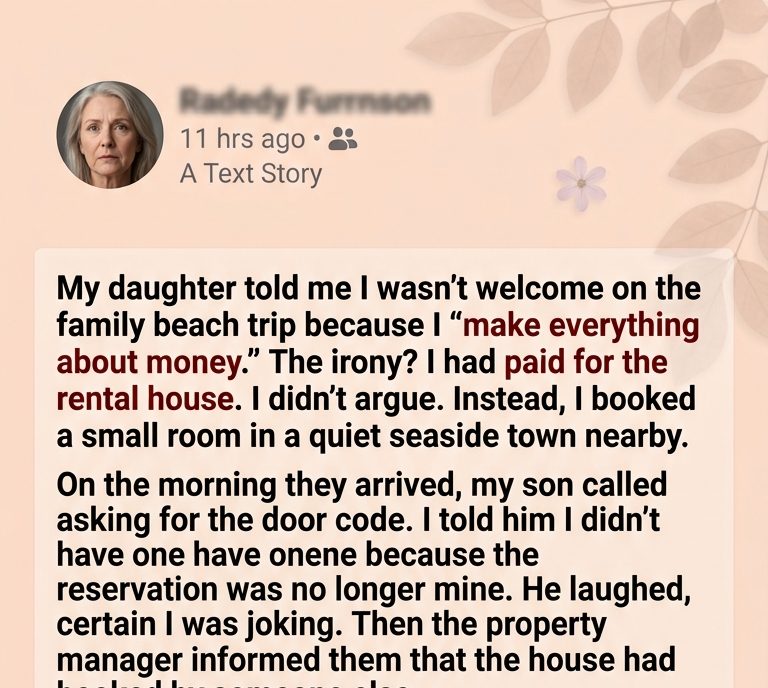
“Mom, I think it would be better if you didn’t come on the beach trip this year. You tend to make everything about money, and we just want a relaxing family vacation.”
I read it twice.
Then I looked at the calendar hanging beside the refrigerator.
The beach trip was only eleven days away.
I had booked the rental house four months earlier, paid the deposit, and covered the remaining balance three weeks before. It was a beautiful five-bedroom property overlooking the ocean, with a private pool, a spacious kitchen, and enough room for my daughter, her husband, their two children, my son, his girlfriend, and me.
At least, that had been the plan.
I had spent months looking forward to it. Since my husband, Robert, died, our family vacations had become one of the few occasions when everyone gathered under the same roof.
I imagined the grandchildren racing down the beach, the smell of grilled seafood drifting from the kitchen, and the evenings when we would sit outside listening to the waves.
Now my daughter, Melissa, was telling me I wasn’t welcome.
And she was doing it in a house I had paid for.
I put down the dish towel and typed a reply.
I understand. I’ll make other arrangements.
That was all.
No argument. No reminder about the money. No list of everything I had done for them.
I had learned that when someone had already decided you were the problem, explaining yourself rarely changed their mind.
I opened my laptop and searched for somewhere quiet near the coast.
Within an hour, I had booked a small room at a family-run inn in a seaside town about twenty minutes from the rental house. It had a balcony, a view of the harbor, and a little café downstairs.
It was exactly the kind of place Robert and I used to enjoy before our lives became crowded with responsibilities.
Then I contacted the rental property’s management company.
I explained that I no longer wished to proceed with the reservation and asked about the cancellation terms.
The property manager, a woman named Denise, told me she would review the booking and call me back.
I assumed that would be the end of it.
I was wrong.
Because when Denise called the following morning, she asked a question that made my stomach tighten.
“Mrs. Carter, did you authorize a change to the reservation last week?”
“What kind of change?”
“Your name was removed as the primary guest, and another adult was added to the booking.”
I sat down.
“Who removed my name?”
“The change was submitted through the guest portal. We need to review the account history, but it appears someone with access to the reservation made the request.”
I stared at my laptop.
“Who was added?”
Denise paused.
“Before I give you the name, I want to make sure you understand that the reservation was originally made under your account. The payment came from your card, and we have no record of you authorizing the change.”
“Please tell me the name.”
She did.
And suddenly, my daughter’s message made a great deal more sense.
The added guest was Derek Shaw.
My daughter’s former boyfriend.
The man she had dated before meeting her husband.
The man she had assured our family she had not spoken to in years.
I sat perfectly still.
Then I asked Denise to send me the change history and the relevant correspondence.
When the email arrived, I opened it immediately.
The screenshot showed that Melissa had contacted the property manager several days earlier. She had requested that my name be removed from the guest list and that Derek be added in my place.
Her explanation was that I had “decided not to attend.”
But I hadn’t decided anything at that point.
I had not even received her message telling me to stay home.
Someone had planned my exclusion before I knew I was being excluded.
And they had done it while keeping my money on the reservation.
I read the screenshot again.
Then I noticed the date.
Melissa had submitted the request six days before she told me I wasn’t welcome.
That meant her message hadn’t been an impulsive attempt to avoid an argument.
It had been the final step in a plan.
I forwarded the screenshot to my daughter.
Then I sent it to the family group chat.
I didn’t add a single accusation.
I simply wrote:
For everyone’s understanding, this is why I canceled the reservation.
Within seconds, my phone began ringing.
The Door Code
My son, Daniel, called first.
“Mom, what’s going on?”
“I canceled the beach house.”
“What? Why?”
“Because I was told I wasn’t welcome.”
He sighed.
“Melissa was upset. She didn’t mean it like that.”
“She sent me a message saying I should stay home.”
“Okay, but we’re all supposed to be going. The kids have been talking about this for weeks.”
“I know. I paid for the house.”
“Exactly,” he said. “So just give me the door code and let everyone enjoy the trip.”
I closed my eyes.
“Daniel, the reservation has been canceled.”
There was a pause.
Then he laughed.
“Mom, stop joking. We arrive tomorrow morning.”
“I’m not joking.”
“But the house is booked. Melissa said everything was sorted out.”
“Apparently, it was sorted out without me.”
He became quiet.
“What does that mean?”
I explained what Denise had told me.
Daniel listened without interrupting.
When I finished, he said, “Maybe she was just trying to make room for someone.”
“By removing me from a house I paid for?”
“That’s not what I meant.”
“Then what did you mean?”
He had no answer.
Before hanging up, he asked me to reconsider.
“Please, Mom. The children are excited. Don’t ruin the vacation over a misunderstanding.”
I looked at the photograph of Robert on the mantel.
“I’m not ruining anything, Daniel. I’m simply not paying for a vacation where I’m not wanted.”
He hung up without saying goodbye.
The following morning, my phone rang again.
This time it was Melissa.
“Mom, what have you done?”
Her voice was sharp enough to cut glass.
“I canceled the reservation.”
“You can’t do that! We’re already on the road.”
“You told me not to come.”
“I said I needed some space!”
“You said I wasn’t welcome.”
“Oh my goodness. You always take everything literally.”
I looked out the window of my little inn.
A fishing boat was moving slowly through the harbor.
“Melissa, you removed my name from the reservation and added Derek.”
Silence.
Then she said, “That was a private arrangement.”
“With my money?”
“He was going to contribute.”
“Did he contribute?”
She didn’t answer.
“Melissa?”
“He was going to pay us back.”
I felt something cold settle in my chest.
“Who is us?”
“The family.”
“I’m the one who paid.”
“You always bring money into everything!”
I almost laughed at the absurdity.
My daughter had excluded me from a trip I had funded, altered the reservation without my permission, and added a man she had hidden from her husband.
Yet somehow, I was the one making everything about money.
“Why did you add Derek?” I asked.
“He’s a friend.”
“Your former boyfriend?”
“That was years ago!”
“Then why didn’t you tell your husband?”
She said nothing.
In the background, I heard a child asking whether they were going to the beach.
Melissa lowered her voice.
“Mom, the children are crying. They’re begging me to fix this. Please just call the manager and get the house back.”
I closed my eyes.
For a moment, I pictured my grandchildren standing beside the car, confused and disappointed.
I wanted to help them.
I wanted to make everything right.
But I knew that if I rescued the trip now, the real problem would disappear beneath another layer of excuses.
“I’m sorry the children are disappointed,” I said. “But I didn’t create this situation.”
“You’re being selfish.”
“Perhaps. But the reservation is canceled.”
I ended the call.
My hands were shaking.
Not because I doubted what I had done.
Because I was beginning to understand how often my love for my family had been used to make me ignore my own boundaries.
The Name That Changed Everything
Later that afternoon, Denise sent me another message.
She had reviewed the reservation history more carefully and found an email attached to the change request.
It had been sent from Melissa’s personal account.
The message read:
Please remove my mother as the primary guest. She will not be attending. Add Derek Shaw instead. We need to keep the house because the children are excited, and my mother has already paid.
I read it slowly.
The words were so ordinary.
That was what made them hurt.
There was no hesitation. No concern about whether I would lose my money. No suggestion that the booking should be changed only after discussing it with me.
Melissa had treated my payment as a resource she could use, regardless of whether I was included.
But the email contained one more detail.
At the bottom, Melissa had copied another address.
Her husband’s.
Andrew.
I stared at his name.
Andrew had always been polite to me. He was quiet, hardworking, and devoted to the children. He rarely involved himself in family disagreements, preferring to let Melissa handle them.
I had assumed he knew nothing about Derek.
Now I wasn’t sure.
I called Denise.
“Did Andrew respond to this email?”
“No,” she said. “But the address was copied.”
I thanked her and ended the call.
For several minutes, I sat without moving.
Then I sent Andrew the screenshot privately.
I wrote only:
I thought you should see this directly from the property manager. I don’t know what you were told, but I didn’t authorize these changes.
He didn’t reply immediately.
I spent the rest of the afternoon walking along the harbor, buying a sandwich from a small café, and watching the tide move across the sand.
I had planned to spend the week with my family.
Instead, I was alone in a quiet seaside town.
And for the first time, I wasn’t trying to convince anyone that I deserved to be included.
That evening, Andrew called.
His voice sounded strained.
“Can we talk?”
“Of course.”
“Did you know Derek was going to be there?”
“No. I found out when the manager contacted me.”
He exhaled.
“Melissa told me he was helping organize some activities for the kids. She said he had rented a separate place nearby.”
“Did you know she removed my name?”
“No.”
“Did you know she told me not to come?”
He was quiet.
“She said you two had argued about money.”
I leaned back in my chair.
“Andrew, I paid for the house. I didn’t ask anyone to reimburse me. I didn’t demand anything. I thought we were taking a family vacation.”
“I know.”
“Then why was I being told I made everything about money?”
He didn’t answer.
Finally, he said, “Because Melissa told me you were upset that Derek was coming.”
I looked at the darkening water outside.
That was the missing piece.
Melissa had not simply wanted me gone.
She had wanted to control what everyone believed about why I was gone.
If I complained, she could say I was angry about the money.
If I refused to pay, she could say I was selfish.
And if I stayed quiet, she could enjoy the vacation I had funded while pretending I had chosen not to attend.
“Andrew,” I said carefully, “I don’t know what is happening between you and Melissa. That’s something you need to work out with her. But I won’t be part of a lie.”
“I understand.”
“Do you?”
“Yes,” he said. “I think I do.”
The Vacation That Never Happened
The next morning, I received a message from Daniel.
The house is gone. We’re staying at a motel for tonight. The kids are upset.
I felt a pang of guilt.
Then another message arrived.
Melissa says you did this because you hate Derek.
I stared at the screen.
I didn’t hate Derek.
I barely knew him.
But I had no intention of allowing my daughter to turn the situation into a debate about a man I had never invited.
I replied:
This happened because Melissa removed my name from a reservation I paid for and added another guest without my permission. The manager has the records. Please don’t involve the children in this.
Daniel sent no further messages.
That afternoon, Andrew called again.
He told me that he and Melissa had argued after he saw the screenshots.
He had asked her why she had invited Derek without discussing it with him.
Melissa insisted that Derek was only a friend and that she had been trying to avoid tension with me.
Andrew asked why she had told him that I was upset about Derek if she had already removed me from the reservation before I received her message.
She had no clear answer.
He also asked why she had described the arrangement as a family vacation when she had intended to exclude a member of the family who had paid for it.
The argument became so heated that Andrew took the children to visit his sister for the afternoon.
He did not tell me what decision he would make about his marriage, and I didn’t ask.
That was not my choice to make.
But he thanked me for sending the screenshot.
“I needed to know what actually happened,” he said.
I told him I was sorry the situation had become painful.
He replied, “You don’t need to apologize for showing me the truth.”
Those words stayed with me.
For years, I had apologized whenever someone in my family became upset.
I apologized for asking questions.
I apologized for offering help and for declining requests.
I apologized for being careful with money, even though I had worked for every dollar I earned.
I had mistaken keeping the peace for keeping the family together.
But peace built on silence was never really peace.
It was simply a way of making sure the person who caused the problem never had to face it.
A Different Kind of Family Vacation
I stayed at the inn for five days.
Each morning, I walked along the beach before breakfast. I visited a little bookstore, read on the balcony, and ate dinner at a restaurant where the owner remembered my name by the third evening.
I had not planned the trip to prove anything to my children.
I had planned it because I needed somewhere to go after my family told me I wasn’t wanted.
And I discovered that being alone was not the same as being abandoned.
On the fourth day, Daniel called.
His voice was softer than it had been before.
“Mom, I owe you an apology.”
I waited.
“I shouldn’t have told you to give me the door code. I knew you had paid for the house, and I didn’t even ask what had happened. I just assumed you would fix everything.”
“Thank you for saying that.”
“The kids are disappointed, but they’re okay. We took them to the aquarium.”
“I’m glad.”
He hesitated.
“Are you coming home soon?”
“In a couple of days.”
“Can we have dinner when you get back?”
“Yes. But I want us to talk honestly.”
“We will.”
When I returned home, Daniel came over with groceries and cooked dinner.
It was the first time in months that we had spent an evening together without discussing money, favors, or family obligations.
He told me that he had always assumed I enjoyed paying for things because I rarely complained.
I told him that I enjoyed treating my family, but I did not enjoy being treated as though my generosity meant I had no right to set limits.
He listened.
Then he said something I hadn’t expected.
“I think we’ve all gotten used to you making things work.”
I nodded.
“Perhaps I made it too easy.”
“No,” he said. “We should have appreciated it.”
It wasn’t a perfect conversation.
But it was an honest one.
What I Learned About My Daughter
Melissa did not call for nearly three weeks.
When she finally did, she began by saying that everyone had been under stress.
The children had been disappointed. Andrew had been angry. Daniel had been caught in the middle.
She said she had never intended for things to become so complicated.
I listened.
Then I asked her one question.
“Why did you remove my name from the reservation before you told me I wasn’t welcome?”
She was quiet.
“I thought it would be easier.”
“For whom?”
“For everyone.”
“Everyone except me.”
She sighed.
“Mom, I know I handled it badly.”
“Badly is forgetting to make a dinner reservation. You made a decision about a trip I paid for, removed me from it, and expected me to keep funding it.”
“I said I was sorry.”
“You haven’t said that yet.”
Another silence.
Then, finally, she said, “I’m sorry I excluded you and used your money without asking. I shouldn’t have done that.”
It was the first time she had described what happened without blaming me.
I accepted the apology.
But I did not immediately offer to pay for another vacation.
I told her that if we traveled together again, we would agree on the plans, guests, and expenses beforehand. If I paid for something, it would not give me the right to control everyone else—but neither would it give anyone else the right to control me.
She said she understood.
Whether she truly did would be revealed over time.
I still loved my daughter.
I still loved my son.
I still wanted my grandchildren to grow up surrounded by family.
But I no longer believed that love required me to absorb every insult, pay every bill, or repair every situation someone else created.
The next summer, I booked a small cottage by the sea.
This time, I invited everyone only after we had agreed on the dates, the guests, and the costs.
Melissa asked whether Derek would be joining us.
I told her that was a decision for her and Andrew to discuss, not something I would arrange behind anyone’s back.
She said he would not be coming.
I didn’t ask why.
The vacation itself was simple. We cooked together, walked along the beach, and watched the children build sandcastles.
I paid for the cottage because I wanted to.
And when Daniel offered to cover the groceries, I let him.
It was a small thing, but it mattered.
For the first time, our family trip felt like something we were sharing rather than something I was purchasing.
On the final evening, I stood on the balcony and watched the sun disappear over the water.
I thought about the screenshot that had changed everything.
It hadn’t created the betrayal.
It had simply revealed what had already happened.
The name on the reservation had shown me that my daughter had made plans involving my money while deliberately removing me from the picture.
The truth had hurt.
But it had also given me something I had been missing for years: the ability to see the situation clearly.
I could love my family without financing every decision they made.
I could help without being taken for granted.
And I could say no without believing I had failed as a mother.
The greatest gift I had given my children was never the vacation house. It was the love behind it. And the greatest gift I could give myself was learning that love should never require me to disappear.