The cashier scanned the final item and announced the total.
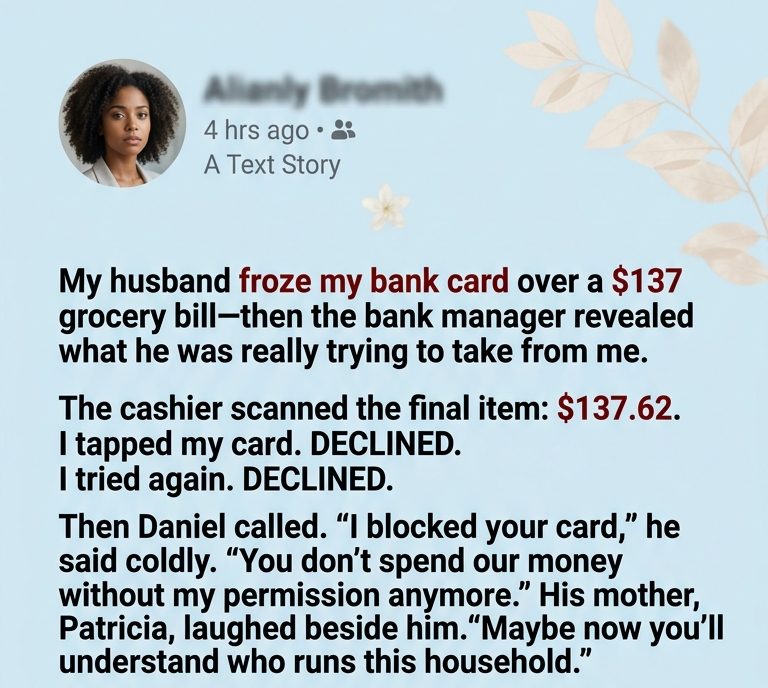
“$137.62.”
I tapped my debit card against the reader.
DECLINED.
I frowned and tried again.
DECLINED.
Behind me, a man sighed impatiently. The cashier gave me an apologetic smile.
“Would you like to try another card?”
I reached into my purse, but before I could answer, my phone began ringing.
It was my husband, Daniel.
“Why isn’t my card working?” I asked as soon as I answered.
“Because I blocked it.”
For a moment, I thought I had misheard him.
“You blocked my card?”
“I blocked the additional card connected to our account,” he replied coldly. “You don’t spend our money without my permission anymore.”
I glanced at the groceries sitting on the checkout belt.
“Daniel, these are household groceries. We need food for the week.”
“Then you should have asked me first.”
A woman’s laughter came through the phone.
His mother, Patricia, was with him.
“Maybe now you’ll understand who runs this household,” she said.
My face burned.
I had spent eleven years managing our home, paying bills, planning meals, and making sure Daniel never had to worry about the ordinary details of life. I had never imagined that buying groceries would become something I needed permission to do.
I swallowed my anger.
“Fine,” I said quietly.
Then I ended the call.
I left the groceries on the belt and walked out of the store with nothing but my purse and the keys in my hand.
For twenty-five minutes, I drove through Baltimore with a strange calm settling over me.
Daniel thought he had embarrassed me.
He thought I would go home, apologize, and promise to ask before spending another dollar.
But there was something he had forgotten.
The bank account he had just restricted was not simply his money.
And three days earlier, I had received a letter from the bank that I had not yet had time to read carefully.
I drove straight to our branch.
When I entered, the receptionist recognized me and directed me to the manager, Ms. Elaine Brooks.
She had helped Daniel and me establish our accounts years earlier. She had also handled the paperwork when we purchased our house.
“Rachel,” she said warmly. “What brings you in today?”
“My card was declined. My husband says he blocked it.”
Her expression changed slightly.
“Let me take a look.”
She asked for identification, then opened our account.
At first, she said nothing.
Her eyes moved across the screen.
Then she clicked on another section.
Her face became serious.
“Rachel, I need to ask you something. Have you recently signed any documents authorizing a change to your joint accounts or property arrangements?”
“No. Why?”
She turned the monitor slightly toward me.
A request had been submitted three days earlier.
It was not simply a request to restrict my debit card.
Daniel had submitted paperwork seeking to remove me as an authorized party on an account connected to our home equity line of credit.
But that was not the part that made my stomach tighten.
The request also included documents relating to a proposed change in the ownership structure of our home.
I leaned closer.
“What does this mean?”
Elaine lowered her voice.
“Your husband has requested changes that could affect your access to funds secured against the property. There is also a document here that appears to bear your signature.”
I stared at the screen.
The signature looked almost like mine.
Almost.
But the final letter was wrong. I always drew a small line beneath the last letter of my name.
This signature did not have it.
“I didn’t sign that.”
Elaine turned back to her computer.
“Then we need to treat this carefully.”
She explained that the bank had not approved the ownership-related request. Some of the paperwork required additional verification, and the signature discrepancy had prevented the process from moving forward.
The card restriction, however, was a separate matter.
Because Daniel was the primary account holder on that particular checking account, the bank had allowed him to suspend the additional card under the account’s terms.
“But the house?” I asked.
“That’s a different issue. The bank cannot simply remove your ownership rights because your husband asks us to. We need to review the title records and the documents involved.”
I felt a chill run through me.
Daniel and I had purchased our home together eleven years earlier.
We had paid the down payment from our savings, and I had contributed money from the small inheritance my grandmother left me.
The house was worth considerably more than we had paid for it.
And according to the deed, both our names were on it.
“What was he trying to do?” I asked.
Elaine did not speculate.
“I can tell you what was submitted. I cannot tell you why he submitted it.”
She printed the transaction history and gave me copies of the documents I was permitted to receive.
Before I left, she added something that would change the course of the next several weeks.
“Rachel, if you believe your signature was forged, consider speaking with an attorney. Keep these copies somewhere safe. And do not sign any new documents until you understand exactly what they mean.”
I thanked her and walked outside.
The Baltimore afternoon seemed strangely bright.
I sat in my car and read the papers again.
Daniel had not simply tried to control what I could buy.
He had attempted to change arrangements involving the home we owned together.
And someone had signed my name.
I drove home without stopping for groceries.
Daniel was in the living room when I arrived. Patricia sat beside him, drinking coffee from my favorite mug.
He looked up.
“Did you get the message?”
“Yes.”
“Good. I hope you understand that things are going to be different.”
I placed my purse on the table.
“We need to talk about the bank.”
His expression tightened.
“What about it?”
“The paperwork you submitted three days ago.”
Patricia stopped stirring her coffee.
Daniel’s eyes narrowed.
“You went to the bank?”
“Yes.”
“You had no right to interfere with my financial decisions.”
I stared at him.
“Our financial decisions? You submitted a document with my signature on it.”
He stood.
“Keep your voice down.”
“Did you sign my name?”
“I handled the paperwork.”
“That isn’t what I asked.”
Patricia set down her mug.
“Rachel, don’t make accusations you don’t understand. Daniel is trying to protect the family.”
“From what?”
She glanced at her son.
He looked away.
That small movement told me more than his words had.
I took the bank documents from my purse and placed them on the table.
Daniel glanced at the pages, then pushed them aside.
“You’re making a huge deal out of nothing.”
“Then explain it.”
He said nothing.
I waited.
Finally, he rubbed his forehead.
“Mom and I have been discussing the house.”
I looked at Patricia.
“What does that have to do with you?”
She straightened in her chair.
“My son has been carrying this family for years. He needs to make decisions without being questioned every time.”
“I helped pay for that house.”
“You live there,” she replied. “You benefit from it.”
“So does Daniel.”
“That is different.”
I almost laughed.
Not because anything was funny, but because I finally understood the rules Patricia had always expected me to follow.
Daniel’s money was his.
My money was ours.
Daniel’s decisions were private.
My decisions required approval.
And anything I owned could become a family resource whenever Patricia decided it should.
I turned back to my husband.
“What exactly were you trying to change?”
He hesitated.
Then he said, “Mom needs a place to live.”
I stared at him.
“She has a house.”
“She can’t afford the repairs.”
“Then we can discuss helping her.”
“We have discussed it. You always say no.”
“I said we couldn’t spend our emergency savings without a plan. I never said we couldn’t help her.”
Patricia’s face hardened.
“You were willing to let me live in a deteriorating house while you sat comfortably in this one.”
I looked at her.
“Your house is not deteriorating. You wanted us to pay for a major renovation, and we couldn’t agree on how much we could afford.”
Daniel stepped between us.
“Enough. The plan was to use the equity in this house to help Mom. Once the paperwork was complete, we could have refinanced.”
“Without asking me?”
“You would have agreed eventually.”
The words landed like a slap.
He had decided that my consent was merely an obstacle to be overcome.
“And the signature?” I asked.
Daniel’s jaw tightened.
“I thought it would save time.”
“You signed my name?”
“I was going to explain everything.”
“When?”
“When it was done.”
Patricia rose.
“You’re acting as though he stole something from you. He’s your husband.”
I looked at her, then at Daniel.
For years, I had believed that the worst thing that could happen to a marriage was losing love.
Now I understood that a marriage could also be damaged by the belief that one person had the right to make decisions for both.
I picked up the papers.
“I’m going to speak with a lawyer.”
Daniel’s face changed.
“You wouldn’t dare.”
“I already should have.”
I went upstairs, closed the bedroom door, and called my sister, Laura.
She listened without interrupting.
When I finished, she said, “Rachel, come stay with me tonight.”
“I don’t want to leave my own home.”
“Then don’t. But don’t handle this alone.”
That evening, I contacted an attorney named Susan Miller, whose name Elaine had given me. Susan arranged a consultation for the following morning.
I slept very little.
Daniel did not come upstairs.
The next day, Susan reviewed the bank documents, the deed, and the records I had brought.
She explained that the exact legal consequences depended on the documents, the property title, and the applicable state law. But one thing was clear: a joint owner could not simply be erased from a deed because the other owner wanted it.
The attempted changes needed to be examined, and the questionable signature required formal attention.
Susan advised me to secure my financial records, obtain copies of the property’s title documents, and communicate with the bank in writing.
She also recommended that I avoid signing anything Daniel presented until it had been independently reviewed.
Over the next week, the truth became clearer.
Daniel had been working with a financial adviser to explore borrowing against our home. The proposed loan would have provided money for renovations to Patricia’s house and helped cover some of her outstanding debts.
Helping his mother was not, by itself, what upset me.
What upset me was that Daniel had planned to use our shared property without a genuine agreement between us.
The documents also showed that he had attempted to change how certain funds connected to the property would be accessed.
The bank had flagged the disputed signature, and the requested changes had not been completed.
When Susan contacted the bank, the institution confirmed that the ownership-related request remained on hold pending verification.
The bank also preserved the records associated with the submission.
Daniel could no longer dismiss the matter as a misunderstanding.
A few days later, he came home early and found me sitting at the kitchen table with Susan’s business card beside my notebook.
“Are you really going to take this further?” he asked.
“I need to know what happened.”
“I told you what happened.”
“You told me you wanted to help your mother. You haven’t explained why you thought you could sign my name.”
He sat across from me.
For the first time since the grocery store incident, he looked uncertain.
“I thought you would refuse.”
“That doesn’t give you permission.”
“I was trying to solve a problem.”
“You created another one.”
He looked down.
Then, quietly, he admitted that Patricia had been pressuring him for months.
She had told him that a good son would provide for her. She had complained that I was controlling the money and keeping him from helping his family.
Daniel had begun to see my questions about budgets as personal opposition.
Instead of talking to me, he had decided to move ahead without me.
“And the card?” I asked.
He swallowed.
“I wanted you to understand that I was serious.”
“About what?”
“About having a say.”
I shook my head.
“You didn’t want a say, Daniel. You wanted control.”
He did not answer.
I told him I would not agree to any loan secured against our home unless we both reviewed the terms and freely consented. I also told him that our finances needed to be transparent, and that no one—not even his mother—would be allowed to dictate what happened to property we owned together.
He said I was making our marriage sound like a business arrangement.
“No,” I replied. “I’m asking you to treat me like your partner.”
For several weeks, we lived in an uneasy quiet.
Daniel’s card restriction remained a painful reminder of how easily he had tried to punish me. I opened an individual checking account for my personal income and everyday spending, while keeping records of our shared expenses.
Susan helped me understand which financial decisions required joint approval and which accounts had different rules.
The bank completed its review of the disputed paperwork. The ownership changes had never taken effect, and the bank would not proceed without the required verification and proper documentation.
The forged-signature concern was handled through the bank’s formal process, and I kept copies of every communication.
Patricia was furious when she learned the plan could not proceed as Daniel had intended.
“You’ve turned this family against me,” she told me during a phone call.
“I haven’t turned anyone against you,” I replied. “I stopped a financial decision I never agreed to.”
“You could have helped us.”
“We can discuss reasonable help. We cannot discuss it through forged signatures or threats.”
She hung up.
Daniel and I eventually began marriage counseling.
At first, he spent much of each session explaining why he had felt pressured. Our counselor listened, but kept returning to the same question:
“Why did you believe pressure from your mother gave you the right to make a decision for your wife?”
Daniel struggled to answer.
Over time, he began to understand that he had confused being a provider with being the sole authority.
He apologized—not just for freezing my card, but for treating my access to money as something he could grant or withdraw.
I accepted the apology cautiously.
Trust did not return because he said the right words. It would have to return through consistent actions.
We agreed that any major financial decision involving our home would require a full discussion and independent review. We established a budget for helping family members, with clear limits and no hidden commitments.
Daniel also agreed that Patricia would no longer be involved in our financial decisions.
Months later, we sat down to review our household expenses.
He looked at the grocery receipts spread across the table and gave a faint, embarrassed smile.
“I owe you an apology for the $137.62.”
I looked at him.
“You owe me an apology for much more than that.”
“I know.”
This time, he did not argue.
I still remember standing at that checkout counter, watching the word DECLINED appear on the screen.
At the time, I thought the worst part was being humiliated over a bag of groceries.
I was wrong.
The real shock came when I learned that my husband had been willing to risk my financial security because he assumed I would eventually accept whatever he decided.
The bank manager did not tell me what kind of husband Daniel was. She simply showed me the documents and gave me the chance to understand what was happening.
That was enough to change everything.
I learned that love does not eliminate the need for boundaries, and marriage does not mean surrendering the right to understand what is being done in your name.
The $137.62 grocery bill was paid the following day.
But the lesson it left behind was worth far more.
A shared life requires shared decisions—and trust cannot survive when one person believes the other has no right to say no.