The room was full of champagne glasses, soft music, and people pretending they weren’t studying one another.
I stood near the entrance of the restaurant, smoothing the sleeve of my navy dress.
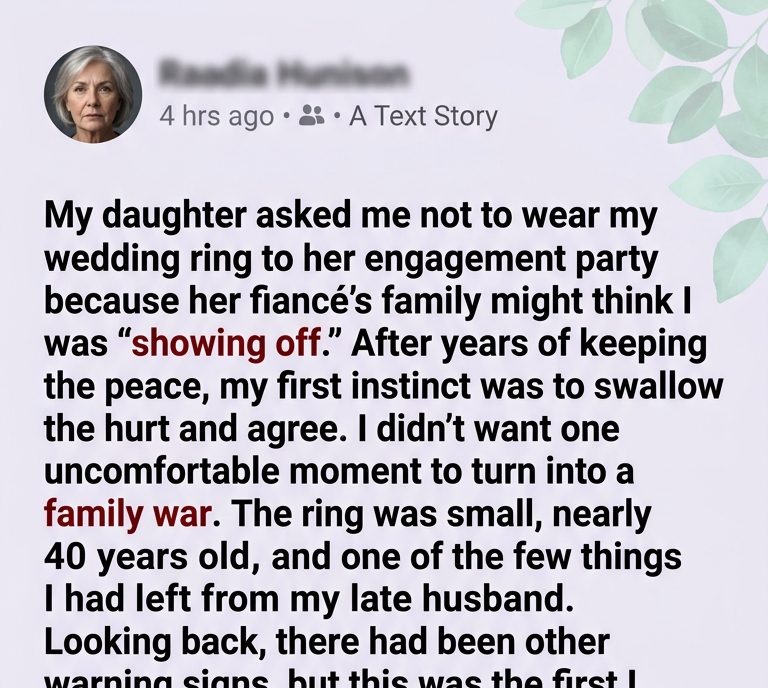
On my left hand was the ring I had worn for nearly forty years.
It was not large.
It was not flashy.
A thin gold band with a small oval diamond, worn smooth by decades of everyday life.
My husband, David, had given it to me when we were twenty-six.
He had saved for months to buy it.
He once told me he had stood outside the jewelry store for almost an hour because he was afraid he couldn’t afford anything good enough.
I had laughed when he finally showed it to me.
“David,” I told him, “I’d marry you with a piece of string around my finger.”
He smiled.
“But I wanted you to have something that stayed.”
He died eight years ago.
The ring was one of the few things that still felt like his hand was holding mine.
And tonight, my daughter had asked me to take it off.
Not because she disliked it.
Not because it was damaged.
Because her fiancé’s family might think I was showing off.
I had almost agreed.
That was what mothers did sometimes.
They swallowed things.
They smiled.
They said, “It’s fine.”
They made themselves smaller so their children could have peaceful lives.
But as I stood outside that restaurant, I remembered the seating chart.
My name had been moved.
Not beside my daughter.
Not beside David’s sister, Margaret, who had practically raised my daughter alongside me after David died.
I had been placed at the far end of the room.
Behind a column.
Near the service hallway.
And when I asked my daughter about it, she had looked embarrassed.
“Mom, please don’t make this into something.”
“I’m not.”
“It’s just… his parents have a lot of important people coming.”
I had stared at her.
“And I’m not important?”
She immediately regretted the words before they even came out.
“That’s not what I meant.”
I knew.
But sometimes what people don’t mean to say is still what they reveal.
Then came the ring.
“Could you just leave it at home?” she asked.
I looked at her.
“Why?”
She lowered her voice.
“His mother thinks jewelry should be understated at family events.”
I almost laughed.
My wedding ring had never been understated to me.
It had been forty years of mornings.
Forty years of arguments and apologies.
Forty years of hospital waiting rooms, mortgage payments, birthdays, Christmas mornings, and ordinary Tuesday nights.
It represented a marriage.
Not wealth.
Not status.
Not showing off.
But my daughter was pleading with me.
“Please, Mom. I just want everyone comfortable.”
So I had said yes.
Then Margaret came over.
She had known David since childhood.
She looked at me for a long moment.
“You’re not taking it off.”
I sighed.
“I don’t want to embarrass her.”
“You won’t.”
“What if her future in-laws think I’m trying to compete with them?”
Margaret smiled.
“Then let them think.”
I looked at her.
She took my hand.
“Your daughter is getting engaged. You’re allowed to look like her mother.”
I laughed despite myself.
“I don’t think that’s a dress code.”
“It should be.”
So I went.
And I wore the ring.
The first twenty minutes were uneventful.
People smiled.
Waiters carried champagne.
My daughter, Emily, moved from group to group, looking beautiful and nervous.
Her fiancé, Nathan, stood beside her.
He was polite.
Always had been.
But his mother, Vivian, had a way of looking at people that made them feel as though they were being evaluated for admission.
She wore a diamond necklace that probably cost more than my car.
When she approached me, she smiled.
“You’re Emily’s mother.”
“Yes.”
“I’ve heard so much about you.”
“Hopefully good things.”
She laughed politely.
Then her eyes dropped to my hand.
Everything changed.
She took my wrist.
Not roughly.
But firmly enough that I felt the sudden tension in her fingers.
“Where did you get this?”
I looked at the ring.
“My husband.”
“When?”
“Almost forty years ago.”
Vivian’s face went pale.
She looked at the ring again.
Then at me.
“Your husband’s name?”
“David Harper.”
Her lips parted.
For several seconds, she said nothing.
Then she whispered:
“David Harper?”
I nodded.
She released my hand.
“That’s impossible.”
Margaret had just approached us.
She heard Vivian.
“What is?”
Vivian stared at the ring.
“Where did he buy it?”
I frowned.
“I don’t know. He bought it before we married.”
Vivian shook her head.
“No.”
She looked frightened now.
“That’s not possible.”
I touched the ring instinctively.
“What are you talking about?”
Vivian looked toward the other side of the room.
Then she said something that made my stomach drop.
“My father owned that ring.”
I thought I had misheard her.
“What?”
“My father.”
She took a breath.
“He bought it in 1985.”
I shook my head.
“My husband bought this ring in 1986.”
“Did he tell you where?”
“No.”
Vivian looked toward Nathan.
“Where is your father?”
Nathan walked over.
“Mom?”
She pointed at my hand.
“Look.”
Nathan stared.
His face changed.
“What?”
His mother whispered:
“That’s Grandfather’s ring.”
Nathan looked at me.
Then at the ring.
“Are you sure?”
Vivian nodded.
“My father had this exact ring made for my mother.”
I felt dizzy.
“That can’t be.”
Margaret stepped forward.
“Vivian, what exactly are you saying?”
Vivian swallowed.
“My mother lost her ring in 1985.”
I stared at her.
“Lost?”
“She said someone stole it.”
“Who?”
Vivian shook her head.
“We never knew.”
The noise of the party seemed to disappear.
I could hear only my own breathing.
“My husband bought this from a jeweler,” I said.
“Which jeweler?”
“I don’t know.”
Vivian looked at me.
“Did he ever mention a man named Robert?”
I froze.
David’s older brother had been named Robert.
But he had died years ago.
“Why?”
Vivian closed her eyes.
“My father was Robert’s closest friend.”
Margaret stared at her.
“Wait.”
She looked at me.
“David never told you?”
“Told me what?”
Margaret looked uncomfortable.
“I remember Robert.”
Vivian nodded.
“He worked for my father.”
That sentence made everything even more confusing.
“What did he do?”
“Accounting.”
Vivian looked down.
“My father owned several jewelry stores.”
I stared at my ring.
Suddenly, memories began returning.
David had always been vague about the ring.
When I asked him about it years later, he would simply say, “It’s an old story.”
I had assumed he meant the marriage.
Now I wondered if he meant something else.
Vivian asked quietly:
“Did David ever tell you how he proposed?”
“Yes.”
“He said he couldn’t afford a proper ring.”
Vivian nodded slowly.
“My father gave one away.”
I looked at her.
“What?”
“My mother died in 1987. Before she died, she told me she had found out the ring wasn’t stolen.”
The room seemed to tilt.
“Then where was it?”
Vivian looked at my hand.
“She said my father had given it to someone.”
“Who?”
Vivian’s eyes filled with tears.
“Robert.”
Margaret gasped.
“My brother?”
Vivian nodded.
“My father discovered that Robert had been stealing from the business.”
I couldn’t speak.
Vivian continued.
“Not huge amounts at first. Small withdrawals. Inventory disappearing. Eventually, my father confronted him.”
“Did he report him?”
“No.”
She shook her head.
“My father was terrified of scandal.”
Instead, he fired Robert and demanded everything back.
But there was a problem.
Robert had already sold or transferred some property.
And one item was missing.
My mother’s ring.
Vivian looked at me.
“My father believed Robert had sold it.”
I looked at my wedding ring.
“So David got it from Robert?”
“We don’t know.”
Margaret sat down.
“My brother never told David any of this.”
Nathan finally spoke.
“Mom, why would Uncle Robert have given the ring to David?”
Vivian looked at me.
“Maybe he didn’t.”
That possibility frightened me more.
“Then how did David get it?”
I remembered something.
A box.
An old wooden box David had kept in the back of his closet.
After his death, I had found it.
Inside were a few letters, an old watch, photographs, and receipts.
I had never understood why he kept them.
I had given most of his things to our children.
But I still had the box.
Margaret looked at me.
“Do you have it?”
I nodded.
“I think so.”
Nathan immediately said, “Can we see it?”
I hesitated.
This was my husband’s private life.
But the ring had suddenly become something else.
A missing piece of a story nobody had finished.
The next morning, Margaret and I went through the box.
At the bottom was an envelope.
My husband’s handwriting was on it.
For Emily, if she ever asks about the ring.
My hands shook.
I opened it.
Inside was a letter.
David had written it twenty years earlier.
He explained that Robert had approached him shortly before our wedding.
He had confessed that the ring came from Vivian’s family.
David had been horrified.
He wanted to return it.
But Robert told him the ring had already been sold and that returning it would expose the theft.
David refused to keep it.
So Robert did something unexpected.
He gave David the ring anyway.
And told him to do whatever he wanted with it.
David took it to a jeweler.
The jeweler confirmed that the ring had originally been sold by Vivian’s father’s store.
But there was no record proving Robert had stolen it.
David didn’t want to build our marriage on something questionable.
So he had tried to return it anonymously.
The jewelry store was gone.
The family had moved.
He couldn’t locate Vivian’s parents.
Eventually, he kept the ring.
But he wrote:
“If one day someone comes looking for it, give it back. A marriage should never depend on a secret.”
I cried when I read that.
Not because of the ring.
Because my husband had carried that burden alone for forty years.
At the bottom of the letter was a name.
Vivian Carter.
And beneath it:
Her father deserves to know the truth.
But her father was dead.
So was David.
So was Robert.
All that remained were their children.
We contacted Vivian.
She came to my house with Nathan.
She read David’s letter three times.
Then she cried.
“I thought my father gave up on finding this.”
I removed the ring.
For the first time in forty years, my finger felt strangely light.
I placed it in her palm.
She stared at it.
“You don’t have to give it back.”
I smiled.
“I think my husband would want me to.”
She shook her head.
“No.”
She closed my fingers around it.
“My mother wanted this ring returned to the family someday. But she also believed people mattered more than possessions.”
I looked at her.
“What does that mean?”
Vivian smiled through tears.
“It means I think it belongs with you.”
I was stunned.
“I can’t take it.”
“You aren’t taking it.”
She touched the ring.
“You’re keeping the story.”
Then she told me something else.
Her father had left instructions in his estate papers years ago.
If the ring was ever recovered, he wanted it offered to the woman who had worn it faithfully.
Not sold.
Not displayed.
Not treated as an asset.
Returned as a symbol.
Vivian said her mother had once told her:
“If someone loves a person enough to wear that ring for forty years, they have earned the right to decide what happens to it.”
I cried again.
Months later, Emily and Nathan married.
This time, nobody asked me to remove my ring.
I sat near the front.
Vivian sat beside me.
And before the ceremony began, she leaned over.
“You know,” she whispered, “I think our families were supposed to meet a long time ago.”
I smiled.
“Maybe they did.”
She looked at my hand.
“Your husband made sure of it.”
I touched the ring.
For decades, I had thought it represented only my marriage.
Now I understood it represented something larger.
A mistake.
A secret.
A choice.
And finally, forgiveness.
My daughter later apologized for asking me to hide it.
She admitted she had been terrified that her fiancé’s family would judge her.
I told her something I wished I had understood earlier.
“You don’t protect a family by making people disappear from the picture.”
She hugged me.
“I know.”
“And you never have to hide where you came from to make someone else comfortable.”
She nodded against my shoulder.
That night, after everyone left, I stood alone in my bedroom.
I looked at the small gold ring.
It still looked exactly the same.
Worn.
Simple.
Nearly forty years old.
But now I knew its story.
My husband had once held it and wondered whether it could carry the weight of a lifetime.
It had.
And when I slipped it back onto my finger, I realized something.
The ring had never been showing off.
It had been remembering.
And some memories, no matter how old they are, deserve to be seen.