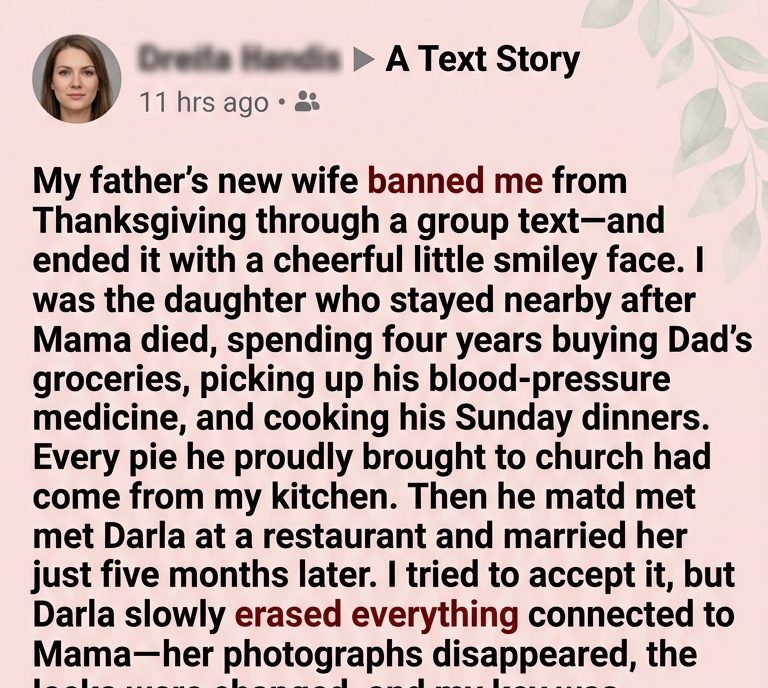
My father’s new wife banned me from Thanksgiving through a group text.
There were six people in the message.
Dad.
Darla.
My brother, Michael.
My aunt Renee.
Darla’s sister.
And me.
The message arrived at 8:14 on the Tuesday before Thanksgiving.
“Just letting everyone know that Thanksgiving will be at our house this year. We’re keeping it small and intimate, so please don’t come unless specifically invited. That includes you, Claire. ❤️😊”
The little smiley face at the end somehow hurt more than the words.
I stared at the screen for almost a minute.
Then I typed:
“Okay.”
I deleted it.
Typed:
“Understood.”
Deleted that too.
Finally, I sent nothing.
I put my phone facedown on the kitchen counter and stood there staring at the refrigerator.
On the door was a photograph of my mother.
She was standing beside my father in the backyard, holding a strawberry pie she’d made for my graduation.
She had died four years earlier.
Four years.
And in those four years, I had stayed.
Not because I was obligated.
Because Dad was alone.
My younger brother Michael lived three states away.
My sister had moved to California.
I was the only one nearby.
So when Dad needed groceries, I went.
When his blood-pressure prescription needed picking up, I picked it up.
When the lawn got too high, I found someone to mow it.
When he couldn’t figure out how to use his new television, I drove over and fixed it.
And every Sunday, I cooked.
Pot roast.
Chicken and dumplings.
Lasagna.
Beef stew.
Whatever he requested.
His favorite was apple pie.
My mother had taught me her recipe when I was twelve.
Dad always said mine tasted exactly like hers.
Sometimes he’d take a pie to church and proudly tell people:
“My daughter made this.”
That sentence meant everything to me.
Until Darla came along.
I met her at a restaurant one rainy evening.
Dad had called me that afternoon.
“I met someone.”
I laughed.
“Someone?”
“Her name is Darla.”
“How long have you known her?”
“Three weeks.”
“Dad.”
“What?”
“Nothing.”
He was sixty-eight years old.
He deserved companionship.
I told myself that.
When he introduced us, Darla hugged me immediately.
“I’m so glad to finally meet you.”
She was charming.
Warm.
Perfectly dressed.
She complimented my hair.
She complimented my cooking.
She even told me she had heard wonderful things about Mama.
At the time, I thought she was trying.
Five months later, Dad married her.
I tried to be happy.
I bought them a wedding gift.
I helped Dad choose his suit.
I even made the cake.
Darla hugged me afterward.
“You’ve been such a blessing,” she said.
I believed her.
Then things started changing.
The first photograph disappeared from the living room.
It was a picture of Mama and Dad on their twenty-fifth anniversary.
I noticed it one Sunday.
“Where’s Mom’s picture?”
Darla didn’t look up from her phone.
“Oh, I put it away.”
“Why?”
“I wanted the house to feel different.”
I stared at her.
“Different?”
“New chapter.”
I looked toward Dad.
He was reading the newspaper.
“Dad?”
He didn’t answer.
I didn’t push.
A month later, more photographs disappeared.
Then Mama’s porcelain dishes.
Then her little wooden recipe box.
Then the quilt she’d sewn by hand.
One afternoon, I asked Darla where it was.
“It’s packed away.”
“Where?”
“Somewhere safe.”
I looked at Dad.
He was sitting in his chair.
Silent.
Again.
Then came the locks.
I arrived one Sunday morning with groceries.
My key didn’t work.
I knocked.
Darla opened the door.
“Oh.”
She smiled.
“You’re here.”
“My key isn’t working.”
“We changed the locks.”
“Why didn’t Dad tell me?”
“He probably forgot.”
She handed me a small plastic bag.
“My spare key.”
I looked inside.
There was one key.
“For emergencies only,” she said.
I wanted to ask what had happened to the woman who had once called me a blessing.
Instead, I said:
“Okay.”
The Sunday dinners gradually disappeared too.
First Darla said they were eating earlier.
Then later.
Then they were “trying a new routine.”
Eventually, Dad stopped answering when I called on Sundays.
I’d still bring food.
Sometimes he’d come to the door.
Sometimes Darla would.
Sometimes I would leave a container on the porch.
Then last week, I brought another casserole.
Darla opened the door.
She smiled.
It was the kind of smile people wear when they’re trying very hard not to show irritation.
“He has a real family now,” she said.
I froze.
“What?”
“Dad has a wife.”
“I know.”
“So you need to stop hanging around.”
I looked past her.
Dad was sitting in his chair.
He wasn’t watching television.
He wasn’t reading.
He was staring at his hands.
“Dad?”
His head lifted slightly.
Our eyes met.
He said nothing.
Darla stepped in front of the doorway.
“Please stop making this difficult.”
I handed her the casserole.
“Fine.”
I went home.
And I cried where nobody could see me.
Thanksgiving morning, I woke up at six.
Habit.
I had been cooking Thanksgiving dinner for my father since Mama died.
My hands moved automatically.
Turkey into the oven.
Stuffing.
Mashed potatoes.
Green beans.
Gravy.
Apple pie.
Pumpkin pie.
I didn’t know why I was doing it.
Maybe because four years of routine don’t disappear because someone sends a group text.
At 8:17 a.m., my phone rang.
The number was unfamiliar.
I answered.
“Hello?”
“Is this Claire?”
“Yes.”
“This is Martin Reeves. I’m your father’s attorney.”
I stopped moving.
“Is Dad okay?”
There was a pause.
“I need you to come to the office as soon as you can.”
My stomach dropped.
“Why?”
“I can’t discuss the details over the phone.”
“Is he sick?”
Another pause.
“Claire, your father was taken to the hospital last night.”
The knife slipped from my hand and landed on the cutting board.
“What?”
“He had a fall.”
“Is he conscious?”
“Yes.”
“Then why are you calling me?”
“Because before he went into the ambulance, he asked the paramedics to call me.”
My heart was pounding.
“What did he say?”
Martin took a breath.
“He told me to call you before anyone else.”
I closed my eyes.
“Why?”
“He said, ‘If something happens to me, Claire needs to know the truth.'”
I didn’t ask another question.
I turned off the oven.
Left the turkey where it was.
Grabbed my coat.
And drove.
Martin’s office was empty except for him.
He stood when I walked in.
He looked tired.
“Your father is stable,” he said.
I exhaled.
“Thank God.”
“But there’s something else.”
He opened a folder.
“I’ve represented your father for almost twenty years.”
He slid a document toward me.
“What is this?”
“Your father’s estate plan.”
I stared at him.
“I don’t understand.”
“Your father changed his will three months before marrying Darla.”
My heart stopped.
“Why?”
“He didn’t tell me everything. But he told me he was worried about being pressured into changing certain things after the marriage.”
I looked at the papers.
“He left the house to me?”
Martin nodded.
“With conditions.”
“What conditions?”
“You inherit the house and the majority of his personal estate. Darla receives a lifetime right to remain in the home under specific conditions, but she does not own it outright.”
I stared at him.
“Why would he do that?”
Martin looked at me.
“Because he wanted you to have your mother’s home.”
I couldn’t speak.
Then Martin opened another folder.
“This is more important.”
He pulled out several pages.
“They’re medical records.”
I looked at them.
“Your father has been having memory problems.”
I frowned.
“What kind?”
“Early cognitive impairment. He was evaluated several months ago.”
My heart sank.
“Dad never told me.”
“He didn’t want you to worry.”
I looked down at the papers.
“How bad is it?”
“His doctor believes he’s still capable of making many decisions, but he’s increasingly vulnerable to pressure.”
I thought about the changed locks.
The missing photographs.
The Sunday dinners.
The group text.
Then I remembered Dad sitting in that chair.
Staring at his hands.
Not saying anything.
Martin continued.
“Three weeks ago, your father called me.”
“What did he say?”
“He asked me whether he could still change his will.”
“Why?”
“He said Darla wanted him to leave the house to her.”
My stomach tightened.
“What did you tell him?”
“That he could make changes as long as he had the necessary legal capacity and wasn’t being coerced.”
“And did he change it?”
“No.”
“Why?”
“He said he wanted to leave things exactly as they were.”
I stared at him.
“Then why didn’t he tell me?”
Martin gave me a sad smile.
“Because he was embarrassed.”
“Embarrassed?”
“He said he had allowed someone into his life and then realized he had pushed away the daughter who had been there for him.”
I covered my mouth.
Tears filled my eyes.
“He said something else.”
“What?”
“He said, ‘Claire has spent four years taking care of me. I don’t want her to spend another four years wondering if I loved her.'”
I broke down.
Martin let me cry.
When I finally looked up, he handed me another envelope.
“This was written by your father.”
My hands shook as I opened it.
Inside was a single sheet of paper.
Claire,
If you’re reading this, something has probably happened that I was too stubborn or ashamed to tell you about.
I need you to know something.
Your mother would be disappointed in me.
Not because I remarried.
She would never have wanted me to live alone forever.
She would be disappointed because I let fear make me silent.
I watched Darla push you away.
I watched your key stop working.
I watched the photographs disappear.
I watched you leave food on the porch.
And every time, I told myself I would fix it tomorrow.
Tomorrow became weeks.
Weeks became months.
And now I’m ashamed.
You were never unwanted.
You were never a burden.
You were my daughter before your mother died, and you were my daughter every day afterward.
I’m sorry I didn’t act like it when you needed me to.
Please don’t let my silence make you believe you weren’t loved.
Dad
I couldn’t see the page anymore.
The tears were falling too fast.
“Why did he stay with her?”
Martin sighed.
“I don’t know.”
I did.
Maybe part of him was afraid to be alone.
Maybe he thought marriage meant starting over.
Maybe he was embarrassed to admit he’d made a mistake.
Maybe he loved her.
People could love someone and still make terrible decisions.
“What happens now?”
“That depends on his recovery.”
“And Darla?”
Martin looked at me carefully.
“She has already contacted me.”
“What did she want?”
“She asked whether your father’s estate plan could be changed.”
I stared at him.
“Already?”
“Yes.”
“What did you tell her?”
“That I would only discuss estate matters with your father and the appropriate legal representatives.”
I nodded.
Then I asked the question I’d been afraid to ask.
“Can I see him?”
“Of course.”
I drove to the hospital.
Dad was awake.
He looked smaller than I remembered.
I walked into his room.
He looked at me.
His eyes filled with tears.
“Claire.”
I stood beside his bed.
“Hi, Dad.”
“I’m sorry.”
I didn’t answer.
He reached for my hand.
I let him hold it.
“I thought you’d hate me.”
“I was hurt.”
“I know.”
“Very hurt.”
“I know.”
He squeezed my hand.
“I was scared.”
“Of what?”
“Being alone.”
I swallowed.
“So you let me become the stranger instead.”
His eyes closed.
“Yes.”
That honesty hurt.
But somehow it was better than another excuse.
“Why didn’t you stop her?”
“I tried.”
“When?”
“Not enough.”
I sat beside him.
For a while, neither of us spoke.
Then he whispered:
“Did you make the pies?”
I laughed through my tears.
“Yes.”
“Apple?”
“Of course.”
“Your mother would have been proud.”
I looked down.
“I think she would have yelled at you first.”
He laughed.
A real laugh.
The first I’d heard from him in months.
Then he said:
“Did you bring me one?”
I shook my head.
“No.”
He looked disappointed.
“I left them at home.”
He smiled.
“Good.”
“Why?”
“Because now I have to get better enough to eat one.”
I smiled.
“That’s the plan.”
He spent several weeks recovering.
During that time, Darla moved out.
Not because I forced her out.
Because Dad decided he didn’t want to continue the marriage.
Martin handled the legal details.
The house remained under the estate plan Dad had established before the wedding.
Darla received the assets she was legally entitled to under the marriage and the documents.
There was no dramatic courtroom battle.
No screaming match.
Just paperwork, attorneys, and a difficult ending.
Dad eventually returned home.
His memory problems didn’t disappear.
Neither did the damage between us.
But we began rebuilding.
Slowly.
He came to my house for Thanksgiving dinner that year.
Not as the man who had once sat silently behind a screen door while I walked away.
As my father.
I placed the turkey on the table.
He looked at the pies.
“Two?”
“One apple. One pumpkin.”
He smiled.
“Your mother always made two.”
“I know.”
He looked around my dining room.
There were photographs everywhere.
Including Mama.
He stared at one for a long time.
Then he said:
“Don’t ever let anyone make you feel like loving your mother means refusing to love me.”
I walked over and hugged him.
“I’m trying.”
“I am too.”
My brother came for Christmas.
My sister flew in from California.
For the first time in years, we were all sitting around one table.
Dad raised his glass.
“I don’t deserve this.”
I shook my head.
“Maybe not.”
Everyone laughed.
Then I added:
“But you can still be grateful for it.”
Dad nodded.
“I am.”
After dinner, he handed me a small wooden box.
I recognized it immediately.
Mama’s recipe box.
The one Darla had said was “packed away.”
I opened it.
Inside were all of Mama’s handwritten recipes.
The corners were worn.
The handwriting was faded.
And underneath the recipes was one folded piece of paper.
I opened it.
It was a note Mama had written years earlier.
Claire,
If you ever make the apple pie, don’t worry if it isn’t perfect. The people who love you will remember that you made it for them.
I smiled.
Dad watched me.
“She wrote that after your first attempt.”
“My first pie was terrible.”
“It was.”
I laughed.
“So you told her?”
“Your mother knew.”
We sat together in silence.
Then Dad reached for my hand.
“Thank you for not giving up on me.”
I squeezed his fingers.
“I almost did.”
“I know.”
“But you called.”
He nodded.
“That was the best thing I did all year.”
I smiled.
“No.”
“What?”
“The best thing you did was tell the truth.”
He looked at me.
And for the first time in a very long time, my father looked like the man I remembered before grief, fear, and loneliness changed both of us.
I didn’t pretend the past hadn’t happened.
I didn’t forget the locks.
I didn’t forget the photographs.
I didn’t forget the casserole sitting in Darla’s hands while my father stared at the floor.
But I also didn’t let those memories become the only story.
Because sometimes forgiveness isn’t pretending someone didn’t hurt you.
Sometimes it’s allowing them the chance to finally tell the truth.
And sometimes the family you thought you had lost isn’t gone forever.
Sometimes they’re sitting across the Thanksgiving table, holding your hand, waiting for you to decide whether there’s still room for them.
That year, there was.
But this time, the door had a lock.
And I was the one holding the key.