My mother called me at 6:43 on Monday morning.
I almost didn’t answer.
For three days, my phone had been filled with messages from my parents.
At first, they were confused.
Then annoyed.
Then worried.
By Sunday night, they were desperate.
Mom: Please call me.
Dad: The electric company says the payment didn’t go through.
Mom: Your father thinks there was a mistake.
Dad: Call us.
Then:
Mom: Please.
I stared at the screen for a long time before finally answering.
“Hello?”
My mother’s voice broke immediately.
“Sweetheart, what’s happening?”
I almost laughed.
“What’s happening?”
“Yes.”
“You tell me.”
She was silent.
Then she whispered, “The bills.”
I leaned back in my chair.
“What about them?”
“We can’t pay them.”
“I know.”
“How do you know?”
“Because I stopped paying them.”
Silence.
My mother inhaled sharply.
“What do you mean?”
I looked around my small apartment.
It wasn’t luxurious.
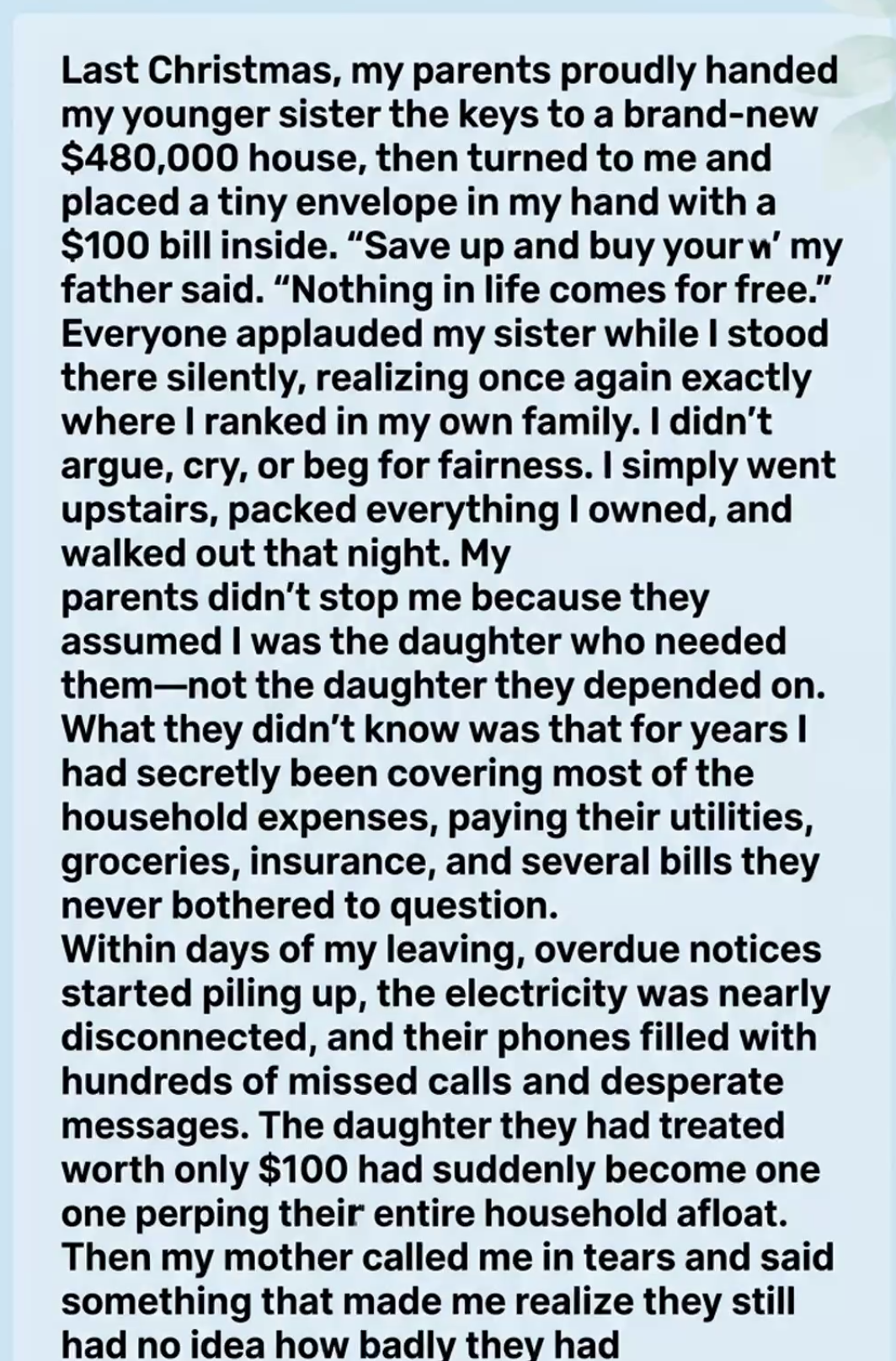
It wasn’t the $480,000 house my sister had received.
It was a modest two-bedroom place I’d rented for years.
But every dollar inside it belonged to me.
Every piece of furniture.
Every appliance.
Every grocery bag.
Every payment.
I had built my life without anyone handing me a house.
“I mean exactly what I said.”
My mother started crying.
“But why would you do this to us?”
That question told me everything.
Even now, she didn’t understand.
“You gave Emma a house.”
“She needed somewhere to live.”
“And I needed somewhere to live.”
“You’re independent.”
“So is she.”
“That’s different.”
“How?”
My mother didn’t answer.
I closed my eyes.
The Christmas scene came back to me.
My sister Emma standing beside the tree.
My father holding a large silver key.
Everyone smiling.
My mother crying happy tears.
“It’s yours,” Dad had said.
Emma screamed.
Then came the hugs.
The photographs.
The champagne.
And finally, my father turned toward me.
He handed me a tiny envelope.
Inside was a single $100 bill.
“Save up and buy your own place.”
I remembered smiling.
Not because it was funny.
Because if I had started crying, I knew I wouldn’t have stopped.
“Nothing in life comes for free,” he had said.
Everyone applauded.
I had looked at Emma.
She couldn’t even look at me.
I didn’t blame her.
She hadn’t asked for any of it.
That night, I went upstairs.
Packed two suitcases.
Loaded my car.
And left.
Nobody stopped me.
Nobody asked where I was going.
Nobody said, “Wait.”
Nobody even noticed that I took the framed photograph of my grandmother from the hallway.
They assumed I’d come back.
They were wrong.
The first bill arrived three days later.
Then another.
Then another.
The electricity account was in my name because I had added myself years earlier to make sure payments were made on time.
The family internet was under my account.
The grocery delivery subscription was mine.
The homeowners insurance on my parents’ property had been paid through my automatic transfer.
The water bill.
The gas.
Their cell phones.
The medical supplement plan my father used.
Even the quarterly property tax installment.
I had been paying all of it.
Not because they demanded it.
Because I thought helping my parents was what good daughters did.
I had started when I was twenty-two.
At first, it was one bill.
Then two.
Then I realized they were falling behind.
So I quietly took over.
My parents never asked how everything kept getting paid.
They simply assumed it would.
That was the part that hurt most.
They didn’t even know what I had been doing.
My father had once told me I was “the practical daughter.”
I had thought it was a compliment.
It wasn’t.
It meant he expected me to handle things without recognition.
Emma was the daughter they celebrated.
I was the daughter they relied on.
There was a difference.
On Tuesday, my mother called again.
“Your father says the mortgage payment is due.”
“I know.”
“Can you make it?”
“No.”
“But you always do.”
“I don’t anymore.”
She started crying.
“Please don’t punish us because you’re upset about Christmas.”
“This isn’t punishment.”
“Then what is it?”
“Reality.”
She said nothing.
I continued.
“Dad told me nothing comes for free.”
“He didn’t mean it like that.”
“He meant exactly what he said.”
“He was trying to teach you independence.”
“Then I’m learning.”
She started crying harder.
“Where are you living?”
“Somewhere.”
“Come home.”
“No.”
“You’re still our daughter.”
“Yes.”
“Then act like it.”
I almost couldn’t believe what I was hearing.
“Mom, I have acted like your daughter for years.”
“What does that mean?”
“It means I paid your bills.”
She went silent.
I continued.
“I paid the electricity.”
Silence.
“The water.”
Nothing.
“Your insurance.”
My mother’s breathing changed.
“Your groceries.”
She whispered, “No.”
“Yes.”
“That’s not possible.”
“It is.”
“Your father’s phone.”
“No.”
“Your phone too.”
She stopped crying.
“You’ve been paying for all of that?”
“Most of it.”
“How much?”
I looked at the spreadsheet on my laptop.
“I calculated it last night.”
I had never calculated it before.
I didn’t want to know.
Now I did.
“About $143,000 over the last four years.”
My mother didn’t speak.
Finally she whispered,
“Why didn’t you tell us?”
I laughed softly.
“Because you never asked.”
That sentence destroyed whatever was left of the conversation.
She hung up.
For the first time in years, I felt free.
But the story didn’t end there.
Three weeks later, I received an email from my father’s bank.
He had apparently discovered that several automatic transfers had stopped.
He wanted to know why.
I didn’t answer.
Instead, I met with an attorney.
Her name was Rebecca.
I brought every bank statement, every receipt, every transfer confirmation, every insurance payment.
She spent two hours reviewing everything.
Finally she looked up.
“You weren’t just helping them.”
“What do you mean?”
“You were financially supporting an entire household.”
“I guess.”
“And they bought your sister a $480,000 house while doing this?”
“Yes.”
Rebecca leaned back.
“What are you planning to do?”
“I don’t know.”
She nodded.
“Then don’t decide yet.”
That was the best advice anyone had given me.
For the first time, I didn’t have to fix someone else’s problem immediately.
I didn’t have to rescue them.
I didn’t have to make the phone call.
I didn’t have to pay the bill.
I could simply wait.
Two months later, my mother called again.
Her voice sounded different.
Not angry.
Not demanding.
Broken.
“Can we meet?”
I agreed.
We met at a small coffee shop.
My mother looked older.
My father came too.
He sat quietly beside her.
Neither spoke for several minutes.
Finally, Dad said,
“I didn’t know.”
I looked at him.
“That’s the problem.”
He nodded.
“I thought you were doing fine.”
“I was.”
“You never complained.”
“I shouldn’t have had to.”
He looked down.
My mother began crying.
“We made a mistake.”
“Yes.”
“We treated Emma differently.”
“Yes.”
“We shouldn’t have.”
“No.”
My father swallowed.
“I thought you didn’t need us.”
I smiled sadly.
“I didn’t need you to pay my bills.”
He looked confused.
“What did you need?”
“Fairness.”
That word hung between us.
My mother reached across the table.
“I want to fix it.”
I pulled my hand back gently.
“You can’t fix four years with one apology.”
She nodded.
“I know.”
“What are you going to do?”
She looked at my father.
Then back at me.
“We’re selling the house.”
I was surprised.
“What?”
“The house is too expensive.”
My father nodded.
“We can’t afford it without you.”
I didn’t say anything.
“And Emma…” my mother continued.
“She doesn’t know what to do.”
I frowned.
“What do you mean?”
“She can’t afford the property taxes, insurance, maintenance, or mortgage.”
I stared at her.
“Mortgage?”
My father looked embarrassed.
“The house was financed.”
Of course it was.
The $480,000 gift wasn’t really a gift.
My parents had taken out a large mortgage and used their savings for the down payment.
They had done it because they wanted Emma to have something impressive.
Now they were discovering what it cost to maintain.
“Does Emma know?”
“Yes.”
“And?”
“She says she wants to sell.”
I nodded.
“Then let her.”
My mother looked at me.
“Can’t you help?”
I almost laughed.
“Mom.”
“I know.”
“No.”
She nodded.
“I know.”
For the first time, she didn’t argue.
That mattered.
A month later, my parents sold their house.
They moved into a smaller place.
Emma sold the new property too.
She lost money on the transaction after closing costs and early financing expenses.
But she survived.
And something unexpected happened.
Emma called me.
Not Mom.
Not Dad.
Me.
“I owe you an apology.”
I listened.
“I didn’t understand what was happening.”
“I know.”
“I thought you were jealous of me.”
“I was hurt.”
“I know that now.”
She took a breath.
“Mom told me how much you paid.”
I said nothing.
“She said you paid over $143,000.”
“Approximately.”
“Why?”
I smiled.
“Because I loved you all.”
Emma started crying.
“I didn’t know.”
“I know.”
“I wish I had.”
“So do I.”
She was quiet.
Then she said,
“I want to pay you back.”
“You don’t have to.”
“I know.”
She paused.
“But I want to.”
I smiled.
“That means more than the money.”
Over the next year, things changed.
My parents stopped expecting me to rescue them.
They learned to budget.
My father took a part-time consulting job.
My mother started selling handmade furniture pieces online.
Emma moved into a smaller home she could actually afford.
And I kept my apartment.
Then, almost a year after that Christmas, my father called me.
“Come over.”
“Why?”
“We have something for you.”
I almost refused.
But I went.
When I arrived, there was a small envelope on the kitchen table.
My father pushed it toward me.
Inside was a check.
$10,000.
I looked at him.
“What is this?”
“First installment.”
I shook my head.
“You don’t owe me.”
“Yes, we do.”
My mother nodded.
“We’ve been keeping track.”
I started to object.
Dad stopped me.
“You spent years keeping track of everyone else’s problems.”
He looked at me.
“Let us keep track of this one.”
I smiled.
Then he reached into his pocket.
There was another envelope.
“This isn’t money.”
I opened it.
Inside was a handwritten letter.
It said:
To our daughter, who gave us more than we ever realized. We taught you that nothing comes for free. We were wrong. Love is freely given. Trust is freely given. And sometimes the person we underestimate is the person holding everything together. We are sorry it took losing your help to understand your value.
I read it twice.
Then I cried.
Not because they finally understood my money.
Because they finally understood me.
I hugged my father.
Then my mother.
For the first time, nobody compared me to Emma.
Nobody talked about what she had.
Nobody talked about what I lacked.
We simply stood there as a family.
And when I left that evening, my father walked me to my car.
“I’m proud of you,” he said.
I smiled.
“You should have said that before.”
“I know.”
Then he looked at me.
“Can I say it now?”
I nodded.
He hugged me.
And for once, I didn’t feel like the daughter who had been given less.
I felt like the daughter who had finally stopped accepting less.