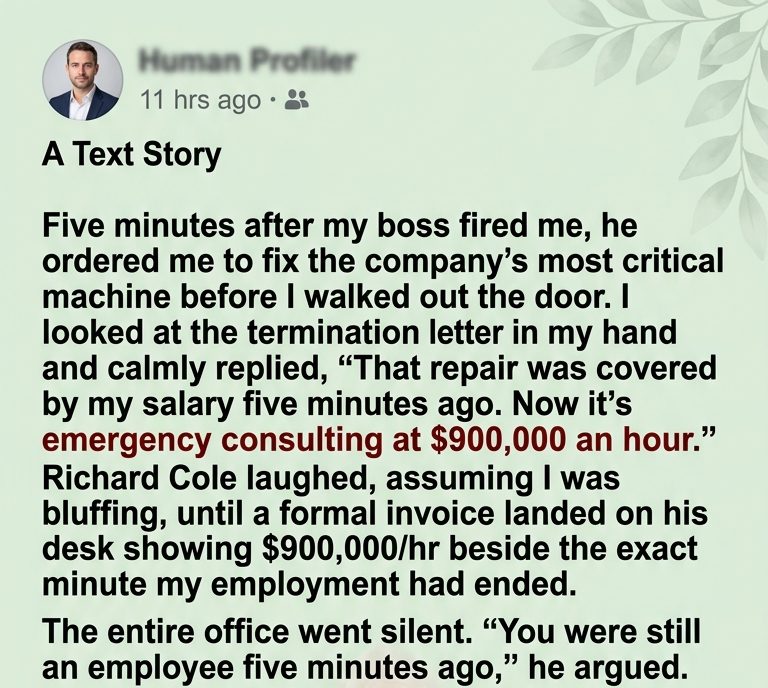
Five minutes after Richard Cole fired me, I was still standing beside my desk with the termination letter in my hand when he told me to fix the company’s most important machine.
“Before you leave,” he said, “get Line Seven running.”
I looked at him.
“You just fired me.”
Richard shrugged.
“And?”
“And the repair was covered by my salary five minutes ago.”
He laughed.
“Don’t be dramatic.”
I looked down at the termination letter.
Effective immediately.
That sentence would become very expensive for him.
“Fine,” I said. “If you want me to repair it now, you’ll need to hire me as an outside consultant.”
Richard rolled his eyes.
“How much?”
“$900,000 an hour.”
The room went silent.
Someone near the break room actually laughed.
Richard stared at me.
“You’re serious?”
“Completely.”
“You’re asking for nine hundred thousand dollars an hour to fix a machine?”
“No,” I replied. “I’m charging that rate because you terminated the only person in this building who can restart it safely.”
Richard shook his head.
“You’ve worked here for eleven years. Don’t suddenly pretend you’re some kind of genius.”
I picked up my cardboard box.
“I don’t have to pretend.”
Then I walked away.
My desk was only halfway packed when the first alarm sounded.
The entire building vibrated.
People looked toward the production floor.
Then another alarm started.
Then another.
Line Seven had stopped.
Not slowed.
Stopped.
The operations director, Martin Shaw, came running down the hallway.
“Where’s Daniel?”
Richard pointed at me.
“He’s leaving.”
Martin looked confused.
“What?”
“Termination.”
Martin stared at Richard.
“You fired him today?”
“Five minutes ago.”
Martin’s face went pale.
“Then we’re in serious trouble.”
Richard’s expression changed.
“What do you mean?”
Martin pulled out his phone.
“The client just called.”
“Which client?”
“Helix Advanced Materials.”
Richard froze.
Everyone knew Helix.
Their contract was worth more than $48 million.
And Line Seven produced the specialized components Helix needed.
If production wasn’t restored quickly, the company would miss the delivery window.
And Helix had already warned us that another failure could trigger a penalty clause and potentially end the contract.
Richard looked at me.
“Fix it.”
I shook my head.
“I’ve been terminated.”
“Don’t be ridiculous.”
“You made that decision.”
Martin stepped between us.
“Richard, can we please deal with this after the machine is running?”
Richard looked at me.
“What do you want?”
I pointed to my invoice.
“It’s already on your desk.”
He picked it up.
$900,000 per hour.
The invoice had started at 2:17 p.m., the exact minute my employment had ended.
Richard’s jaw tightened.
“This is extortion.”
“No. It’s a consulting rate.”
“You can’t charge this.”
“I can.”
“Why would anyone pay that?”
“Because replacing me will cost you more.”
Martin looked at the machine diagnostics.
“Daniel is right.”
Richard snapped at him.
“You’re taking his side?”
“No. I’m telling you what the numbers say.”
Martin turned his laptop around.
The production failure had already cost the company nearly $1.4 million in delayed output.
And the clock was still running.
Richard stared at the screen.
“How long?”
Martin answered.
“Every hour we remain down increases the exposure.”
Richard looked at me.
“Fine.”
He hated the word.
“Fine what?”
“You’re hired.”
I smiled.
“Consulting agreement first.”
“Now?”
“Yes.”
“You’re standing here while the machine is down.”
“And you’re standing here because you need me.”
Martin looked between us.
Then he said, “I’ll get legal.”
Twenty-three minutes later, I had a signed emergency consulting agreement.
The rate was $900,000 per hour.
There was a minimum two-hour charge.
Richard tried to remove the minimum.
Legal told him not to.
I put down my coffee.
“Now we can work.”
I walked to Line Seven.
The machine was enormous.
It had been custom-built over a decade earlier.
I had helped design part of its control architecture.
Over the years, I’d repeatedly warned management that several components were approaching the end of their useful life.
I had sent eleven maintenance reports.
Every one had been ignored.
I opened the main control panel.
“Don’t touch anything,” I told the technicians.
One of them looked at Richard.
Richard nodded.
They stepped back.
I checked the diagnostic logs.
“Control sequence failure.”
Martin frowned.
“What caused it?”
“Not one thing.”
I pointed toward a cabinet.
“Temperature.”
Then another.
“Power fluctuation.”
Then the central processor.
“And an outdated firmware patch.”
Martin looked shocked.
“Can you fix it?”
“Yes.”
Richard crossed his arms.
“How long?”
“Forty minutes.”
“Forty?”
“If nobody interrupts me.”
He looked like he wanted to argue.
Then he stepped away.
I worked.
At minute twenty-seven, I found the deeper problem.
Someone had bypassed a safety interlock.
I stopped.
“Who authorized this?”
Nobody answered.
I pulled up the maintenance history.
The bypass had been installed three months earlier.
My name was listed on the original system documentation.
But I hadn’t approved it.
I showed Martin.
“This modification wasn’t in my report.”
He looked at Richard.
Richard looked uncomfortable.
“That’s not relevant.”
“It is if this machine fails because someone altered the safety system.”
Martin leaned closer.
“Who authorized it?”
Richard said nothing.
I took photographs and documented the condition.
Then I restored the original configuration.
At 3:04 p.m., the machine restarted.
The alarms stopped.
The production line slowly came back online.
The room erupted in applause.
I didn’t celebrate.
I looked at Richard.
“It’s running.”
He nodded.
“Good.”
I picked up my box.
“Your invoice is still open.”
Richard frowned.
“How much?”
“Two hours minimum.”
“That repair took forty-seven minutes.”
“You signed the agreement.”
He looked furious.
Martin quietly said, “He’s right.”
Richard paid the invoice.
$1.8 million.
Two hours later, I was sitting in my car when Martin called.
“Can we talk?”
“About what?”
“Your invoice.”
“If Richard wants to dispute it, he can talk to legal.”
“No.”
Martin paused.
“I want to hire you.”
I laughed.
“You already did.”
“I mean permanently.”
“I was fired.”
“I know.”
“By Richard.”
“I know.”
“Then why are you calling me?”
“Because the board just found out what happened.”
I went quiet.
“What did they say?”
Martin hesitated.
“They want to know why you were fired five minutes before a critical production failure.”
I smiled.
“Good question.”
The next morning, I was called into a board meeting.
Richard was there.
So were the CEO, two directors, the legal counsel, and Martin.
The CEO looked at me.
“Mr. Cole says you were fired because of performance concerns.”
I looked at Richard.
“Is that what you told them?”
Richard shifted in his chair.
“Yes.”
I opened my laptop.
“I brought my performance records.”
I displayed eleven years of maintenance reports.
Every warning.
Every proposed replacement.
Every documented failure.
Every time I had requested funding for preventive maintenance.
Then I showed the board the safety-interlock bypass.
Finally, I displayed the email Richard had sent two weeks earlier.
Daniel is too cautious. We need someone willing to move faster.
The CEO stared at the screen.
Richard’s face reddened.
“I was trying to improve efficiency.”
“You fired me for being cautious,” I said, “then five minutes later demanded that I fix the exact system you accused me of overcomplicating.”
The room went silent.
The board chairman looked at Richard.
“Why did you fire him?”
Richard couldn’t answer.
Then the legal counsel spoke.
“There is another issue.”
She placed a document on the table.
“Daniel’s termination was processed without the required performance review.”
The CEO looked angry.
“Why?”
Richard said nothing.
The chairman leaned back.
“Richard, step outside.”
Richard stood.
Before leaving, he looked at me.
“This isn’t over.”
I replied calmly.
“No. It isn’t.”
He left.
The CEO turned toward me.
“We owe you an explanation.”
“You owe me more than that.”
He nodded.
“I know.”
They offered me my old position back.
I declined.
They offered me a promotion.
I declined.
Then they asked what I wanted.
“I want an independent consulting company.”
The CEO looked surprised.
“You want to work for yourself?”
“Yes.”
Martin smiled.
“What would you charge?”
I looked at him.
“For your company?”
“Yes.”
“$900,000 an hour.”
Everyone laughed.
Even the CEO.
Then he stopped laughing.
“You’re serious.”
“Yes.”
He thought for a moment.
“Fine.”
That was how my consulting company began.
I called it Northstar Industrial Reliability.
My first client was the company that had fired me.
My second was Helix Advanced Materials.
Then another manufacturer called.
Then another.
Within six months, I had twelve clients.
Within two years, my company had twenty-seven employees.
We specialized in preventing the exact failures companies usually waited too long to address.
And something unexpected happened.
Richard Cole was eventually removed from his position.
The board’s investigation found that his management decisions had contributed to several preventable operational risks.
There wasn’t one dramatic crime.
There didn’t need to be.
There were ignored warnings.
Bad decisions.
Pressure to reduce maintenance costs.
And a habit of blaming employees when those decisions eventually caught up with the company.
A year after my firing, Richard called me.
“I owe you an apology.”
I was sitting in my office reviewing a proposal.
“For what?”
“For firing you.”
I leaned back.
“And?”
“And for telling everyone you weren’t valuable.”
I didn’t say anything.
He continued.
“You were the most valuable person in that building.”
I smiled slightly.
“You only realized that after you had to pay $1.8 million to get forty-seven minutes of my time.”
He laughed bitterly.
“Fair.”
There was a pause.
“Would you ever come back?”
“No.”
“I figured.”
I looked out the window.
My company logo was visible on the building across the street.
“I didn’t leave because I hated the company.”
“Then why?”
“Because I realized something.”
“What?”
“My value didn’t begin when you recognized it.”
He was quiet.
Then he said goodbye.
I never heard from him again.
Years later, people sometimes ask me whether charging $900,000 an hour was worth it.
The truth is, I never expected to collect that money.
I expected Richard to laugh.
I expected him to walk away.
I expected the machine to be someone else’s problem.
But he had spent eleven years treating my expertise as part of my salary.
The moment he ended my employment, he accidentally turned that expertise into a service the company had to buy.
The lesson wasn’t that everyone should charge ridiculous consulting fees after being fired.
The lesson was simpler.
Never confuse someone’s willingness to work for you with their lack of value.
Because sometimes the person you dismiss is the person holding together everything you thought would keep running without them.