For years, I had convinced myself that helping my parents with their California home was simply what family did.
The house had been purchased when I was twenty-six. It was a modest three-bedroom property at the time, but years of rising prices had turned it into something far more valuable. By the time my younger brother Nathan graduated from college, real estate sites estimated the house was worth around $920,000.
My parents loved reminding everyone that the house was “the family home.”
What they rarely mentioned was how much of it I had paid for.
It started with the mortgage.
Dad had retired earlier than expected, and Mom had cut back her hours after a health scare. They could still manage most of their expenses, but the mortgage had become difficult. I offered to cover it temporarily.
“Just until things settle down,” Mom had promised.
Things never settled down.
One month became six. Six became two years.
Then property taxes came due.
I paid those too.
When the roof needed repairs, I handled the bill.
When the water heater died, I replaced it.
When the insurance premium increased, I transferred the money.
When termites damaged part of the garage, I paid for treatment.
I never demanded repayment.
I never asked them to put my name on the deed.
And I never kept a spreadsheet of what I had spent.
At least, not consciously.
But every bank statement was still sitting in my records.
And every payment had a paper trail.
Over nearly six years, I had paid well over $200,000 toward the property and its expenses.
My brother Nathan knew I helped.
He simply didn’t understand how much.
Nathan had always been treated differently.
He was four years younger than me, and my parents had a soft spot for him.
When he changed majors three times, they called it “finding himself.”
When he quit his first job, they said he was “looking for the right opportunity.”
When he accumulated credit-card debt, they helped him pay it down.
Whenever I asked for nothing, they called me independent.
Whenever Nathan needed something, they called him their son.
I told myself it didn’t matter.
Then Nathan graduated.
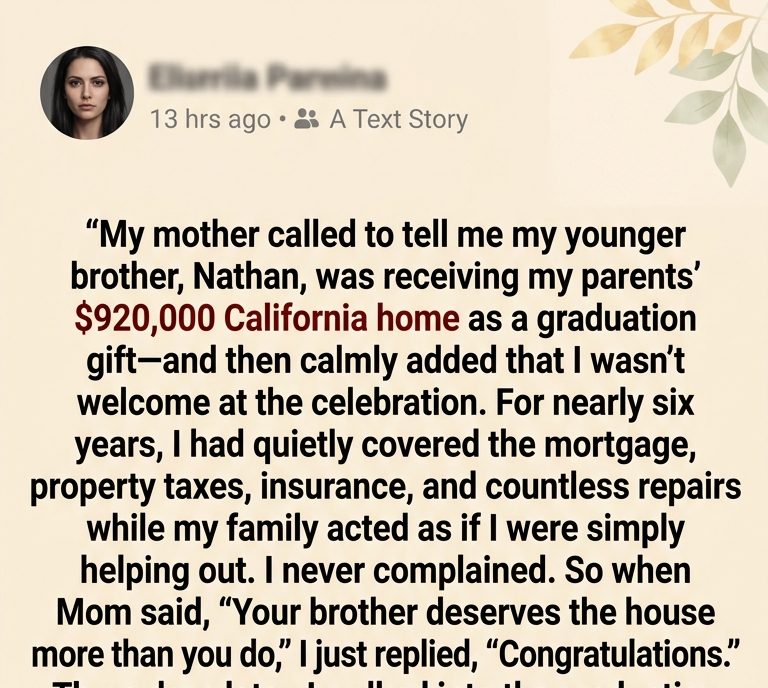
Two days before the ceremony, Mom called me.
Her voice was unusually cheerful.
“Nathan got his graduation gift,” she said.
“Oh?”
“We’re giving him the house.”
I thought I had misunderstood her.
“The house?”
“Our California house.”
There was a pause.
“Mom, are you serious?”
“Of course. He needs a place to start his life. He’s worked hard.”
I almost laughed.
Nathan had lived with them rent-free for the last eighteen months.
But I didn’t argue.
Instead, I asked, “What does Dad think?”
“He agrees.”
“And what about the mortgage?”
“It’s almost paid down.”
I knew exactly how much was left because I had been making the payments.
“Right,” I said quietly.
Then Mom added something that hurt more than the house itself.
“Oh, and don’t come to the celebration.”
I thought she was joking.
“What?”
“We’re keeping it small. Nathan doesn’t want unnecessary drama.”
“What drama?”
“You know how things get when you start talking about money.”
I stared at the wall.
I had never asked them for a dollar.
I had never mentioned the money I spent.
I had simply kept their house standing.
Mom continued.
“Your brother deserves the house more than you do.”
There it was.
Six years of silence reduced to a single sentence.
I swallowed.
“Congratulations,” I said.
Then I hung up.
For three days, I said nothing.
I didn’t call Dad.
I didn’t confront Nathan.
I didn’t even tell my friends.
Instead, I opened an old folder on my computer.
Inside were mortgage transfers.
Property-tax payments.
Insurance renewals.
Contractor invoices.
Roof repairs.
Plumbing.
Electrical work.
A new furnace.
Garage repairs.
Landscaping.
Over and over, my name appeared.
I started adding the numbers.
By midnight, the total was far higher than I expected.
$238,417.62.
That didn’t include groceries, furniture, or smaller household expenses I’d covered.
I stared at the number.
Then I remembered something my uncle Richard had told me five years earlier.
“You should keep copies of everything,” he’d said.
At the time, I hadn’t understood why.
Uncle Richard was my father’s older brother and had worked as a real-estate attorney before retiring.
He had occasionally helped my parents with paperwork.
Once, when I mentioned that I was making the mortgage payments, he’d looked at me strangely.
“Are you on title?”
“No.”
“Then make sure you keep records.”
I had laughed.
“It’s family.”
Richard hadn’t laughed.
He had simply said, “Family is exactly why you keep records.”
Now I understood.
The morning of Nathan’s graduation, I received a text from my uncle.
Are you coming tonight?
I replied:
I wasn’t invited.
Three dots appeared.
Then:
Come anyway. We need to talk.
I almost didn’t go.
But something in his message made me change my mind.
So three days after Mom’s call, I walked into the graduation party.
The celebration was being held at the house.
The same house whose mortgage I had been paying.
The same house my parents had supposedly just given away.
Cars lined the street.
People filled the backyard.
Nathan stood near the patio wearing his graduation gown over a white shirt, accepting congratulations.
Then he saw me.
His smile disappeared.
The conversations around him faded one by one.
Mom turned.
Her expression hardened immediately.
“What are you doing here?”
I looked at her.
“I was invited.”
“You weren’t.”
I glanced toward Uncle Richard.
He was standing near the dining room with a black briefcase.
“Yes,” I said. “I was.”
Nathan stepped forward.
“Can you not do this today?”
“Do what?”
“Make everything about you.”
I almost smiled.
“I haven’t said anything.”
Mom crossed her arms.
“You need to leave.”
I looked around the room.
Then I said, “Actually, before I go, I have one question.”
Everyone became quiet.
I looked at Uncle Richard.
“Do you want to explain it, or should I?”
His smile disappeared.
Mom looked confused.
“Explain what?”
Richard walked toward the table.
He placed his briefcase down.
“There’s something your mother should have shown you years ago.”
Mom’s face changed.
“Richard, don’t.”
He ignored her.
He opened the briefcase and removed a sealed folder.
Nathan looked from him to our mother.
“What is that?”
Richard placed the first document on the table.
It was a property record.
He pointed to the legal description.
“This is the recorded title.”
Mom shook her head.
“We know who owns the house.”
Richard looked at her.
“No. You don’t.”
The room went silent.
He turned the document around.
“The house was placed into a family trust nine years ago.”
I stared at the page.
“What?”
Richard looked at me.
“Your grandfather established the trust before he died.”
My mother immediately interrupted.
“That trust was temporary.”
“No,” Richard said. “It wasn’t.”
He pulled out another document.
“This is the original trust agreement.”
My eyes moved across the pages.
The house was listed as an asset.
My grandfather’s name appeared as the grantor.
My father’s name was listed as trustee.
And then I saw something I hadn’t expected.
My name.
Not Nathan’s.
Mine.
I looked up.
“What does this mean?”
Richard sat down.
“It means your parents never owned this property outright.”
Mom’s face had gone pale.
Richard continued.
“Your grandfather created the trust because he was concerned about what would happen to the property after his death. He wanted it preserved for the family, but he specifically designated you as the beneficiary responsible for maintaining it.”
Nathan stared at the papers.
“That doesn’t make sense.”
“It does,” Richard replied.
He pulled out another document.
“This is the amendment your grandfather signed two years before his death.”
My hands trembled slightly as I read it.
The language was clear.
The property was to remain protected for my benefit, provided I continued maintaining the mortgage, taxes, insurance, and essential repairs.
My grandfather had anticipated exactly what happened.
He had known my parents might eventually struggle financially.
He had also known Nathan was impulsive with money.
But there was something else.
A clause near the bottom said the property could not be sold, transferred, gifted, mortgaged, or assigned without the written approval of the designated beneficiary and an independent trustee.
Me.
I looked at Mom.
“You knew?”
She didn’t answer.
Dad finally stepped forward.
“Your mother knew about the trust.”
Mom snapped, “You knew too.”
Dad looked down.
Nathan looked devastated.
“So the house isn’t mine?”
“No,” Richard said gently.
Nathan turned toward our parents.
“You told me it was.”
“I thought it would become yours,” Mom said.
“That isn’t what I asked.”
His voice cracked.
“You told me it was my graduation gift.”
Mom started crying.
“You deserved something.”
Nathan laughed bitterly.
“Apparently I deserved a house you didn’t own.”
Richard opened another folder.
“This is where it gets more complicated.”
He handed me a stack of bank statements.
I recognized the account immediately.
It was the account I had been transferring money into for years.
But beneath the deposits were withdrawals.
Large withdrawals.
Richard explained that my grandfather had also created a maintenance reserve for the property.
The account had originally contained nearly $180,000.
Over the years, portions had been used for legitimate repairs.
But approximately $74,000 had been withdrawn for unrelated expenses.
Some of those payments had gone toward Nathan’s tuition.
Others had covered credit-card balances, a vehicle down payment, vacations, and personal expenses.
I looked at my mother.
“You used the house fund for him?”
She wiped her eyes.
“We were trying to help him.”
“You were supposed to protect the house.”
“We needed the money.”
“And I was paying the mortgage.”
Mom said nothing.
That silence told me everything.
Richard pulled out one final document.
“This is the part you need to understand.”
It was a letter from my grandfather.
I had never seen it.
He had written it shortly before his death.
The letter wasn’t angry.
It wasn’t dramatic.
It simply explained why he had chosen me.
He wrote that I had always been the one who quietly took responsibility when things became difficult.
He didn’t want that responsibility to become an obligation.
He wanted the house to be a place where I could always have security, regardless of what happened to the rest of the family.
Then came the sentence that broke me.
“If they ever tell you that maintaining the house means you owe them ownership of your own life, remember that responsibility and sacrifice are not the same thing.”
I had to stop reading.
For years, I thought I had been helping my parents.
Instead, I had been unknowingly fulfilling the responsibility my grandfather had entrusted to me.
Nathan sat down.
“Does this mean she owns the house?”
Richard shook his head.
“Legally, the trust owns it. She is the designated beneficiary and successor property manager.”
Nathan looked at me.
“So you could kick us out?”
I shook my head.
“I don’t want to kick anyone out.”
Mom looked surprised.
“Then what are you going to do?”
I took a breath.
“First, we’re going to account for every dollar.”
Richard nodded.
“That’s the right approach.”
We later hired an independent accountant and another attorney who had no connection to the family.
The review took months.
Some expenses were legitimate.
Others were not.
My parents weren’t charged with anything, because much of the issue involved family trust administration rather than criminal conduct.
But there were serious financial breaches.
My father resigned as trustee.
An independent trustee was appointed.
The missing reserve funds were gradually restored through the sale of investments and repayment arrangements.
Nathan didn’t receive the house.
But I didn’t punish him for something he hadn’t known.
I told him he could stay temporarily while he found work and his own apartment.
He accepted.
And for the first time in our lives, Nathan and I had an honest conversation.
“I thought you hated me,” he said.
I looked at him.
“I never hated you.”
“Then why didn’t you ever tell me?”
“Because I thought Mom and Dad loved us equally. I thought they just needed more help with you.”
Nathan looked away.
“They always told me you didn’t need anything.”
I laughed quietly.
“That’s what they told me too.”
We sat in silence.
Then he said something I didn’t expect.
“I don’t want the house.”
I looked at him.
“I know.”
“I want my own life.”
That was the first time I felt like my little brother had finally grown up.
My parents eventually moved into a smaller home.
The trust remained intact.
The California house was never sold.
I became its official property manager, and the trust agreement was updated so that no future transfer could happen without independent oversight.
Mom apologized months later.
Not for losing the house.
For the years of letting me believe my sacrifice was invisible.
“I should have told you,” she said.
“Yes,” I replied.
“You deserved to know.”
“Yes.”
She cried.
I didn’t immediately forgive her.
But I didn’t walk away either.
Some things take time.
The graduation party that was supposed to celebrate Nathan ended up exposing a family secret none of us had expected.
And strangely enough, it changed my relationship with him for the better.
Years later, whenever I drove past that house, I remembered the night Mom told me I wasn’t welcome.
I remembered how easily she had said Nathan deserved it more.
But I also remembered my grandfather’s letter.
The house was never really the prize.
The real inheritance was the lesson he had left behind:
You can love your family without surrendering your boundaries.
And sometimes the quiet person who keeps everything together is the one everyone forgets to protect.
Until the paperwork finally speaks for itself.
5 Strong Title Options
The House My Parents Gave My Brother Was Never Theirs To Give
My Parents Gave My Brother A $920,000 House Until My Uncle Opened One Folder
I Paid For My Parents’ Home For Six Years Then They Gave It To My Brother
My Mother Banned Me From My Brother’s Graduation Party Until The Deed Was Revealed
They Thought My Brother Had Inherited The Family Home Until The Trust Documents Appeared