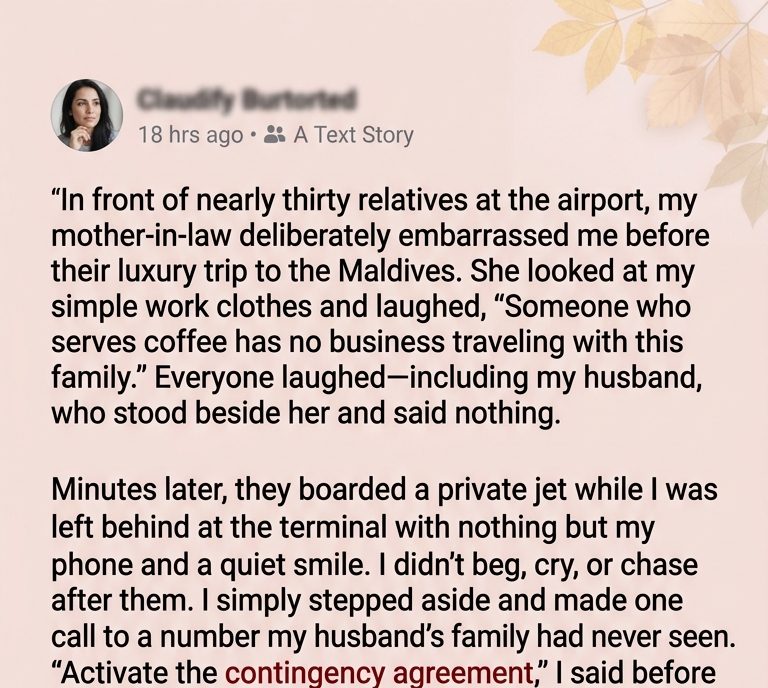
The laughter at the airport followed me long after the private jet disappeared from view.
There were nearly thirty relatives gathered that morning, dressed in designer clothes and carrying luggage that probably cost more than my annual salary had once been.
My mother-in-law, Patricia, stood in the center of them all, wearing oversized sunglasses and a cream-colored designer jacket.
She looked at me from head to toe.
I was wearing the same simple black trousers and white blouse I normally wore to work.
Patricia smiled.
Then she laughed.
“Someone who serves coffee has no business traveling with this family.”
A few relatives chuckled.
Someone behind her whispered something about me “not fitting the lifestyle.”
Then my husband, Daniel, laughed too.
That hurt more than Patricia’s words.
I looked at him.
He didn’t defend me.
He simply adjusted his watch and said, “Mom’s just joking.”
I knew she wasn’t.
Neither was he.
For years, I had been treated like the embarrassing addition to the family.
Daniel came from money.
His parents owned several businesses and lived in a gated estate outside the city.
I had grown up in an ordinary family.
My parents taught me to work hard, save money, and never judge someone by what they wore.
I followed that advice.
I also worked.
A lot.
Daniel’s family knew me as someone who worked at a café.
What they didn’t know was that the café was only one part of my professional life.
Five years earlier, after finishing university, I had started a small hospitality consulting company.
At first, it had been nothing more than a laptop, a rented desk, and two clients.
I helped boutique hotels improve reservations, guest services, and luxury-property operations.
One client became three.
Three became twelve.
Eventually, investors approached me.
We began acquiring minority interests in hospitality properties.
Then management contracts.
Then entire resorts.
I never told Daniel’s family.
Not because I wanted revenge.
I simply didn’t care whether they approved of me.
And Daniel never asked much about my work.
To him, I was the woman who occasionally came home smelling like coffee because I sometimes spent time at one of our properties helping staff understand how ordinary guests experienced luxury service.
The irony was almost funny.
The family was flying to the Maldives that morning for a two-week vacation.
The villa Patricia had reserved cost approximately $75,000 a night.
What she didn’t know was that the resort was part of a hospitality group my company had acquired a controlling interest in eighteen months earlier.
The acquisition had been kept private during restructuring.
Our public-facing management team remained in place.
The resort’s ownership information wasn’t something ordinary guests could see.
And Patricia had never bothered to ask.
At the airport, she handed her passport to a staff member.
Then she looked at me again.
“Are you sure you’re staying here?”
I smiled.
“Yes.”
Daniel frowned.
“You’re not coming?”
“You didn’t want me there.”
“That was Mom.”
I looked at him.
“And you agreed with her.”
He said nothing.
The family began walking toward the private terminal.
Patricia called over her shoulder.
“Maybe next year we’ll find a trip more appropriate for you.”
Everyone laughed again.
I didn’t.
I stepped away from the group.
Then I pulled out my phone.
There was one number saved under a name none of them would have recognized.
I called it.
“Operations?”
“Yes.”
“Activate the contingency agreement for the Maldives property.”
There was a pause.
“Effective immediately?”
“Yes.”
“Understood.”
I ended the call.
I didn’t cancel anyone’s flight.
I didn’t cancel their rooms because I was angry.
Instead, I instructed the resort to suspend any reservation changes made without verified authorization from the account holder and to review the access privileges attached to Patricia’s booking.
There was a reason.
Three weeks earlier, Patricia had contacted the resort directly and requested several upgrades.
Private transfers.
Additional villas.
A yacht.
A personal chef.
Spa appointments.
Excursions.
She had also asked the resort to bill several expenses to a corporate hospitality account connected to my company.
She didn’t own that account.
She had never been authorized to use it.
The resort’s finance department had flagged the request.
I had told them to wait.
Now I was activating the contingency agreement.
It meant every reservation associated with my family’s group would undergo manual verification.
Nothing would disappear.
Nothing would be confiscated.
They would simply have to pay for what they had booked themselves.
That distinction mattered.
I wasn’t interested in humiliating them.
I wanted the truth to become impossible to ignore.
The jet landed hours later.
I knew because my phone received the notification.
The family reached the resort expecting a seamless arrival.
Instead, they were met by a manager.
“Mrs. Patricia Bennett?”
“Yes.”
“Welcome.”
Patricia smiled.
“Thank you. We’re expected.”
“Yes.”
The manager looked at his tablet.
“Before we proceed, I need to verify the authorization for your villa and the associated hospitality services.”
Patricia frowned.
“What authorization?”
“The account connected to several of your requested services.”
“My son arranged everything.”
The manager looked toward Daniel.
Daniel immediately said, “My mother booked the trip.”
The manager nodded.
“Then she’ll need to provide the approved payment authorization.”
Patricia became irritated.
“This is a family vacation.”
“Of course, ma’am.”
“And I paid for it.”
“Yes.”
“Then why are you questioning me?”
The manager remained polite.
“Because several services were requested under an account that isn’t registered to you.”
Patricia’s face changed.
“What account?”
The manager didn’t answer immediately.
He simply said, “I’ll have the hotel director speak with you.”
A few minutes later, the hotel director entered the villa.
Patricia stood.
“This is ridiculous.”
The director looked at her.
“Mrs. Bennett, I’m sorry for the inconvenience.”
“You should be. We paid an enormous amount for this villa.”
“Yes.”
“And now you’re telling me we can’t access everything?”
“Not without proper authorization.”
Patricia’s voice rose.
“Who authorized this?”
The director hesitated.
Then he said:
“The owner.”
Patricia laughed.
“Then get the owner.”
The director looked at her.
“You need to speak with the owner.”
“Fine. Call them.”
The director took out his phone.
Then he stopped.
“Actually, I believe they’re already aware of the situation.”
Patricia’s face tightened.
“Who is the owner?”
The director looked toward Daniel.
Then back at Patricia.
“I think you know her.”
Daniel frowned.
“What are you talking about?”
The director said quietly:
“Your wife.”
Silence.
Nobody moved.
Patricia stared at him.
“My daughter-in-law?”
“Yes.”
Daniel looked as if someone had struck him.
“That can’t be right.”
The director opened a secure ownership file on his tablet.
“Your wife is the controlling shareholder of the hospitality group that owns this property.”
Patricia’s mouth opened.
No sound came out.
Daniel looked at me through the video call the director had just initiated.
I had been waiting in my office.
He stared at my face.
“You?”
I nodded.
“Yes.”
Patricia grabbed the phone.
“You did this?”
“No.”
Her voice became louder.
“You humiliated us!”
I shook my head.
“I didn’t humiliate you.”
“You locked us out!”
“No.”
“Then why did the hotel stop our services?”
“Because you tried to charge expenses to an account you weren’t authorized to use.”
She went silent.
I continued.
“You are welcome to use anything you personally paid for.”
Patricia looked at the director.
“Everything was supposed to be covered.”
I said, “No. Everything was supposed to be covered by my company because you asked the resort to put it on my corporate account.”
Daniel stared at his mother.
“Mom?”
She looked away.
I continued.
“I didn’t cancel your villa. I didn’t cancel your flights. I didn’t cancel your vacation.”
Patricia’s expression changed.
“Then what did you do?”
“I removed unauthorized access.”
Nobody spoke.
Then Daniel asked quietly:
“Why didn’t you ever tell us?”
I looked at him.
“Would you have treated me differently?”
He didn’t answer.
“That isn’t fair,” he finally said.
I almost smiled.
“Neither was what happened at the airport.”
He looked down.
I had expected anger.
Instead, I felt tired.
For years, I had listened to comments about my clothes.
My job.
My family.
My background.
Patricia had once told Daniel that I would “never understand how their family lived.”
She was right.
I didn’t understand how people could have everything and still feel the need to make someone else feel small.
The next morning, Daniel came back alone.
He asked to meet me.
We sat in a quiet restaurant near my office.
He looked exhausted.
“I owe you an apology.”
I didn’t answer.
“I should have defended you.”
“Yes.”
“I didn’t know about the company.”
“I know.”
“Why did you hide it?”
“I didn’t hide it.”
He frowned.
“You never told me.”
“I told you I worked in hospitality.”
“You let me think you were working at a café.”
“I did work at a café.”
He looked confused.
I explained.
“I still spend time there.”
“Why?”
“Because it’s where I learned how people experience service. Before you ever enter a luxury resort, you learn what makes ordinary customers feel welcome.”
He stared at me.
“You own all this?”
“Not all of it.”
I smiled.
“But enough.”
He looked down.
“What happens now?”
I took a breath.
“That depends on whether you want to stay married to me because you love me or because you finally understand what I own.”
He looked hurt.
“I love you.”
“Then prove it without discussing money.”
He nodded.
The vacation continued.
Patricia paid for the services she had personally booked.
The unauthorized charges were removed.
Nobody was thrown out.
Nobody was stranded.
And I never canceled their villa.
But something else was canceled.
The illusion that I needed their approval.
When Daniel returned home, he apologized to me again.
This time, he didn’t make excuses.
He admitted that he had become comfortable watching his family disrespect me because confronting them was inconvenient.
That was harder to hear than anything Patricia had said.
We went to counseling.
It took time.
Patricia eventually called.
“I owe you an apology,” she said.
I waited.
“I judged you.”
“Yes.”
“I thought you were beneath us.”
“Yes.”
She was quiet.
Then she said something I didn’t expect.
“I was wrong.”
I didn’t immediately say everything was forgiven.
Instead, I told her:
“Respect isn’t something you give after discovering someone’s bank account.”
She cried.
“I know.”
“Then remember that.”
Months later, Daniel and I returned to the Maldives.
Not with his family.
Just the two of us.
We stayed at the same resort.
This time, Daniel walked beside me through the lobby.
No private jet.
No family entourage.
No designer sunglasses.
Just us.
As we reached the terrace overlooking the ocean, he smiled.
“You know what’s funny?”
“What?”
“My mother spent years thinking you were trying to marry into the family.”
I laughed.
“She had it backward.”
Daniel smiled.
“You already had your own.”
I looked across the water.
I thought about the woman standing alone at the airport while everyone laughed.
She had been hurt.
But she hadn’t been powerless.
She simply hadn’t needed to prove anything.
The truth had done that for her.
And I learned something that day that I wish I had understood much earlier:
Never measure a person’s worth by the uniform they wear, the job title printed on a badge, or the way they dress for a flight.
Sometimes the person everyone dismisses is the one quietly holding the keys.
And sometimes the most powerful response to being underestimated isn’t revenge.
It’s simply refusing to explain your value to people who already decided you had none.