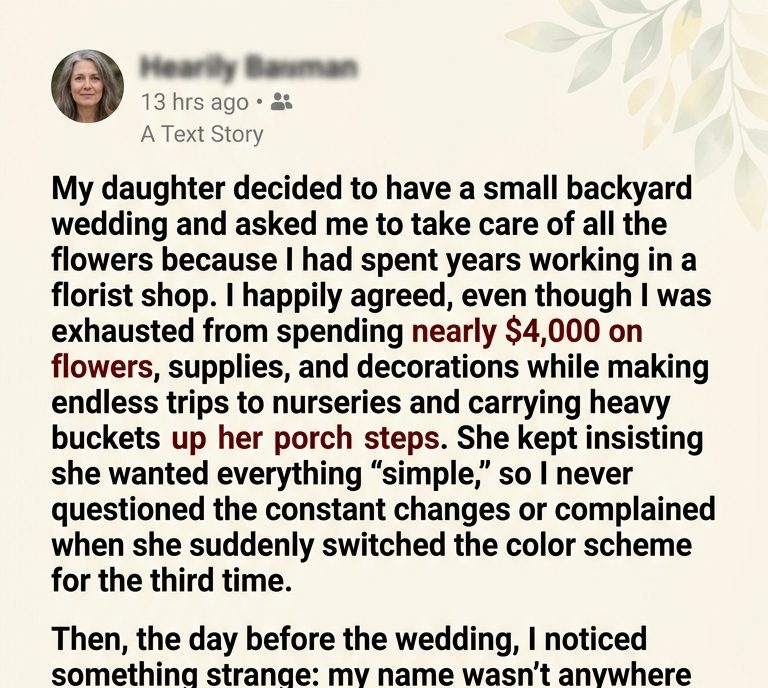
My daughter Emily had always dreamed of a small wedding.
Nothing extravagant.
Just a backyard ceremony, a few close friends, family, string lights, good food, and enough flowers to make the whole place feel magical.
When she asked me to handle the flowers, I was thrilled.
I had worked in a florist shop for nearly twenty years before retiring.
Flowers were more than a job to me.
They were something I understood.
Something I could create with my hands.
So when Emily said, “Mom, I want everything to look simple and natural,” I immediately said yes.
I didn’t realize how much that simple wedding would cost me.
By the week of the ceremony, I had spent nearly $4,000.
Flowers.
Greenery.
Vases.
Ribbon.
Buckets.
Floral foam.
Candles.
Extra decorations.
And endless trips to nurseries and wholesalers.
I carried heavy buckets up her porch steps until my shoulders hurt.
I spent nights trimming stems at my kitchen table.
Emily kept changing things.
First she wanted blush and ivory.
Then lavender.
Then white and greenery.
Then suddenly she wanted deep burgundy accents.
“This is the third color change,” I joked.
She laughed.
“I know. I’m sorry, Mom. I just want everything perfect.”
I told her it was fine.
It was her wedding.
I wanted her happy.
Even when she asked me to make twice as many arrangements as we’d originally discussed, I did it.
Even when she added a flower arch three days before the ceremony, I found a way.
Even when she said the reception tables needed smaller arrangements because the original ones “looked too expensive,” I redid them.
I didn’t complain.
I was her mother.
Then, the day before the wedding, I noticed the seating chart.
It was taped to the refrigerator.
I scanned the names.
Emily.
Her fiancé, Nathan.
Nathan’s parents.
His grandparents.
His siblings.
My cousins.
Friends.
Neighbors.
Everyone seemed to have a place.
Except me.
I looked again.
My name wasn’t there.
I called Emily.
“Sweetheart, did you forget to put my name on the seating chart?”
She glanced at it.
“Oh.”
She shrugged.
“Probably a printing mistake.”
“Where am I sitting?”
“Mom, we’ll figure it out tomorrow.”
That answer bothered me.
But I let it go.
That evening, while I was unloading the last boxes of flowers, Nathan’s mother, Linda, quietly approached me.
“Can I ask you something?”
“Of course.”
She hesitated.
“Why are you sitting beside the catering staff tomorrow?”
I stared at her.
“What?”
She looked uncomfortable.
“That’s what Emily told us.”
I felt my stomach drop.
“She told you that?”
Linda nodded.
“When we finalized the seating arrangements, Emily specifically said you shouldn’t sit with the guests.”
I couldn’t speak.
Linda touched my arm.
“I thought you knew.”
I forced myself to smile.
“No.”
She looked horrified.
“I am so sorry.”
“Why?”
Linda hesitated.
Then she said,
“Emily told us she didn’t want people thinking you were her mother.”
Everything around me seemed to go silent.
The sound of traffic disappeared.
The wind disappeared.
Even the music playing from Emily’s backyard speakers seemed far away.
“What?”
Linda looked down.
“She said you were helping with the flowers because you were good at it, but she didn’t want people asking about your job or your appearance.”
I stared at her.
“My appearance?”
Linda’s eyes filled with tears.
“She said you looked too ordinary for the wedding.”
I felt something crack inside me.
Not because I thought I was beautiful.
I didn’t.
I was fifty-six.
My hands were rough from years of floral work.
My hair was streaked with gray.
I had gained weight over the years.
I wasn’t embarrassed by any of it.
I had earned every line on my face.
Every ache in my shoulders.
Every gray hair.
But hearing my daughter describe me as someone she didn’t want associated with her wedding was different.
I whispered,
“What else did she say?”
Linda hesitated.
“She said people would assume she came from a poor family.”
I closed my eyes.
There it was.
The real reason.
Not a seating mistake.
Not a printing error.
Shame.
She was ashamed of me.
The mother who had spent nearly $4,000 making her wedding beautiful was the person she didn’t want sitting beside her guests.
I thanked Linda for telling me.
Then I walked home.
I didn’t cry until I closed my front door.
I sat on the kitchen floor surrounded by leftover flowers.
For years, I had believed that loving your child meant giving without keeping score.
And I still believed that.
But I had never imagined my daughter would accept everything I gave her while hiding me from the people she wanted to impress.
The next morning, I woke before sunrise.
I looked at the arrangements.
They were beautiful.
White roses.
Eucalyptus.
Baby’s breath.
Small touches of lavender.
Everything Emily had requested.
I packed them into the car.
Then I drove to her house.
She was already outside.
“Mom! Thank goodness.”
She hugged me.
I didn’t hug her back.
She noticed.
“What happened?”
“I spoke to Linda.”
Her face changed immediately.
“What did she tell you?”
“The truth.”
Emily looked away.
“Mom…”
“Why didn’t you tell me?”
She started crying.
“I didn’t know how.”
“You could have tried.”
“I was embarrassed.”
“Of me?”
She nodded.
I looked at my daughter.
“You were embarrassed that your mother worked in a florist shop?”
“You don’t understand.”
“Then explain it.”
She wiped her face.
“Nathan’s family is wealthy.”
“I know.”
“They have lawyers, doctors, executives…”
“And?”
“I thought they would judge me.”
“Judge you?”
She shook her head.
“I thought they would judge where I came from.”
I stared at her.
“Where you came from?”
She looked at the flowers.
“I wanted them to think I grew up differently.”
I felt numb.
“You wanted them to think I wasn’t your mother.”
She whispered,
“Yes.”
I took a slow breath.
“Then why did you ask me to create the wedding?”
She didn’t answer.
“Emily?”
She finally said,
“Because I knew you’d make it beautiful.”
That hurt more than anything else.
She wanted my hands.
My skills.
My money.
My time.
My work.
But not me.
I looked around the backyard.
Every arrangement had my fingerprints on it.
Every table had something I had carried.
Every flower had been selected, trimmed, and arranged by me.
Then I noticed something else.
There were small cards beside each centerpiece.
I picked one up.
It said:
“Floral Design by Harper & Rose.”
My business name.
I looked at Emily.
“What is this?”
She swallowed.
“I told them it was a professional florist.”
“So you lied about me.”
“I was going to tell everyone afterward.”
“No.”
She started crying.
“I was scared.”
I shook my head.
“You weren’t scared of losing me.”
I paused.
“You were scared of being seen with me.”
That sentence silenced her.
I turned toward the flowers.
“I’ll leave them.”
She looked surprised.
“You will?”
“Yes.”
I handed her the keys to the van.
“But I’m taking everything I personally paid for that hasn’t been installed.”
Her eyes widened.
“What?”
“I bought it.”
“But it’s for the wedding.”
“No.”
I looked at her.
“It was for you.”
There was a difference.
I didn’t take the arrangements already placed.
I didn’t ruin her wedding.
I simply removed the extra decorations, unused supplies, vases, and materials I had personally purchased.
Then I left.
I didn’t attend the ceremony.
That decision broke my heart.
But I couldn’t sit beside catering staff while pretending everything was fine.
Later that evening, Linda called me.
“Are you okay?”
“No.”
She sighed.
“I want you to know something.”
“What?”
“Nathan knows.”
I froze.
“Knows what?”
“That you are Emily’s mother.”
I closed my eyes.
“How?”
“She told him months ago.”
My heart sank.
“So he knew?”
“Yes.”
“Then why didn’t he say anything?”
“He did.”
Linda explained that Nathan had confronted Emily after she told his family she didn’t want me seated with the guests.
He had asked her why she was ashamed of her mother.
Emily had told him it was complicated.
Nathan had apparently responded:
“Your mother isn’t embarrassing. The way you’re treating her is.”
I sat silently.
Then Linda said something I never expected.
“Nathan also told us he wanted you at the wedding.”
“Why?”
“Because he knows you paid for most of the flowers.”
I laughed bitterly.
“Of course.”
“No,” Linda said quickly.
“He wasn’t talking about money.”
She explained that Nathan had seen Emily’s wedding planning folder.
He had seen the receipts.
He had seen the notes.
He knew how many trips I had made.
He knew how much work I had done.
And he was ashamed of Emily’s behavior, not of me.
The wedding still happened.
It was smaller than planned.
Some decorations were missing.
The color scheme wasn’t perfect.
But people ate.
People laughed.
Nathan married Emily.
And I stayed home.
Three days later, Emily came to my house.
She didn’t bring flowers.
She didn’t bring an excuse.
She stood on my porch for several minutes before knocking.
I opened the door.
“Hi, Mom.”
“Hi.”
She looked exhausted.
“I owe you an apology.”
“You do.”
She nodded.
“I was ashamed.”
“I know.”
“I thought marrying into Nathan’s family meant I had to become someone else.”
I didn’t answer.
“I thought if they knew where I came from, they’d think less of me.”
“And instead?”
She started crying.
“They think less of me because of how I treated you.”
I looked away.
She continued.
“Nathan told me the night before the wedding that if I couldn’t be proud of the woman who raised me, he wasn’t sure I understood what marriage was supposed to mean.”
I swallowed.
“That was a hard thing for him to say.”
“He was right.”
She took a breath.
“I used you.”
I looked at her.
She nodded.
“I wanted your talent. Your work. Your money. Your time.”
She wiped her eyes.
“But I didn’t want people to know you were my mother.”
I said nothing.
She reached into her bag.
She pulled out a photograph.
It was from when she was six.
I was standing behind her at a school flower show.
My hair was dark.
I was thinner.
I was holding a ridiculous bouquet she had made from weeds and dandelions.
On the back she had written:
“Mommy always makes things beautiful.”
I looked at her.
“You wrote that?”
She nodded.
“I forgot about it.”
“I didn’t.”
She cried.
“I know.”
For a long time, neither of us spoke.
Then I said,
“I forgive you.”
Her head lifted.
“But forgiveness doesn’t mean everything goes back to normal tomorrow.”
She nodded.
“I know.”
“You have to learn to be proud of where you came from.”
“I will.”
“And you have to understand that I don’t need to be invited to every room you enter.”
She looked confused.
“What?”
“I don’t need a seat at every table.”
I paused.
“I just don’t want you ashamed that I’m the person who taught you how to build the table.”
She started crying again.
This time, I hugged her.
Not because everything was fixed.
Because she was my daughter.
Months later, Emily asked me to help her with another event.
I smiled.
“Are you sure?”
“Yes.”
“What do you need?”
She laughed.
“Nothing.”
I raised an eyebrow.
“Nothing?”
“I just want you there.”
I smiled.
“Then I’ll come.”
She took my hand.
“And Mom?”
“Yes?”
“Don’t sit with the catering staff.”
I laughed for the first time in months.
“I’ll sit wherever you want.”
She shook her head.
“No.”
She squeezed my hand.
“You’ll sit beside me.”
And this time, she meant it.