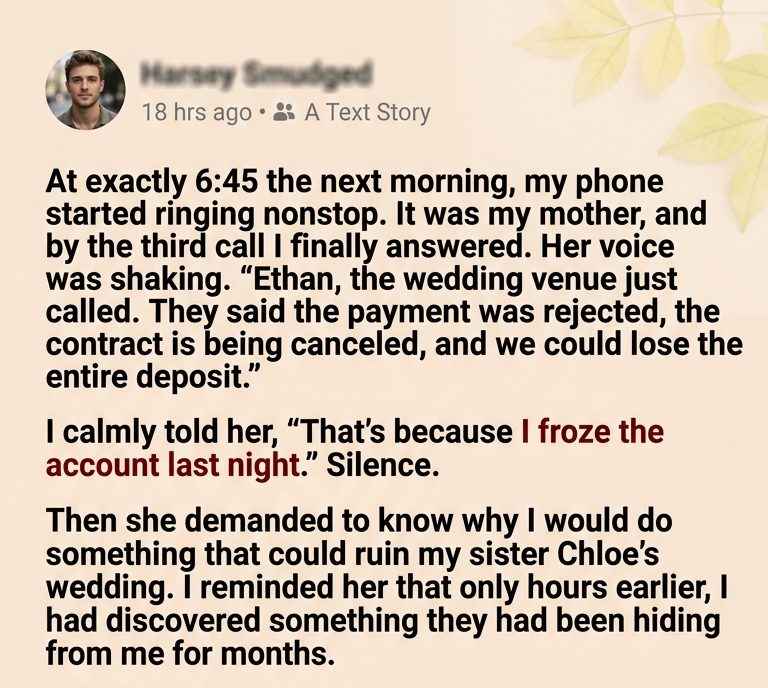
At exactly 6:45 the next morning, my phone started ringing nonstop.
It was my mother.
I watched her name flash across the screen three times before I finally answered.
“Ethan!”
Her voice was shaking.
“The wedding venue just called. They said the payment was rejected, the contract is being canceled, and we could lose the entire deposit.”
I sat up in bed.
“I know.”
There was silence.
Then she whispered,
“What did you do?”
“I froze the account.”
My mother inhaled sharply.
“Why would you do that?”
“Because I found the transfers.”
She stopped breathing for a moment.
I didn’t need to explain which transfers.
She knew.
For months, my parents had been quietly moving money from an account connected to our grandfather’s estate.
The total was $410,000.
And they had spent it on my younger sister Chloe’s wedding.
A designer wedding gown.
Imported flowers.
A private chef.
Luxury transportation.
A destination bachelorette trip.
A resort.
A photographer.
A rehearsal dinner.
Everything Chloe had ever dreamed about.
Everything my grandfather’s estate was never supposed to pay for.
My parents thought they had hidden the trail.
They hadn’t.
What they didn’t know was that I still had access to the original trust records.
Our grandfather had named me as one of the people responsible for monitoring certain estate assets.
I hadn’t touched the money.
I hadn’t even looked at the accounts in months.
Until two nights earlier.
That was when I noticed something strange.
A $38,500 transfer.
Then another.
$62,000.
Then $19,800.
Then $41,000.
The descriptions looked legitimate.
Event services.
Family distribution.
Administrative expenses.
But when I opened the underlying records, the names didn’t match.
The money had been routed through several accounts.
Eventually, it landed in accounts controlled by vendors connected to Chloe’s wedding.
I spent the entire night reviewing documents.
By sunrise, I had found $410,000.
And I had found something worse.
A document with my name on it.
It was dated eighteen months earlier.
I called my mother.
“Where is Dad?”
“He’s here.”
“Put him on.”
She hesitated.
Then I heard my father’s voice.
“Ethan.”
“Did you move $410,000 from Grandpa’s estate?”
Silence.
“It’s complicated.”
“No.”
I opened the spreadsheet again.
“It’s actually very simple.”
My father sighed.
“Chloe needed help.”
“She needed a wedding.”
“She needed to get married.”
“Those aren’t the same thing.”
My mother suddenly took the phone.
“You don’t understand.”
“Then explain it.”
She started crying.
“If Chloe doesn’t get married, everything falls apart.”
I stared at the wall.
“What does that mean?”
Neither of them answered.
“Mom.”
Finally she whispered,
“Chloe isn’t marrying him because she loves him.”
I felt cold.
“What?”
“She has to marry him.”
“Why?”
My mother began crying harder.
“Because of the agreement.”
“What agreement?”
“The family agreement.”
I knew there was one.
Grandfather had created several structures around the estate because he didn’t trust people to handle money responsibly.
But I had never seen every document.
My mother continued.
“If Chloe doesn’t marry Nathan before the deadline, the trust changes.”
“How?”
“The money doesn’t go to her.”
I stared at the phone.
“Who gets it?”
My mother whispered,
“You.”
I didn’t speak.
“What?”
“The final document names you.”
My stomach tightened.
“What does it say?”
My mother wouldn’t answer.
“Mom.”
She finally said,
“Grandfather created a condition.”
“What condition?”
“If either of his grandchildren married into the family of his business partner, a portion of the estate would remain protected.”
I frowned.
“Nathan’s family?”
“Yes.”
I knew Nathan’s family owned a large construction company.
Grandfather had worked with them decades ago.
But I didn’t understand.
“Why would Grandpa care who Chloe married?”
“Because he knew their family.”
“How?”
My father finally spoke.
“Your grandfather believed Nathan’s father was trying to gain access to the estate.”
I sat silently.
“Then why are you paying for Chloe’s wedding?”
My father didn’t answer.
I knew immediately.
“You’ve been trying to satisfy the condition.”
My mother whispered,
“Yes.”
“So Chloe gets the inheritance?”
“Not exactly.”
“Then what?”
“The marriage activates a separate agreement.”
I stood and walked to my desk.
“Send me the document.”
My mother hesitated.
“Mom. Send it.”
Ten minutes later, the document arrived.
I opened it.
And read it twice.
Then a third time.
Grandfather had anticipated exactly what my parents had done.
The trust prohibited estate funds from being used to finance a beneficiary’s wedding unless the expenses were directly connected to a documented family obligation.
Chloe’s wedding did not qualify.
More importantly, the trust had a protection clause.
If anyone knowingly diverted estate funds for personal expenses, that person’s access could be suspended.
My name appeared as the temporary administrator.
My parents had known.
They had hidden it from me.
And they had been using the money because they believed Chloe’s marriage would trigger a separate financial arrangement that would protect them from losing control of certain family assets.
But there was one problem.
Nathan’s family didn’t know about the trust.
And Chloe didn’t know either.
My sister thought our parents were simply paying for her dream wedding.
I called her.
She answered immediately.
“Ethan?”
“Did you know Mom and Dad used estate money for your wedding?”
Silence.
“What?”
“Four hundred ten thousand dollars.”
“That can’t be true.”
“It is.”
“No.”
“I have the records.”
She started crying.
“I thought they paid for it.”
“They did.”
“With what?”
“The inheritance.”
She was silent.
Then she whispered,
“Why?”
“Apparently because your marriage triggers a clause.”
“What clause?”
“I don’t know everything yet.”
She began crying harder.
“I don’t want Grandpa’s money.”
“Then tell Mom and Dad.”
“I will.”
“You need to.”
She hung up.
That afternoon, Chloe arrived at my house.
She looked exhausted.
“I’m sorry.”
“For what?”
“I didn’t know.”
“I believe you.”
She sat down.
“Mom said Grandpa wanted me to have everything.”
I shook my head.
“He didn’t.”
She looked confused.
“What did he want?”
“Control.”
She frowned.
“Control?”
“Not over us.”
I opened the trust documents.
“Over the people who might try to control us.”
She read the pages.
Her expression changed.
“My name isn’t even on this.”
“No.”
“Why?”
“Because Grandpa didn’t want your marriage determining your inheritance.”
She stared at the page.
Then she said,
“Then why did Mom say I had to marry Nathan?”
I didn’t know.
So I called our attorney.
The attorney explained everything.
Grandfather had been concerned that Nathan’s family might attempt to acquire certain assets connected to the estate.
The marriage condition wasn’t designed to reward Chloe.
It was designed to prevent the family from transferring assets without independent oversight.
My parents had misunderstood—or deliberately twisted—the provision.
They believed if Chloe married Nathan before the deadline, they could restructure the family assets afterward.
They had been spending estate money to create a wedding that would satisfy their interpretation of the agreement.
But the agreement didn’t say that.
They had been risking the entire estate for nothing.
The wedding venue was only one part of it.
There were dozens of vendors.
Some deposits were refundable.
Others weren’t.
The $410,000 was already under review.
Some expenses could be recovered.
Others had been paid directly to vendors and would require negotiations.
Then we discovered something even worse.
My mother had signed a declaration stating that the wedding expenses were “ordinary family support.”
That declaration was false.
The estate attorney recommended that the family stop all transfers immediately.
My parents were furious.
My father called me.
“You’ve destroyed your sister’s wedding.”
“No.”
“You froze the money.”
“Yes.”
“You’re punishing Chloe.”
“No.”
I paused.
“I’m stopping you from spending money that isn’t yours.”
He became quiet.
Then he said,
“You don’t understand what this family will lose.”
I replied,
“Maybe that’s because you never trusted me enough to tell me the truth.”
The wedding was postponed.
Not canceled.
Postponed.
Chloe called Nathan.
She told him everything.
To his credit, he didn’t walk away.
He said they didn’t need a $410,000 wedding.
They could get married at the courthouse.
Or wait.
Or cancel it entirely.
He didn’t care.
That was when Chloe realized something.
She had spent months believing the wedding had to happen.
But it didn’t.
She wasn’t trapped.
She had simply been surrounded by people telling her she was.
Six weeks later, Chloe and Nathan got married.
It wasn’t at the luxury resort.
There were no imported flowers.
No private chef.
No designer production team.
There were forty-two guests.
My father wore the same suit he had worn to my graduation.
My mother carried a small bouquet.
And Chloe wore a simple dress she bought herself.
I stood beside her before the ceremony.
She looked nervous.
“Do I look okay?”
I smiled.
“You look like yourself.”
She smiled back.
“That’s enough.”
“Yes.”
After the ceremony, our attorney finalized the estate review.
A significant portion of the $410,000 was recovered or credited back through vendor cancellations and repayment agreements.
Other disputed amounts were handled through formal accounting.
My parents lost control over the estate accounts.
An independent administrator was appointed.
Chloe was protected from being blamed for decisions she hadn’t made.
And I stopped being the person everyone treated as though I was merely “the difficult one.”
Because the truth was finally out.
Grandfather hadn’t left us money because he wanted us to fight over it.
He had left us safeguards because he knew exactly what money could do to a family.
Months later, Chloe and I visited his grave.
She stood quietly for a while.
Then she said,
“I thought Grandpa left me a wedding.”
I smiled sadly.
“He left you something better.”
“What?”
“A choice.”
She looked at me.
“What do you mean?”
“You thought you had to marry someone to keep the family happy.”
I paused.
“You didn’t.”
She nodded.
“I know.”
Then she smiled.
“And you?”
“What about me?”
“You finally got to choose too.”
I looked at her.
“Choose what?”
“Whether to keep protecting people who kept secrets from you.”
I laughed softly.
“That one I’m still working on.”
She hugged me.
And for the first time in months, there was no argument about money.
No secret account.
No hidden document.
No family member trying to control the future.
Just two siblings standing beside the grave of the man who had quietly planned for the day we would need to protect ourselves from the people we loved.
And I finally understood why my name had been written on that final document.
Grandfather hadn’t chosen me because he trusted me more than Chloe.
He had chosen me because he knew I would read the fine print before signing away the family.