When I first moved into my house, I expected the usual surprises.
A loose cabinet hinge.
A dripping faucet.
A few boxes I’d forgotten to unpack.
What I didn’t expect was an electricity bill that nearly doubled within the first few months.
At first, I blamed myself.
Maybe the air conditioner was running more.
Maybe the old refrigerator was inefficient.
Maybe I was using more lights than I realized.
But nothing about my routine had changed.
I lived alone.
I worked similar hours.
I cooked about as often as before.
I used the same appliances.
Yet my electricity consumption kept climbing.
I started saving every bill.
After several months, the pattern became impossible to ignore.
My usage wasn’t gradually increasing.
It had jumped.
And then it stayed unusually high.
One evening, I decided to walk around the outside of the house after dark.
That’s when I saw it.
A thick extension cable ran from my neighbor’s garage, across the narrow space between our properties, and straight toward an outdoor outlet attached to the back of my house.
For several seconds, I simply stared at it.
I followed the cable with my eyes.
It disappeared beneath some landscaping near his garage.
I walked closer.
There was no question.
It was plugged directly into my outlet.
The next morning, I knocked on his door.
He opened it holding a coffee mug.
“Can I help you?”
I pointed toward the cable.
“Is that yours?”
He glanced behind me.
“Oh.”
“Why is your extension cord plugged into my house?”
He shrugged.
“I’ve been using that outlet.”
“Why?”
“Your outlet is closer.”
I stared at him.
“You’re running electricity to your garage from my house.”
“It’s not a big deal.”
“It is when I’m paying for it.”
He laughed.
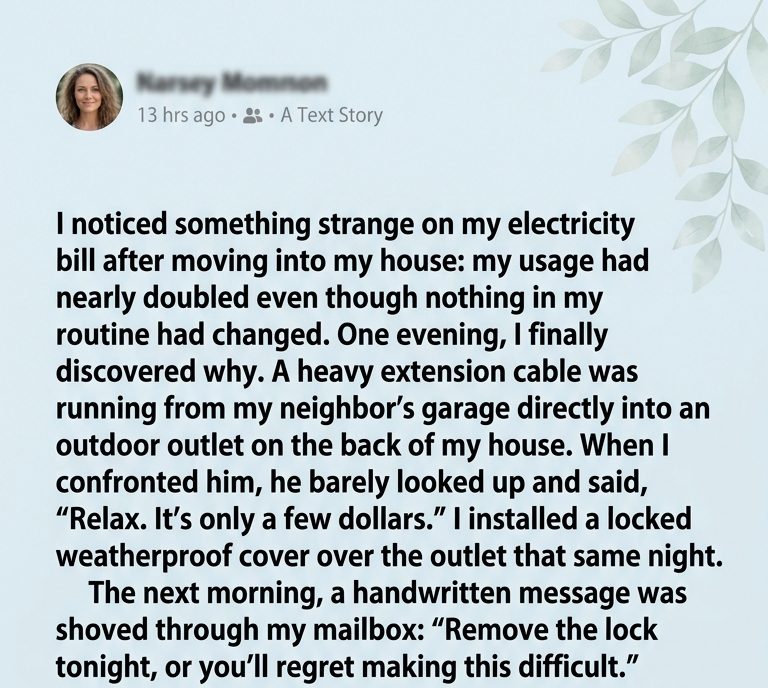
“Relax. It’s only a few dollars.”
I couldn’t believe what I was hearing.
“How long have you been doing this?”
“Not that long.”
“How long?”
He shrugged again.
“Maybe a while.”
I told him to unplug it.
He rolled his eyes.
“Fine.”
I went back inside.
That evening, I installed a locked weatherproof cover over the outlet.
I also checked my security cameras to make sure they were recording properly.
I thought that would be the end of it.
It wasn’t.
The next morning, I found a folded piece of paper shoved through my mailbox.
There were six words written across it.
Remove the lock tonight, or you’ll regret making this difficult.
I stood there holding the note.
Suddenly, this wasn’t about a few dollars of electricity.
I photographed it.
I put it inside a plastic sleeve.
Then I saved copies of the security-camera footage.
I also pulled out every electricity bill I’d kept since moving into the house.
I made a spreadsheet.
Month by month.
Usage.
Cost.
Dates.
Anything unusual.
The numbers were disturbing.
My consumption had been significantly higher during periods when I’d barely been home.
I called the electric company.
They sent someone to inspect the meter.
The technician examined it for nearly an hour.
Then he asked me a question.
“Do you know if anyone has accessed your meter?”
“Not that I know of.”
He looked at me.
“There’s something unusual here.”
“What?”
He couldn’t tell me much until they completed an investigation.
But he advised me to file a police report.
I did.
An officer came to the house that afternoon.
I showed him the cable.
Then the note.
Then the footage.
Then the bills.
He looked at everything carefully.
“Do you have any idea how long this has been happening?”
“I don’t know.”
He studied the electricity records.
“We may be able to figure that out.”
Two days later, another officer came by.
This time, he wasn’t alone.
They had spoken with the utility company.
The utility records showed something strange.
My neighbor’s electricity usage was unusually low compared with the equipment he appeared to be running.
His garage contained several power-hungry tools.
He had multiple freezers.
A heating system.
Workshop equipment.
Yet his meter showed surprisingly little consumption.
Mine showed the opposite.
That changed the entire investigation.
Police reviewed my camera footage.
They saw my neighbor connecting and disconnecting cables.
They saw him entering my yard when he thought I wasn’t home.
They also found footage from another nearby property showing a similar cable.
Then another.
Apparently, I wasn’t the only person.
Investigators eventually traced several suspicious connections to my neighbor.
When they obtained authorization to search his garage, they found something far more serious than an extension cord.
Behind a large shelving unit was a concealed electrical setup.
It had been designed to bypass his own meter.
Some of the wiring had been altered in ways that allowed certain equipment to draw power without it being fully recorded by his meter.
The utility company estimated the losses over several years.
The amount was substantial.
But the investigation didn’t stop there.
They found records showing that he had been tracking electricity consumption at neighboring properties.
There were handwritten notes.
Addresses.
Dates.
Descriptions of exterior outlets.
He hadn’t simply noticed that my outlet was convenient.
He had deliberately identified houses where he could connect equipment without immediately being noticed.
And then officers found another room.
It was locked.
Inside were shelves filled with electrical components, tools, wire, meters, and equipment that investigators believed had been used in unauthorized electrical modifications.
But what caught one officer’s attention wasn’t the equipment.
It was a stack of envelopes.
Each contained photographs of properties around the neighborhood.
My house was among them.
So were several others.
The photographs showed outdoor outlets, meters, garages, side entrances, and utility boxes.
I felt sick when police showed me copies.
“Why would he photograph my house?”
The officer didn’t answer immediately.
“We’re still trying to determine what all of this means.”
A few days later, I learned.
The photographs weren’t just about electricity.
My neighbor had been documenting security weaknesses around the neighborhood.
Which houses had cameras.
Which homes had side gates.
Which garages were usually open.
Which properties appeared empty during the day.
The electricity theft had given him a reason to walk around and inspect properties without immediately raising suspicion.
That was the part that frightened me.
I had originally thought I’d caught someone stealing electricity.
Instead, I’d stumbled onto something much larger.
Investigators eventually discovered that my neighbor had been involved in other unauthorized activities involving stolen equipment and improperly obtained property.
Not everything found in his garage belonged to someone else, and not every item resulted in charges.
But there was enough evidence for authorities to pursue several separate allegations.
Meanwhile, the utility company calculated the electricity losses.
My own bills were reviewed.
They determined that a significant portion of my unusual consumption was consistent with unauthorized usage from my property.
I wasn’t responsible for paying for the stolen electricity.
The utility company adjusted my account after completing its investigation.
My neighbor was ordered to pay restitution connected to the confirmed losses, along with fines and other costs resulting from the case.
The exact amount was far more than the “few dollars” he’d laughed about.
But money wasn’t what stayed with me.
It was the note.
Remove the lock tonight, or you’ll regret making this difficult.
That sentence became part of the evidence.
The handwriting was compared with samples connected to him.
Investigators also matched his movements to the security footage.
The evidence became difficult for him to explain.
Eventually, he stopped trying.
One afternoon, an officer called me.
“We’ve finished the main part of the investigation.”
“Is he going to jail?”
“There are multiple factors involved, and the case is still moving through the legal process.”
I understood.
“What should I do now?”
“Keep your cameras running.”
I almost laughed.
“I was planning to.”
The officer became serious.
“Don’t confront him.”
“I won’t.”
“And if you see anyone entering your property, call us.”
I did exactly that.
My neighbor eventually moved away while the legal proceedings continued.
The house was sold.
Before he left, he never apologized.
Not once.
I never got the satisfaction of hearing him admit that he had been wrong.
But I didn’t need it.
The locked outlet stayed on my house.
So did the cameras.
And every time I looked at that little weatherproof cover, I remembered how close I’d come to ignoring the entire thing.
If he’d simply asked to borrow electricity, I probably would have said no.
If he’d apologized when I confronted him, maybe I would have thought it was a stupid neighborhood disagreement.
Instead, he threatened me.
That threat forced me to preserve evidence.
The evidence forced investigators to look deeper.
And looking deeper revealed that the cable connected to my house was only the visible part of a much larger operation.
Months later, I received a letter from the utility company confirming the final adjustment to my account.
For the first time since moving into the house, my electricity bill reflected what I actually used.
It was almost half what I’d been paying.
I taped the letter to my refrigerator.
Not because of the money.
Because it reminded me that I hadn’t imagined the problem.
The numbers had been telling me something was wrong.
I just hadn’t known what.
One evening, while taking out the trash, I looked across the street toward my old neighbor’s empty garage.
The place was dark.
Quiet.
Ordinary.
It was strange to think that behind those walls had been a hidden electrical system, stacks of property photographs, and records documenting the routines of people who had no idea they were being watched.
I had started with a simple question:
Why is my electricity bill so high?
I thought I was investigating a few dollars of stolen power.
Instead, I uncovered a neighbor who had been stealing electricity from multiple homes, bypassing his own meter, documenting other people’s properties, and hiding equipment connected to a much larger pattern of misconduct.
And the strangest part was this:
If he hadn’t dismissed me with those four careless words—
“Relax. It’s only a few dollars.”
—I might never have looked closely enough to discover any of it.