My son gave me the DNA kit as a joke.
It was Mother’s Day, and after dinner, Daniel handed me a small box wrapped in bright yellow paper.
“It’s time we finally figure out where all those strange family traits came from,” he said, laughing.
I laughed too.
The box contained a home DNA testing kit that cost $129.
I’d never been particularly interested in genealogy. My mother had always told me our family was ordinary. My father had been born in Ohio, she said, and she had grown up in Pennsylvania. There were no dramatic stories, no famous relatives, no mysterious branches of the family tree.
Just us.
My parents.
Me.
I was their only child.
At least, that’s what I had believed my entire life.
So I mailed the sample away and forgot about it.
Six weeks later, I received an email.
Your DNA results are ready.
I opened the website while sitting at my kitchen table.
The results were mostly what I expected.
Then I saw a section labeled:
New Family Matches
There was one match at the top.
A man named Michael.
He lived in Ohio.
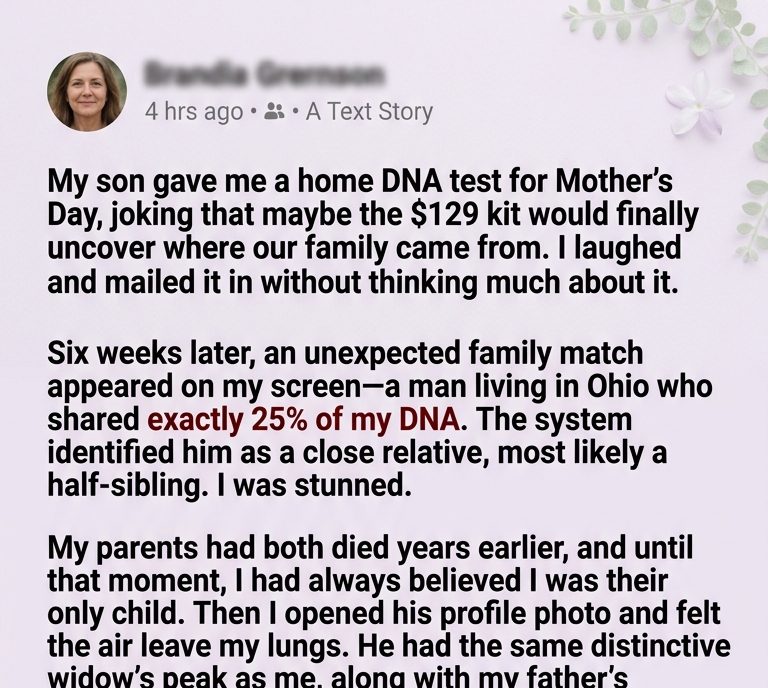
The system estimated that we shared approximately 25 percent of our DNA.
I stared at the screen.
Twenty-five percent.
The site identified him as a close relative, with the strongest possibilities being half-sibling, grandparent, aunt or uncle, or another similarly close relationship.
I immediately dismissed the grandparent and aunt possibilities.
Michael was obviously too young.
Then I saw his age.
He was only three years older than me.
My stomach tightened.
I clicked his profile.
His photograph loaded.
And I stopped breathing for a moment.
He had my father’s eyebrows.
Not similar eyebrows.
My father’s eyebrows.
Heavy, dark, slightly angled downward toward the center.
Then I noticed his widow’s peak.
Mine.
I leaned closer to the screen.
“No,” I whispered.
There had to be another explanation.
I called my son.
“Daniel?”
“Happy Mother’s Day again, Mom.”
“Do you remember the DNA test you gave me?”
He laughed.
“Already regretting it?”
“I found someone.”
His laughter stopped.
“Someone?”
“A man in Ohio. The website says we share twenty-five percent of our DNA.”
There was silence.
“That’s a lot, Mom.”
“I know.”
“Could he be a cousin?”
“Maybe.”
But even as I said it, I didn’t believe it.
I spent the next hour comparing photographs.
Michael’s eyebrows.
My eyebrows.
Michael’s nose.
My father’s nose.
The shape of his jaw.
My father’s jaw.
There were too many similarities.
That night, I couldn’t sleep.
The next morning, I called my aunt Evelyn.
She was ninety-one.
She was also the last surviving person who had known my parents as young adults.
I didn’t tell her everything.
I simply said,
“Aunt Evelyn, have you ever heard of a man named Michael Hart who lived in Ohio?”
The silence on the other end was immediate.
Not confusion.
Recognition.
My heart began pounding.
“Aunt Evelyn?”
She breathed in slowly.
“Why are you asking me that?”
“I found him through a DNA test.”
Another silence.
Then she whispered,
“Please tell me you didn’t find him through a DNA test.”
I sat upright.
“What do you know?”
Her voice became quieter.
“He isn’t your half-brother.”
I frowned.
“Then what is he?”
She didn’t answer.
“Aunt Evelyn, what is going on?”
Finally she said,
“Your parents never told you because they were afraid of what would happen if you discovered who he really was.”
My hands started shaking.
“Who is he?”
She began crying.
And then she said the words that changed everything.
“Michael is your father’s son.”
I closed my eyes.
“So he is my half-brother.”
“No.”
I opened my eyes.
“What?”
“He isn’t your father’s biological son.”
I felt completely lost.
“Then why did you say he’s my father’s son?”
“Because that’s what everyone believed.”
“Everyone?”
She took a shaky breath.
“Your father raised him for the first few years.”
I couldn’t speak.
Then Aunt Evelyn told me a story I had never heard.
Before my parents married, my father had been stationed near a military base in Ohio.
He had met a woman named Margaret Collins.
They dated briefly.
Then my father returned home.
A few months later, Margaret gave birth to a boy.
Michael.
My father believed the baby was his.
But there was a problem.
Margaret was married to another man.
My father confronted her.
She insisted Michael was his.
He believed her.
For several years, he secretly sent money.
Then, when Michael was almost four, something happened.
Margaret’s husband discovered the payments.
A violent argument followed.
My father was threatened.
And suddenly, Margaret disappeared from his life.
Years later, my father met my mother.
They married.
Then I was born.
I listened silently as Aunt Evelyn continued.
“Your father always believed Michael was his first son.”
“Then why isn’t he?”
“Because your father eventually discovered the truth.”
I gripped the edge of the table.
“How?”
Aunt Evelyn hesitated.
“A letter.”
“What letter?”
“From Margaret.”
Apparently, Margaret had written my father years later.
She confessed that Michael was not his biological child.
She had lied because she needed financial help.
Michael’s biological father was another man.
My father was devastated.
But by then, he had already developed a bond with the boy.
He wanted to tell him.
He wanted to bring him into the family.
But Margaret refused.
She threatened to disappear with Michael permanently.
My father eventually stopped fighting.
Then came the part that shocked me most.
Aunt Evelyn said,
“Your father didn’t want you to know.”
“Why?”
“Because Michael’s biological father wasn’t some stranger.”
I felt cold.
“Who was he?”
Aunt Evelyn didn’t answer immediately.
Then she said,
“Your mother’s older brother.”
I stared at the wall.
“My uncle?”
“Yes.”
My mother had an older brother named Thomas.
He had died when I was twelve.
I barely remembered him.
He had always been described as difficult.
He rarely visited.
My mother almost never spoke about him.
I had never understood why.
Aunt Evelyn explained.
Thomas had been secretly involved with Margaret before my parents married.
Michael was his biological son.
My father discovered the truth only after Thomas accidentally revealed it during an argument.
My mother knew.
And somehow, my father knew.
But nobody told me.
I couldn’t understand.
“Why would my parents hide something like that?”
“Because Thomas had a dangerous temper,” Aunt Evelyn said.
“He threatened people.”
“Who?”
“Your father.”
She explained that Thomas had struggled with addiction and financial problems.
He had borrowed money from several people, including my father.
When my father threatened to expose the truth about Michael, Thomas threatened to ruin his marriage.
My mother begged my father to keep quiet.
And he did.
For decades.
I hung up the phone feeling like the floor had disappeared beneath me.
That evening, I searched through my mother’s old belongings.
After she died, I’d kept several boxes in the attic.
Most contained photographs, Christmas cards, and old letters.
I opened one box I hadn’t touched in years.
At the bottom was an envelope.
My father’s handwriting was on the front.
For my daughter, if she ever asks.
My hands trembled.
I opened it.
Inside was a letter dated seventeen years earlier.
My father had written it shortly after my mother died.
He had apparently intended to tell me everything.
But he never did.
The letter began:
My daughter,
There is something about our family that your mother and I spent most of our lives trying to protect you from.
I stopped reading.
I needed to sit down.
The next paragraph explained Michael.
But there was something else.
Something I hadn’t expected.
My father wrote that he had eventually met Michael again when Michael was twenty-six.
They had spent one afternoon together.
My father had asked whether Michael wanted to know the truth about his biological father.
Michael said no.
He already suspected.
But he didn’t want the truth.
He wanted the man who had raised him to remain his father.
So my father walked away.
And he never told me.
At the end of the letter, my father wrote:
If you ever meet him, don’t punish him for a secret he never chose.
I cried for a long time.
Not because I had discovered a brother.
Because I realized my father had carried an enormous secret for most of his life.
The next morning, I sent Michael a message.
I didn’t tell him everything.
I simply wrote:
I believe we may be connected in a way neither of us expected. Would you be willing to talk?
He replied six hours later.
I’ve been waiting for someone from your family to find me.
I stared at that sentence.
Then I called him.
Our first conversation lasted nearly three hours.
Michael told me he had always suspected something was wrong.
His mother had given him very little information.
When she died, he found an old photograph of my father.
On the back was written:
The man who should have known.
Michael had spent years wondering what it meant.
Then my DNA test appeared.
We eventually did a second test through a separate laboratory.
The result confirmed that Michael and I were half-siblings.
But there was another surprise.
He wasn’t related to my mother.
He wasn’t related to my father.
His biological father was my uncle Thomas.
Which meant something strange had happened in the way our family story had been remembered.
My father had not been Michael’s biological father.
But my father had loved him like a son.
And somehow, that mattered more than biology.
Michael and I began talking regularly.
At first, it was awkward.
We didn’t know how to refer to each other.
Brother?
Half-brother?
Family?
Eventually, Michael said,
“You can just call me Mike.”
I laughed.
“That’s convenient.”
He laughed too.
And slowly, we began filling in the missing pieces of each other’s lives.
He had two daughters.
I had one son.
He loved woodworking.
My father had loved woodworking.
He hated raisins.
So did my father.
He had the same habit of tapping his fingers against the table when he was thinking.
I had watched my father do that thousands of times.
One afternoon, Mike sent me an old photograph.
It showed my father standing beside a little boy.
The boy was about four years old.
Mike.
My father was holding his hand.
I stared at the photograph for a long time.
Then I noticed something written on the back.
My father’s handwriting.
Not my blood, but my boy.
I cried again.
But this time, they were different tears.
I had spent weeks thinking the DNA test had exposed a family secret.
In reality, it had uncovered something much more complicated.
My family had lied.
My parents had hidden the truth.
My uncle had created a situation that had affected generations.
But my father had made a choice.
He could have rejected Michael.
Instead, he loved him.
Years later, when I finally told my son Daniel everything, he sat quietly.
Then he said,
“So that little $129 gift changed the entire family.”
I smiled.
“Yes.”
He shook his head.
“I thought I was buying you a fun Mother’s Day present.”
“You did.”
He looked at me.
“Do you regret taking the test?”
I thought about the old letter.
The photograph.
The man in Ohio who had spent his entire life wondering where he belonged.
Then I shook my head.
“No.”
Because sometimes the truth doesn’t destroy a family.
Sometimes it finally gives the missing pieces somewhere to belong.
Mike wasn’t a stranger anymore.
He wasn’t a secret.
He wasn’t an uncomfortable name buried in an old letter.
He was my brother.
And after seventy-four years of believing I was an only child, I finally understood something my father had written decades earlier.
Family isn’t always created by the blood running through your veins.
Sometimes it’s created by the people who choose to love you, even when the truth gives them every reason to walk away.