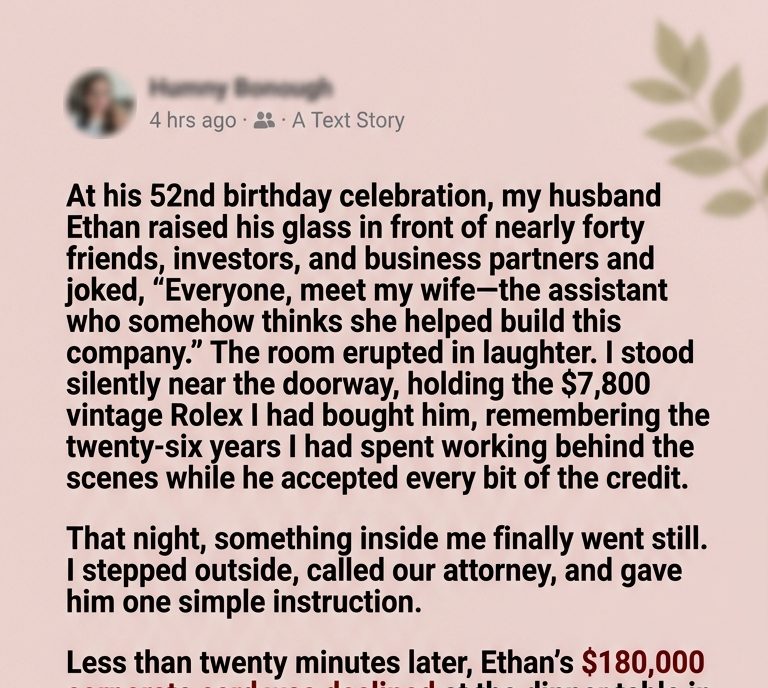
The room erupted in laughter.
I didn’t.
I stood near the doorway of the private dining room, holding the gift box in both hands.
Inside was a vintage Rolex I had spent $7,800 finding.
It was Ethan’s 52nd birthday.
Forty people had gathered around him.
Friends.
Investors.
Business partners.
Executives.
People who had known him for years.
People who believed every success bearing his name had come from his brilliance alone.
Ethan raised his glass.
“Everyone, meet my wife.”
He pointed at me.
“The assistant who somehow thinks she helped build this company.”
More laughter.
I smiled.
Not because it was funny.
Because something inside me had finally gone completely still.
For twenty-six years, I had been the person behind Ethan’s success.
When we started, there was no company.
There was a folding table in our apartment.
One borrowed laptop.
Three clients.
And a man with enormous ambition.
I believed in him.
So I worked.
I handled invoices.
Contracts.
Payroll.
Vendor negotiations.
Scheduling.
Taxes.
Cash flow.
Client relationships.
When Ethan traveled, I kept the company running.
When he wanted to expand, I built the financial projections.
When he made mistakes, I fixed them quietly.
When investors asked questions he couldn’t answer, I prepared the information he needed.
Over the years, the company grew.
Five employees became twenty.
Twenty became eighty.
Eventually, it became a company worth tens of millions.
And Ethan became the face of it.
People called him visionary.
Brilliant.
Fearless.
I never corrected them.
Because I loved him.
Or at least, I loved the man I thought he was.
That night, however, something changed.
After the laughter died down, Ethan looked at me.
“Come on, sweetheart. Don’t look so serious.”
I walked toward him.
I placed the gift box on the table.
“Happy birthday.”
He opened it.
When he saw the Rolex, his expression brightened.
“Now that’s more like it.”
He held it up.
“See? She may not understand business, but she knows how to shop.”
Another wave of laughter.
I simply nodded.
Then I walked outside.
I sat in the back of my car.
And I called our attorney.
His name was David.
He had handled our corporate documents for almost fifteen years.
He answered immediately.
“Everything okay?”
“No.”
There was a pause.
“What happened?”
“I want you to activate the documents we discussed.”
He became quiet.
“Are you certain?”
“Yes.”
“Tonight?”
“Tonight.”
He exhaled.
“Then I’ll make the calls.”
Twenty minutes later, Ethan’s corporate card stopped working.
He discovered it while trying to pay the restaurant bill.
At first, he laughed.
“Banking error.”
Then he tried again.
Declined.
He pulled out another card.
Declined.
The restaurant manager approached.
“Mr. Parker, I’m sorry.”
Ethan’s smile disappeared.
“Call the bank.”
His phone rang.
It was his CFO.
Ethan answered.
“What?”
I couldn’t hear the other side.
But I watched his expression change.
The confidence disappeared.
“What do you mean the account is restricted?”
He looked toward me.
Then walked outside.
His voice rose.
“Who authorized this?”
He listened.
Then turned toward me.
“WHAT DID YOU DO?”
I remained calm.
“You should probably check the company records before blaming the bank.”
He stared at me.
His phone rang again.
He looked at the screen.
And froze.
The caller wasn’t his banker.
Not his CFO.
Not our attorney.
It was someone else.
Someone Ethan had spent decades pretending didn’t matter.
His older brother, Michael.
Michael had disappeared from Ethan’s public life years ago.
According to Ethan, they had had a falling-out.
He always said Michael had been irresponsible.
Jealous.
Bitter.
He told everyone Michael had walked away from the family business before it became successful.
What nobody knew was that Michael had never actually walked away.
He had been watching.
And he had documents.
Ethan answered.
“Michael.”
I couldn’t hear his brother clearly.
But I heard one sentence.
“Check the original shareholder agreement.”
Ethan went pale.
“What about it?”
Michael replied:
“You’ve been acting like you own everything for twenty-six years.”
A pause.
“You don’t.”
Ethan looked at me.
Michael continued.
“Your wife does.”
Ethan’s face went white.
I walked toward him.
He lowered the phone.
“What did you do?”
“I didn’t do anything tonight.”
“Then why are my accounts frozen?”
“Because you don’t control them the way you thought you did.”
He laughed nervously.
“This is insane.”
“No.”
I looked at him.
“It’s documented.”
He shook his head.
“You’re my wife.”
“Exactly.”
I reminded him of the night we started the company.
He had been twenty-six.
I had been twenty-four.
We had signed the first incorporation documents together.
At the time, Ethan didn’t have enough money to fund the company.
I did.
I had inherited a small investment portfolio from my grandfather.
I put nearly $190,000 into the business.
Ethan contributed his work.
I contributed the capital.
We agreed that I would hold the controlling shares while he handled operations.
It was supposed to be temporary.
But the company grew quickly.
Ethan became the public face.
Investors came in.
New shares were issued.
Different holding companies were created.
And somewhere along the way, Ethan began acting as though the company belonged entirely to him.
But the original agreement had never disappeared.
Neither had my shares.
Michael had known.
Why?
Because he had been the lawyer who drafted the original corporate structure.
Ethan had spent decades telling everyone Michael had nothing to do with the business.
That was technically true.
Michael wasn’t running the company.
But he was still the custodian of the original records.
And he had never released them.
The reason was simple.
My grandfather had required that the original investment remain protected.
If I ever became separated from Ethan through divorce, fraud, or documented financial misconduct, my controlling interest would remain mine.
Ethan knew about the clause.
But he had convinced himself I would never use it.
Until that birthday.
Until he humiliated me in front of everyone.
David, our attorney, arrived the next morning.
He brought documents.
Lots of them.
“Here’s the situation,” he said.
“The corporate card wasn’t canceled because of a random banking problem.”
He placed a folder on the table.
“Your wife is still the controlling shareholder of the holding company that owns the majority interest in the operating company.”
Ethan stared at him.
“That’s impossible.”
David looked at me.
“No. It’s very possible.”
He opened another folder.
“Over the years, several transactions were executed under your authority.”
Ethan swallowed.
“Which transactions?”
“Loans.”
“Investments.”
“Asset transfers.”
“Consulting agreements.”
“Some legitimate.”
“Some questionable.”
Ethan looked at me.
“You’ve been investigating me?”
I shook my head.
“No.”
“Then how?”
“Because I was the one reviewing the records every quarter.”
His expression changed.
He had forgotten.
For twenty-six years, I had been the person who reconciled the books.
He had assumed that meant I was merely administrative.
He never understood that I knew exactly where the money went.
I knew which subsidiaries existed.
I knew which accounts had unusual activity.
I knew which contracts had been amended.
I knew which assets had been transferred.
And I had kept copies.
Not because I planned revenge.
Because I had always been responsible.
Then David showed him something else.
A series of transfers totaling nearly $4.6 million.
Money that had moved through consulting entities connected to people close to Ethan.
Some transactions were legitimate.
Others had no supporting documentation.
And one transfer had gone toward a private investment Ethan had never disclosed to the board.
Ethan stared at the pages.
“That’s not what you think.”
“I don’t need to think anything,” I said.
“The auditors can determine what happened.”
His face tightened.
“You did this because I embarrassed you?”
“No.”
I looked at him.
“You embarrassed yourself.”
The board called an emergency meeting.
I attended.
Ethan sat at the other end of the table.
For the first time in twenty-six years, nobody introduced me as his wife.
The chairman said:
“Mrs. Parker is the controlling shareholder.”
Ethan stared at the table.
The board voted to suspend him as CEO pending an independent review.
The corporate card was restored under new authorization procedures.
The financial accounts were reviewed.
And the independent investigation eventually confirmed that Ethan had made several unauthorized transfers.
Some were recoverable.
Some were legitimate business expenses that had been poorly documented.
Others were personal transactions disguised as company expenses.
He wasn’t immediately charged with anything.
The investigation had to distinguish mistakes from intentional misconduct.
But the consequences were already enormous.
His reputation changed overnight.
The investors who had laughed at me at his birthday stopped laughing.
Several apologized.
One of them approached me after the board meeting.
“I owe you an apology.”
I nodded.
“You do.”
He looked uncomfortable.
“I honestly thought Ethan built everything.”
“So did everyone else.”
“Why didn’t you ever say anything?”
I looked toward the conference room.
“Because I thought we were married.”
That was the hardest truth.
I had protected Ethan because I believed protecting him meant protecting our family.
Instead, I had protected a man who eventually used my silence as proof that I didn’t matter.
The divorce took almost a year.
Ethan fought for control.
He claimed I had only been involved in administrative work.
The documents proved otherwise.
My original investment.
The shareholder agreement.
The corporate records.
The financial models.
The board minutes.
The archived emails.
Everything existed.
In the end, I retained my controlling interest.
Ethan received the portion of the company he was legally entitled to after the valuation and settlement.
I didn’t destroy the business.
I rebuilt it.
We hired a professional CEO.
The board added independent directors.
Financial controls were strengthened.
And for the first time, the company had governance that didn’t depend on one person’s ego.
Months later, I received a package.
Inside was the vintage Rolex I had bought Ethan.
He had returned it.
There was a note.
I never deserved this.
I stared at it for a long time.
Then I put the watch back in its box.
I didn’t sell it.
I didn’t give it away.
I kept it.
Not as a reminder of Ethan.
As a reminder of the woman I had been before that birthday.
The woman who stood silently while everyone laughed.
The woman who had spent twenty-six years making someone else look brilliant.
The woman who finally realized that being quiet wasn’t the same as being powerless.
Years later, the company was stronger than ever.
I became chairwoman.
Not because I wanted revenge.
Because I finally understood what I had built.
One afternoon, I walked past a conference room where a group of young employees were discussing the company’s history.
One of them said:
“Do you know who actually started this company?”
Another answered:
“Ethan Parker.”
I smiled.
Then the senior director corrected him.
“No.”
She pointed toward the hallway.
“Her.”
They turned.
I didn’t say anything.
I simply kept walking.
Because after twenty-six years of being called an assistant, I no longer needed to explain who I was.
The records already did that.
And somewhere in an old corporate archive was the original agreement Ethan had forgotten about.
The agreement that proved something he had spent decades denying:
He had built the company.
But he had never built it alone.
And the woman he publicly reduced to an “assistant” had quietly been holding the one thing his entire empire could never survive without.
Control.