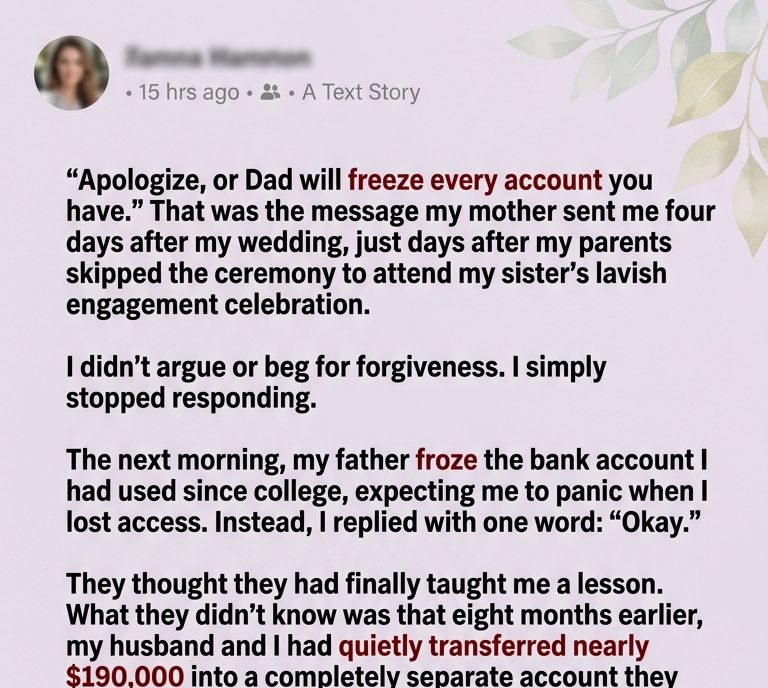
“Apologize, or Dad will freeze every account you have.”
That was the message my mother sent me four days after my wedding.
I read it twice while sitting at our kitchen table, my husband, Daniel, making coffee across from me.
I didn’t answer.
The message wasn’t surprising because of what it threatened. It was surprising because my parents had spent years teaching me that family meant obedience, sacrifice, and never making them uncomfortable.
Apparently, my wedding had finally made them uncomfortable enough to punish me.
Three days before the message arrived, my parents had skipped my wedding.
Not because they were sick.
Not because there had been an emergency.
They simply chose my younger sister Ava’s lavish engagement celebration instead.
My wedding was a small ceremony with about forty guests. Daniel and I had deliberately kept it simple. We had been saving for a house, and neither of us wanted to begin our marriage buried under unnecessary debt.
My parents had complained about it for months.
“You should have waited,” my mother said when I told her our date.
“Ava’s engagement party is going to be much bigger,” my father added.
I remember looking at him and asking, “Are you saying you won’t come?”
He shrugged.
“We’ll see.”
They never did.
On the morning of my wedding, I checked my phone more times than I want to admit.
No message from Dad.
No message from Mom.
At two o’clock, my sister posted photos from her engagement celebration.
There were flowers everywhere.
A champagne wall.
A string quartet.
A five-tier cake.
And my parents standing behind Ava, smiling proudly for the cameras.
I stared at the screen for several seconds.
Then I turned the phone face down.
Daniel noticed.
“Are they coming?”
I shook my head.
He didn’t ask anything else.
He just took my hand.
“Then let’s make today about us.”
So I did.
I married the man who had never made me feel like I had to compete for a place in his life.
And for one day, I forgot about my family.
Four days later, my mother sent the message.
Apologize, or Dad will freeze every account you have.
I knew exactly what she meant.
My father had access to an old joint account I had opened when I was nineteen.
At the time, my parents had insisted it was safer.
“You’re young,” Dad had said. “If something happens, we can help.”
I had never bothered closing it because I rarely used it.
But over the years, my father had started treating that account as if it were part of his financial territory.
He knew I still had it.
He knew my old direct deposit information was connected to it.
And he apparently believed freezing it would scare me.
I didn’t respond to my mother.
The next morning, my debit card stopped working.
Then I received an automated notification.
Account access restricted.
I smiled.
Daniel looked up from his laptop.
“What?”
“My father froze it.”
He stared at me.
“Are you okay?”
“I’m fine.”
“You’re not angry?”
“I was angry years ago.”
That was the truth.
What my parents didn’t know was that eight months earlier, Daniel and I had made a decision.
We were done mixing our future with my family’s expectations.
We had been saving aggressively for our own home and emergency fund. Between our savings, investments we had liquidated, and money from a small business account, we had moved nearly $190,000 into a separate account at a different bank.
My parents had no access to it.
They didn’t even know it existed.
The account my father controlled contained less than $500.
And there was another detail they had completely forgotten.
For years, I had been helping them financially.
Not occasionally.
Consistently.
Their mortgage was $3,400 a month.
I had been paying part of it.
I covered two car payments.
I paid their insurance several times when they were short.
I paid property taxes.
And when Ava needed help with private university debt, my parents had convinced me that contributing was “the right thing to do for family.”
Over several years, I had transferred tens of thousands of dollars.
I never kept score.
At least, I thought I didn’t.
But after my father froze my account, I opened my banking records.
I began adding everything.
Mortgage payments.
Insurance.
Car payments.
Tax payments.
Tuition transfers.
Emergency expenses.
The number eventually crossed $230,000.
I stared at the total.
Then Daniel said quietly, “You realize they aren’t punishing you.”
“I know.”
“They’re punishing themselves.”
I looked at him.
He was right.
So I made one decision.
I stopped one payment.
Only one.
The mortgage.
I didn’t cancel their insurance.
I didn’t touch anything else.
I simply didn’t send the next $3,400.
For the first week, nothing happened.
Then my mother called.
I didn’t answer.
She called again.
Then my father.
Then my sister.
Finally, my mother left a voicemail.
“You need to fix this immediately.”
I deleted it.
Two days later, another voicemail arrived.
This time, my father’s voice sounded different.
“Call me.”
Not angry.
Not commanding.
Worried.
I still didn’t call.
The following morning, a letter arrived at my parents’ house.
I didn’t know about it until my mother called me screaming.
“What did you do?”
I was standing in our living room.
“Nothing.”
“You know exactly what you did!”
“I really don’t.”
“You stopped the mortgage payment!”
“Yes.”
“You can’t do that!”
“Apparently I can.”
There was silence.
Then she said something that made me sit down.
“The bank sent us a notice.”
“What kind?”
“A notice about the loan.”
“What does it say?”
She didn’t answer.
My father took the phone.
“Your mother and I need to talk to you.”
“I’ve been trying to talk to you for years.”
“It’s not that simple.”
“Then explain it.”
Another silence.
Finally, Dad said, “Come over.”
I almost refused.
But something in his voice made me curious.
So Daniel drove me there.
When we arrived, my parents were sitting at the dining table.
My mother looked exhausted.
My father had a folder in front of him.
Ava was there too.
She wouldn’t look at me.
Dad pushed the folder across the table.
“Read this.”
I opened it.
The first page was a mortgage statement.
The second was a notice from the lender.
The third was an older document.
I recognized the house immediately.
My parents had bought it twelve years earlier.
But the name on the document wasn’t only theirs.
My name was there.
I looked at Dad.
“What is this?”
He rubbed his forehead.
“We refinanced the house six years ago.”
“I know.”
“No. You don’t.”
He pointed to the signature.
“This loan was approved partly because of your income.”
I felt my stomach tighten.
“What?”
“They listed you as a supporting borrower.”
“I never signed this.”
My father looked away.
My mother began crying.
Then the truth came out.
Years earlier, when my parents were struggling financially, Dad had discovered that my credit and income were strong enough to help them refinance.
He had obtained paperwork through a family acquaintance who worked in lending.
He told me at the time that I was only being added as an emergency contact.
I had signed several documents without reading every page because I trusted him.
But the paperwork had apparently given my parents access to financing they otherwise might not have qualified for.
Over the years, they had used the increased borrowing capacity to refinance the mortgage and consolidate other debts.
Some of the transactions were legitimate family expenses.
Others were not.
A portion of the money had gone toward Ava’s education.
Another portion had helped Dad’s struggling business.
And a significant amount had been used to cover debts my parents had never told me about.
Then the mortgage lender had recently reviewed the account.
Because my payments had stopped, the lender noticed inconsistencies in the account history and began requesting updated documentation.
That was the letter my mother had been screaming about.
I looked at my father.
“You put me on this loan without telling me what it was?”
“I thought you understood.”
“No.”
“We were trying to protect the family.”
“You froze my bank account because I got married, but you used my name to protect yours?”
He didn’t answer.
Ava finally spoke.
“It wasn’t supposed to get this far.”
I turned toward her.
“What does that mean?”
She started crying.
“I knew they were using some of the money for my school.”
“Did you know my name was on the loan?”
She shook her head.
“No.”
I believed her.
At least partly.
My father reached into the folder and pulled out another document.
“There is more.”
I didn’t want to look.
But I did.
It was an agreement showing that my parents had been trying to transfer part of their remaining debt into a private family arrangement.
My name appeared again.
This time, my signature did not.
Someone had attempted to use my old signature from another document.
Daniel immediately took photographs.
“This needs to go to an attorney,” he said.
Dad looked at him.
“Don’t make this bigger than it is.”
Daniel’s voice remained calm.
“You already made it bigger than it is.”
That was the first time my father looked afraid.
We left that afternoon.
The next morning, I contacted an attorney.
She reviewed everything carefully.
She told me something I needed to hear.
“Don’t assume every document is fraudulent just because the situation is ugly. Some of these transactions may have been authorized. We need to separate what you actually signed from what you didn’t.”
That became the beginning of a long financial review.
Bank records were collected.
Old loan applications were requested.
Signatures were compared.
Payment histories were reconstructed.
Some documents were legitimate.
Some were questionable.
And one signature was clearly not mine.
My parents eventually admitted that Dad had asked an old family acquaintance to “help complete” paperwork years earlier.
He claimed he never intended to steal from me.
He said he believed everything would eventually be repaid.
That explanation didn’t erase what had happened.
Neither did the fact that I had willingly helped them for years.
The attorney helped me remove myself from the obligations I had never authorized and formally separate my finances from theirs.
But there was one thing I couldn’t get back.
Trust.
My mother eventually called me.
She didn’t threaten me.
She didn’t demand an apology.
She simply said, “I miss you.”
I answered quietly.
“I miss the parents I thought I had.”
She cried.
So did I.
But I didn’t immediately forgive them.
Forgiveness wasn’t the same thing as giving them access again.
My parents had to refinance their house without using my income.
They sold one of their cars.
My father closed the business account that had been mixed with family money.
Ava took responsibility for her remaining student debt.
And I stopped being the person everyone called whenever something went wrong.
Months later, my mother asked if she could meet me for coffee.
I agreed.
She arrived early.
When I sat down, she pushed a small envelope across the table.
Inside was a handwritten letter.
It wasn’t an excuse.
It was an apology.
She admitted that she and Dad had spent years treating me like the reliable daughter because they believed I could handle anything.
They had confused my strength with permission.
They had mistaken my generosity for an obligation.
And when I finally built a life that didn’t revolve around them, they reacted as though I had betrayed them.
My mother wrote one sentence that stayed with me.
“We were so busy making sure you would always be there for us that we never stopped to ask whether we were there for you.”
I folded the letter.
“I don’t know if things will ever be the same.”
She nodded.
“They shouldn’t be.”
That answer surprised me.
She continued.
“Maybe they should be better.”
I didn’t promise anything.
But I agreed to coffee again.
It took time.
There were still boundaries.
Separate finances.
No access to accounts.
No signing documents on anyone’s behalf.
No secret loans.
No guilt when I said no.
And, most importantly, no more measuring love by how much money I was willing to give.
A year later, my parents finally sold their old house.
They moved into something smaller.
My father paid me back part of what he owed.
Not all of it.
But enough to prove that he understood repayment was no longer optional.
My relationship with Ava also changed.
She eventually apologized for accepting help without understanding where it came from.
I told her she didn’t have to spend the rest of her life feeling guilty.
She just had to make different choices going forward.
As for my father, it took him the longest.
One evening, he called me.
“I was wrong,” he said.
I didn’t say anything.
He continued.
“I thought freezing your account would make you come back.”
“It almost did.”
“What stopped you?”
I looked at Daniel sitting beside me.
“Realizing I didn’t need your permission to build my own life.”
There was a long silence.
Then Dad said, “I’m proud of you.”
For the first time, I believed he meant it.
My parents had tried to teach me a lesson by taking away access to an account containing less than five hundred dollars.
Instead, they taught themselves something far more expensive.
They learned that dependence can look like power until the person you’ve been depending on finally walks away.
And I learned something too.
Helping your family is an act of love.
But allowing someone to control your life because you once helped them is not.
Sometimes the healthiest boundary isn’t a dramatic confrontation.
Sometimes it’s simply stopping one payment, closing one account, and refusing to keep financing a life that keeps asking you to apologize for having one of your own.