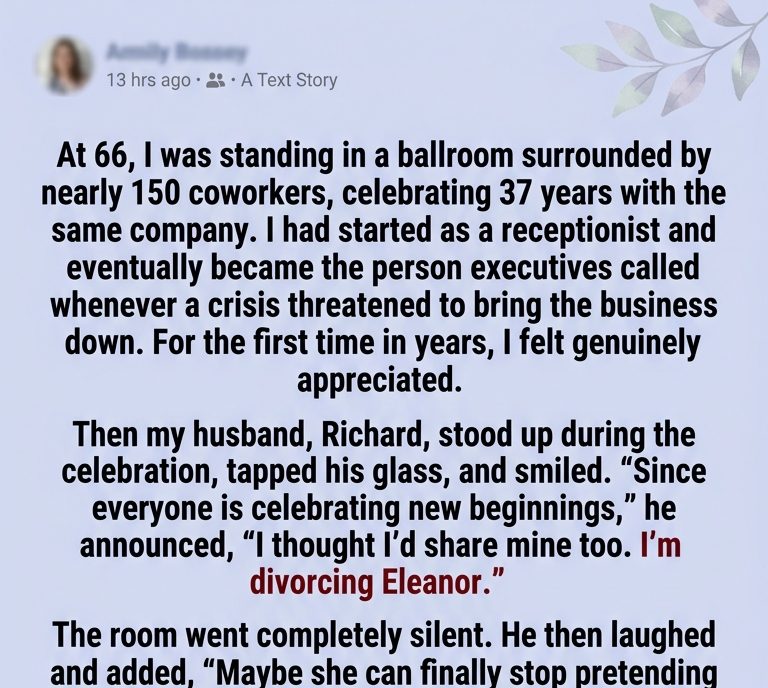
At sixty-six, I had spent thirty-seven years building a career at a company that had become a second home to me. I started as a receptionist, answering phones and greeting visitors, and gradually became the person executives turned to when million-dollar contracts were falling apart, critical decisions had to be made, or a crisis threatened the entire business.
I never chased recognition. I simply believed that if someone trusted me with a responsibility, I should do everything in my power to fulfill it.
That evening, nearly 150 coworkers gathered in a beautifully decorated ballroom to celebrate my retirement. There were flowers on the tables, photographs from different stages of my career, and a large screen displaying moments I had almost forgotten.
For the first time in years, I felt that people truly understood how much my work had meant.
My husband, Richard, sat beside me in an expensive suit. We had been married for thirty-eight years, and I had hoped he would share my happiness. Although he often dismissed my career as an ordinary office job, I thought he might finally appreciate what I had accomplished.
I was wrong.
Halfway through dinner, Richard stood and tapped his glass with a spoon.
“Since everyone is celebrating new beginnings,” he announced with a broad smile, “I thought I’d share mine too. I’m divorcing Eleanor.”
At first, I thought I had misunderstood him.
Then he laughed.
“Maybe she can finally stop pretending that her little office job ever mattered.”
The room fell silent.
I could feel 150 pairs of eyes turning toward me. Some people looked shocked. Others lowered their heads, embarrassed to witness such cruelty. A woman from accounting reached for my hand beneath the table, but I could barely move.
Richard leaned back in his chair as if he had just delivered the funniest joke of the evening.
For years, he had complained that I worked too much. He had mocked the late nights, the emergency calls, and the meetings I attended while he sat at home watching television. When I received promotions, he called them meaningless titles. When executives thanked me, he said they were merely being polite.
I had convinced myself that his behavior came from insecurity and that one day he would understand.
Now, standing in front of my colleagues, he had made it clear that he had never intended to understand.
I rose slowly, determined not to give him the satisfaction of watching me cry.
“I think I’ll go home,” I said quietly.
But before I reached the ballroom doors, our longtime company president, Mr. Whitaker, stood up and took the microphone.
“Eleanor, please wait a moment.”
His voice was calm, but something in his expression made me stop.
He turned toward Richard.
“Actually, Richard, I was saving one final announcement for tonight.”
Richard’s smile remained for only a second.
Mr. Whitaker looked around the room.
“Many of you know Eleanor as the woman who has spent thirty-seven years keeping this company organized, steady, and moving forward. But there is something most of you don’t know. Eleanor has never been merely an employee here.”
My heart began to pound.
Nearly twenty years earlier, Mr. Whitaker had asked me to join a small group responsible for evaluating a struggling division of the business. The division was losing money, its senior leadership was divided, and several major clients were preparing to leave.
I had worked behind the scenes for months, reviewing contracts, identifying unnecessary expenses, and helping negotiate a plan that saved hundreds of jobs.
The company recovered.
What nobody knew was that during those difficult years, I had also been quietly investing my own savings in a separate employee investment program established under the company’s approved ownership plan. I had started with modest contributions and continued reinvesting the distributions over the years.
I never discussed it with coworkers. I certainly never discussed it with Richard.
He believed my salary was the whole story.
Mr. Whitaker continued.
“Twenty years ago, Eleanor made a decision that helped protect this company during one of the most difficult periods in its history. She accepted responsibility when others refused, and she helped us preserve jobs when the future was uncertain.”
He paused, allowing the words to settle.
“Today, I am pleased to announce that Eleanor’s retirement comes with something more than our gratitude.”
A presentation appeared on the screen behind him.
It showed a summary of my years of service, the major projects I had helped lead, and the investment units I had accumulated through the employee ownership plan.
My hands began to tremble.
Mr. Whitaker explained that the plan’s most recent independent valuation had established the current value of my vested holdings. Combined with the retirement benefits I had earned, the total represented a substantial financial foundation for the next chapter of my life.
Then he turned toward me.
“Eleanor, you have earned the right to decide what comes next.”
The room erupted in applause.
I stood frozen, unable to process the generosity of the moment.
Richard, however, had stopped smiling.
He stared at the screen, then at me, as though he were seeing a stranger for the first time.
But Mr. Whitaker wasn’t finished.
“There is one more thing,” he said. “Effective today, Eleanor has accepted our invitation to serve as a paid adviser to the board during the transition to our new leadership team.”
More applause followed.
I had known the board was considering the arrangement, but I had not expected the announcement that evening. The role would allow me to help train the next generation of leaders without returning to the exhausting schedule I had maintained for decades.
It was an opportunity I had earned.
And it was mine.
Then Mr. Whitaker looked directly at Richard.
“You said Eleanor’s career never mattered. Let me correct that. She helped build the company you’re standing in.”
The six words hit the room like a thunderclap.
Richard’s face turned pale.
For the first time that evening, he had nothing to say.
I returned to my seat, but I no longer felt humiliated. The embarrassment was still there, yet it had been joined by something stronger: the realization that I did not have to defend the value of my life to someone determined to diminish it.
After the speeches, coworkers surrounded me with congratulations and warm embraces. Several told me they had always admired my patience and professionalism. One of the younger managers admitted that she had modeled her own approach to leadership on mine.
I thanked them, but my attention kept drifting toward Richard.
He stood near the bar, speaking urgently to a man from the finance department. When he noticed me looking, he approached with a strained smile.
“Eleanor, we should talk privately.”
“About what?”
“About what happened. I was trying to make a joke.”
“You announced our divorce in front of my coworkers,” I replied. “Then you insulted the work I spent thirty-seven years doing.”
He glanced around to see whether anyone was listening.
“You know how I am. I didn’t think everyone would take it so seriously.”
I studied him.
That was the explanation he had always used. He had not meant to hurt me. He had not thought it through. He had only been joking.
Every insult became smaller in his mind once he had delivered it.
“Richard,” I said, “you seemed very certain when you stood up there.”
His expression changed.
“Look, I was frustrated. But now that I understand your financial situation, maybe we should slow down and discuss everything before making any decisions.”
There it was.
He had been ready to leave me when he believed I had little more than a pension and a modest salary. Now that he understood I had independent assets and a future beyond the company, he wanted to reconsider.
I felt a sadness deeper than anger.
For decades, I had hoped Richard would someday take pride in me. I had imagined us traveling after retirement, visiting places we had postponed seeing, and enjoying quiet mornings without rushing to work.
But I had been planning a future with a man who appeared to value me only when he discovered what I could provide.
“I didn’t ask you to announce a divorce tonight,” I told him. “But you did. I won’t pretend it didn’t happen just because you regret the timing.”
He reached for my hand.
I stepped back.
“Let’s go home,” he insisted. “We can work this out.”
“I’ll arrange somewhere to stay tonight. Tomorrow, I’ll contact a lawyer.”
His jaw tightened.
“You’re really going to throw away thirty-eight years over one stupid speech?”
“No,” I said. “I’m finally taking those thirty-eight years seriously.”
I left the ballroom with my head held high.
That night, I stayed with my younger sister, Margaret. She made tea, listened while I described everything that had happened, and didn’t once tell me that I should forgive him for the sake of the marriage.
When I finished, she asked one question.
“Eleanor, if your boss hadn’t made that announcement, would Richard still want a divorce?”
I looked down at my cup.
I already knew the answer.
The following morning, I consulted an attorney who specialized in divorce and property matters. We reviewed my retirement benefits, my ownership-plan documents, and the financial records I had kept over the years.
I learned that some of the assets would need careful classification under the applicable law and that the divorce would require a proper financial settlement. I would not make decisions based on anger or assumptions. Everything would be documented and handled fairly.
Richard called repeatedly.
His first messages were apologetic. Then they became defensive. Eventually, he began suggesting that I was being selfish by refusing to return home.
I did not respond to every message.
Instead, I focused on the things I had postponed for years.
I met friends for lunch without checking the time. I walked through the botanical gardens on weekday mornings. I began planning a trip to Italy that I had once abandoned because Richard said it was too expensive and inconvenient.
Most importantly, I began to understand that retirement did not mean my life was ending.
It meant I finally had the freedom to decide how I wanted to spend it.
The divorce process took several months. There were difficult conversations, financial disclosures, and negotiations. I insisted on professional advice and a fair resolution rather than allowing either of us to dictate the terms.
Richard eventually acknowledged that he had underestimated me. He said he had become accustomed to thinking of my work as something that happened around his life instead of something I had built for myself.
I listened, but I did not mistake his regret for a guarantee that he would change.
We reached a settlement through our lawyers and went our separate ways.
On the day the divorce became final, I sat alone on my balcony with a cup of coffee. There was no dramatic celebration, no sudden feeling that every wound had vanished.
There was simply peace.
A few weeks later, I returned to the company for my first advisory meeting. The new leadership team welcomed me warmly, and I spent the morning helping them navigate a complicated client transition.
At the end of the meeting, a young employee approached me.
“Can I ask you something?” she said.
“Of course.”
“How did you stay confident for so long when people didn’t seem to recognize what you were doing?”
I considered the question.
“I wasn’t always confident,” I admitted. “Sometimes I worked hard because the job needed doing. Sometimes I kept going because I was afraid that if I stopped, everything would fall apart. And sometimes I stayed quiet when I should have spoken up for myself.”
She listened carefully.
“But I learned something,” I continued. “Someone else’s inability to recognize your value doesn’t erase it. And you don’t have to spend the rest of your life trying to convince them.”
She smiled and thanked me.
As I walked out of the building, I thought about the woman who had started there thirty-seven years earlier. She had been nervous, inexperienced, and eager to prove herself. She could never have imagined the responsibilities she would one day carry or the people whose lives her decisions would affect.
She also could not have imagined standing in a ballroom while her husband publicly dismissed everything she had accomplished.
But I wished I could tell that younger woman one thing.
You do not need to make yourself smaller to keep someone comfortable.
At sixty-six, I was no longer trying to prove my worth to Richard or anyone else. My career had meaning before that announcement, and it still had meaning afterward. My investments were the result of years of discipline, not a reward bestowed on me by a man in a suit. My future belonged to me.
On my first free Monday after the divorce, I woke up early, made coffee, and opened the travel folder I had kept in a drawer for almost a decade.
The first destination was Florence.
I booked the trip.
Then I stood by the window, watching sunlight spill across the floor, and smiled.
For thirty-seven years, I had helped other people find a way through their most difficult days.
Now, at sixty-six, I was finally building a life in which I no longer had to earn the right to be respected.
And that was a new beginning worth celebrating.