My younger sister, Lauren, had always been the person everyone noticed first.
She was charming, spontaneous, and effortlessly good at making a room revolve around her. I loved her, but growing up beside her had taught me that family celebrations rarely stayed mine for long.
Still, when I found out I was expecting my first child, I promised myself that things would be different.
I was thirty-two, happily married to Michael, and finally preparing for the family I had dreamed about for years. My mother, Diane, seemed excited when I announced the pregnancy. She called almost every day to ask about the baby and volunteered to help organize my shower.
For once, I allowed myself to believe that I would get to enjoy a moment without competing for attention.
The baby shower was held on a sunny Saturday afternoon at my aunt’s house. Pink and white flowers covered the tables, tiny decorations hung from the ceiling, and a beautiful cake stood in the center of the dining room.
Nearly thirty relatives and friends attended.
I wore a pale blue dress and spent the afternoon opening gifts, laughing with friends, and imagining what life would be like when my daughter finally arrived.
Then Lauren stood up.
She tapped her glass and smiled at everyone.
“I have some news, too.”
My mother immediately turned toward her.
Lauren placed a hand over her stomach.
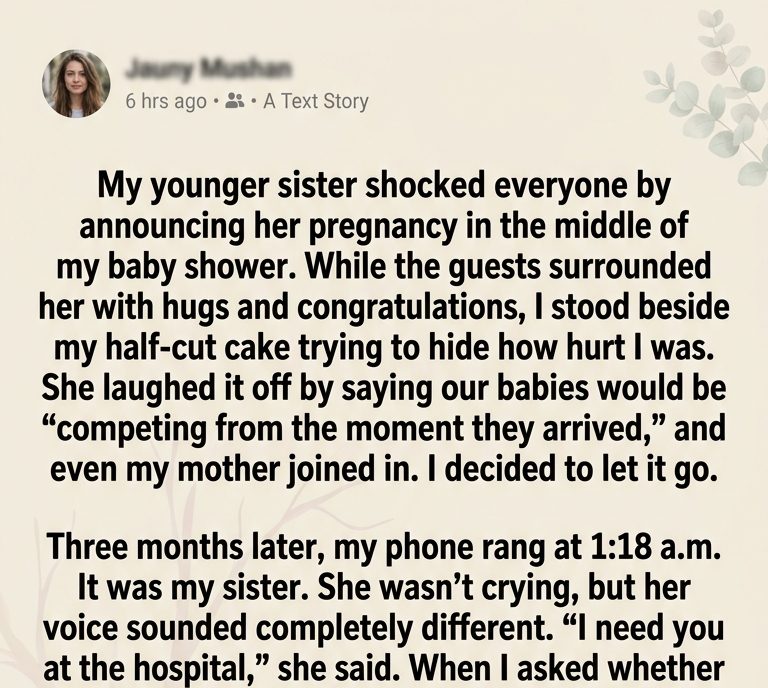
“I’m pregnant!”
For a second, the room was silent.
Then everyone erupted.
My mother rushed over to hug her. My aunts began asking questions about the due date. Cousins gathered around Lauren, and someone started crying happy tears.
I stood beside the cake with a gift ribbon still tangled around my wrist.
I genuinely was happy that my sister was expecting a baby. I had imagined our children growing up together, sharing holidays, and becoming close.
But the announcement had swallowed my baby shower whole.
Lauren glanced at me and laughed.
“Looks like our babies will be competing from the moment they arrive!”
A few relatives chuckled.
My mother joined in.
“Well, Lauren has always known how to make an entrance.”
Everyone laughed again.
I smiled because I didn’t know what else to do.
Then I excused myself and went to the bathroom, where I sat on the closed toilet lid and tried not to cry.
Michael found me a few minutes later.
“You don’t have to pretend you’re fine,” he said gently.
“I’m happy for her,” I whispered. “I just wanted one afternoon where I didn’t feel invisible.”
He wrapped his arms around me.
“You deserved that afternoon.”
I returned to the party and finished opening my gifts. I didn’t confront Lauren, and I didn’t ask my mother why she had encouraged the comparison. I told myself that everyone had been excited, that pregnancy made people emotional, and that I shouldn’t turn a joyful occasion into a family argument.
Three months passed.
My daughter grew stronger with every ultrasound, and Michael and I began preparing the nursery. Lauren’s pregnancy was progressing, too, although our relationship had become awkward. She called occasionally, but most conversations somehow became comparisons between our babies.
Whose nursery was bigger.
Whose due date came first.
Whose child would be the first grandchild to walk.
I stopped responding to the comparisons and focused on my own pregnancy.
Then, at 1:18 a.m. on a Thursday morning, my phone rang.
Lauren’s name appeared on the screen.
I answered immediately.
“Lauren? What’s wrong?”
“I need you at the hospital.”
Her voice was so different from the cheerful voice I knew that I sat upright in bed.
“Is it the baby? Are you okay?”
“The baby is fine.”
I heard her take a shaky breath.
“This is about Mom.”
My heart began racing.
“What happened to her?”
“Please just come. Bring Michael if you want, but don’t call anyone else yet.”
She ended the call.
Michael was already getting dressed. We drove through nearly empty streets, neither of us speaking much. I kept calling Lauren back, but she didn’t answer.
When we arrived, a nurse directed us to a consultation room near the maternity ward.
Lauren was sitting alone in a chair.
Her face was pale, and her eyes were swollen. Our mother’s old brown handbag sat beside her on another chair.
I had seen that handbag hundreds of times. Mom carried it everywhere, even after the leather handles began to crack. She kept appointment cards, old receipts, medication lists, and photographs inside it.
“What happened?” I asked, rushing toward her.
Lauren shook her head.
“Mom is stable. She’s being evaluated, and the doctors are looking into something they found in her medical records.”
I stopped.
“Then why are we here at one in the morning?”
Lauren picked up a sealed envelope and slid it across the table.
“I found out why Mom always treated us differently.”
She stared at me.
“And I don’t know how to tell you without destroying everything you believe about our family.”
I opened the envelope.
The first page was a medical report. Near the top were my mother’s name, her date of birth, and a reference to an old hospital admission.
Beneath that was a line that made my entire body go cold.
PATIENT: DIANE MILLER. HISTORICAL GENETIC TESTING AND MATERNAL LINEAGE REVIEW.
I looked up.
“What is this?”
Lauren pressed both hands over her mouth.
“I found it in her handbag when I went to visit her yesterday. There was a second envelope with it, and I recognized the name of the clinic. I called them because I thought something might be wrong with her medication.”
She swallowed.
“They told me the records had been released to Mom years ago. They couldn’t explain anything over the phone, but they confirmed that the report was genuine.”
I looked back at the pages.
The report referred to a genetic screening that had been conducted years earlier, apparently after a medical concern involving our family. Several sections were marked for physician review.
One paragraph mentioned a discrepancy between the family history recorded in my mother’s file and the results of a later genetic assessment.
I read it twice.
Then I reached the second page.
The report suggested that the woman listed as my biological mother might not be my biological mother at all.
I stared at the words until they blurred.
“Lauren,” I whispered. “What does this mean?”
She began crying.
“I don’t know everything. That’s why I called you.”
I sat down.
For thirty-two years, I had believed I understood my family. I knew our childhood stories, the photographs on our walls, the relatives who visited every holiday, and the reasons my mother gave for treating us differently.
Lauren had always been the favorite.
Mom attended every school event she could, praised Lauren’s achievements, and defended her mistakes. When I received a scholarship, Mom said I was fortunate. When Lauren won a small award, Mom invited the entire family to dinner.
When I asked why the difference existed, she always told me that Lauren needed more encouragement.
I had accepted that explanation for years.
Now a medical report was suggesting that the difference might have a much older origin.
“Did you ask Mom about this?” I said.
Lauren nodded.
“She was at home when I found the envelope. I asked her what it meant, and she started crying. Then she told me she needed to speak to her doctor before explaining anything.”
“Why didn’t you call me then?”
“Because I didn’t know what to say. I thought maybe I had misunderstood the report.”
She wiped her cheeks.
“But there was another document in the envelope. A letter with your name on it.”
She reached into the handbag and pulled out a folded sheet of paper.
The handwriting was our mother’s.
My name was written across the front.
I opened it carefully.
My dear Emily,
If you are reading this, then the secret I have carried for most of your life has finally come to light.
I should have told you years ago.
I stopped reading.
My throat tightened.
Michael pulled his chair closer but didn’t interrupt.
I continued.
You were born during the most frightening period of my life. I was young, your father and I were struggling, and I made a decision that I believed would protect you. But as the years passed, fear became an excuse for silence.
There is something I need you to understand before you read the rest of this letter. None of this changes the fact that I raised you, loved you, and considered you my daughter.
But I know that love does not erase the right to know the truth.
My hands trembled.
I looked at Lauren.
“Did you read the rest?”
She nodded.
“I couldn’t understand all of it. I thought we should read it together.”
I continued.
When you were a baby, I learned that there had been an error involving the records at the hospital where you were born. The circumstances were complicated, and I was told that the matter had been corrected. I believed the explanation because I wanted to believe it.
Years later, when a medical concern led to genetic testing, I learned that the truth was not as simple as I had been told.
I stopped again.
An error at the hospital?
I looked at Michael.
He was as stunned as I was.
The letter continued.
The genetic findings suggested that you and I were not biologically related in the way I had always believed. I was advised to pursue further testing and a formal investigation. I did not do enough. I was frightened that if I asked too many questions, I would lose the child I had raised.
I convinced myself that keeping the secret was protecting you. In truth, I was protecting myself from having to face what I did not know.
My eyes filled with tears.
I had always thought the differences between Lauren and me were proof that I somehow deserved less of our mother’s affection.
Now I was reading that she had been hiding a secret about my birth for decades.
But I still didn’t know what had happened.
“Where did she go?” I asked. “The hospital? Did they find the other family?”
Lauren shook her head.
“That’s what I was trying to understand.”
I reached the final paragraph.
There is one more thing. The woman who gave birth to you was not a stranger who abandoned you. I have reason to believe she spent years trying to find you, but I do not know what happened after the hospital records became confused.
Her name was Margaret Ellis.
I stared at the name.
Margaret Ellis.
It meant nothing to me.
I had never heard it before.
The letter contained a phone number and the name of a medical records specialist who had handled the old case. There were also photocopies of documents with sections missing and handwritten notes that appeared to have been added over the years.
Lauren leaned forward.
“Emily, I think Mom has known for a long time that something happened when you were born. I think she was afraid to tell us.”
I couldn’t speak.
I had spent my life wondering why Mom seemed to hold Lauren closer. I had imagined a hundred explanations, and none of them had prepared me for this.
But the report did not establish the complete circumstances. It raised serious questions about my biological origins, and the old hospital records needed to be verified. The letter was our mother’s account, written from her own memory and fear, not a substitute for a proper investigation.
I wiped my face.
“Where is Mom now?”
“She’s in a room upstairs. She became dizzy when I confronted her. The doctors are checking her blood pressure and making sure she is okay.”
I stood immediately.
“I’m going to see her.”
Lauren grabbed my wrist.
“Please don’t hate her before you hear everything.”
I looked at my sister.
“I don’t know what I feel yet.”
She released my hand.
We went upstairs together.
Our mother was awake when we entered her room. She looked smaller than I remembered, her gray hair spread across the pillow, her old handbag sitting on the bedside table.
The moment she saw the letter in my hand, she began to cry.
“Emily.”
I stood at the foot of the bed.
“Is it true?”
She covered her mouth.
“Which part?”
“All of it. The hospital. The records. Margaret Ellis. Am I not your biological daughter?”
Mom closed her eyes.
For a long time, she didn’t answer.
Then she whispered, “I don’t know every part of the truth. But I know the records were wrong, and I know I was afraid to keep asking questions.”
I pulled a chair beside her bed.
“How could you let me grow up without knowing?”
She began explaining that shortly after my birth, a hospital employee had contacted her about a discrepancy in the newborn records. At the time, she had been exhausted and overwhelmed. She was told the issue was administrative and that the hospital would investigate.
The matter seemed to disappear.
Years later, after a doctor noticed inconsistencies in the family medical history, genetic testing raised further questions. Mom had been told that more investigation was needed, but she never completed it.
Instead, she kept the paperwork.
She said she had been afraid that someone would take me away or that I would stop loving her if I learned the truth.
“That was never your decision to make alone,” I said.
“I know.”
Her voice broke.
“I know that now.”
I asked about Lauren.
“Did you treat her differently because she was your biological daughter?”
Mom looked toward the window.
“I thought I was being fair. But I know I wasn’t. I think I was trying so hard to prove that I loved you both equally that I ended up giving Lauren more attention and expecting you to be the understanding one.”
I felt tears running down my face.
“So all those years, when I wondered why I wasn’t enough—”
“You were always enough,” Mom interrupted. “You were never the problem.”
I wanted to believe her, but the pain didn’t disappear simply because she had finally said the words.
“Why didn’t you tell me when I was older? Why not when I got married? Why not when I started thinking about having a child of my own?”
Mom reached for my hand.
“Because every year I waited made the truth harder to tell. I thought I could take it to my grave and spare you the pain.”
I pulled my hand back gently.
“You didn’t spare me anything. You left me to invent reasons for why you treated me differently.”
She began sobbing.
Lauren stood beside the window, crying quietly.
For the first time in our lives, neither of us was competing for Mom’s attention. We were simply two daughters facing a truth that had been hidden from both of us in different ways.
I left the hospital before dawn and went home with Michael.
I barely slept.
The following weeks were filled with calls, appointments, and questions. With my consent, the medical records specialist helped us locate the archived files from the hospital where I had been born. The records were incomplete, but they contained enough information to justify further investigation.
My mother agreed to cooperate.
A genetic counselor explained what testing could establish and what it could not. We arranged independent testing through a reputable laboratory, along with a review of the old hospital records.
I was frightened by the idea of learning that my biological family might be completely different from the one I knew.
But I was even more frightened of spending the rest of my life wondering.
Lauren supported me through the process. She apologized for the baby-shower announcement and for years of turning our relationship into a competition.
“I thought you were always the strong one,” she told me one afternoon. “Mom treated you like you could handle anything, and I started believing it too.”
“I was strong because I thought I had to be,” I replied. “That doesn’t mean it didn’t hurt.”
She nodded.
“I know. I’m sorry.”
Our relationship didn’t become perfect overnight, but something changed between us. We stopped measuring our lives against each other. For the first time, we began talking honestly about the ways our childhood had shaped us.
Several weeks later, the independent genetic results arrived.
Michael sat beside me as I opened the report.
The findings confirmed that Diane was not my biological mother and that Lauren and I were not biological sisters.
The laboratory could not establish the full circumstances of the hospital incident, but the results gave us the first reliable answer we had received in decades.
I was not biologically related to the woman who had raised me.
That fact was devastating.
It was also clarifying.
The medical records specialist helped us identify a possible biological relative connected to the name in Mom’s letter. With appropriate consent and further testing, we eventually established contact with a woman named Susan, who was a close biological relative of Margaret Ellis.
She told us that Margaret had given birth to a daughter on the same day I was born. After the delivery, the family had been informed that the baby had been transferred for medical observation. The explanations they received afterward never fully matched the records they later obtained.
Margaret had spent years trying to find answers.
She had died several years earlier, never knowing for certain what had happened to her child.
When I learned that, I sat at my kitchen table and cried for a woman I had never met.
I thought about all the birthdays she had missed, the first steps she hadn’t seen, the school photographs she had never received, and the possibility that she had spent years wondering whether her daughter was safe.
I could not recover those years.
But I could finally stop wondering whether the name in my mother’s letter belonged to a real person.
It did.
And the evidence suggested that she had been searching for the truth, just as I was now.
My mother apologized again when I told her what we had learned.
“I should have kept asking questions,” she said.
“Yes,” I replied. “You should have.”
She nodded without defending herself.
I didn’t immediately forgive her. I needed time to separate the love she had given me from the choices she had made. I also needed to grieve the biological mother I would never meet and the childhood questions I had spent years answering with self-blame.
But I eventually understood that the truth did not require me to erase the good parts of my life.
Diane had raised me. She had sat beside me when I was sick, helped me through school, and held me when my first relationship ended. Those memories were real.
So was the secrecy.
Both things could be true.
When my daughter was born, Lauren came to the hospital carrying a small gift and a handwritten card.
She waited until the room was quiet before handing it to me.
Inside, she had written:
I hope our daughters grow up knowing that they never have to compete for our love. I hope they can tell each other the truth without fear. And I hope we can give them the kind of sisterhood we had to learn how to build.
I read the words twice.
Then I hugged her.
For the first time, I wasn’t thinking about who had received more attention, whose pregnancy had been celebrated, or which daughter our mother had favored.
I was thinking about the future.
My daughter would grow up knowing her story. She would learn that families could be complicated, that love did not require silence, and that the truth was something we could face together.
As for my sister and me, we began again.
Not as rivals.
Not as two women trying to prove which one deserved more.
But as sisters who had finally learned that the past could explain our wounds without dictating the rest of our lives.
And every time I looked at my daughter sleeping peacefully in my arms, I made myself one promise:
Whatever secrets the adults in my family had carried, my child would never have to spend her life wondering whether she was worthy of being loved.