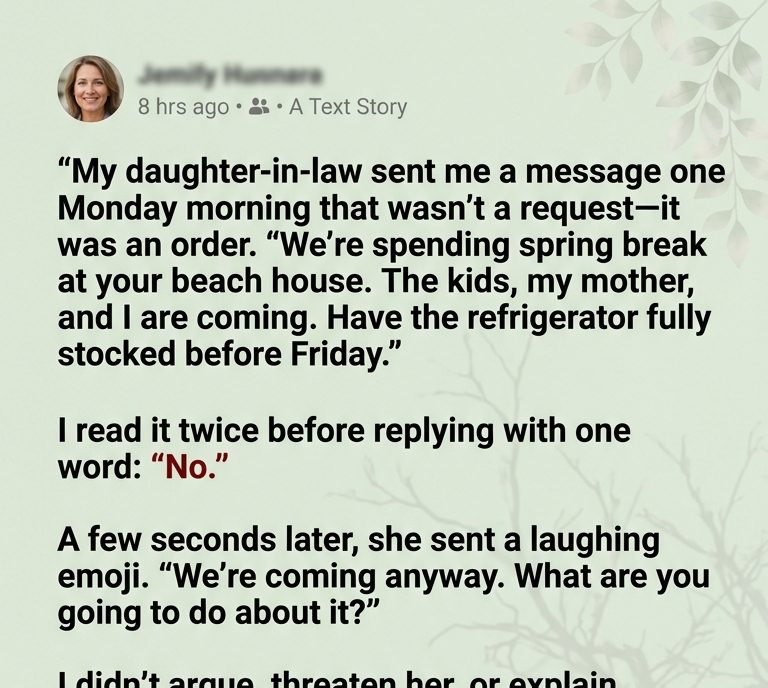
The message arrived on a Monday morning while I was drinking coffee on my back porch.
“We’re spending spring break at your beach house. The kids, my mother, and I are coming. Have the refrigerator fully stocked before Friday.”
My daughter-in-law, Vanessa, had sent it without a greeting, a question mark, or even the pretense of asking permission.
I was sixty-eight years old, retired, and perfectly capable of deciding who could stay in my own property. Yet Vanessa had somehow convinced herself that my beach house was an extension of her personal vacation plans.
I read her message twice before typing one word.
“No.”
Her response arrived almost immediately.
A laughing emoji.
Then another message.
“We’re coming anyway. What are you going to do about it?”
I stared at the screen for a moment, then placed my phone beside my coffee cup.
I wasn’t going to argue with her.
I wasn’t going to send a dozen messages explaining why she was wrong.
And I wasn’t going to let her turn my refusal into another family drama in which I would eventually be pressured to apologize for having boundaries.
Instead, I made one phone call.
By Friday afternoon, Vanessa would discover that a person could mistake generosity for an obligation for years without realizing how quickly that arrangement could end.
But to understand why I chose that particular Friday to change everything, you need to understand how we had arrived there.
My name is Margaret Ellis. I spent thirty-four years working as a hospital administrator before retiring. My husband, Robert, and I had saved carefully, lived modestly, and raised our only son, Andrew, in a home where people were expected to show consideration for one another.
When Robert died six years ago, I inherited enough money from his pension, life insurance, and our investments to remain comfortable.
The beach house was our favorite place.
We had purchased it twenty-two years earlier, when Andrew was still in college. It wasn’t a mansion, but it had four bedrooms, a wide deck overlooking the water, and windows that filled the living room with morning sunlight. Robert had spent countless weekends repairing the deck himself. He had planted hydrangeas along the walkway and installed a small wooden bench beneath the bedroom window.
After he died, I kept the house because I couldn’t bear to sell it.
At first, visiting it alone was painful. Eventually, the sound of the waves became comforting, and the house turned into a place where I could remember my husband without feeling that every room was waiting for him to return.
Andrew and Vanessa began visiting with their children, Lily and Ethan, a few years after they married.
I welcomed them.
I stocked the refrigerator, washed the sheets, bought the children’s favorite snacks, and left beach toys in the garage. When Vanessa’s mother, Diane, joined them, I prepared the guest room and made sure there was coffee she liked.
I did these things because I wanted my family to feel welcome.
Unfortunately, Vanessa interpreted hospitality as a permanent invitation.
The first few visits were harmless enough. She asked whether she could bring a friend, and I agreed. Then she started telling me which weekends she intended to use the house. Eventually, she stopped asking altogether.
One summer, she arrived with three extra guests and informed me that they would be staying for a week.
Another time, she called from a grocery store and complained that I hadn’t purchased the specific brand of sparkling water she preferred.
I tried to laugh it off.
“She doesn’t mean any harm,” Andrew would say whenever I mentioned the behavior.
“She can be a little demanding, Mom, but she’s good with the kids.”
I loved my grandchildren more than anything. I didn’t want them caught between their mother and grandmother, so I swallowed my frustration.
But the demands gradually became expectations.
Vanessa began referring to the beach house as “our summer place” when speaking to her friends. She posted photographs online with captions about family traditions, never mentioning that I owned the property or that she had arrived without asking.
Once, I overheard her telling Diane that I was lucky to have someone using the house regularly because otherwise it would just sit empty.
I was standing in the hallway with a basket of clean towels.
She saw me and smiled.
“Oh, Margaret! I didn’t mean anything by that.”
I smiled back, carried the towels upstairs, and said nothing.
That was my mistake.
Every time I chose silence to preserve peace, Vanessa took it as permission to demand a little more.
The breaking point came two months before spring break.
I had planned to spend that week at the beach house alone. I wanted to repaint the guest room, sort through Robert’s old tools, and enjoy a few days without having to cook for anyone.
Then Vanessa sent her message.
She had already decided that she, Diane, and the children would occupy the house for the entire week. She expected me to prepare the refrigerator and have everything ready before their arrival.
I called Andrew that evening.
“Did you know Vanessa was planning to use the beach house next week?”
He hesitated.
“She mentioned it.”
“Did she ask you to check with me?”
Another pause.
“She assumed you’d be okay with it.”
“Andrew, I told her no.”
“I know, Mom. She showed me your message.”
“And what did you tell her?”
“I said you probably just needed some time to think about it.”
I closed my eyes.
“Your wife told me she was coming anyway.”
“She’s stressed, Mom. Work has been difficult, and the kids have been looking forward to the beach.”
“Then she can plan a vacation somewhere else.”
He sighed.
“Could you please not turn this into a huge argument? It’s only a week.”
I looked through the window at the garden Robert and I had planted together.
“Andrew, it isn’t about one week. It’s about the fact that your wife believes she can order me to prepare my own house for her vacation.”
“I’ll talk to her.”
I wanted to believe him.
But the next day, Vanessa sent another message asking whether I had purchased the groceries yet.
I didn’t reply.
Instead, I called my attorney, Susan Miller, who had helped me update my estate documents after Robert died.
I explained the situation and asked her to review the beach house’s ownership records, insurance arrangements, and security access. I wanted to be certain that no one had a legal right to enter the property without my permission.
Susan confirmed that the house was solely mine. Vanessa had no ownership interest, and Andrew had never been given authority to grant anyone access on my behalf.
She also reminded me that I could revoke any informal permission I had previously given and secure the property appropriately.
I asked her to prepare a written notice stating that Vanessa and her guests did not have permission to use the house during spring break or at any other time without my explicit consent.
Then I called a local security company.
I changed the entry code, removed the temporary access codes I had created for family visits, and arranged for the housekeeper to remove all perishable food. I didn’t want anything spoiling in the refrigerator while I was away.
I also asked the property manager to confirm that the house would remain secured.
Finally, I prepared an envelope addressed to Vanessa.
Inside was a copy of the written notice, a letter from my attorney explaining that the property was privately owned, and a formal statement withdrawing the standing permission I had previously extended to family members to use the house without arranging dates with me.
The notice was firm, but it was not a threat. It explained the boundaries clearly and advised that any future access would require my written approval.
I placed the envelope on the kitchen counter.
Then I went home and waited.
On Friday afternoon, my phone began ringing.
I was sitting in my living room when Vanessa’s name appeared on the screen.
I let it ring twice before answering.
“Margaret, what have you done?”
Her voice was sharp enough to make me pull the phone away from my ear.
“Good afternoon, Vanessa.”
“Don’t good-afternoon me! The house is locked. The code doesn’t work, the refrigerator is empty, and there’s some ridiculous letter sitting on the counter!”
“Did you read it?”
“Of course I read it! What is wrong with you?”
I took a slow breath.
“You told me you were coming after I said no. I made sure the house was secured.”
“We drove for hours! The children are exhausted, and my mother has nowhere to sit. You can’t do this to us!”
“You chose to travel without permission.”
“You’re Andrew’s mother! This is his family!”
“And I’m the owner of the house.”
She went silent for half a second.
Then she lowered her voice, as though she believed a quieter tone would make her demands more reasonable.
“Andrew said you would eventually agree. He told me you always do this when you’re upset, but you calm down after a day or two.”
That sentence hurt more than I expected.
Not because Vanessa had insulted me, but because Andrew had apparently taught her that my decisions were temporary obstacles.
“Put Andrew on the phone,” I said.
“He’s at work.”
“Then you can tell him to call me.”
“Margaret, we have nowhere to stay!”
“There are hotels and vacation rentals nearby. I suggest you find one.”
“You’re seriously going to make your grandchildren sleep somewhere else?”
“No. I’m refusing to let you use my house without permission. Those are two different things.”
She hung up.
Twenty minutes later, Andrew called.
“Mom, why didn’t you tell me you were changing the code?”
“I told you your wife did not have permission to use the house.”
“You could have handled this differently.”
“I could have. I could have argued with her for another week, stocked the refrigerator after she told me to, and pretended that she had every right to order me around. But I chose not to.”
He exhaled heavily.
“She’s really upset.”
“I imagine she is.”
“The kids are confused.”
“Then please explain to them that Grandma’s house isn’t a hotel they can visit whenever someone else decides.”
He fell silent.
Then he said something that made my heart sink.
“You know, Mom, sometimes I think you care more about that house than you do about us.”
I stared at the photograph of Robert on the mantel.
For years, I had tried to make my son understand that my generosity came from love. Now he was suggesting that the simple act of protecting something I owned proved that I didn’t love him enough.
“No, Andrew,” I said quietly. “I think I’ve spent too long proving my love by giving in to people who don’t respect me.”
I ended the call before the conversation could become another argument.
That evening, I received a photograph from Vanessa.
It showed her standing outside the beach house with her arms crossed. The children were beside her, and Diane sat on one of the suitcases.
The caption read:
Hope you’re happy. You ruined spring break.
I didn’t respond.
Instead, I called the nearby hotel and made a reservation for myself for the following weekend. I had decided to visit the beach house after all, not because I wanted to confront anyone, but because I wanted to spend time in a place that had begun to feel like a battlefield.
I arrived the following Monday morning.
The house was quiet, the air smelled faintly of salt, and the hydrangeas had begun to bloom. I unlocked the door and stepped inside.
The envelope was gone.
For a moment, I wondered whether Vanessa had taken it with her.
Then I noticed a second envelope on the counter, one I had not left behind.
My name was written on the front in Andrew’s handwriting.
I opened it.
Inside was a short letter.
Mom,
I owe you an apology. Vanessa and I have been treating your kindness as if it were something we were entitled to. I should have stopped it a long time ago.
I didn’t realize how often I was asking you to give up what you wanted because it was easier than dealing with conflict at home.
I also need to tell you something about the house. Vanessa has been telling people that we’re planning to sell it someday and use the money to buy a larger family home. I never agreed to that, but I didn’t correct her when she said it.
I think I finally understand why you changed the locks.
I’m sorry.
I read the letter twice.
Then I sat at the kitchen table and cried.
Not because Andrew’s apology solved everything, but because it was the first time in years that he had acknowledged what had been happening without blaming my reaction.
Later that afternoon, I called him.
“Thank you for the letter,” I said.
“I’m sorry, Mom.”
“I believe you. But I need you to understand that an apology is a beginning, not a reset button.”
“I know.”
“Your wife is welcome to have a relationship with me if she can treat me respectfully. The children are always welcome when we arrange visits together. But nobody is going to use the beach house without asking me again.”
“I understand.”
“And Andrew?”
“Yes?”
“I love you. That has never been the question.”
His voice broke slightly.
“I love you too, Mom.”
We spoke for another twenty minutes. For once, he didn’t try to convince me to change my mind.
Vanessa took longer to respond.
At first, she blamed me for embarrassing her in front of Diane and the children. Then she complained that the hotel had been expensive and that I should reimburse her for the inconvenience.
I declined.
Eventually, after several weeks, she sent a shorter message.
I shouldn’t have assumed I could use your house after you said no. I’m sorry.
It wasn’t a dramatic reconciliation. She didn’t suddenly become affectionate, and I didn’t forget sixteen years of small insults simply because she had finally apologized.
But I accepted the message for what it was: a first step.
The following summer, Andrew asked whether the family could spend a long weekend at the beach house.
He gave me the dates, asked how many bedrooms were available, and offered to bring groceries.
I checked my calendar before answering.
“Yes,” I told him. “That weekend works.”
When they arrived, Vanessa carried her own bags inside. Diane thanked me for having them over, and the children ran straight to the garden.
The refrigerator was stocked, but this time I had done it because I wanted to—not because anyone had ordered me to.
On Sunday morning, I sat on the deck with a cup of coffee while the children built a sandcastle below.
Andrew came outside and sat beside me.
“It’s nice here,” he said.
“It is.”
He looked toward the water.
“I think Dad would be glad you kept it.”
I smiled.
“Your father would be glad I finally learned how to say no.”
We laughed quietly.
For years, I had believed that being a good mother meant making life easier for my son, even when it made my own life smaller. I had confused generosity with obligation and silence with love.
That spring break changed something.
The empty refrigerator had not been an act of revenge. The changed security code had not been punishment. And the envelope had not been a threat.
They were simply the consequences of a decision I had every right to make.
My beach house remained mine, but so did my time, my peace, and my ability to choose when and how I welcomed people into my life.
I still loved my son. I still adored my grandchildren. And I was willing to give my daughter-in-law another chance.
But I no longer believed that loving family meant surrendering every boundary.
Sometimes, the most loving thing you can do is stop saying yes when you mean no.
And sometimes, the most important door you learn to close is the one that has been left open to disrespect for far too long.