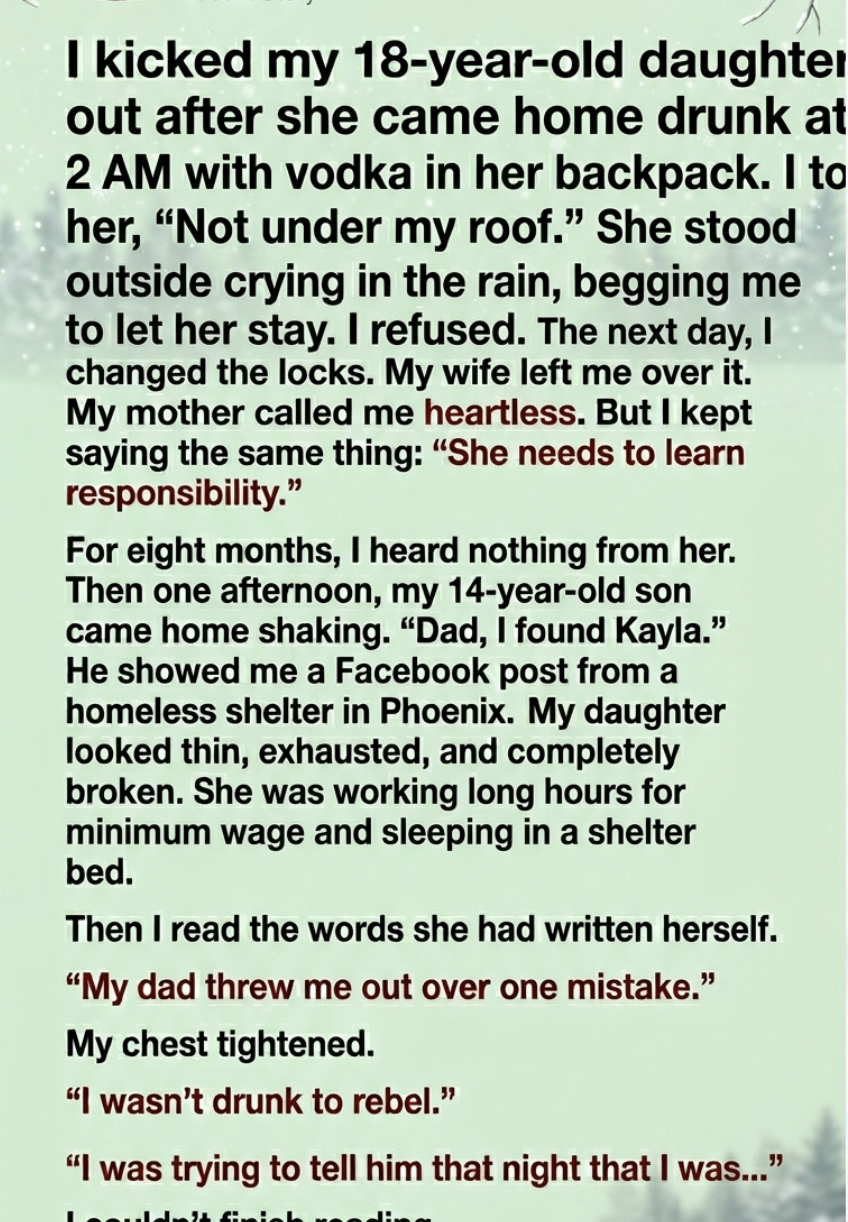
I kicked my eighteen-year-old daughter out after she came home drunk at 2 AM.
At least, that’s what I thought happened.
She stumbled through the front door carrying a backpack.
When I opened it, I found a bottle of vodka.
I saw red.
I didn’t ask questions.
I didn’t listen.
I didn’t care what explanation she had.
I pointed at the door and said:
“Not under my roof.”
She cried.
Begged.
Tried to speak.
Rain poured outside while she stood on the porch.
My wife screamed at me to calm down.
My daughter kept saying:
“Dad, please. Just let me explain.”
I wouldn’t.
The next morning, I changed the locks.
Three days later, my wife moved out.
A week later, my mother called me heartless.
Everyone acted like I was the villain.
But I kept repeating the same sentence.
“She needs to learn responsibility.”
Months passed.
Eight of them.
No calls.
No texts.
No birthday card.
Nothing.
I convinced myself she was fine.
Young people bounce back.
That’s what I told myself.
Then one afternoon, my fourteen-year-old son came home shaking.
“Dad.”
I looked up.
His face was pale.
He handed me his phone.
“I found Kayla.”
My stomach dropped.
The screen showed a post from a homeless shelter in Phoenix.
There she was.
My daughter.
Twenty pounds lighter.
Dark circles under her eyes.
Wearing a diner uniform.
Standing beside a shelter bed.
I barely recognized her.
Then I started reading.
“My dad threw me out over one mistake.”
My chest tightened.
I kept scrolling.
“I wasn’t drunk to rebel.”
My hands began to shake.
Then came the sentence that changed everything.
“I was trying to tell him that night that I was pregnant.”
The room spun.
I read it again.
And again.
Pregnant.
My daughter had been pregnant.
That night.
The night I threw her out.
I couldn’t breathe.
According to the shelter article, the vodka wasn’t even hers.
She had taken it from her boyfriend’s car after discovering he had been drinking heavily.
She planned to show me.
She was scared.
She needed help.
She wanted advice.
And instead of listening, I threw her away.
I sat there staring at the screen while my son cried beside me.
For the first time in eight months, I stopped defending myself.
The next morning, I got in my truck and drove to Phoenix.
Ten hours.
The longest drive of my life.
Every mile felt heavier than the last.
I rehearsed apologies the entire way.
None of them sounded big enough.
When I finally arrived at the shelter, the woman at the front desk recognized her immediately.
“Kayla?”
She smiled.
“She’s one of our hardest workers.”
The words broke my heart.
Because I realized strangers knew more about my daughter than I did.
A few minutes later, she walked into the lobby.
For a second, neither of us moved.
She looked older.
Tired.
Hurt.
And the worst part was the look in her eyes.
Not anger.
Disappointment.
The kind that comes after hope finally dies.
I stood up slowly.
“Kayla…”
She folded her arms.
“What do you want?”
The question nearly destroyed me.
Because fathers aren’t supposed to need permission to talk to their children.
But I’d lost that right.
I swallowed hard.
“I’m sorry.”
She laughed bitterly.
“Sorry for what?”
I opened my mouth.
Then closed it again.
Because there wasn’t one thing.
I was sorry for all of it.
Sorry for not listening.
Sorry for choosing pride over compassion.
Sorry for throwing her out.
Sorry for being so convinced I was right.
Finally I whispered:
“Sorry for failing you.”
For a long time, she said nothing.
Then tears filled her eyes.
Mine too.
We sat together for hours.
Talking.
Listening.
Crying.
For the first time in years, I actually listened.
The pregnancy had ended shortly after she left.
Stress.
Poor nutrition.
Exhaustion.
She lost the baby.
Alone.
Without family.
Without support.
Without me.
That truth is something I’ll carry for the rest of my life.
Eventually I asked the question I feared most.
“Can you ever forgive me?”
She looked down at her hands.
Then quietly said:
“I don’t know.”
It wasn’t the answer I wanted.
But it was honest.
And honesty was something I’d finally learned to respect.
Today, we’re rebuilding.
Slowly.
Carefully.
One conversation at a time.
Trust isn’t restored with a single apology.
Neither is family.
But every week we talk.
Every month we spend time together.
And every day I remind myself of something I should have understood from the beginning.
Sometimes people don’t need punishment.
Sometimes they need a safe place to tell the truth.
The night my daughter stood crying on that porch, she wasn’t asking for permission.
She was asking for help.
And I was too busy teaching a lesson to hear what she was actually saying.
Some mistakes can be fixed.
Others leave scars.
The goal isn’t pretending they never happened.
It’s making sure you never repeat them.
Because the most painful words I’ve ever read weren’t written by a stranger.
They were written by my own daughter.
And they started with:
“I was trying to tell him…”