My name is Emily Carter, and for twelve years, I believed my marriage to Daniel was built on love, trust, and the life we had created together.
We had two children, a comfortable home, and what most people considered a successful marriage. Daniel worked in corporate sales, and I managed our household while running a small bookkeeping business from home. My parents had helped us buy our house when we first married, and they had contributed toward our two cars when our children were born.
I had always considered their generosity a blessing.
I never imagined Daniel considered it an opportunity.
The truth began to unravel on an ordinary Thursday afternoon.
I had planned to pick up the children from school, but their teacher called to say the after-school program was closing early. I finished my errands sooner than expected and drove home, thinking I would surprise Daniel with his favorite dinner.
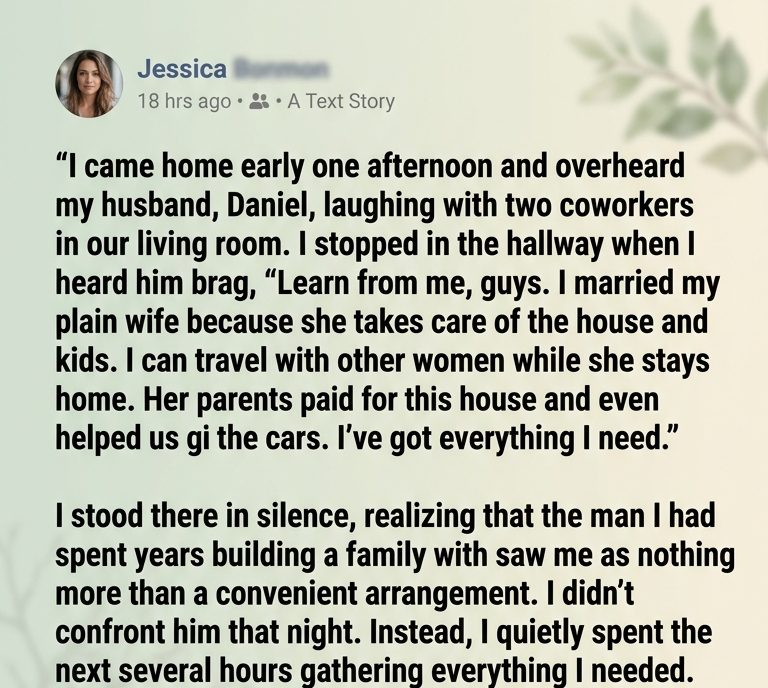
When I opened the front door, I heard laughter coming from the living room.
Daniel was there with two coworkers, Mark and Steven. Their jackets were draped over the sofa, and three glasses sat on the coffee table.
I was about to announce myself when Daniel spoke.
“Honestly, guys, if you want an easy life, learn from me.”
The men laughed.
I stopped in the hallway.
“I married Emily because she takes care of the house and kids,” Daniel continued. “She’s not exactly the glamorous type, but she keeps everything running. I can travel for work, enjoy myself, and she never asks too many questions.”
My hand tightened around the grocery bag I was carrying.
Mark chuckled. “Doesn’t she ever get suspicious?”
Daniel laughed.
“Suspicious of what? She trusts me completely. Besides, her parents paid for this house and helped us get the cars. I’ve got everything I need. Why would I mess that up?”
Steven whistled.
“You really have the whole arrangement figured out.”
“Exactly,” Daniel replied. “Some guys work hard to build a life. I found a way to have someone else build mine.”
They burst out laughing again.
I stood in the hallway, unable to move.
The man speaking was my husband. The father of my children. The person whose shirts I had ironed before important meetings, whose meals I had prepared after long business trips, and whose career I had supported whenever he needed to work late or travel.
I remembered the nights I had stayed awake waiting for him to return from conferences. I remembered canceling plans with friends because one of the children was sick. I remembered telling my parents that Daniel was under pressure at work and needed more understanding from everyone.
And I remembered the anniversary card he had given me the previous year.
Thank you for being my home, my peace, and my favorite person.
Apparently, those words had been easier to write than to mean.
I quietly backed away from the doorway and went upstairs.
I didn’t confront him that afternoon.
I didn’t cry in front of him, throw his belongings outside, or demand an explanation he could twist into another excuse.
Instead, I entered our bedroom, closed the door, and sat on the edge of the bed.
For nearly an hour, I stared at the wedding photograph on my dresser.
Then I picked up my phone.
I called my father.
“Dad, do you still have the original documents for the house?”
He paused.
“Of course. Why?”
“I need you to help me understand something about the way we arranged the property when Daniel and I bought it.”
His voice changed immediately.
“Emily, what’s happened?”
“I’ll explain everything tonight. Can you and Mom come over tomorrow evening?”
“Yes. Whatever you need.”
After that call, I contacted a family attorney my mother had recommended to me several years earlier. I explained what I had overheard and asked what I should do before confronting Daniel.
She advised me to preserve any information I had lawfully obtained, avoid moving or concealing shared assets, and gather copies of relevant financial and property records. She also explained that ownership and divorce rights depended on the actual documents and applicable state law, not simply on who had paid the original purchase price.
I followed her advice.
I reviewed our mortgage records, property documents, investment statements, and the agreements my parents had signed when they helped us buy the house.
What I discovered surprised me.
The house had never been transferred to Daniel and me in the way he believed.
My parents had contributed the down payment through a documented family loan, and the original property agreement included specific provisions concerning repayment and ownership. Later, when they helped us purchase our cars, the money was recorded as separate gifts to me rather than unrestricted gifts to the household.
Our investment account was also more complicated than Daniel understood. A substantial portion came from an inheritance my grandmother had left me, which had been kept in a separate account before certain funds were used for shared expenses.
None of this meant I could simply take everything and leave. My attorney made that clear.
But Daniel’s assumption that my parents had provided him with a personal fortune was wrong.
More importantly, I discovered a series of unexplained transfers from our joint account to a consulting business Daniel had established two years earlier. The amounts were not enormous individually, but together they were significant enough to require an explanation.
I printed the relevant statements and placed them in a folder.
I also saved the recording I had made from the hallway.
I had started recording after hearing Daniel’s first few sentences, holding my phone low beside the wall. Before using it, I asked my attorney to review the circumstances and the applicable recording laws. I did not want to violate anyone’s rights or create a problem that could undermine the rest of my preparations.
By midnight, I had stopped asking myself whether I had misunderstood what I heard.
I had not.
The following evening, Daniel came home at his usual time.
He opened the front door, loosened his tie, and walked toward the dining room.
Then he stopped.
My parents were seated at the table. His parents, Richard and Susan, sat beside them. Mark and Steven were there too, looking deeply uncomfortable.
Daniel stared at the room.
“What is this?”
I stood beside the dining table.
“Please sit down.”
He glanced at Mark, then Steven.
“Why are you two here?”
Neither man answered.
I placed my phone on the table and pressed play.
Daniel’s voice filled the room.
“Honestly, guys, if you want an easy life, learn from me.”
The recording continued.
Every laugh. Every boast. Every word about marrying me for convenience. Every comment about my parents paying for the house and cars.
Nobody interrupted it.
When the recording ended, the silence felt heavier than the sound had been.
Daniel’s face drained of color.
He looked at me, then at his parents.
“Emily, I can explain.”
I nodded toward the empty chair.
“Then explain.”
He remained standing.
“It was a joke. We were messing around at work.”
“Which part was the joke?” I asked. “The part where you said you married me because I take care of the house and children? Or the part where you said you travel with other women while I stay home?”
His mouth opened, but nothing came out.
Mark stared at the table.
Steven rubbed his forehead.
Daniel finally turned toward them.
“You recorded us?”
“I recorded what I heard,” I replied. “And before you start blaming anyone else, remember that I didn’t put those words in your mouth.”
His father, Richard, leaned forward.
“Daniel, is any of this true?”
“Dad, please. This is a private matter.”
“You made it a public matter when you bragged about your wife to your coworkers.”
Daniel’s jaw tightened.
I slid the folder toward him.
“There’s something else you should understand.”
He opened it.
The first page contained a summary of the property arrangements. The next pages included the relevant agreements, account statements, and records of the transfers I had identified.
He read the first page twice.
Then he looked up at me.
“You knew?”
“I knew what my parents had agreed to when they helped us buy the house. I knew what my grandmother left me. What I didn’t know was that you had decided those things made me someone you could use.”
His eyes moved back to the documents.
“You can’t just take the house away from me.”
“I haven’t taken anything away from you. These are the existing agreements, and my attorney has advised me about the rights and responsibilities they create. If you disagree with them, we can resolve that through the proper legal process.”
My father spoke for the first time.
“Daniel, we helped you both because we believed you loved our daughter and wanted to build a life with her. We never intended our help to become something you could boast about as your own personal achievement.”
Daniel looked toward him.
“Sir, I appreciate everything you’ve done.”
My father shook his head.
“You appreciated the money. I’m no longer sure you appreciated the person we gave it to.”
Daniel’s mother, Susan, began to cry quietly.
She had always treated me kindly, and I could see that the recording had hurt her too.
“Daniel,” she said, “how could you speak about Emily that way?”
He rubbed both hands over his face.
“I was trying to impress them. I didn’t mean it like that.”
I looked directly at him.
“Then tell us what you meant.”
He said nothing.
I took another document from the folder.
“These are the transfers from our joint account to your consulting company. I want a full accounting of them. I am not accusing you of a crime, but I will not ignore money leaving our household without a clear explanation.”
His expression changed.
“Those were business expenses.”
“Some may have been. That’s why I want the records reviewed.”
He looked around the table as though searching for someone who would defend him.
Nobody did.
Then I placed one final document in front of him.
It was the divorce petition my attorney had prepared.
Daniel stared at it.
“You’re divorcing me?”
“Yes.”
“Because of one stupid conversation?”
I felt something inside me settle.
“No, Daniel. Because of what that conversation revealed about our marriage. Because you described our life as an arrangement in which I provide everything you need while you do whatever you want. And because I no longer believe I can trust you to be honest with me.”
He shook his head.
“You can’t throw away twelve years over this.”
“I didn’t throw them away. I lived them. I raised our children with you. I supported your career. I gave you my trust. You were the one who stood in our living room and laughed about how easily you could take advantage of it.”
He sank into the chair.
For the first time since I had known him, Daniel seemed unable to find a sentence that would make the consequences disappear.
Mark finally spoke.
“Daniel, we shouldn’t have laughed. I should have said something.”
I turned toward him.
“You heard what he said. Why didn’t you?”
Mark looked ashamed.
“I didn’t think about how it would sound if someone heard us.”
“That isn’t the same as understanding what you were laughing at,” I said.
Steven apologized too, though he admitted he had been uncomfortable long before I entered the room.
I accepted that their behavior had been wrong without pretending their apologies repaired everything.
Then I asked them to leave.
They stood, murmured their goodbyes, and walked out without meeting Daniel’s eyes.
My parents followed after my father squeezed my shoulder.
Richard and Susan remained for a few minutes.
Susan took my hand.
“I’m sorry,” she whispered. “You deserved better than this.”
“Thank you.”
Richard turned to his son.
“You have a great deal to think about.”
Then they left too.
When the door closed, Daniel and I were alone.
He looked at the divorce papers, then at me.
“Emily, please. I can change.”
I believed that people could change.
But I no longer believed that a promise made when someone was afraid of losing their comfortable life was enough.
“Perhaps you can,” I said. “But I cannot stay married to you simply to find out.”
He began listing everything we had built together: the children’s birthdays, family holidays, the home we had decorated, the vacations we had taken.
I listened.
Those memories were real. So was the affection I had once felt for him. I did not need to pretend the entire marriage had been a lie to acknowledge that it had become something I could no longer accept.
“We have children,” he said finally.
“Yes. And they deserve parents who show them what respect looks like, even when a marriage ends.”
He looked down.
“What am I supposed to tell them?”
“The truth, in an age-appropriate way. That we have serious problems and will be living separately while we work through them. They do not need to hear the recording or be asked to choose sides.”
For once, he didn’t argue.
The following weeks were difficult.
Daniel initially tried to persuade me to withdraw the divorce petition. He sent flowers, wrote long messages about our history, and promised that he would never speak about me that way again.
I didn’t respond to every message.
I focused on keeping the children’s routines stable and working with my attorney to protect my financial interests. We arranged separate living accommodations, established a temporary parenting schedule, and began the process of reviewing our property and finances.
The financial review revealed that some of the transfers to Daniel’s consulting company were legitimate business expenses. Others were personal purchases that had not been clearly disclosed. The records were handled through the legal process, and the parties negotiated an accounting and an appropriate division of assets rather than relying on assumptions or accusations.
The property arrangements were also resolved according to the actual agreements and the law. My parents’ documented loan was addressed, and the court-approved settlement recognized the separate property interests supported by the records while dividing the remaining marital assets.
Daniel did not lose everything, and I did not receive everything.
That was never the point.
The point was that neither of us could simply declare ourselves entitled to what belonged to the other.
Months later, Daniel asked to meet me at a café near our children’s school.
He looked older, or perhaps I was finally seeing him without the excuses I had once placed around his behavior.
“I owe you a better apology,” he said.
I waited.
“I treated you like your work didn’t matter because you weren’t earning the same salary I was. I acted as if the house ran itself and the children raised themselves. And I used your parents’ generosity to make myself look successful in front of people whose approval I wanted.”
He paused.
“I don’t expect you to forgive me. I just want you to know that I understand what I did.”
I studied his face.
For the first time, he wasn’t asking me to make him feel better.
“I’m glad you understand,” I said. “But understanding doesn’t mean we have to go back to being married.”
He nodded.
We talked about the children and agreed to keep our disagreements away from them. Over time, our conversations became calmer. We learned to cooperate as parents without pretending we were still a couple.
I also returned to my bookkeeping business full-time and began taking on clients I had turned away during the years when Daniel’s career dominated our family schedule.
My parents helped me move into a smaller home near the children’s school. They did not demand repayment for their generosity or tell me what decisions to make.
Instead, my father helped me assemble a bookshelf, and my mother brought over a casserole that lasted three dinners.
One evening, several months after the separation, my daughter asked whether I was sad.
I sat beside her on the couch.
“Sometimes,” I admitted.
“Do you miss Dad?”
I considered my answer.
“I miss some of the good times we had. But I don’t miss feeling as though I have to pretend I’m okay when I’m not.”
She leaned against me.
“Are we going to be okay?”
I kissed the top of her head.
“Yes. It may take time, but we are going to be okay.”
And we were.
The divorce became final the following year. Daniel and I established a stable co-parenting arrangement, and I continued rebuilding my life without rushing into another relationship.
I eventually learned that peace could be quieter than happiness, but it could also be stronger. I no longer needed to wonder whether someone loved me for who I was or for the comfort I provided.
I knew what I contributed to my family. I knew the value of the work I had done, much of it unpaid and unnoticed.
Most importantly, I learned that generosity should never be mistaken for weakness.
The house my parents helped us buy was more than a financial asset. It represented their trust in me, their hope that I would build a secure life, and their belief that I deserved to be treated with love.
I had spent years trying to prove I was a good wife.
I no longer needed to prove that by accepting disrespect.
The last time Daniel came to the house to collect a box of his remaining belongings, he paused at the front door.
“I really thought you would always forgive me,” he said.
I looked at him calmly.
“I thought you would always respect me.”
Neither of us had anything else to say.
After he left, I closed the door and returned to the living room. Sunlight fell across the floor, and the house was quiet except for the sound of my children laughing in the garden.
For the first time in years, I didn’t feel like someone else’s convenient arrangement.
I felt like myself.
And that was worth more than anything Daniel had ever believed he owned.