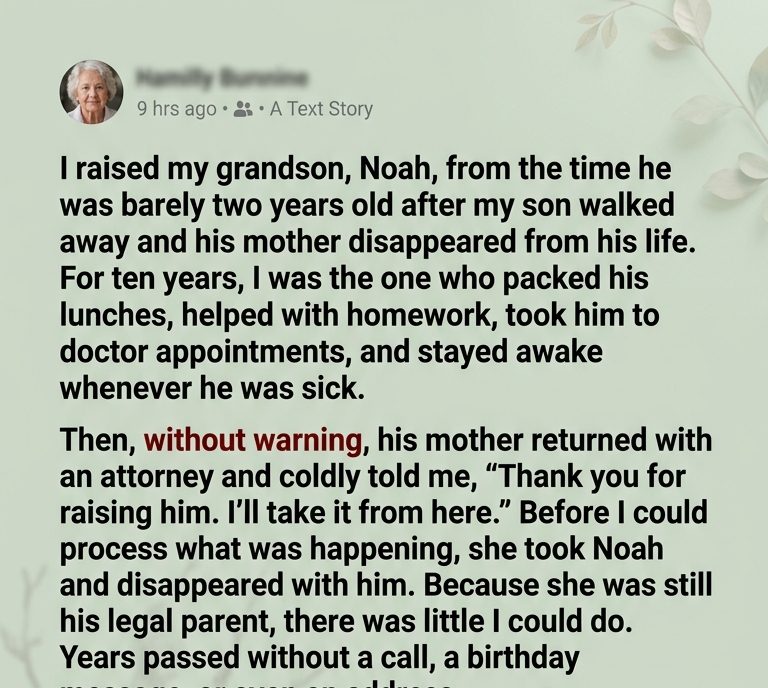
For ten years, I was the only parent my grandson, Noah, could count on.
His father, my son Michael, left when Noah was barely two years old. Noah’s mother, Vanessa, disappeared shortly afterward, leaving behind a little boy who cried himself to sleep whenever someone mentioned his parents.
I never intended to raise another child at my age. I had already raised Michael, buried my husband, and imagined that the remaining years of my life would be quieter.
But the first time Noah reached for me with his tiny hands and called me Grandma, I knew I would do whatever it took to give him a home.
I learned to make his favorite pancakes, packed sandwiches shaped like dinosaurs, and sat beside his bed whenever nightmares woke him. I attended every school performance, remembered every doctor’s appointment, and kept a jar of coins on the kitchen counter so we could save for his birthday presents together.
When he started school, I was the grandmother who waited outside the classroom with an umbrella on rainy days.
When he struggled with reading, I sat beside him every evening until the words stopped looking like tangled strings.
And when he asked why his parents weren’t around, I never told him they had abandoned him because they didn’t love him.
I simply said, “Sometimes grown-ups make choices that children don’t understand. But you will never have to wonder whether you’re loved.”
I meant every word.
For ten years, Noah was the center of my world.
Then, on an ordinary Thursday afternoon, Vanessa returned.
I was preparing dinner when the doorbell rang. I opened the door and found a woman standing on my porch in an expensive coat, holding a leather handbag. For a moment, I didn’t recognize her.
Then she smiled faintly.
“Hello, Margaret.”
My stomach tightened.
Vanessa looked older, more polished, and far more confident than the young woman who had disappeared from our lives a decade earlier.
Beside her stood a man in a dark suit carrying a briefcase.
“May I come in?” she asked.
I stepped aside, though every instinct told me something was wrong.
Noah was in his bedroom doing homework. He hadn’t heard the doorbell.
Vanessa sat on my sofa and crossed her legs.
“I’ve come to take my son home.”
I stared at her.
“Your son?”
She gave me a cold look.
“Yes. Noah is my child. I’ve allowed this arrangement to continue long enough.”
“Allowed it?” My voice shook. “You left him here when he was two years old. You didn’t call on his birthdays. You didn’t ask whether he was sick or whether he had started school. You didn’t even tell me where you were.”
“I had my reasons.”
“Then explain them.”
She glanced at the attorney beside her.
“That’s not necessary. I am his mother, and I have the legal right to take him.”
The attorney confirmed that Vanessa was Noah’s legal parent and that the situation would need to be handled according to the applicable custody laws. At the time, I had no formal guardianship arrangement that gave me the authority I thought I had earned through ten years of raising him.
I had believed love and responsibility would be enough to protect us.
I was wrong.
When Noah came into the living room and saw his mother, he froze.
“Mom?”
Vanessa stood and opened her arms.
“Come here, sweetheart. We’re going home.”
He looked at me.
I will never forget the expression on his face. It was the look of a child who had spent ten years building a life around one person and was suddenly being told that everything familiar was about to disappear.
“Grandma, what’s happening?”
I knelt beside him.
“I don’t know yet, sweetheart.”
Vanessa took his hand.
“Pack your things, Noah.”
He began to cry.
I wanted to pull him away from her. I wanted to lock the door and refuse to let her leave with him. But I knew that a desperate reaction could make an already difficult situation worse.
I asked the attorney whether we could discuss a transition that would protect Noah’s emotional well-being.
Vanessa refused.
“Thank you for raising him,” she said as she led him toward the door. “I’ll take it from here.”
Those words followed me for years.
Noah turned back once, tears streaming down his face.
“Grandma!”
I reached for him, but Vanessa guided him outside.
Then the door closed.
I stood in the hallway listening to their car pull away.
That night, I sat at the kitchen table with two untouched plates of dinner. Noah’s schoolbag remained beside the stairs. His favorite blue sweater hung over the back of a chair.
I called Vanessa repeatedly.
She didn’t answer.
The following morning, I contacted a family lawyer and learned what I should have understood earlier: my long-standing role as Noah’s caregiver did not automatically give me parental rights. The attorney helped me explore my options, but without a reliable address or evidence of an immediate legal basis to intervene, my ability to obtain contact was limited.
I sent letters to the last address I had for Vanessa.
They came back unopened.
I searched public records and asked relatives whether they had heard anything. Most knew nothing. A few said Vanessa had moved to another state and wanted a fresh start.
I never received a birthday card from Noah.
I never heard his voice on the phone.
The years passed, each one leaving me with more questions than answers.
Did he remember the bedtime stories?
Did he remember the pancakes?
Did he believe I had willingly let him go?
On his eighteenth birthday, I baked a small chocolate cake and placed a single candle in the center.
I knew he was legally an adult now, but I still couldn’t stop myself from imagining him blowing out the candles while I sang the ridiculous birthday song I had made up when he was little.
I sat alone at the kitchen table until the candle burned down.
Then someone knocked on the front door.
I opened it.
A tall young man stood on the porch, wearing a dark jacket and holding a small backpack. His hair was longer than I remembered, and his face had matured, but his eyes were unmistakable.
For a moment, neither of us moved.
Then he whispered, “Grandma?”
My knees nearly gave way.
“Noah?”
He nodded.
I reached for him, and he stepped into my arms. He was taller than I was now, but when I held him, I could still feel the little boy who used to wrap both arms around my waist whenever thunder frightened him.
We cried in the doorway.
I touched his face, his shoulders, his hair, trying to convince myself he was real.
“Oh, sweetheart,” I whispered. “I’ve missed you so much.”
“I missed you too.”
I wanted to ask a thousand questions.
Where had he been? Why hadn’t he called? Was he safe? Had he been happy? Had his mother told him lies about me?
But before I could speak, Noah stepped back.
He reached into his jacket and removed a sealed envelope.
“Grandma,” he said, his voice trembling, “I need you to read this before you ask me anything.”
I looked at the envelope.
My name was written across the front in Vanessa’s handwriting.
My fingers went cold.
I invited Noah inside, sat him at the kitchen table, and carefully opened the envelope.
Inside were several pages, a copy of an old court document, and a smaller envelope containing a letter addressed to Noah.
The first page was a letter from his mother.
Margaret,
If Noah has brought this to you, it means he is finally old enough to decide what he wants to know about his childhood.
I owe you the truth. I have owed you the truth for sixteen years.
I stopped reading and looked at Noah.
He sat very still, his hands clasped together.
I continued.
When I left Noah with you, I told myself I was doing it because I couldn’t afford to raise him. That was partly true. I was young, frightened, and unable to manage the responsibilities of motherhood.
But it was not the whole truth.
The next paragraph made my chest tighten.
Michael did not leave us because he wanted a different life. He left because he discovered what I had been doing with money that was supposed to support our son.
I stared at the page.
Michael had told me very little about the final months of his relationship with Vanessa. Before he walked away, he had said only that their relationship had become unbearable and that he could no longer trust her.
I had assumed their separation was another painful story between two young people who had not been ready to become parents.
The letter continued.
Vanessa had been receiving money from Michael’s family to help support Noah. She had also been receiving financial assistance from a community program for young parents. Instead of using all of it for Noah’s needs, she had used a substantial portion to pay personal debts and cover expenses she had hidden from Michael.
When he confronted her, they argued. Michael left, telling her he would not continue sending money without knowing how it was being spent.
Vanessa panicked.
She was overwhelmed by debt, frightened of losing custody, and ashamed of the choices she had made. She asked me to care for Noah while she tried to get her life under control.
At first, she intended to return within a few months.
But as time passed, she became increasingly afraid that I would refuse to give Noah back if she admitted what had happened.
So she stayed away.
Then, years later, she returned with an attorney and took him.
I read the next paragraph twice.
I did not take Noah away because you had done anything wrong. I took him because I was afraid that if he remained with you, he would grow up believing you were the person who had saved him and I was the person who had abandoned him.
I convinced myself that being his biological mother gave me the right to reclaim the place I had lost. I told myself he would eventually understand.
I was wrong.
My eyes blurred.
I had spent years wondering whether Vanessa had returned because she had finally learned to love her son.
Instead, she had returned because she could not bear the thought that someone else had become the person he trusted most.
I turned to the court document.
It showed that, shortly before Vanessa took Noah, she had initiated a legal process to reestablish her custody and obtain permission to relocate. The document did not establish that she had harmed Noah, but it showed how deliberately she had prepared to remove him from the only home he had known.
The final pages explained why Noah had come back on his eighteenth birthday.
Vanessa had died several months earlier after a sudden illness.
Before her death, she had left instructions for Noah to receive the letters when he turned eighteen. She had also arranged for the remaining family documents to be delivered to him, including records concerning an account established by my late husband for Noah’s future education.
I had forgotten about that account. My husband had opened it shortly before he died, intending it to help Noah when he grew older. Vanessa had been named as the adult responsible for administering it while Noah was a minor, subject to the account’s terms.
The records showed that most of the funds had been withdrawn over the years.
Some withdrawals had been used for legitimate expenses related to Noah’s care. Others were not adequately documented.
The papers did not prove where every dollar had gone, and I refused to assume the worst without evidence. But the records made clear that Noah deserved a full accounting of what remained and how the account had been managed.
I lowered the letter.
“Your mother left all this to you?”
Noah nodded.
“She told me a little before she died. She said she had made mistakes, but she never explained everything. I found the envelope while sorting through her papers after her funeral.”
He took a breath.
“I didn’t know what to believe. I wanted to hate her, but she was still my mom. And I wanted to come here, but I was afraid you wouldn’t want to see me.”
I reached across the table and took his hand.
“Why would you ever think that?”
“Because I thought you might believe I had forgotten you.”
I felt tears run down my face.
“Oh, Noah. I never forgot you for a single day.”
He lowered his head.
“I remember the pancakes,” he whispered. “I remember you sitting beside me when I had the flu. I remember the blue sweater you used to put on me when we went outside.”
He began to cry.
“I remembered everything, Grandma. I just didn’t know how to get back to you.”
I stood and wrapped my arms around him.
For several minutes, we remained that way, crying over ten years that could never be returned.
Eventually, we sat down again.
Noah explained that his life with Vanessa had not been entirely unhappy. She had cared for him in her own way, but she had never allowed him to contact me. Whenever he asked about his childhood, she changed the subject or said I had been too old to raise him properly.
As he grew older, the explanations stopped making sense.
He remembered being taken from my house, but his memories were fragmented. He had been too young to understand the legal conflict, and Vanessa had given him only pieces of the story.
After she became ill, he helped organize her belongings. That was when he found the letters, court documents, and financial records.
He spent months trying to understand what had happened.
“I didn’t want to come here just to accuse her of being a bad person,” he said. “I wanted to know the truth. And I wanted to see you.”
I nodded.
“That is all I ever wanted for you. The truth, and the chance to make your own choices.”
He looked at the cake on the counter.
“Is that for my birthday?”
I laughed through my tears.
“I made it before you arrived.”
He smiled, and for the first time that evening, I saw a glimpse of the little boy who used to lick the frosting from the spoon.
We lit the candle together.
I sang the ridiculous birthday song I had made up years ago. Noah laughed when I forgot a verse, then corrected me because he remembered the words better than I did.
When he blew out the candle, I made no wish.
For the first time in ten years, I had my grandson sitting at my table.
That was enough.
Over the following weeks, Noah stayed with me while he decided what he wanted to do next. He had recently finished school and was considering college, but he didn’t want me to feel responsible for every decision he made.
I told him that loving him did not mean controlling his life.
We contacted an attorney to review the documents concerning my husband’s education account. The attorney helped Noah determine what records could be obtained and whether any further action was appropriate. We did not rush into accusations or assume that every withdrawal had been improper. We focused on establishing the facts and making sure Noah understood his options.
He also began counseling to work through the years of separation and the complicated grief he felt after his mother’s death.
Some evenings, he asked questions about Vanessa.
I answered honestly, without turning her into a monster.
“Your mother made choices that hurt people,” I told him. “She was frightened, and she allowed that fear to control her. But you don’t have to spend your life hating her to acknowledge what she did.”
“Do you forgive her?”
I thought about that for a long time.
“I don’t know if forgiveness is something that happens all at once. I can understand some of her fear without excusing the years she kept you away from me.”
He nodded.
“I think that’s how I feel too.”
As the months passed, we developed a new relationship. I was no longer raising a little boy who needed me to make every decision. I was learning how to love a young man who had his own opinions, dreams, and scars.
We cooked together. He taught me how to use the video-calling app his friends preferred. I helped him review college applications, and he helped me organize the old photographs I had kept in boxes for years.
One afternoon, he found a picture of himself at three years old, sitting on my kitchen counter with flour on his nose.
He stared at it for a long time.
“Can I keep this?”
“Of course.”
He slipped it into his wallet.
“I want to remember where I started.”
I hugged him.
“You never stopped being part of this family, Noah. Not for one day.”
On the first anniversary of his return, we visited my husband’s grave together. Noah placed the old photograph beside the flowers and thanked his grandfather for creating the education account that had been intended to help him.
Then he turned to me.
“I used to think my mother taking me away meant she had won,” he said. “But now I think I lost something too. I lost ten years with you.”
I held his hand.
“We can’t get those years back.”
He nodded.
“But we can decide what happens next.”
We walked back to the car slowly, with the afternoon sun falling across the cemetery path.
I had once believed that raising Noah for ten years would be enough to guarantee that he would always remain in my life. Then I learned that love alone could not protect us from legal realities, fear, or the choices other people made.
For years, I had blamed myself for not being able to keep him.
But when Noah returned on his eighteenth birthday, carrying the letter that explained his mother’s actions, I finally understood that I had not failed him by losing custody. I had loved him with everything I had, even when I could do nothing to bring him home.
And Noah had not forgotten me.
He had carried our memories through every birthday, every school year, and every moment when he wondered why his childhood had been divided into two lives.
Today, the blue sweater still hangs in my closet. The old pancake recipe remains in my kitchen drawer, and the photograph of Noah covered in flour sits on the mantel.
Sometimes, I still think about the ten years we lost.
But I no longer spend my days wondering whether he remembers me.
He comes by every Sunday. Sometimes he brings groceries, sometimes he brings a friend, and sometimes he simply sits at the kitchen table and tells me about his week.
Last Sunday, he arrived with a bag of flour and a mischievous smile.
“Grandma,” he said, “I think it’s time you taught me how to make those pancakes properly.”
I handed him an apron.
“At last,” I said. “I’ve been waiting eighteen years for you to ask.”
And as we stood together in the kitchen, laughing over spilled flour, I realized that the most important part of our story had never been the years we lost.
It was the fact that, after everything, we had found our way back to each other.