The detective didn’t answer my question immediately.
He stood in the middle of the kitchen, holding the handwritten letter in one hand and staring at the old woman’s name on the front of the envelope. Outside, the late afternoon sun stretched across the neglected garden, illuminating the rosebushes that had grown wild along the back fence.
Finally, he looked at me.
“Before I tell you what used to stand here, I need you to promise me something.”
“What?”
“Don’t dig anything up. Not until we understand what we’re dealing with.”
I glanced at the map.
Six red X’s marked the garden beds. Beneath them, the old woman’s handwriting was unmistakable.
Start digging beneath the roses, but whatever you uncover, do not let the police take it until you understand why I hid it.
I had read the sentence three times already, and each time it seemed more unsettling.
“You’re the police,” I reminded him.
His expression tightened.
“That’s exactly why I’m telling you to be careful.”
My name is Daniel Mercer. I’m fifty-two, divorced, and until that summer, I had never believed that buying an old house could change the direction of my life.
I had spent twenty-six years working as a building contractor. When my marriage ended, I sold the family home and rented a small apartment near the edge of town. I wanted somewhere quiet, somewhere I could repair with my own hands, and somewhere I wouldn’t have to listen to the neighbors arguing through the walls.
Then I heard about the house on Willow Lane.
Its owner, Eleanor Whitcomb, had died at eighty-four. She had lived alone for decades, rarely attended town events, and apparently had no relatives willing or able to claim her estate. After the county completed its paperwork, the neglected property went to auction.
The house needed work. The roof was aging, the plumbing was questionable, and the garden looked as though nobody had touched it in twenty years.
Still, the structure was sound.
I offered $264,000 and won.
The auction clerk congratulated me, handed over the documents, and warned me that the county had no useful records about the home’s interior.
I didn’t think much of it.
Old houses often contained forgotten furniture, outdated appliances, and boxes of things nobody wanted. I expected to spend several months sorting through Eleanor’s belongings before renovating the kitchen and bathroom.
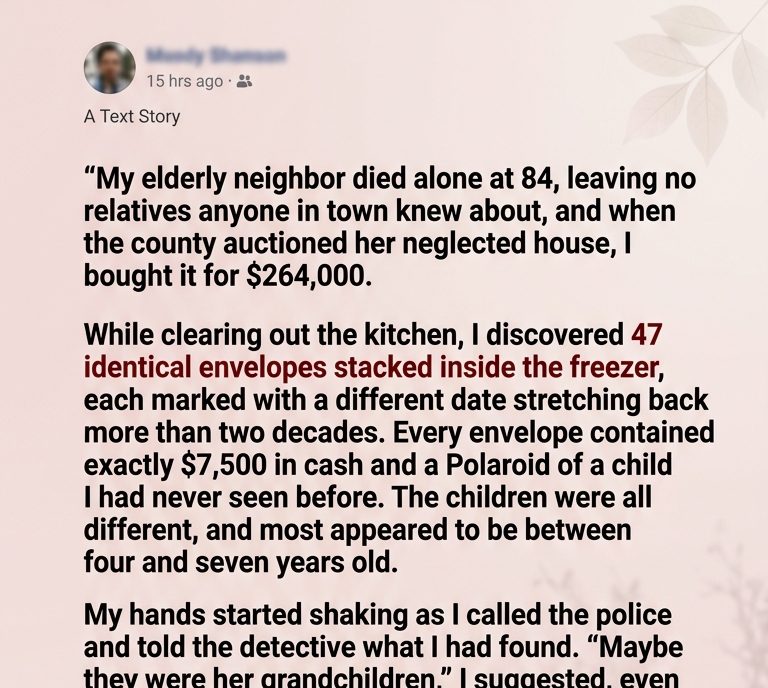
I never expected to find forty-seven envelopes inside a freezer.
They were stacked in neat rows beneath a layer of frost, each sealed with yellowed tape and marked with a date. The earliest was more than twenty years old. The latest was dated only four months before Eleanor died.
Every envelope contained exactly $7,500.
And every envelope contained a Polaroid photograph of a child.
I had opened three before realizing that the children were not related to one another. One was a little boy with curly black hair. Another was a red-haired girl wearing a yellow dress. A third showed a dark-skinned child sitting on a wooden bench, looking directly into the camera.
Most appeared to be between four and seven years old.
On the back of each photograph was a handwritten number and a short line of text. Some included dates. Others contained only initials.
My first thought was that Eleanor had been hiding money for grandchildren.
But I knew from the auction records that she had never married and had no children of her own.
My second thought was far worse.
I called the police.
Detective Laura Bennett arrived less than an hour later. She was in her forties, with tired eyes and a habit of listening without interrupting. She photographed the envelopes, recorded where I had found them, and asked me not to touch anything else.
When I suggested that the photographs might be connected to missing children, she stopped writing.
“Why would you think that?”
“Because there are forty-seven of them. Forty-seven different children. Forty-seven envelopes full of cash. It doesn’t look like a normal collection.”
She studied me for a moment.
Then she took the photographs to her vehicle and contacted a specialist.
Within two hours, several possible matches appeared in missing-person records.
I remember the way her face changed when she returned to the kitchen.
“We need to look at every photograph,” she said.
I helped her arrange them across the dining table. Some of the images were faded, but others were remarkably clear. The children looked happy in a few pictures. In others, they appeared frightened or exhausted.
The detective began making notes.
Then she reached the forty-eighth envelope.
Unlike the others, it contained no cash.
Only a handwritten letter addressed to me.
I couldn’t understand how Eleanor could have known my name when I had purchased the property only weeks earlier. The county auction had been public, but she had died months before my bid.
Detective Bennett read the letter silently.
Then she unfolded the map and asked me whether I knew what had once stood on the property.
I told her I didn’t.
She looked toward the garden.
“Until 1998, this land was part of the grounds of a children’s residential home called Briar House.”
I stared at her.
“What kind of residential home?”
“An institution for children who had been removed from unsafe homes, abandoned, or placed in temporary care. It operated here for decades before closing.”
She turned the map toward me.
“Eleanor Whitcomb worked there.”
The room seemed to shrink around us.
“She never told anyone?”
“According to the records we have, she was employed as an administrative assistant. But there are gaps in the institution’s files, especially during its final years.”
She tapped one of the red X’s.
“And some of the children in these photographs were reported missing from Briar House.”
My mouth went dry.
“How many?”
“We’re still checking. At least four of the photographs appear to match children who disappeared or were never properly accounted for. We don’t yet know what the other photographs represent.”
She folded the map carefully.
“I need to speak to the county and our forensic team. Nobody is going to dig up the garden until we have a warrant or the appropriate authorization.”
I looked at the letter again.
“What about the part where she says not to let the police take what we find?”
The detective’s expression became unreadable.
“That’s what worries me.”
She placed the letter in an evidence sleeve, but before sealing it, she read the final paragraph aloud.
If you are reading this, Daniel, then the house has finally passed to someone who can ask the questions I was too frightened to ask when it mattered most.
The money is not payment. It is not a reward. It is what I managed to save when the children were taken away from this place.
The photographs are the only proof I have left that they existed.
Beneath the roses are six boxes. They contain records that were never meant to survive.
Do not let anyone destroy them.
And do not trust a person simply because they wear a uniform.
Detective Bennett went completely still.
I looked at her.
“Does that mean you?”
“No,” she said quietly. “It means someone.”
For the first time since discovering the envelopes, I wished I had never bought the house.
But I was already involved.
And the six red X’s in the garden were waiting.
The following morning, two investigators arrived with a search warrant. They established a perimeter around the old rosebeds and brought in a specialist team to examine the ground.
I watched from the porch as they carefully removed the first layer of soil.
The work took hours.
At the first marked location, they found a rusted metal box wrapped in plastic. Inside were children’s identification cards, several handwritten lists, and a stack of official-looking forms.
At the second location, they uncovered a sealed container filled with medical records.
The third held school enrollment documents and letters addressed to different families.
By noon, Detective Bennett had stopped speaking casually.
The records suggested that Briar House had been involved in a system of unauthorized transfers. Children had been moved between facilities without complete paperwork. Some had been sent to foster placements that were never properly documented. Several files contained signatures from people who had no clear authority to approve the transfers.
The documents didn’t prove that every child had been abducted. Some placements may have been lawful, and some records had been lost during the institution’s closure.
But the gaps were alarming.
At the fourth location, the team found a small tin box containing a list of names.
Forty-seven names.
Each was followed by a date, a number, and a handwritten note.
Detective Bennett compared the list to the photographs from the freezer.
Then she sat down on the porch steps.
“Daniel,” she said, “I think Eleanor spent years trying to keep track of these children.”
“Why the money?”
“I don’t know yet.”
“Could she have been paying someone?”
“Possibly. But we shouldn’t assume that until we understand the records.”
She looked toward the garden.
“Whatever happened here, she appears to have kept evidence for a very long time.”
The fifth location produced a bundle of letters tied with string.
Some were from parents searching for children they had been told were transferred to another facility. Others were from former employees describing suspicious practices at Briar House.
One letter, dated twenty-four years earlier, was particularly disturbing.
I have been told that the boy was transferred to a family in Ohio. No address has been provided, and the placement agency says it has no record of him. I have contacted the county three times. No one will tell me where he is.
The letter was signed by a woman named Ruth Alvarez.
Detective Bennett searched the name in the records.
A match appeared.
Ruth had reported her six-year-old son missing in 1997, after he was placed at Briar House during a family crisis. The original case had been closed after authorities concluded that he had been transferred to another state.
No further information had been recorded.
I watched the detective read the report twice.
“Did they ever find him?” I asked.
“Not according to this file.”
She turned toward the sixth marked location.
“We need to know whether Eleanor kept anything that could explain what happened to him.”
The last rosebed was closest to the old fence.
The investigators dug slowly, uncovering a large metal box sealed beneath a flat stone. Unlike the others, this container had been wrapped in several layers of waterproof material.
When they opened it, they found a ledger, a collection of cassette tapes, and a packet of letters bound together with a red ribbon.
The ledger contained dates and names, along with references to money, transportation, and a series of coded abbreviations.
At first, it looked like a financial record.
Then Detective Bennett found a repeated notation beside several children’s names.
Released without guardian confirmation.
She turned a few pages.
The same notation appeared dozens of times.
I felt a cold pressure building in my chest.
“Does that mean they were taken?”
“It could mean several things,” she said. “But given the missing-person reports, we need to investigate every entry.”
One cassette had a date written on its label.
November 14, 1998.
Detective Bennett arranged for it to be examined and copied by the forensic team. The original was too fragile to play without risking damage.
We waited nearly two days for the recording to be transferred.
When the investigator finally called us into the station, I understood why.
The recording began with the sound of a door closing.
Then a man’s voice spoke.
“Eleanor, you need to stop keeping copies of these records.”
A woman answered.
“I can’t. These children have families. Someone needs to know where they’ve gone.”
“You don’t understand the situation.”
“I understand that their parents are looking for them.”
There was a long silence.
Then the man said something that made Detective Bennett sit forward.
“If those records ever leave this building, the entire department will be implicated.”
The recording ended abruptly.
No names were spoken.
No one identified the man.
But the date placed the conversation shortly before Briar House closed.
Detective Bennett ordered a review of former employees, administrators, and county officials connected to the institution. She also contacted the families of the children whose photographs had matched missing-person reports.
Within days, the investigation expanded beyond our town.
Former employees were interviewed. Archived placement records were requested from state agencies. Several families who had spent decades searching for their children were contacted.
Some of them refused to believe the news at first.
One woman hung up on the detective, then called back twenty minutes later, crying so hard she could barely speak.
Her daughter had disappeared from Briar House when she was six.
The photograph from Eleanor’s freezer matched the picture she had carried in her wallet for twenty-seven years.
The woman asked one question.
“Is my little girl alive?”
Detective Bennett didn’t promise what she couldn’t know.
“We have evidence that may help us find out,” she said.
For the first time in decades, the woman’s case was active again.
Three weeks later, the detective called me to the station.
She had found a document in the ledger that explained the money.
The forty-seven envelopes had been prepared over more than twenty years. Each contained $7,500 because Eleanor had been saving the money for a specific purpose: to help the children, or their families, once the truth could be established.
Some of the money appeared to have come from her own savings. Other deposits were linked to an account she had maintained after leaving Briar House.
The records did not yet show exactly how every dollar had been acquired, but investigators had found no evidence that the cash itself came from a recent crime.
Eleanor had been preserving it in case she could reunite any of the children with their families.
The photographs were not a list of victims alone.
They were a record of the children she had watched leave the institution.
The dates on the envelopes corresponded to the dates of those departures.
I stared at the ledger.
“Why didn’t she go to the police?”
Detective Bennett looked tired.
“She did. At least twice, according to the letters. One complaint was dismissed for lack of evidence. Another was filed under the wrong case number. We’re investigating why.”
“And the warning about not trusting someone in uniform?”
“We found a letter suggesting Eleanor believed one of the people involved had been a senior county official. She may have feared that a complaint would be passed back to the people she was accusing.”
The detective paused.
“We’re checking that claim carefully. A letter can establish what someone believed, but not necessarily what happened.”
I appreciated her honesty.
By then, I had learned how dangerous it could be to turn a suspicion into a certainty.
The investigation continued for months. Several former officials had died. Others were too ill to be interviewed. Some denied wrongdoing, while others admitted that records had been mishandled during the institution’s closure.
One former administrator eventually acknowledged that children had sometimes been moved without proper documentation. He claimed the practice had been intended to protect them from abusive relatives, but investigators found no evidence that the process had been consistently authorized or reviewed.
The state opened a formal inquiry.
And the missing children began to emerge from the shadows.
Two had been located under different names in other states. Both were adults now, living ordinary lives without knowing the circumstances of their early childhoods. When investigators approached them, they were offered counseling and time to decide whether they wanted to learn more.
One accepted.
One declined.
Their decisions were respected.
A third case ended in tragedy. Records showed that a child had died several years after being placed with a family, but the death had never been properly connected to the original missing-person report. His mother had spent the rest of her life believing he might still be alive.
She had died before the investigation began.
I thought about that for days.
No amount of money could give her back the years she had lost.
No discovery could undo the damage done to the children who had grown up without knowing their origins.
But the records mattered.
They gave families answers. They gave survivors choices. And they gave investigators something concrete to work with.
The house on Willow Lane became the center of a story far larger than the neglected property I had bought at auction.
Journalists began calling. Former residents of Briar House came forward with their own memories. Some described kind caregivers and happy moments. Others spoke of unexplained transfers, sudden separations, and staff members who warned them never to ask questions.
I declined interviews.
I had purchased a house, not a platform.
The important work belonged to the families, the investigators, and the people who had lived through what happened.
Still, I couldn’t ignore the fact that Eleanor had chosen to leave the evidence there.
She had known the property would eventually be sold. She had known that someone might discover the envelopes. And somehow, she had learned my name before she died.
I asked the detective about it.
She showed me a copy of Eleanor’s final will.
It had been signed six months before her death and filed with the county shortly afterward. Eleanor had included a paragraph stating that the house should be sold publicly, with no private transfer to a named buyer.
There was no reference to me.
The letter addressed to me had been written after the will, but the paper trail showed that Eleanor had kept a newspaper clipping announcing the upcoming auction beside her correspondence.
My name appeared on a list of registered bidders after the sale.
She could not have known with certainty that I would win.
But she may have anticipated that someone who bought the house would eventually find the freezer and the garden.
The detective believed Eleanor had prepared the letter for whoever became the next owner and written my name after the auction results became public, shortly before she died.
It was not supernatural knowledge.
It was a final, deliberate act.
She had been waiting for someone to open the door.
Six months after the discovery, I returned to Willow Lane with a shovel in my truck.
The investigation had released most of the property back to me, although several documents remained in official custody. The six holes in the garden had been filled, and the old rosebushes had begun to recover.
I stood beside the first bush and looked at the place where the metal boxes had been buried.
I had spent much of my life repairing buildings. I understood how to replace a roof, reinforce a foundation, and bring an old house back into good condition.
But I had never repaired anything quite like this.
The house had once been a place where children waited for adults to tell them what would happen next. Eleanor had spent years preserving evidence because she believed those children deserved answers.
Now the property belonged to me.
I decided to restore the garden, not because I wanted to turn the house into a monument, but because I wanted the place to be something other than a reminder of what had happened there.
I replanted the roses.
I repaired the porch steps and replaced the broken windows. I kept the old kitchen freezer until the renovations were finished, then donated it to a local charity after the police confirmed that it contained nothing else relevant to the investigation.
The money from the envelopes remained under legal review. It wasn’t mine, and I never considered keeping it. Eventually, the authorities established a process for preserving it while they worked to determine whether any portion belonged to identifiable families or should be handled through the estate.
I didn’t want a reward.
I wanted the truth to reach the people who had spent their lives waiting for it.
A year after I bought the house, Detective Bennett visited me again.
She carried a small package.
Inside was a copy of a photograph from the freezer, along with a note from a woman named Ruth Alvarez.
Her son had been one of the children whose disappearance was connected to Briar House. Investigators had located him living under a different name in another state. He had chosen to meet his mother after months of counseling and preparation.
They were rebuilding their relationship slowly.
Ruth had written that she didn’t know how to thank the people who had helped reopen the case.
She had also written one sentence that I read several times.
For twenty-seven years, I thought my son had forgotten me. Now I know he was a child who had never been given the chance to find me.
I placed the note in a drawer beside Eleanor’s letter.
The investigation was not finished. Some questions might never be answered. Not every child could be located, and not every missing record could be reconstructed.
But families had been given new information. Former residents had been heard. And the institution’s history was no longer hidden behind a closed file.
On the anniversary of my purchase, I sat on the porch and watched the sunlight fall across the rose garden.
I thought about the forty-seven envelopes, the six buried boxes, and the old woman who had spent decades trying to preserve what others had wanted forgotten.
I had bought her house because I wanted a quiet place to start over.
Instead, I inherited a responsibility I had never expected.
I still think about Eleanor sometimes. I wonder how many nights she spent in that kitchen, looking at the photographs and asking herself whether she had done enough. I wonder whether she believed the evidence would ever reach the people who needed it.
I wish she had lived long enough to see the first families reunited.
I wish she had not carried so much fear alone.
But I understand now why she left the letter.
She knew that a house could be sold, a garden could be neglected, and a life could disappear from public memory. She also knew that the truth sometimes survived in the smallest places: a photograph tucked inside an envelope, a name written in a ledger, a letter hidden beneath a floorboard.
The forty-seven envelopes had seemed like a mystery about money.
They were really a record of forty-seven children whose stories had been interrupted.
And the six red X’s had not marked buried treasure.
They marked the places where one frightened woman had hidden the truth, hoping that someday someone would be brave enough to uncover it.
I had gone to Willow Lane looking for a home.
I found a history that needed to be heard.
And I learned that the value of a house is not always measured by what someone pays for it. Sometimes it is measured by what the house has been holding, quietly and patiently, waiting for the right person to open the door.