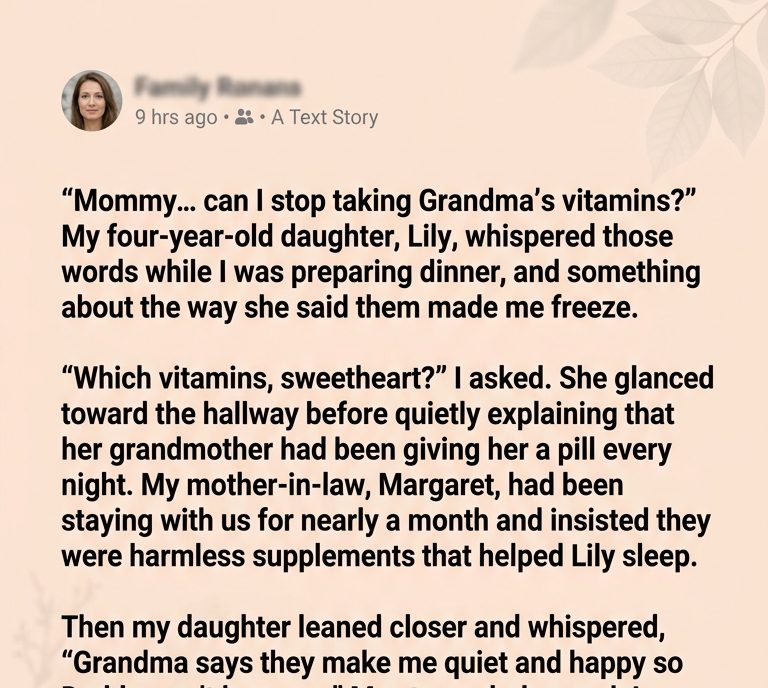
“Mommy… can I stop taking Grandma’s vitamins?”
My four-year-old daughter, Lily, whispered those words while I was preparing dinner, and something about the way she said them made me freeze.
I turned away from the stove and knelt beside her.
“Which vitamins, sweetheart?”
She glanced toward the hallway before answering.
“The little white pill Grandma gives me every night.”
I felt a knot form in my stomach.
My mother-in-law, Margaret, had been staying with us for nearly a month. She had offered to help care for Lily while my husband, Daniel, worked longer hours at his company. At first, I had been grateful. Margaret seemed attentive, cooked meals, folded laundry, and insisted that she wanted to make our lives easier.
A few days after arriving, she had told me she possessed some harmless supplements that helped children settle down at bedtime.
“She gets so restless in the evenings,” Margaret had explained. “These will help her sleep better. My friend recommended them.”
I had never agreed to give Lily medication, and I had assumed Margaret was simply talking about ordinary vitamins. When I asked to see the bottle, she said she had left it in her bedroom and would show me later.
Somehow, the conversation had ended without me seeing it.
Now my daughter was standing in front of me, asking permission to stop taking something she had been given every night.
“Does Grandma tell you what the pills are for?” I asked gently.
Lily nodded.
“She says they make me quiet and happy.”
“Does she tell you anything else?”
My daughter twisted the hem of her little shirt.
“She says I have to take them so Daddy won’t leave us.”
For a moment, the kitchen seemed to go completely silent.
I turned off the stove and pulled Lily into my arms.
“Sweetheart, listen to me. You never have to take something because you’re afraid Daddy will leave. You haven’t done anything wrong, and you can always tell Mommy when something makes you uncomfortable.”
She buried her face against my shoulder.
“I don’t like how sleepy I feel.”
Those words frightened me more than anything else she had said.
I asked her when she had last taken the pill and whether she felt unwell at that moment. She said Grandma had given her one the previous evening, but she couldn’t remember exactly what it looked like.
I didn’t give her any more medication. I called her pediatrician’s office, explained what Lily had told me, and asked where I should take her for an urgent assessment. Because I didn’t know what the substance was or how much she might have received, I followed the medical team’s instructions rather than trying to investigate it myself.
Then I went to Margaret’s bedroom.
She was folding a stack of towels when I entered.
“Where is the bottle you’ve been giving Lily?” I asked.
Her hands stopped moving.
“What bottle?”
“The vitamins. The pills you give her every night.”
Margaret looked at me for a long moment before opening the bedside drawer.
“They’re perfectly safe,” she said, removing a small amber bottle. “You’re making a fuss over nothing.”
I took the bottle only long enough to secure it for the medical team.
“I’m taking Lily to her doctor. They’ll identify it.”
Her expression hardened.
“You’re going to make your daughter afraid of her own grandmother over a harmless supplement?”
“I don’t know what you’ve been giving her. That’s why we’re going.”
For the first time since she had moved into our house, Margaret looked genuinely unsettled.
“Don’t you dare tell Daniel about this before you understand what you’re doing,” she said.
That was when I realized she was more concerned about my husband’s reaction than about whether Lily was safe.
I didn’t argue with her. I took Lily to the medical facility recommended by her pediatrician and brought the bottle with us.
The doctor examined Lily and asked me to describe everything I knew. He wanted to know when she had started taking the pills, how often Margaret had given them to her, whether Lily had experienced unusual sleepiness, and whether there were any other medications or supplements in the house.
Then he examined the label.
His expression changed.
“Who has been giving this to your daughter?” he asked.
“My mother-in-law. She told us they were vitamins.”
The doctor looked at the bottle again.
“This is not a routine children’s vitamin. It contains a medication that should not be given to a child without appropriate medical authorization.”
My hands went cold.
“Is she going to be okay?”
“We need to assess her carefully before I can answer that. We’ll determine what the medication is, consider the possible dose and timing, and monitor her according to the clinical findings.”
He arranged the appropriate evaluation and explained that if Lily became difficult to wake, had trouble breathing, experienced a seizure, or developed other severe symptoms, emergency treatment would be necessary.
I sat beside my daughter while the medical team assessed her.
She kept asking whether she was in trouble.
Every time she asked, I told her the same thing.
“No, sweetheart. You’re not in trouble. The grown-ups are responsible for making sure you’re safe.”
Eventually, the doctor returned with the preliminary findings.
The substance was a prescription medication, not a vitamin. Giving it to a four-year-old without proper medical supervision could be dangerous.
The doctor wanted to establish exactly how Lily had received it and whether she had been exposed to anything else.
Then he asked whether Margaret had ever mentioned having a medical condition or taking prescription medication herself.
I remembered a few vague comments about her sleep problems, but nothing that explained what was happening.
“I don’t know,” I admitted.
The doctor documented the information and explained that he needed to check Lily’s medical history and verify whether the medication had ever been prescribed to her.
He opened her electronic medical record.
After a few minutes, he stopped typing.
“That’s unusual,” he said quietly.
“What is it?”
He turned the screen slightly toward himself and reviewed an entry from several months earlier.
There was a record of an earlier consultation that I had never attended. It indicated that someone had contacted a medical office about Lily’s sleep difficulties, claiming to be authorized to discuss her care.
But Lily had never been prescribed the medication in the bottle.
The doctor began checking the details with the relevant office to determine who had made the contact and what information had been provided.
Then he looked at me.
“Did your mother-in-law ever have permission to make medical decisions for Lily or access her medical information?”
“No,” I answered immediately. “She has never been Lily’s legal guardian. She helps us at home, but we never authorized her to arrange medication.”
The doctor nodded and continued documenting the discrepancy.
The record raised questions that needed to be investigated. It did not yet establish who had made the earlier contact or why.
But it meant the bottle was not necessarily the whole story.
I called Daniel.
He answered on the second ring.
“Hey, everything okay? I’m about to leave the office.”
“Daniel, I need you to come to the hospital.”
His voice changed immediately.
“What’s wrong? Is Lily hurt?”
“She is being examined. Your mother has been giving her a medication she called vitamins. The doctor says it wasn’t prescribed for her.”
There was a long silence.
Then he said, “That can’t be right. Mom wouldn’t do that.”
“I have the bottle, Daniel. The doctor is examining her now. Please come.”
He arrived less than forty minutes later, still wearing his work clothes. His face was pale, and he went straight to Lily’s bedside.
She reached for him.
“Daddy, I’m sorry.”
Daniel knelt beside her.
“Sorry for what, sweetheart?”
“Grandma said I had to take the pills so you wouldn’t go away.”
My husband looked as if the floor had disappeared beneath him.
He hugged Lily carefully and told her that nothing she had done could make him stop loving her.
Then he turned toward me.
“Why would Mom tell her that?”
I shook my head.
“I don’t know. But the doctor has found something else in her medical records that needs to be checked.”
Daniel sat down beside me. For the first time, neither of us tried to defend his mother or explain away what had happened.
We waited for the doctor to return.
When he did, he told us that the medical team had found no evidence that Lily had been prescribed the medication through her regular pediatric care. They were continuing to assess her condition and had documented the circumstances of the exposure.
He also explained that the earlier record needed verification before anyone could draw conclusions about the identity of the caller or the purpose of the contact.
Daniel asked what we should do next.
The doctor advised us to make sure no further doses were given, follow the medical team’s treatment recommendations, and cooperate with the appropriate safeguarding authorities. He also recommended that we preserve the bottle and any related messages or records.
Daniel nodded.
Then he looked at me and said, “I’m going to speak to my mother.”
I took his hand.
“Not alone, and not until we know how to keep Lily safe. We need to let the professionals handle this properly.”
He looked toward our daughter.
For a long time, he said nothing.
Finally, he agreed.
That evening, we returned home after the medical team had determined the next steps for Lily’s care. Margaret was sitting in the living room when we entered.
She stood up immediately.
“How is she?”
Daniel answered before I could.
“Why have you been giving our daughter prescription medication?”
Margaret’s expression hardened.
“She needed help sleeping. You both work too much, and I was trying to help.”
“That’s not what you told her,” I said. “You told her the pills would make her quiet and happy so I wouldn’t have to worry about her.”
Margaret looked away.
“I never meant to hurt her.”
“Then why did you tell her Daddy might leave if she didn’t take them?”
She didn’t answer.
Daniel stood very still.
“You told my daughter that she had to take a pill to keep me from leaving our family. Do you understand what that did to her?”
Margaret began to cry.
“I was trying to keep everything together.”
“By frightening a four-year-old?” he asked.
She covered her face with her hands.
I wanted an explanation. I wanted to know why she had done it, how she had obtained the medication, and whether the earlier medical record was connected to her.
But I also understood that an emotional confrontation would not establish the facts.
We told Margaret that she could no longer provide unsupervised care for Lily. We secured the remaining medication for the authorities and arranged for the relevant records to be reviewed. We also made it clear that any further discussion about the medication or medical history would take place with the appropriate professionals involved.
Margaret left the house that evening to stay with another relative.
In the days that followed, the investigation uncovered an important distinction between what we knew and what we still needed to establish.
The medical record showed that someone had previously contacted a medical office about Lily. The office’s records were being reviewed to establish who had contacted it and what had been said. The medication itself had not been prescribed to Lily through her usual pediatric care.
Those findings were concerning, but they did not automatically prove that Margaret had made the earlier contact. We cooperated with the authorities so that the evidence could be examined properly.
Meanwhile, Lily’s recovery became our priority.
Her doctor arranged follow-up appointments to monitor her physical health and assess whether she needed additional support. We also consulted a child counselor to help her process the frightening things she had been told.
At home, we changed our routines.
Daniel began coming home earlier whenever possible. We made dinner together, read Lily’s favorite stories, and reminded her that she never had to take medication or keep secrets to make someone love her.
We didn’t interrogate her about Grandma. We allowed her to talk at her own pace, and we made sure she understood that telling us how she felt would never get her into trouble.
One evening, several weeks later, Lily sat beside me while I folded laundry.
“Mommy?”
“Yes, sweetheart?”
“Daddy isn’t going to leave because I don’t take Grandma’s pills, right?”
I put the clothes down and pulled her into my arms.
“No, Lily. Daddy loves you because you’re his little girl. You never have to take a pill to keep him here.”
She rested her head against my chest.
“Can I just take medicine when the doctor says I need it?”
I felt tears rise in my eyes.
“Yes. And you can always ask me what something is and why you’re taking it. If you’re ever unsure, we’ll ask your doctor together.”
She nodded, satisfied with that answer, and returned to her coloring book.
It was such a small conversation, but it showed me how deeply the situation had affected her. She hadn’t simply been given something she didn’t understand. She had been made to believe that her family’s love depended on obeying an adult’s instructions.
That was the part I never wanted her to carry into the rest of her life.
As the weeks passed, the authorities continued reviewing the medication, the medical records, and the circumstances surrounding Margaret’s actions. We waited for verified answers rather than making assumptions about what the evidence would ultimately show.
Daniel struggled with the possibility that his mother had deliberately frightened his daughter. He felt angry, betrayed, and confused. At times, he wondered whether he had missed warning signs because he trusted Margaret.
I reminded him that the responsibility for giving a child an unauthorized medication did not belong to the child or to the parent who had not known about it. We could learn from what happened without blaming ourselves for another adult’s choices.
Eventually, our family established new boundaries. Margaret would not be allowed to administer medication, access Lily’s medical information, or care for her without appropriate safeguards. Any future contact would depend on Lily’s well-being and the guidance of the professionals involved.
I didn’t know whether our relationship with Margaret could ever be repaired.
That question could wait.
My daughter needed stability, honesty, and the freedom to be four years old without worrying about whether her behavior might cause someone to abandon her.
One night, I tucked Lily into bed and kissed her forehead.
“Are you happy, Mommy?” she asked.
I smiled gently.
“I am, sweetheart. Are you?”
She thought for a moment.
“Yes. Because I don’t have to take Grandma’s vitamins anymore.”
I held her hand until she fell asleep.
I thought about the moment she had first whispered those words in the kitchen. If I had dismissed her, assumed Margaret knew best, or treated her discomfort as a childish complaint, we might not have discovered the problem when we did.
Children don’t always know the right words to describe what frightens them. Sometimes they offer a small question, an unexplained change in behavior, or a request that seems insignificant until we stop and listen.
Lily had given me that chance.
And I was grateful that I had listened.
I couldn’t change what had happened, and I couldn’t promise that every question about Margaret’s actions would have an easy answer. But I could make sure my daughter never again believed that she had to sacrifice her comfort or safety to keep the people she loved close.
Because love should never be used as a bargaining tool.
A child should never be made responsible for an adult’s emotions.
And no one—not even a grandparent—should ever give a child medication without appropriate medical authorization and the knowledge of the people responsible for that child’s care.
That night, as I watched Lily sleep peacefully in her own bed, I finally understood what had mattered most about the question she had asked me.
She hadn’t been asking about vitamins.
She had been asking whether she was allowed to say no.
And I wanted her to grow up knowing the answer would always be yes.
She was allowed to ask questions. She was allowed to speak up. She was allowed to feel safe. And she would never have to earn her family’s love by swallowing a pill—or by keeping a frightening secret.