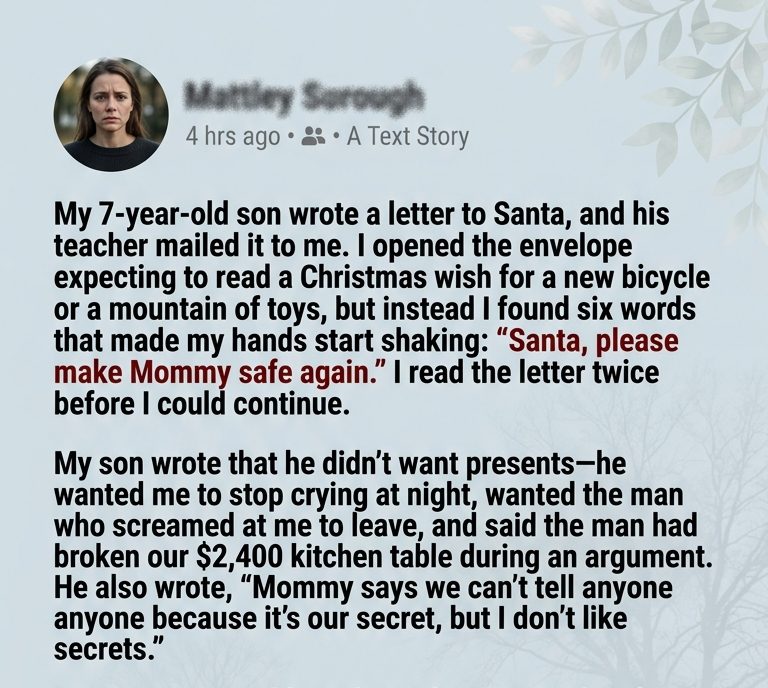
I read my son’s letter to Santa three times before I could accept what it said.
My name is Emily Parker. I was 34 years old, raising my seven-year-old son, Noah, while trying to build a stable life on a salary of barely $47,000 a year. From the outside, we probably looked like an ordinary little family. We lived in a modest two-bedroom rental, decorated a small Christmas tree every December, and ate pancakes together on Sunday mornings.
But inside our home, I had been learning how to survive without admitting that I was afraid.
The man who had brought fear into our lives was my boyfriend, Jason. When we first met, he had been charming, attentive, and wonderful with Noah. He helped fix things around the apartment, brought home takeout when I worked late, and told me I deserved someone who would take care of me.
Slowly, things changed.
His temper became unpredictable. A disagreement about money could turn into an argument that lasted hours. He began criticizing how I dressed, questioning who called me, and insisting that I was disrespecting him whenever I disagreed.
Then came the shouting.
Then came the broken objects.
One night, during an argument about an unpaid bill, Jason slammed his hand against our kitchen table so hard that the wooden frame split. The table had cost me $2,400, and I had saved for months to buy it.
I remember staring at the broken wood while Jason paced around the kitchen, telling me I had made him angry.
The next morning, I pushed the damaged table against the wall and covered the worst of the cracks with a tablecloth.
When Noah asked what happened, I told him the table had broken by accident.
I told myself I was protecting him.
I didn’t understand that he was already seeing everything.
By December, I had become skilled at hiding the evidence of our arguments. I threw away broken dishes before Noah came home from school. I cleaned up spilled food, replaced damaged decorations when I could afford them, and practiced smiling whenever my son asked whether everything was okay.
Whenever Jason apologized, I wanted to believe him.
He would promise that he was stressed, that he loved us, and that nothing like this would happen again.
I wanted those promises to be true so badly that I kept giving him another chance.
Then, one Thursday afternoon, Noah’s teacher sent me a message asking whether I could speak with her after school.
I assumed he had gotten into trouble.
Instead, when I collected him, Mrs. Carter handed me a small envelope.
“Your son wrote this during a classroom activity,” she explained gently. “He asked me to mail it to you because he wanted you to read it at home.”
The envelope was addressed in crooked blue letters:
TO SANTA — FROM NOAH.
I smiled when I saw it.
“Did he write his Christmas list early?”
Mrs. Carter didn’t smile back.
“I think you should read it privately,” she said.
That evening, after Noah had gone to bed, I opened the envelope at the kitchen counter.
Inside was a single sheet of paper covered in careful handwriting.
At the top, he had written:
Dear Santa,
I don’t need toys this year.
Then came the words that made my hands shake.
Please make Mommy safe again.
I pressed my palm against my mouth.
The letter continued.
I want Mommy to stop crying at night. I want Jason to stop yelling at her. He broke our table and said it was Mommy’s fault.
Mommy says we can’t tell anyone because it’s our secret, but I don’t like secrets.
Please make our house quiet again. I want Mommy to smile like she does when we’re alone.
At the bottom, Noah had drawn two small figures holding hands beneath a Christmas tree.
One was labeled MOMMY.
The other was labeled ME.
There was no third figure.
I sat on the kitchen floor and cried until I could barely breathe.
For months, I had convinced myself Noah was too young to understand what was happening. I had told myself that as long as Jason never hurt him physically, I could manage the situation.
But my little boy had been measuring his childhood by the sound of my crying.
He had been learning when to stay quiet, when to disappear into his bedroom, and when to pretend not to notice the tension in the room.
I had spent so much time worrying about whether Jason was angry that I hadn’t realized how much Noah was afraid.
My phone rang.
It was Mrs. Carter.
“Emily,” she said, “I’m glad you’ve read the letter. I need to explain something important.”
I wiped my face.
“Okay.”
“When Noah wrote this, he became very upset. I asked him whether he felt safe at home. He told me that Jason had threatened him and warned him that something terrible would happen if he ever told anyone what was going on.”
My heart dropped.
“What did Jason say to him?”
Mrs. Carter paused before answering.
“Noah told me Jason said that if he talked about the arguments, his mother would lose everything and they would both be sorry.”
I felt sick.
Jason had not only frightened me into silence. He had made our son believe that speaking up could destroy the only home he knew.
Mrs. Carter continued carefully.
“I am required to report concerns like these under the rules that apply to my role. I have made the appropriate report. I wanted you to know because Noah needs to be safe, and you deserve support too.”
I couldn’t speak.
Then she said something that changed everything.
“Emily, there’s one more thing. Noah didn’t just write that letter. He came to me earlier this week and asked if he could tell me something privately. He said he had kept something because he thought it might help you.”
I gripped the phone.
“What did he keep?”
“A note,” she replied. “He told me Jason had left it somewhere he could find it. Noah was frightened, but he thought it was important. I haven’t asked him to investigate anything further. I wanted you to know that he has already tried to get help.”
For a moment, I couldn’t hear anything except my own heartbeat.
My seven-year-old son had been so worried about me that he had carried a secret he didn’t know how to handle.
I asked Mrs. Carter whether Noah was safe at school and whether we could arrange a meeting the next morning. She said she would help coordinate the appropriate support.
When the call ended, I looked toward the hallway.
Noah was asleep behind his bedroom door, his favorite stuffed bear tucked beneath his chin.
I wanted to wake him and promise that everything would be okay.
But I knew promises alone were no longer enough.
I needed to act.
That night, I quietly gathered my identification, Noah’s birth certificate, our medication, and a few essential belongings. I contacted my sister, Rachel, who lived twenty minutes away, and told her I needed somewhere safe to stay.
She didn’t ask me why I had waited so long.
She simply said, “Come here. Both of you.”
Before dawn, I made sure Jason was not between us and the exit. With Rachel on the phone, I took Noah and left for her house.
I didn’t leave a note.
I didn’t argue.
I didn’t wait for another apology.
For the first time in months, I made a decision without asking myself whether Jason would be angry about it.
When Noah woke up at Rachel’s house, he looked around the unfamiliar bedroom and then at me.
“Are we staying here, Mommy?”
“For now,” I said, sitting beside him. “We’re somewhere safe.”
He studied my face.
“Is Jason coming here?”
“No. We’re going to get help, and the grown-ups are going to handle this.”
He nodded slowly.
Then he asked the question that nearly broke me.
“Are you mad at me because I told my teacher?”
I pulled him into my arms.
“No, baby. Not even a little bit.”
“But Jason said—”
“Listen to me, Noah.” I gently held his face between my hands. “You did the right thing by telling someone you were scared. None of this is your fault. You are not responsible for what Jason does, and you are not responsible for protecting me.”
He began to cry.
“I just wanted you to be happy again.”
I held him tighter.
“I know. And I’m going to take care of you. You don’t have to fix this for me anymore.”
That was the moment I understood what his letter had really been asking.
He hadn’t asked Santa for a miracle because he wanted a perfect Christmas.
He had asked because he believed the adults around him had run out of ways to make things better.
And he had decided that if nobody else could help his mother, perhaps Santa could.
The following day, I met with Mrs. Carter and the appropriate support professionals. We discussed the letter, Noah’s disclosure, and the note he had brought to school.
I learned that Jason had written a message about making sure Noah “kept his mouth shut” after one of our arguments. Noah had found it on a piece of paper near the kitchen counter and tucked it into the pocket of his school backpack.
He hadn’t fully understood what the message meant.
He only knew that it frightened him.
The note did not solve everything, and it was not Noah’s job to gather evidence. But it helped explain why he had been so afraid to speak.
The professionals handling the report took the information seriously and explained the next steps. I also sought advice about protecting myself and Noah, including our housing situation and what to do if Jason tried to contact us.
I had spent months believing I needed undeniable proof that things were bad enough before I could leave.
I finally understood that I did not need to wait for another frightening incident to justify keeping my child and myself safe.
Over the next several weeks, life became complicated in ways I had never imagined.
I had to rearrange my work schedule, speak with my landlord, organize childcare, and figure out how to manage my expenses while living somewhere else. My $47,000 salary suddenly felt smaller than ever.
There were days when I worried about every dollar.
There were nights when I missed the version of Jason I had fallen in love with, even though I knew that missing someone did not mean I should return to an unsafe situation.
There were also moments when I questioned myself.
Had I exaggerated things? Could I have handled the arguments differently? Had I failed as a mother by allowing the situation to continue?
A counselor helped me understand that those questions were common for people leaving controlling or frightening relationships. We worked on separating responsibility from guilt.
Jason was responsible for his own behavior.
I was responsible for the choices I made now to protect Noah and myself.
Those were not the same thing.
I followed the guidance I received from the professionals involved and kept our location private. When Jason tried to contact me, I did not meet him alone to discuss the relationship. I used the appropriate channels to handle necessary communication.
He sent messages apologizing. He promised to change. He said he couldn’t understand how I could leave after everything we had shared.
For a while, those words pulled at me.
Then I remembered Noah’s letter.
I want Mommy to stop crying at night.
I could not let the guilt of leaving become another reason to ignore what my son had experienced.
As Christmas approached, Rachel helped Noah and me decorate a small tree in her living room.
We used inexpensive lights and paper ornaments. Noah made a star from yellow construction paper and wrote our names on it.
MOMMY AND NOAH.
When we finished, he stepped back and studied the tree.
“It’s not as big as our old one,” he said.
“No,” I replied. “It’s not.”
He looked at me.
“But it’s quieter here.”
I swallowed hard.
“Yes, sweetheart. It is.”
Then he gave me a small smile.
“Can we have pancakes on Christmas morning?”
I laughed through my tears.
“Absolutely.”
For the first time in a long while, the sound of my own laughter didn’t feel like something I had to force.
A few days later, Mrs. Carter sent me a message asking whether Noah would like to receive a reply to his letter from the school. She explained that they wanted to make sure he understood he had done nothing wrong by asking for help.
I agreed.
The next afternoon, Noah came home holding a sealed envelope.
“Mrs. Carter said this is for me.”
He sat beside me on the sofa and carefully opened it.
Inside was a simple card.
Dear Noah,
Thank you for telling a trusted adult when something frightened you. You deserve to feel safe, and it is never your job to protect grown-ups from the truth.
You are not in trouble for speaking up. You are loved, and there are adults whose job it is to help.
Keep being a kid. You do not have to solve everything yourself.
Noah read the card slowly.
Then he folded it and placed it beside his Santa letter.
“Mommy?”
“Yes?”
“Does this mean Santa got my letter?”
I looked at him, at the two envelopes resting in his small hands, and at the Christmas tree glowing softly in the corner.
I thought about all the things I had once believed I needed to make a family complete: a permanent home, a partner who stayed, enough money to stop worrying, and a Christmas that looked happy from the outside.
Now I understood that none of those things mattered more than a child feeling safe enough to sleep peacefully.
I brushed his hair away from his forehead.
“I think your letter helped us find the people who could help,” I told him. “And I think that was very brave.”
He leaned against me.
“Can I ask Santa for a bicycle next year?”
I smiled.
“Of course you can.”
“And maybe a Lego set?”
“That’s allowed too.”
He giggled, and I held him close.
That Christmas wasn’t perfect. We didn’t have our own home again yet, and I was still learning how to rebuild a life I had spent years trying to hold together.
But I no longer hid broken things beneath tablecloths.
I no longer told my son that frightening behavior was just an accident.
And I no longer believed that keeping a family together meant keeping its secrets.
The $2,400 kitchen table was still broken. The money I had spent on it was gone, and I couldn’t afford to replace it.
For months, I had treated that table as a symbol of everything falling apart.
Eventually, I realized the table was only a piece of furniture.
What mattered was the little boy who had sat at it, watched his mother cry, and found the courage to tell someone the truth.
Noah had not rescued me by himself. He was a child, and he should never have had to carry that burden.
But his letter helped bring the truth into the open, and the adults around us finally began doing what adults should have done from the beginning: listening, taking the danger seriously, and helping us find a safer path.
I still keep his letter in a small wooden box beside my bed.
Sometimes I read it when I feel overwhelmed by the challenges of starting over.
Not because I want to remember the fear, but because I want to remember the moment I stopped pretending.
My son asked Santa to make Mommy safe again.
The truth is, Santa didn’t do it.
A teacher listened. A family member opened her door. Professionals helped us understand our options. And I finally accepted that I was allowed to leave a situation that frightened us.
Most importantly, my son learned that telling the truth was not a betrayal.
It was a way to ask for help.
That year, my seven-year-old son didn’t get every toy he might have wanted. But he got something far more important: a mother who stopped making excuses for fear, a home where he could sleep without listening for shouting, and the freedom to be a child instead of the person trying to save his family.
And I learned that the bravest thing a mother can do is not always to endure more for the sake of her child.
Sometimes, it is to show her child that love should never require anyone to live afraid.