After seven years working overseas, I thought I knew exactly what I would feel when I finally returned home.
I imagined my mother opening the front door, recognizing me, and throwing her arms around me. I imagined her crying happy tears, touching my face as if she needed to make sure I was real. I imagined sitting beside her in the living room of the beautiful house I had bought for her, listening to her tell me all the little things I had missed while I was away.
Most of all, I imagined her finally resting.
My mother was sixty-eight years old. She had spent most of her life putting everyone else first, working long hours, stretching every dollar, and making sacrifices so my sister and I could have better opportunities.
When I left for Singapore, I made her a promise.
“One day, Mom, you’ll never have to worry about money again.”
I meant it.
For seven years, I worked exhausting shifts, accepted extra responsibilities, and lived far more simply than my salary might have allowed. While other people spent their money on vacations and expensive clothes, I transferred money home and saved what I could.
Eventually, I had enough to buy my mother a beautiful house worth approximately $850,000.
It had a spacious kitchen, a peaceful garden, a large living room, and enough bedrooms for the family to visit comfortably. I chose it because I wanted her to have everything she had gone without when she was younger.
The property was legally purchased in my name, with the intention that it would be her home for the rest of her life.
My mother knew I had bought the house for her, but I had never told her exactly when I would return. I wanted to surprise her.
I landed on a Tuesday morning, exhausted from the journey but too excited to rest. I took a car straight to the house, carrying a suitcase and a small gift bag filled with things I had bought for her in Singapore.
When I arrived, I stood outside the front gate for a moment, smiling.
The house looked even more beautiful than it had in the photographs.
I imagined my mother sitting on the veranda, drinking tea without worrying about the next electricity bill or whether she could afford to repair something that had broken.
I walked up the path and rang the doorbell.
The door opened almost immediately.
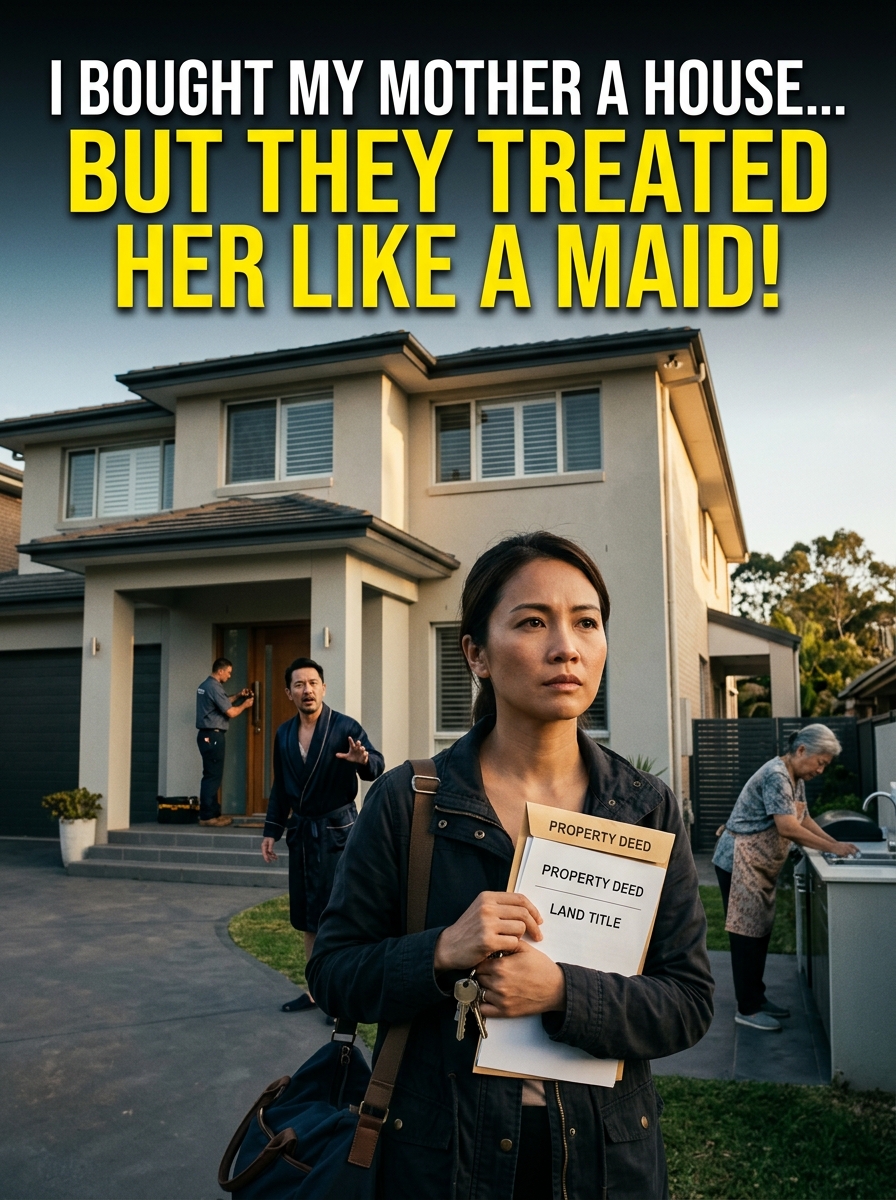
A man stood in front of me wearing an expensive silk robe. His hair was perfectly styled, and he held a coffee cup in one hand.
It was Richard, my sister’s husband.
He looked me up and down.
Then he said, “The maid is out back.”
I blinked.
“I’m sorry?”
He glanced at my suitcase and gift bag.
“If you’re here to work, hurry up. We have guests arriving tonight.”
For a second, I thought he was joking.
Then I noticed the expression on his face.
He genuinely believed I was someone who had come to work in the house.
“Richard,” I said carefully, “where is my mother?”
He frowned.
“Who?”
“My mother. Margaret.”
He gave an impatient sigh.
“She’s probably in the backyard. There’s always something for her to do out there.”
Then he turned and walked away, leaving the front door open as if I were expected to follow him.
I stood in the doorway, trying to understand what I had just heard.
Richard had been married to my sister, Claire, for six years. We had met several times before I left for Singapore, although most of our conversations had been brief. I had sent my sister money occasionally, and she had assured me that our mother was comfortable and happy.
I had no reason to think otherwise.
But Richard’s behavior made something inside me uneasy.
I walked through the house.
The living room was filled with expensive furniture I didn’t remember choosing. There was a large television mounted on the wall, decorative vases on the shelves, and framed photographs of Richard, Claire, and their two children.
My mother was nowhere to be seen.
Then I heard water running outside.
I followed the sound through the kitchen and out into the backyard.
And there she was.
My mother was wearing an old apron over a faded blouse. Her gray hair was tied back loosely, and her hands were wet from scrubbing a large outdoor kitchen counter.
A bucket sat beside her feet.
She was working so hard that she hadn’t noticed me approaching.
For several seconds, I couldn’t move.
This was the woman for whom I had sacrificed seven years of my life.
The woman I had imagined spending her retirement reading books, tending flowers, and enjoying quiet mornings in the garden.
Instead, she was scrubbing an outdoor kitchen while my sister’s family relaxed inside the house I had bought for her.
I looked through the open glass doors.
Richard was back on the sofa, scrolling through his phone.
One of the children was watching television.
A woman I didn’t recognize was arranging flowers on the dining table.
And my mother was outside, working like someone who had been hired to prepare the house for guests.
“Mom?” I whispered.
She turned.
The moment she saw me, the cloth slipped from her hand.
For a few seconds, she stared at me as if she couldn’t believe what she was seeing.
Then she hurried toward me.
“My child?”
I dropped my suitcase and embraced her.
She held me so tightly that I could feel her trembling.
“You came home,” she whispered. “You really came home.”
I closed my eyes.
I had imagined this moment a thousand times.
But I had never imagined my mother crying against my shoulder while wearing an apron in her own backyard.
“Mom, why are you doing this?”
She quickly wiped her eyes.
“It’s nothing, sweetheart. We have guests coming tonight, so I wanted to help.”
“Where is everyone else?”
“They’re inside.”
“And why are you the one preparing everything?”
She hesitated.
Then she looked toward the house.
“Please, don’t start an argument today. You just arrived. We can talk later.”
Those words frightened me more than Richard’s insult.
My mother had never been afraid to speak her mind.
What had happened during my seven years away?
I helped her put down the cleaning supplies and guided her toward a chair beneath the veranda.
She tried to protest, saying she still had things to finish.
I gently took her hand.
“Mom, sit down. Please.”
She obeyed, but she kept looking toward the house as if she expected someone to call her back to work.
I went inside.
Richard was still sitting on the sofa.
“Why is my mother cleaning the outdoor kitchen while everyone else sits inside?” I asked.
He barely looked up.
“She’s always doing something. She likes to keep busy.”
“She’s sixty-eight years old.”
“So?”
I stared at him.
He finally put down his phone.
“Look, I don’t know what your problem is, but if you’re here to work, Claire can explain what needs to be done. We have people coming tonight, and I don’t have time for this.”
I felt my hands tighten.
I could have told him who I was.
I could have explained that the house belonged to me and that every room he was treating as his own had been purchased with money I had earned through years of hard work.
But something told me not to reveal everything yet.
I needed to understand what had happened while I was away.
So I simply said, “I understand.”
Richard nodded, satisfied that he had put me in my place.
I turned and walked out.
Then I made three phone calls.
The first was to my lawyer.
I explained that I had returned home and discovered that my sister’s husband appeared to be controlling access to the property. I asked the lawyer to verify the ownership documents, review any permissions or agreements involving the house, and advise me on the lawful steps I could take to protect my mother’s right to live there comfortably.
The second call was to a property manager who had helped me oversee maintenance from overseas.
I asked for a complete record of repairs, expenses, and any correspondence concerning the property.
The third call was to my sister, Claire.
She didn’t answer.
I sent her a message saying I had arrived home and wanted to see her that evening.
Then I returned to the backyard.
My mother was still sitting beneath the veranda, twisting the edge of her apron between her fingers.
“Mom,” I asked softly, “have you been happy here?”
She looked at me.
“Of course.”
But the answer came too quickly.
“Have you been comfortable?”
She looked down.
“Your sister has a busy life. The children need things. Richard works hard. I try to help.”
“That isn’t what I asked.”
Her eyes filled with tears.
“I don’t want to cause problems between you and your sister.”
I sat beside her.
“You’re not causing problems by telling me the truth.”
She shook her head.
“Please, let tonight pass. There are things you don’t understand.”
I wanted to press her for answers, but I stopped.
She had already spent too long worrying about everyone else’s feelings.
I wasn’t going to force her to explain everything while she was frightened.
Instead, I brought her inside, helped her wash her hands, and made her a cup of tea.
Richard watched us from the living room but said nothing.
At around six in the evening, my lawyer called back.
The ownership records confirmed what I already knew: the property was registered in my name.
There was no completed transfer of ownership to Richard or Claire.
The lawyer also found a few administrative records that needed closer examination, including changes to certain contact details associated with the house.
I asked him to handle those matters through the proper channels.
I did not want to do anything that could unlawfully deprive my mother or anyone else of their rights. I wanted the facts established, the records secured, and my mother’s position protected.
By nine that evening, the lawyer had confirmed the immediate steps available to me. The property manager had also provided a list of recent expenses and maintenance requests.
Some of the information was concerning.
Several maintenance requests had been made in my mother’s name without my knowledge. There were also messages suggesting that she had been told not to contact me directly about household matters because I was supposedly too busy overseas.
I read those messages twice.
My mother had been made to believe that asking her own daughter for help would be selfish.
I felt sick.
Then I learned that Richard had been presenting the house to friends and acquaintances as a property he and Claire controlled.
That explained the expensive furnishings, the parties, and his casual assumption that he could order people around.
But it still didn’t explain why my mother had been reduced to scrubbing counters while the rest of the household relaxed.
At 9:17 p.m., I received confirmation that the relevant property records and access arrangements had been reviewed with my lawyer. Any necessary changes were being handled lawfully, with attention to my mother’s safety and continued access to her home.
I also arranged for my mother to have her own set of keys and a private way to contact me.
Then I sat down at the dining table and waited.
At 9:42 p.m., Claire’s car pulled into the driveway.
She entered the house carrying a shopping bag, talking into her phone.
“Richard, did you tell the caterer where to set everything up?”
Then she saw me.
Her phone slipped from her hand.
For several seconds, she simply stared.
“You’re home?”
I stood.
“Yes.”
She rushed toward me and hugged me, but the embrace felt stiff and brief.
“Why didn’t you tell me you were coming?”
“I wanted to surprise Mom.”
Her eyes moved toward the backyard, where our mother was sitting quietly beneath the veranda.
Then Claire looked at Richard.
Something passed between them.
It was quick, but I saw it.
I asked Claire to sit down.
Richard remained standing.
“What is going on?” he demanded. “Why is everyone acting like this is some kind of investigation?”
I looked at him calmly.
“Because I have spent seven years working overseas to buy this house for our mother, and I returned today to find her scrubbing the outdoor kitchen while you told me the maid was out back.”
His face changed.
Claire’s mouth fell open.
Richard stared at me.
“You bought this house?”
“I did.”
He looked toward Claire as if expecting her to correct me.
She didn’t.
I continued.
“The deed is in my name. I paid for this property so Mom could live comfortably. I never agreed to let anyone treat her as a servant or use the house as though it belonged to them.”
Richard’s face turned red.
“That’s ridiculous. Your sister told me—”
He stopped.
I turned toward Claire.
“What did you tell him?”
She began to cry.
“Please, can we talk privately?”
“No,” I said quietly. “Mom has spent months being afraid to speak openly in her own home. We’re going to stop pretending nothing is wrong.”
My mother appeared in the doorway.
“Please,” she whispered. “Don’t fight because of me.”
I walked toward her and took her hand.
“Mom, you are not the reason for this. What happened to you is the reason we’re talking.”
Claire covered her face.
Then she said something I had not expected.
“I didn’t know how to stop it.”
I looked at her.
“What does that mean?”
She lowered her hands.
“When you first bought the house, Richard said it would be easier if we handled the household arrangements. He said Mom shouldn’t have to worry about bills, repairs, or visitors. I agreed because I thought he was helping.”
She took a shaky breath.
“At first, it was just small things. He started deciding who could visit. Then he began telling Mom what she should do around the house. He said she needed to contribute because we were all living here together.”
I stared at her.
“Contribute? I bought this house for her.”
“I know.”
“Then why was she cleaning outside while you all sat inside?”
Claire began crying harder.
“Because I was afraid of Richard.”
The room fell silent.
Richard took a step toward her.
“Don’t be ridiculous.”
Claire flinched.
That small movement told me more than another dozen explanations could have.
She looked at me and continued.
“After the children were born, Richard started controlling more of our lives. He checked my spending, criticized who I spoke to, and became furious whenever I disagreed with him. When Mom tried to defend me, he said she was ungrateful and threatened to make life difficult for everyone.”
My mother closed her eyes.
Claire wiped her cheeks.
“He told me that if I challenged him about the house, he’d take the children and leave me with nothing. He said the house was practically his because he lived here and paid for some of the furniture.”
I looked at Richard.
“Furniture doesn’t make you the owner of a house.”
He said nothing.
Claire continued, her voice barely audible.
“Then he started making Mom do things around the house. At first, I told myself it was temporary. I said she was just helping. But eventually, I realized she was afraid to say no.”
My mother began to cry quietly.
Claire turned toward her.
“Mom, I’m sorry.”
Our mother shook her head.
“I tried to help you,” she whispered. “I thought if I stayed quiet, he wouldn’t make things harder for you or the children.”
Claire knelt beside her.
“I know.”
I felt anger rising inside me, but beneath it was a terrible sadness.
My mother had been trying to protect my sister.
My sister had been trying to protect her children.
And Richard had used their fear to make them believe they had no choice.
That did not erase the harm Claire had allowed to happen. She had watched our mother struggle and had failed to intervene. But I could now see that the situation was more complicated than simple selfishness.
I needed to protect my mother without pretending that everyone had made the same choices.
I turned to Richard.
“You will no longer make decisions about Mom’s living arrangements or the property. My lawyer will communicate with you about any legitimate legal issues. Until those matters are resolved, you will not pressure Mom, restrict her access to the house, or interfere with her ability to contact me.”
He laughed bitterly.
“You think you can come back after seven years and tell us what to do?”
“No,” I answered. “I think I can come back after seven years and find out what has been happening to the woman I bought this house for.”
He looked toward Claire.
“Tell her she’s overreacting.”
Claire didn’t move.
For the first time that evening, Richard seemed to realize that his usual commands were no longer working.
He began arguing about the money he had spent on the house, the repairs he had arranged, and the furniture he had purchased.
I listened.
Some expenses might have been legitimate, and my lawyer would review the records fairly. I wasn’t interested in inventing accusations or pretending that ownership meant I could ignore other people’s rights.
But none of those expenses gave him permission to intimidate my mother.
That night, I moved my suitcase into the guest bedroom and stayed with her.
Before bed, I found her sitting on the edge of her mattress, still wearing the same faded blouse she had worn that afternoon.
“Mom,” I said, “you don’t have to earn the right to live here.”
She looked up at me.
“I know you bought the house for me. But I was afraid that if I complained, I’d lose everything.”
I sat beside her.
“You haven’t lost me.”
She began to cry again.
“I wanted to tell you so many times. Every time I picked up the phone, I thought about how hard you worked. I didn’t want you to feel that all your sacrifices had been wasted.”
I took her hands.
“Your safety and happiness were never a waste. Nothing you tell me could make me regret buying this house for you.”
She leaned against me, and I held her until she grew tired.
For the first time since I had arrived, she seemed able to breathe.
The following days were difficult.
My lawyer reviewed the property records and communicated with the people involved. We clarified my mother’s right to occupy the home, addressed the unauthorized administrative changes, and made sure she could contact me without anyone interfering.
Claire and I also had several long conversations.
I told her that I loved her, but love did not mean pretending she had done nothing wrong.
She had allowed our mother to be treated in a way no parent should experience in her own home. Whatever fear she had endured, we needed to make sure our mother would never again be placed in that position.
Claire admitted that she had become so accustomed to managing Richard’s moods that she had stopped recognizing how much she was asking our mother to sacrifice.
She began seeking independent legal advice and support for herself and her children.
I didn’t promise that everything would be forgiven immediately.
Trust would have to be rebuilt through actions, not tears or apologies.
As for Richard, the legal and property matters were handled through the appropriate channels. He could no longer simply declare himself the owner or decide that my mother should work for the privilege of living in her own home.
I made sure my mother had money she could access independently, a set of keys no one else controlled, and the freedom to decide how she wanted to spend her days.
Then I did something I should have done from the beginning.
I asked her what she wanted.
She thought about it for a long time.
“I want to wake up when I want,” she said finally. “I want to sit in the garden. I want to cook when I feel like cooking, and rest when I’m tired. I want people to visit because they love me, not because I have to prepare everything for them.”
I smiled.
“Then that’s what we’ll work toward.”
Over the next few weeks, the house began to change.
The expensive decorations stayed where they were, but the atmosphere became quieter. My mother planted flowers along the garden path and returned to making tea in the mornings. She started calling old friends she hadn’t spoken to in months.
One afternoon, I found her sitting beneath the veranda with a book in her lap.
She was wearing a clean, comfortable dress instead of the old apron.
The outdoor kitchen was spotless, but no one had ordered her to clean it.
She looked up and smiled.
“Would you like some tea?”
I sat beside her.
“Yes, please.”
As she poured the tea, I watched her hands. They were still marked by years of work, but they no longer trembled whenever a car pulled into the driveway.
I had spent seven years in Singapore believing that money was the hardest thing I would ever have to provide for my mother.
I had been wrong.
The house had given her shelter, but it hadn’t automatically given her peace. My absence had left room for other people to make decisions on her behalf, and I had trusted assurances without asking enough questions.
I couldn’t change those seven years.
But I could make sure the years ahead belonged to her.
One evening, my mother took my hand and said, “You know, when you left, I used to count the days until you came home.”
I smiled sadly.
“I counted them too.”
“I just didn’t expect you to come home and find me like that.”
“Neither did I, Mom.”
She looked toward the garden.
“But you came.”
I squeezed her hand.
“Always.”
I still think about the moment Richard opened the front door and called me the maid.
At first, I remembered only the insult.
Now I remember something more important: how confidently he spoke because he believed no one would challenge him, and how quietly my mother had learned to accept a life that was never meant to be hers.
I had bought that house to give her comfort, not power over anyone else. I had wanted her to enjoy the home she had spent her life earning through her sacrifices as a mother.
And that was what she finally began to do.
The greatest gift I brought home from Singapore wasn’t the $850,000 house. It was the chance to give my mother back her dignity, her independence, and her voice. Because a home is not truly a gift if the person living inside it is afraid—and no amount of money can replace the peace that every parent deserves.