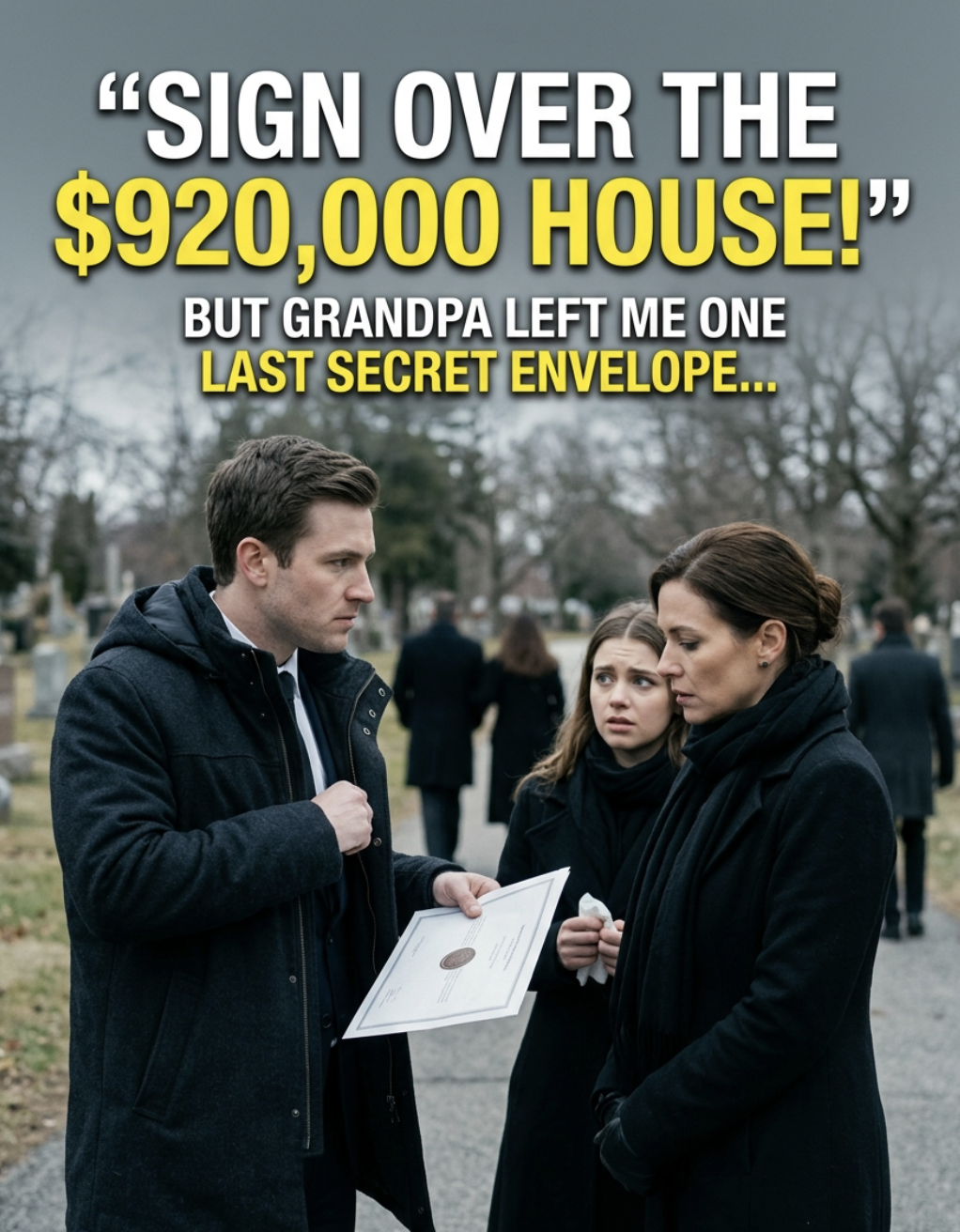
The moment my grandfather’s funeral ended, my 39-year-old mother pulled me away from the grieving relatives and made a demand that left me speechless.
“Son, you took such wonderful care of Grandpa. I heard he left you his $920,000 house. Well, you need to sign it over to your sister. She has three young children, and you’re a single man. You can always buy another house later.”
I stared at her, wondering whether grief had somehow made her forget that she was talking about a person’s final wishes—or whether she had simply never cared about them.
For four years, I had been the person my grandfather depended on most.
I drove him to medical appointments, organized his prescriptions, prepared meals when his hands became too weak to cook, and sat beside his bed during nights when pain kept him awake. When he fell in the bathroom at two in the morning, I was the one who rushed him to the hospital. When he was frightened after receiving a difficult diagnosis, I was the one who held his hand and promised I would stay.
My sister, Lauren, had visited him perhaps six times during those four years.
Sometimes she brought the children for an hour. Sometimes she canceled at the last minute because she was busy. She always had a reason, and Grandpa never complained. He loved her too much to criticize her, even when I could see how disappointed he was.
Yet now, standing in the cemetery parking lot, my mother spoke as though Lauren had been the devoted granddaughter and I had merely been holding a house for her until the rightful owner arrived.
“You understand why this makes sense,” Mom continued. “Lauren has three children. They need space. You live alone. It would be selfish to keep a house that big when they could actually use it.”
I glanced toward Lauren.
She stood a few feet away, dressed in black, holding a tissue beneath her eyes. When she noticed me looking, she gave me a small, hopeful smile.
“When do you think I could move in?” she asked. “The kids could start getting their rooms ready next month.”
I felt something inside me go cold.
Not one of them had asked how I was doing. Not one had asked what Grandpa’s final days had been like for me. They had waited until his body was buried before discussing how to divide the things he had left behind.
And they had already decided that my answer would be yes.
“Mom,” I said carefully, “Grandpa left the house to me. That was his decision.”
She waved her hand dismissively.
“Oh, please. He was old. You know how emotional elderly people get. He probably thought you deserved something because you helped him. But family has to be fair.”
“Fair to whom?”
Her expression hardened.
“To your sister! She has children to raise. What are you going to do with four bedrooms? Sit in them by yourself?”
Before I could answer, she stepped closer and lowered her voice.
“Don’t embarrass me in front of everyone. Your grandfather would want his great-grandchildren to have a home.”
I almost laughed at the irony.
Grandpa had spent the last year of his life telling me that the most important thing a person could own wasn’t a house, a bank account, or a collection of valuable possessions.
It was the ability to look at yourself in the mirror and know you had done the right thing.
And he had been very specific about one other thing: I should never allow anyone to pressure me into giving away something he had deliberately chosen to leave me.
I took a slow breath.
“Before I sign anything, Mom, there’s something you need to know about Grandpa’s house.”
Her confident smile faltered.
I reached into the inside pocket of my jacket and pulled out a sealed envelope.
My name was written across the front in Grandpa’s familiar handwriting.
Beneath it were five words.
Open only after my funeral.
Mom immediately reached for it.
“What is that?”
I stepped back.
“Something Grandpa wanted me to have.”
“Give it to me. I’ll take care of the paperwork.”
“No.”
The single word seemed to surprise her more than anything else I had said.
For a moment, nobody spoke. The relatives who had been gathering near the cars began looking in our direction.
Lauren walked over.
“What is going on?”
“Your brother is making a scene,” Mom announced. “He has some papers from Grandpa, and he’s refusing to let me see them.”
I looked at my sister.
“Do you know what Grandpa told me during his final week?”
She blinked.
“No.”
“He told me that when he was gone, some people would suddenly remember how much they loved him. He said I should pay attention to what they did next.”
Lauren’s face reddened.
“That is a horrible thing to say at his funeral.”
“I agree,” I replied. “That’s why I didn’t want to say it.”
I turned away from them and walked to my car. My mother followed, insisting that I was being unreasonable, while Lauren muttered that I had always been Grandpa’s favorite.
I didn’t open the envelope until I was home.
For several minutes, I simply sat at my kitchen table, looking at the handwriting.
I could still hear Grandpa’s voice in my head, the way it sounded when he was tired but determined to finish a sentence.
Don’t let anyone turn my love into a debt you have to pay.
Finally, I opened the envelope.
Inside were three documents, a letter addressed to me, and a business card belonging to an attorney named Mr. Bennett.
The first document was a certified copy of Grandpa’s will.
The second was a legal statement concerning the ownership of the house.
The third was a letter bearing Grandpa’s signature, witnessed and notarized several months before his death.
I read the will first.
There was no ambiguity.
Grandpa had left me the house, his savings, and the majority of his personal belongings. He had left Lauren a separate inheritance of $40,000, along with a collection of jewelry that had belonged to our grandmother.
He had also instructed his attorney to distribute everything according to the will without allowing family pressure to alter his wishes.
I read the document twice.
Then I opened his letter.
My dear Daniel,
If you’re reading this, I’ve finally run out of time to tell you everything in person. I’m sorry for that.
You gave me four years of your life. You gave me patience when I was difficult, companionship when I was lonely, and dignity when I needed help with things I once did for myself.
You never once made me feel like a burden.
I know you will probably tell yourself you were only doing what family should do. That is exactly why I want you to understand something.
You did not earn this house because you were useful to me. You deserve it because you have shown me what love looks like when nobody is watching.
I had to stop reading.
My eyes filled with tears, and for the first time since the funeral, I allowed myself to cry.
Grandpa continued.
I also know your mother may ask you to give the house to Lauren. She has already spoken to me about it.
I froze.
I reread that sentence.
My mother had spoken to him about the house?
I continued reading.
Last winter, she visited me and explained that Lauren needed a bigger home. She suggested I should leave the property to her because she had children. I told her I would consider it.
I did consider it.
Then I asked myself a simple question: If I leave the house to Lauren, will she take care of you when you are old? Will she spend four years sitting beside your bed when you cannot sleep? Will she give up her free time without expecting anything in return?
I knew the answer.
But the house is not the most important thing I need you to understand.
The next paragraph was underlined.
Your mother told me something during that visit that I have not forgotten. She said you were helping me because you expected to inherit the house. She said you had always been calculating and that I was too old to recognize it.
I sat motionless.
For four years, I had worried that I wasn’t doing enough. I had taken extra shifts when Grandpa was stable, rearranged my schedule when he wasn’t, and declined opportunities that would have required me to move away.
Not once had I thought about inheritance.
I had never even asked Grandpa what he planned to do with his estate.
The accusation hurt, but what came next hurt more.
I told your mother that if she truly believed you were helping me for money, she should have offered to take over your responsibilities for a month. She refused.
She said she had her own life and that you were better suited to the work.
I closed my eyes.
There it was.
The explanation for the years of excuses. The reason my mother had always praised me for being dependable while never volunteering to help.
I had been useful enough to care for Grandpa, but not important enough for anyone to share the burden.
The letter continued.
Daniel, I am not leaving you this house to punish your mother or your sister. I am leaving it to you because I want you to have security. You have spent years making sure I was safe. Now I want you to have somewhere you can feel safe yourself.
Do not sell it because someone makes you feel guilty. Do not give it away because someone tells you that your needs matter less than theirs.
If you ever choose to help your sister, do it because you want to—not because anyone tells you that being a good brother means surrendering your future.
There is one final thing. Call Mr. Bennett before you respond to anyone. He has the complete estate file, including a record of the conversation I had with your mother about the property.
I love you, son. You were never my favorite because you did the most for me. You were simply the person who kept showing up.
Grandpa.
I pressed the letter against my chest.
For a long time, I couldn’t move.
The following morning, I called Mr. Bennett.
He confirmed that the will was valid and that the estate was being handled according to Grandpa’s documented wishes. The house was legally part of the estate, and I would receive it after the required probate process. There was no provision allowing my mother to redirect it to Lauren simply because she believed her daughter needed it more.
He also explained that the additional statement in the envelope documented Grandpa’s wishes and his understanding of the family discussions surrounding the property.
“Your grandfather was very clear,” Mr. Bennett told me. “He wanted you to have the house without pressure or interference. He anticipated that someone might try to persuade you to change the arrangement.”
“Did he really believe my mother would do that?”
There was a brief silence.
“He was concerned about it,” the attorney answered. “He asked me to make sure you understood that you had no obligation to sign anything over to another family member.”
I thanked him and ended the call.
By lunchtime, my mother had called me eleven times.
I didn’t answer until the twelfth.
“You need to stop making this difficult,” she said as soon as I picked up. “Lauren’s husband has already spoken to their landlord. They were counting on moving into Grandpa’s house.”
I stared at the wall.
“They were counting on moving into a house they don’t own?”
“Don’t twist my words. I told them you would help.”
“You told them I would give them my inheritance without asking me.”
“Because I thought you would do the right thing!”
“What do you think Grandpa would have called the right thing?”
She became quiet for a moment.
Then she said, “Don’t bring him into this.”
I almost couldn’t believe what I was hearing.
“Mom, he’s the only reason we’re having this conversation.”
She accused me of being cruel, selfish, and obsessed with money. She reminded me that Lauren had three children who needed stability. She told me I could buy a smaller property someday, while Lauren could never afford a house like Grandpa’s.
Finally, I asked her one question.
“Did you tell Grandpa that I was taking care of him because I wanted his money?”
Silence.
“Did you?”
“I was worried about you,” she replied. “I thought you were putting your life on hold for an old man.”
“That isn’t what I asked.”
She sighed sharply.
“I said I thought you were expecting something in return. I was trying to protect him.”
“Then why didn’t you offer to take care of him yourself?”
“Because I had responsibilities!”
“So did I.”
“You don’t have children!”
The words landed between us like a door slamming shut.
I looked around my quiet home. For years, I had thought being single meant I had more freedom than everyone else. My family had treated that freedom as an unlimited resource they could spend whenever they wanted.
But I had responsibilities, too. I had work, friendships, plans, and a future I had repeatedly postponed because Grandpa needed me.
And I had loved him.
That should have been enough.
“I am not giving Lauren the house,” I said.
My mother’s voice turned cold.
“Then don’t expect this family to forget what you’ve done.”
I ended the call.
For the next two weeks, the family group chat became a battlefield.
One aunt sent me a long message about the importance of generosity. An uncle asked whether I would rather have a house or a relationship with my sister. A cousin I hadn’t spoken to in years informed me that my grandfather would be disappointed to see us fighting over money.
Nobody asked whether I was grieving.
Nobody asked what Grandpa had actually wanted.
I stopped responding.
Then, three weeks after the funeral, Lauren arrived at my door.
She looked exhausted. Her youngest child was asleep against her shoulder, and she had dark circles beneath her eyes.
“Can we talk?” she asked.
I let her in.
For the first few minutes, she spoke about the children, their cramped rental, and the rising cost of living. Her husband had recently lost some overtime hours, and they were worried about renewing their lease.
I listened.
I knew she was under pressure. I knew raising three children wasn’t easy. And despite everything, I loved my sister.
But her problems didn’t make Grandpa’s property hers.
Finally, she set her purse on the table.
“Mom says you have a letter from Grandpa.”
“I do.”
“Can I read it?”
I hesitated, then took out the letter and handed it to her.
She read it standing by the window.
At first, her expression was defensive. Then her eyes moved back to the paragraph about our mother accusing me of caring for Grandpa for money.
She read that section again.
When she reached the part about refusing to take over his care for even a month, her face changed.
“Mom said you volunteered,” she whispered.
“I did.”
“She told me you wanted to do it because you didn’t have anything else going on.”
I said nothing.
Lauren lowered the letter.
“She said Grandpa was lonely and that you were happy to keep him company. She never told me you were doing all of this.”
“I asked you to visit him more than once.”
“I know.”
“You canceled almost every time.”
Her eyes filled with tears.
“I know.”
For the first time since the funeral, she wasn’t trying to convince me that I owed her something.
She sat down slowly.
“I thought he was fine because Mom said you had everything under control. I didn’t understand how bad things had gotten.”
“You could have called him.”
“I should have.”
The room was quiet except for the hum of the refrigerator.
Then Lauren looked at me.
“I still wish I could have the house. I won’t pretend I don’t. The children need more space, and I don’t know how we’re going to manage everything.”
I appreciated her honesty more than I expected.
“But I shouldn’t have assumed it was mine,” she continued. “And I shouldn’t have asked when I could move in before you even had time to grieve.”
It wasn’t a perfect apology. It didn’t erase the years of missed visits or the way she’d stood beside our mother at the cemetery, waiting for me to surrender my inheritance.
But it was the first honest conversation we’d had in years.
“I can’t give you the house,” I told her. “I won’t sign away what Grandpa chose to leave me.”
She nodded, wiping her cheeks.
“I understand.”
I wasn’t sure whether she truly did, but for once, she didn’t argue.
Before she left, I offered to help her review their budget and look for housing assistance programs that might fit their circumstances. I told her I could help with a few practical things if I chose to, but I would not promise money I couldn’t comfortably afford or give away the house.
She accepted the offer without asking for more.
When I closed the door behind her, I felt something I hadn’t expected.
Not victory.
Relief.
A month later, the estate process moved forward, and the house officially became mine.
I went there alone on a Saturday morning.
The rooms were quiet. Sunlight spilled across the living room floor, illuminating the chair where Grandpa used to sit and watch the birds outside. His walking stick still rested beside the bookshelf, exactly where he had left it.
I sat in his chair and read his letter again.
For the first time, I understood why he had insisted that I wait until after the funeral to open it.
He hadn’t wanted his final days to become an argument about property. He wanted me to have a chance to say goodbye without knowing that my family might try to turn his gift into a bargaining chip.
He had protected me in the only way he could.
Over the following months, I made small changes to the house. I repaired the garden fence, repainted the guest bedroom, and turned Grandpa’s old study into a quiet office. I kept his chair by the window and his favorite books on the shelves.
I didn’t sell the house.
I didn’t give it away.
And I didn’t feel guilty about either decision.
My mother eventually called again.
This time, she didn’t mention the inheritance immediately. She asked whether I was still angry with her.
I told her I was hurt, and that trust would take time to rebuild.
She said she had only wanted to help Lauren.
“I understand that,” I replied. “But helping her doesn’t mean you get to decide what happens to something Grandpa left me.”
She didn’t apologize that day.
Perhaps she wasn’t ready. Perhaps she still believed that being a mother gave her the authority to decide what was best for her adult children.
I couldn’t change what she believed.
I could only decide what I would accept.
Months later, Lauren brought the children to visit the house. They ran through the garden, laughed in the living room, and asked me questions about the grandfather they barely remembered.
I showed them his photographs and told them stories about the man who had taught me how to repair a broken fence, make pancakes on Sunday mornings, and recognize when someone needed company without knowing how to ask for it.
Lauren stood beside me, listening.
When the children went outside, she touched my arm.
“I wish I’d spent more time with him,” she said.
“So do I.”
We didn’t discuss the house again that afternoon.
And that was enough.
I sometimes think about what my mother said at the cemetery: that I was a single man who could always buy another house later.
She had measured my needs by whether I had children, a spouse, or someone else depending on me.
Grandpa had measured my worth differently.
He had seen the nights I stayed awake, the appointments I never missed, the quiet sacrifices nobody else noticed. He had understood that love wasn’t proven by how much someone could demand from you. It was proven by what you gave freely—and by whether others respected your right to choose.
The house was worth $920,000.
But the letter he left me was worth more than any property could ever be.
It reminded me that I didn’t have to surrender my future to prove I loved my family.
And it taught me something I wish I’d learned years earlier:
Being a good son does not mean giving everyone else permission to decide what you deserve.