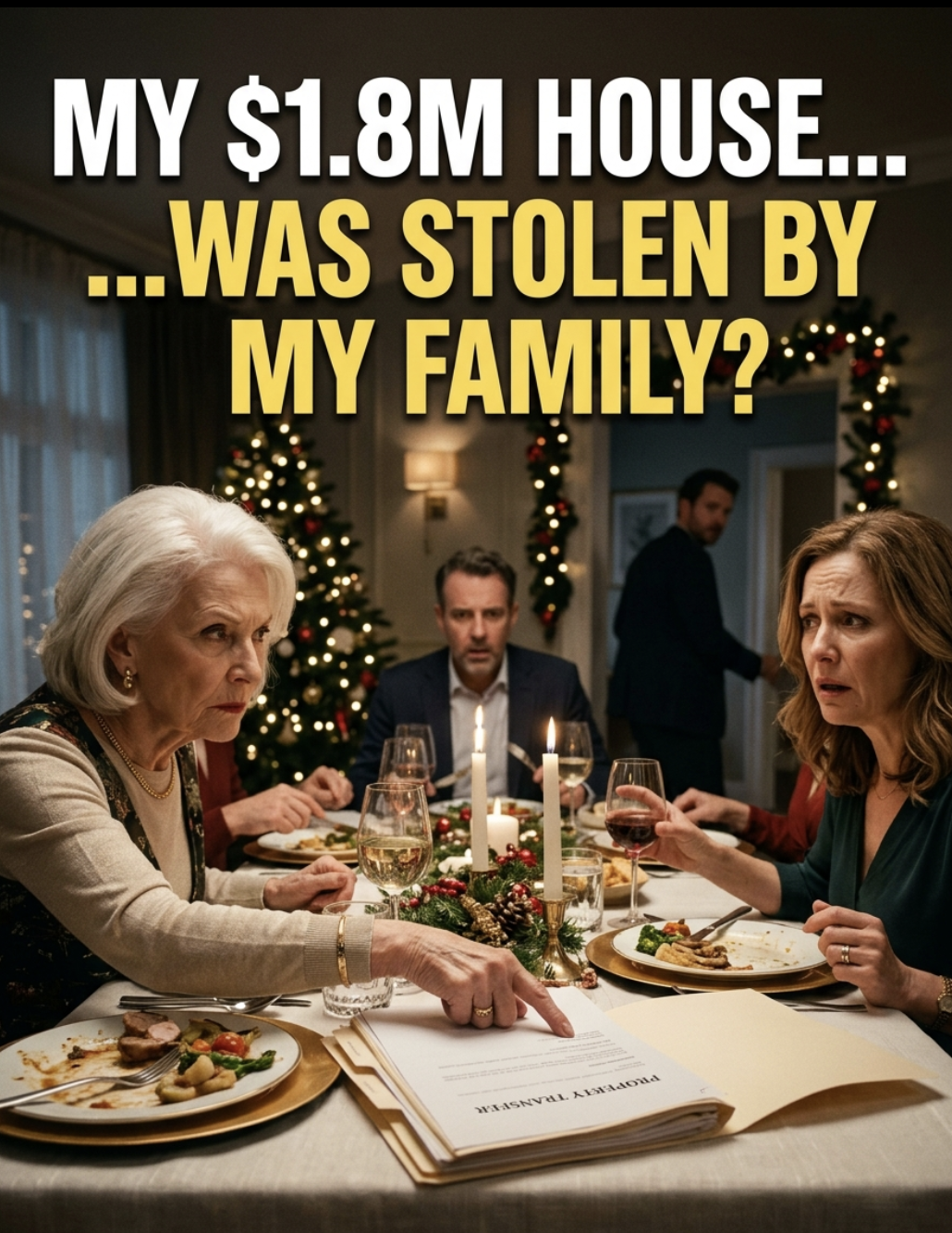
The moment my grandmother asked why someone else’s name appeared on the deed to the house she had bought for me, my mother stopped breathing normally.
For a few seconds, nobody moved.
The Christmas lights twinkled above the dining room. The fireplace crackled softly. Somewhere near the kitchen, a waiter dropped a spoon, and the tiny metallic sound seemed impossibly loud in the silence.
My grandmother, Margaret Whitmore, was eighty-one years old. She had built a billion-dollar real estate empire from a small investment business she started with my grandfather decades earlier. She was sharp, observant, and almost impossible to deceive.
Yet someone in our family had managed to hide a $1.8 million house from her own grandchild.
And judging by the look on my mother’s face, this wasn’t a mistake.
Grandma slowly turned the final page toward the light.
“I’m going to ask this once,” she said, her voice frighteningly calm. “Why does this property list Daniel’s cousin, Ethan, as the intended recipient instead of Daniel?”
My thirty-four-year-old cousin Ethan stood frozen beside the hallway entrance. His wineglass was still in his hand, but his fingers had tightened around the stem so hard that I thought it might break.
My mother, Patricia, finally found her voice.
“Margaret, please. This isn’t the place to discuss complicated financial paperwork.”
Grandma looked at her.
“You told me the paperwork had been delivered.”
“It was being handled.”
“By whom?”
My mother swallowed.
“By the family.”
Grandma closed the folder.
“Families don’t sign property transfers behind one another’s backs.”
Then she turned to me.
“Daniel, sweetheart, did you receive anything from my attorney last month? A letter, a package, a set of keys?”
I shook my head.
“Nothing. Mom told me you had sent me a $750 Christmas check, so I assumed that was my gift.”
Grandma’s face changed.
Not anger at first.
Hurt.
“I never sent you a check.”
I felt the room tilt around me.
My mother had called me three weeks earlier, laughing as she told me Grandma had decided to send everyone modest gifts this year because she wanted to teach the younger generation to appreciate what they had.
She had even said, “You know how Grandma is. She thinks a little cash is better than spoiling people.”
I had thanked her for passing along the information and never questioned it.
Now I understood why she had been so eager to explain the gift before I could ask Grandma about it myself.
Grandma reached into the folder and removed another document.
“This is the original purchase agreement,” she said. “The house was purchased through my family trust. I arranged everything privately because I wanted Daniel to have a place of his own. The transfer was supposed to be completed last month.”
She tapped the page.
“This is the signature authorizing the change in the recipient’s name.”
My mother stared at the paper.
Ethan took one step backward.
And Grandma noticed.
“Ethan,” she said.
He stopped.
“Come here.”
He looked at my mother as if silently begging her to save him.
She didn’t move.
Slowly, Ethan walked back to the table.
Grandma pointed to the document.
“Did you know about this house?”
His mouth opened, but no sound came out.
“Answer me.”
“Yes,” he whispered.
A sharp gasp escaped my aunt.
Grandma leaned back in her chair.
“Tell me everything.”
Ethan looked at my mother again.
Then, in a voice barely louder than a whisper, he said, “Mom told me Daniel didn’t want the house.”
I turned toward him.
“What?”
“She said you had already told her you didn’t want a property that expensive. She said you were planning to move overseas and that Grandma had agreed to give the house to me instead.”
I stared at him, unable to process the words.
“I never said anything like that.”
“I know that now.”
“You accepted a $1.8 million house based on something my mother told you?”
Ethan’s eyes filled with tears.
“I thought it had been approved.”
Grandma’s expression hardened.
“Did you receive the keys?”
Ethan hesitated.
Then he nodded.
My stomach dropped.
“Where are they?” I asked.
He reached into his jacket and pulled out a small envelope. Inside was a set of keys attached to a silver keychain bearing the address of a house I had never seen.
Grandma took the envelope without touching the keys for several seconds.
“Who delivered these to you?”
“My mother.”
The entire table turned toward Patricia.
She finally stood up.
“This is being blown out of proportion,” she said. “I was trying to help Ethan. He has a wife, two children, and a mortgage. Daniel is single and perfectly capable of making his own money.”
Grandma looked at her as though she were a stranger.
“You changed a gift I purchased for one grandchild and gave it to another without my permission.”
“I was going to explain everything eventually.”
“When?”
My mother said nothing.
“When Daniel discovered the house himself? When Ethan sold it? Or when I was dead and nobody thought I could object?”
“That’s not fair!”
“No,” Grandma replied. “What you did was not fair.”
Then she asked the question that finally shattered my mother’s composure.
“Patricia, did you change the name because you wanted to help Ethan—or because you knew what was inside that house, and you were afraid Daniel would discover it?”
My mother went completely still.
For the first time that evening, Ethan looked genuinely terrified.
And I realized the house itself might not have been the real secret.
Grandma had always believed that money revealed people’s character rather than changing it.
She had told me that when I was a child, usually after I complained about one of my cousins receiving something I didn’t have.
“Never judge a person by what they own, Daniel,” she would say. “Pay attention to what they do when they think nobody is watching.”
At the time, I thought it was just another one of her sayings.
That night, sitting at the Christmas table with a $1.8 million property transfer spread between the serving dishes, I finally understood.
My mother wasn’t simply trying to give Ethan a house.
She had been hiding something.
Grandma pushed the folder toward her.
“Sit down, Patricia.”
My mother remained standing.
“I don’t have to sit here while everyone treats me like a criminal.”
“Then you may leave,” Grandma said. “But if you walk out without explaining why you altered these documents, I will instruct my attorney to investigate every transaction connected to this property.”
That made my mother sit.
Grandma turned to Ethan.
“Where is the house?”
“Northbridge.”
I knew the neighborhood. Northbridge was one of the wealthiest residential areas in the city, filled with private gardens, tree-lined streets, and enormous modern homes. A property there could easily cost several million dollars.
“Have you been inside?” Grandma asked.
“Yes.”
“How long have you had access?”
“About three weeks.”
“Who has been staying there?”
Ethan stared at the table.
“My wife and the children.”
I felt a strange ache in my chest.
My cousin’s children had already been sleeping in rooms I had never seen in a house I hadn’t known existed.
He had decorated the place, moved his belongings into it, and begun treating it as his own.
All while I believed my grandmother had sent me a $750 check.
“Did you pay for anything?” Grandma asked.
“No. Mom told me everything had been arranged.”
My mother abruptly interrupted.
“Because it had been arranged! I was the one dealing with the attorneys when you were busy with your business. You can’t expect me to remember every detail.”
Grandma raised an eyebrow.
“You weren’t authorized to change the recipient.”
“I was trying to make the best decision for everyone.”
“Except Daniel.”
“He doesn’t need the house!”
I stared at her.
“Mom, you never asked me what I needed.”
She turned toward me.
“You have a good job. You have savings. You don’t have children to support. Ethan’s family needs stability.”
“And that gave you the right to take something Grandma bought for me?”
“I didn’t take anything. I redirected a gift.”
“You redirected a house worth $1.8 million.”
“Stop repeating the price as though you’re the only person who understands money!”
I looked at Grandma.
She was watching my mother with an expression I had never seen before.
Not merely disappointment.
Recognition.
As if she had finally understood something about her daughter that she had spent years refusing to acknowledge.
“Patricia,” Grandma said quietly, “you’ve spent your entire life deciding what other people should do with what belongs to them.”
My mother’s face flushed.
“That is ridiculous.”
“When your father was alive, you told him how to manage his investments. When your brother inherited his apartment, you insisted he sell it because you thought the money would be more useful in your hands. And now you’ve decided that Daniel’s inheritance belongs to Ethan.”
Grandma paused.
“Have you ever considered that other people are allowed to make their own decisions?”
My mother looked away.
Then Grandma opened the folder again and removed a thin, cream-colored envelope.
“This was delivered to me by my attorney yesterday,” she said. “I hadn’t opened it because I intended to give it to Daniel tonight.”
She handed it to me.
My name was written across the front.
Inside was a letter from the attorney who had handled the purchase.
The first paragraph confirmed that the house had been purchased specifically for me. The second explained that the final transfer had been delayed after a request was submitted to change the intended recipient.
The third paragraph contained a sentence that made my heart pound.
The request was accompanied by a statement indicating that Daniel Whitmore had voluntarily declined the property and authorized its transfer to Ethan Whitmore.
I looked up.
“Who signed this?”
The attorney’s name appeared beneath the statement.
But the authorization itself contained a signature attributed to me.
It looked similar to my handwriting.
Similar enough that someone who didn’t know me well might have accepted it.
But I had never signed it.
“That’s a forgery,” I said.
Ethan’s face went pale.
My mother pressed her hands together.
“Daniel, listen—”
“Did you forge my signature?”
“I was trying to prevent a family argument.”
“You forged my signature to transfer a house?”
“I thought you’d understand once everything was settled!”
Grandma closed her eyes for a moment.
When she opened them, her voice was steady.
“Patricia, did you do this yourself?”
My mother didn’t answer.
“Did you instruct someone else to do it?”
Still nothing.
Finally, Ethan began to cry.
“It wasn’t supposed to happen like this.”
I turned toward him.
“What does that mean?”
He rubbed his face with both hands.
“Mom told me you had agreed to give me the house. Then she said the transfer was taking longer than expected because the lawyers needed some extra paperwork. I asked if we could just wait until Christmas so we could thank Grandma properly.”
He looked at my mother.
“She told me not to mention it because she wanted the surprise to be perfect.”
My mother shook her head desperately.
“Ethan, don’t.”
But he continued.
“Three weeks ago, she gave us the keys. She said the house was ours, and we could move in whenever we were ready. We sold some furniture and gave notice to our landlord.”
He turned back to me.
“I swear I didn’t know about the signature.”
I wanted to be angry with him.
Part of me was angry.
But I could see that he was frightened, too. He had accepted something he wanted to believe was a gift, trusting his mother without asking questions.
That didn’t erase his responsibility to verify what was happening, but it made the situation more complicated than I had expected.
Grandma picked up her phone.
“I’m calling Mr. Lawson.”
My mother immediately stood.
“Please don’t do that.”
Grandma looked at her.
“Why?”
“Because we can settle this ourselves.”
“You had three weeks to settle it yourself.”
“Please, Margaret. Think about the children.”
Grandma’s expression softened for the briefest moment.
“I have thought about the children. I’ve thought about Daniel, too. And I’ve thought about the kind of family they are growing up in.”
She pressed the call button.
“Mr. Lawson, it’s Margaret. I need you to come to the house tomorrow morning. Bring the original purchase file and the documents concerning the recipient change.”
She listened.
“Yes. There appears to be an unauthorized alteration and a disputed signature.”
My mother sat down heavily.
Grandma ended the call.
“No one is moving anything else out of that property until the ownership is clarified.”
Ethan looked devastated.
“My children have already moved in.”
“Then you need to explain to them that the adults made a mistake,” Grandma said. “They are not responsible for what happened.”
She looked at him carefully.
“But neither are they entitled to a house simply because someone promised them one without having the right to do so.”
For the first time that evening, Ethan nodded without arguing.
The next morning, Grandma’s attorney arrived at her home carrying two thick binders and a laptop.
He was a careful, soft-spoken man named Robert Lawson, who had represented Grandma’s family for nearly twenty years.
He reviewed the original purchase agreement, the disputed authorization, and the records documenting how the transfer request had been submitted.
Then he asked my mother to explain her role.
At first, she insisted that everything had been done with good intentions.
She said she had been trying to ensure Ethan’s children had a secure future. She claimed she believed Grandma would approve if she understood how much Ethan’s family needed the property.
Mr. Lawson listened without interrupting.
Then he placed a printed email on the table.
“This message was sent from your account to the property attorney three weeks ago,” he said. “It requests that the beneficiary be changed from Daniel to Ethan. It also states that Daniel has agreed to the transfer.”
My mother stared at the screen.
“That’s private correspondence.”
“It concerns a disputed property transaction,” Mr. Lawson replied. “And it was submitted as part of the file.”
He opened another document.
“This email also requests that all future correspondence be sent to you rather than Daniel.”
I felt sick.
My mother hadn’t simply intercepted the gift.
She had attempted to control the entire process, ensuring I would never learn about the house until the transfer was complete.
“Why?” I asked.
She looked at me, and for a moment, I thought she might finally tell the truth.
Instead, she said, “Because I knew you would make everything difficult.”
I stared at her.
“Difficult for whom?”
“For everyone!”
“You mean difficult for you.”
She shook her head.
“You always have to challenge everything. You never understand that families sometimes need to make sacrifices.”
“Why was I the one expected to sacrifice a house I didn’t even know existed?”
She opened her mouth, then closed it.
Grandma leaned forward.
“Patricia, tell us what you were afraid Daniel would discover.”
My mother began twisting a tissue between her fingers.
Finally, she whispered, “The property wasn’t the only thing.”
The room went silent.
Mr. Lawson stopped turning pages.
Grandma’s expression sharpened.
“What else?”
My mother looked toward Ethan.
He shook his head slowly.
“Mom, please tell them.”
She took a long breath.
“Several months ago, I borrowed money from Ethan.”
I frowned.
“How much?”
She didn’t answer.
“Mom, how much?”
“Two hundred and eighty thousand dollars.”
Ethan lowered his head.
Grandma looked between them.
“Why?”
My mother began explaining in broken sentences.
Two years earlier, she had invested a substantial amount of her savings in a private business venture introduced by an acquaintance. The investment had gone badly. She had borrowed money to cover her losses, believing she could recover the funds before anyone noticed.
When she couldn’t repay the debt, she turned to Ethan.
She promised him the money would be returned within a few months.
But the business had failed completely.
The debt remained.
And Ethan, who had a mortgage and two children, had become increasingly worried about recovering his savings.
“So you offered him my house as compensation?” I asked.
My mother looked down.
“I thought I could make it work.”
“You thought you could give him something that wasn’t yours?”
“I thought the transfer would go through before anyone questioned it.”
Mr. Lawson interrupted.
“Mrs. Whitmore, the disputed authorization raises serious legal concerns. Any attempt to transfer the property using a signature Daniel says he did not provide will need to be investigated. I strongly advise you not to alter or destroy any documents.”
My mother nodded, trembling.
Grandma sat perfectly still.
Then she turned to Ethan.
“Did you know your mother was planning to use the house to settle the debt?”
He wiped his eyes.
“Not at first. She told me she would repay me. Later, when she said the house was mine, she told me it was a way to make things right.”
“And you accepted it?”
“I thought Daniel had agreed.”
I took a deep breath.
“You could have called me.”
“I know.”
“You could have asked Grandma.”
“I know.”
“You could have waited until the paperwork was finished.”
He nodded, tears running down his face.
“I was scared I would never get my money back.”
For a moment, I saw him not as the cousin who had quietly backed away from the Christmas table, but as a father who had watched his family’s savings disappear and had been offered what he believed was a solution.
His fear was real.
So was what had been done to me.
“I understand why you wanted your money back,” I told him. “But you can’t accept a house that was never yours and call it repayment.”
He nodded again.
“I know.”
Grandma looked at her daughter.
“You should have come to me.”
My mother let out a bitter laugh.
“And told you I had failed? Told you I had lost money and couldn’t fix it? You would have looked at me the same way you’re looking at me now.”
Grandma’s eyes filled with tears.
“No, Patricia. I would have helped you understand what to do next. I might even have helped you work through the debt. But you never gave me that choice.”
She paused.
“You decided that protecting your pride mattered more than respecting your family.”
My mother covered her face.
For the first time, she looked less like the powerful woman who had controlled every conversation and more like someone who had finally run out of excuses.
But the truth didn’t disappear simply because she was crying.
Mr. Lawson explained that the property transfer would be paused while the documents were reviewed. The original purchase records, correspondence, and disputed signature would be preserved. He would determine the appropriate steps to protect the property and address the attempted change.
Grandma made one thing clear.
The house would not be transferred to Ethan simply to settle the debt.
Any repayment arrangement would have to be addressed separately and lawfully.
She also refused to let the family quietly bury the incident.
“We are going to resolve this properly,” she said. “Not because I want to destroy anyone’s life, but because I will not teach my grandchildren that wrongdoing becomes acceptable when the person responsible is related to them.”
I looked at her and felt a deep, unexpected gratitude.
For years, I had watched family members excuse one another’s behavior in the name of loyalty.
Grandma was finally drawing a line.
And she was drawing it for all of us.
The following weeks were difficult.
My mother stopped attending family gatherings. Some relatives blamed me for allowing the situation to become a legal matter. Others quietly admitted they had suspected she was hiding financial problems but had been afraid to confront her.
I stopped trying to convince everyone of the truth.
The records spoke for themselves.
Grandma’s attorney worked to secure the property’s legal status and determine how the disputed transfer had been processed. The forged authorization was referred for appropriate review, and my mother was required to cooperate with the investigation.
Ethan and his family moved out of the house while the ownership issue was resolved. Grandma helped ensure the children had somewhere stable to stay, but she did not give Ethan the property or promise to erase his debt.
He eventually apologized to me in person.
We sat across from each other in a small café near his office.
“I don’t expect you to forgive me immediately,” he said. “I should have called you. I should have asked questions instead of accepting something because I wanted it to be true.”
I watched him for a moment.
“Why didn’t you tell me about the money you lent Mom?”
“Because she said you already had enough problems of your own. She told me you were doing well and wouldn’t understand why she needed help.”
I shook my head.
“She told each of us a different story.”
He nodded.
“I believed her because I wanted to believe her.”
It was the most honest thing he had said since Christmas.
I didn’t promise that everything would return to normal.
I told him that trust had to be rebuilt through actions, not apologies.
He accepted that.
As for my mother, the relationship was more difficult.
For a while, she continued to insist that she had acted out of love. She said she was trying to help Ethan and protect the family from embarrassment.
But one evening, several months later, she called and asked whether she could visit me.
I agreed.
She arrived carrying a small box of old photographs. We sat in my living room, looking at pictures from birthdays, summer vacations, and Christmases when our family had been happier.
Eventually, she placed one photograph on the table.
It showed me at about ten years old, sitting beside Grandma in her garden. Grandma was laughing, and I was holding a crooked wooden birdhouse we had built together.
“I remember this day,” my mother said quietly.
“So do I.”
“Your grandmother always said you were patient.”
I smiled faintly.
“She taught me.”
My mother looked at the photograph for a long time.
Then she said, “I thought I was fixing everything by giving Ethan the house.”
“You weren’t giving him something you owned.”
“I know.”
“And you weren’t protecting him. You were putting him in the middle of a problem you created.”
Her eyes filled.
“I know that now, too.”
For the first time, she didn’t follow her admission with an excuse.
She apologized for hiding the gift, for allowing Ethan to believe I had declined it, and for the false authorization that had put the property transaction in jeopardy.
I listened.
I didn’t tell her that everything was forgiven.
But I told her that if she wanted a relationship with me, it would have to be built on honesty.
She nodded.
It was a beginning, not a conclusion.
The legal process continued separately, and the consequences of her actions were not erased by a private apology. Some matters took time to resolve, and some family relationships remained strained.
But the house was eventually secured in my name through the proper legal process.
On the day I received confirmation, Grandma invited me to visit her.
She was sitting by the window in her favorite chair, wearing a blue cardigan and reading glasses.
“Have you seen the house yet?” she asked.
“I have.”
“And?”
I smiled.
“It’s beautiful.”
She looked pleased.
“Good. Then promise me something.”
“What?”
“Don’t let that house become the reason you stop trusting everyone. Learn from what happened, but don’t let it turn you into someone who assumes the worst about every person you love.”
I sat beside her.
“I’ll try.”
She took my hand.
“I bought that house because I wanted you to have a secure future. Not because I expected you to win a fight with your mother.”
I laughed softly.
“I know.”
“Then remember that.”
I did.
When I finally moved into the house, I didn’t fill it with expensive furniture or throw a party to celebrate my inheritance. I started slowly. I furnished the guest room, planted flowers in the garden, and put a photograph of Grandma and me on a shelf beside the front door.
The house became a place where I could breathe.
Not because it was worth $1.8 million, but because it represented a choice someone had made freely on my behalf—and a choice I had finally been allowed to keep.
That Christmas, my mother had tried to turn my grandmother’s gift into a solution for her own mistakes.
She had assumed that because I was younger, single, and financially stable, my future mattered less than everyone else’s.
She had assumed that family loyalty meant silence.
And she had assumed I would forgive her simply because she was my mother.
She was wrong about all three.
I still love my family. I still hope the relationships can heal. But I no longer confuse love with surrender, or forgiveness with pretending that nothing happened.
Grandma taught me that a person’s character is revealed by what they do when they believe nobody is watching.
That Christmas, I discovered something else.
Sometimes, the truth is revealed when everyone is watching—and the person who has been hiding it finally realizes there is nowhere left to run.
The house gave me security.
The documents gave me proof.
But the most valuable gift my grandmother gave me was the courage to stand at that table, look at the people I loved, and refuse to let their choices determine my worth.
Because family should be the place where your future is protected, not the place where someone decides it belongs to them.