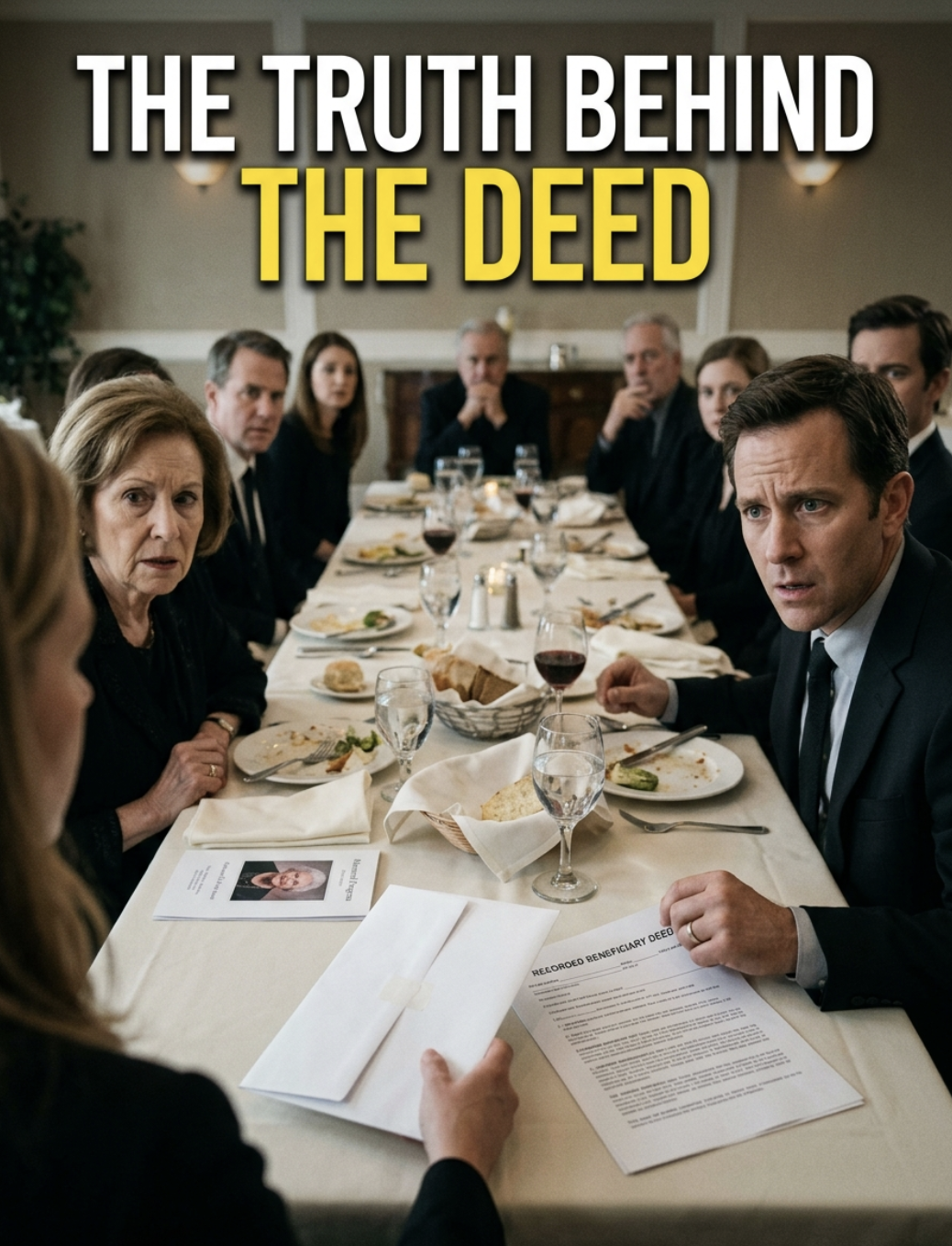
The moment I placed the sealed envelope beside my brother’s recorded beneficiary deed, the confident smile on his face disappeared.
For the first time since our mother’s memorial lunch began, Michael looked genuinely afraid.
“What is that?” he demanded.
I kept my hand on the envelope.
“Something Mom asked me to keep until after she was gone.”
Our aunt Linda immediately leaned forward.
“Please,” she whispered, “whatever this is, think carefully before you do anything. We’ve already lost your mother. We don’t need to lose each other, too.”
I looked at her.
“Aunt Linda, I don’t want a family war. I want to understand why Mom’s $925,000 house suddenly belongs entirely to Michael when she spent years telling us her estate would be divided equally.”
Michael scoffed.
“We’ve already been through this. Mom signed a beneficiary deed. It was recorded. The house is mine.”
“Then you shouldn’t have any problem explaining who arranged for the notary to visit her while she was in hospice.”
His jaw tightened.
“You’re not a lawyer.”
“No. But I know our mother.”
I opened the envelope.
Inside were three documents: a letter written in Mom’s handwriting, a copy of an earlier estate-planning agreement, and a business card from an attorney neither Michael nor Aunt Linda appeared to recognize.
I slid the letter across the table.
Michael glanced at the first line and immediately reached for it.
I moved it out of his reach.
“Let everyone read it first.”
His face flushed.
“You have no idea what you’re doing.”
“Then explain it to us.”
He stared at me, breathing hard.
For years, Michael had been the louder sibling, the one who could turn any disagreement into a conversation about how much he had sacrificed. He was forty-two, three years older than me, and had always been able to make people feel guilty simply by reminding them that he was the eldest son.
When Mom became ill, he moved into her Scottsdale home and told everyone he was taking care of her.
I lived across town and visited several times a week. I handled insurance calls, organized medical paperwork, and helped coordinate appointments. Michael stayed overnight more often, particularly during the final months, and I never denied that he had done difficult work.
But he had also controlled who visited, which phone calls Mom received, and what information the family was allowed to hear.
At first, I assumed he was overwhelmed.
Then Mom began telling me things in private that didn’t make sense.
She asked whether I had received a letter from her attorney. She wondered why Michael kept talking about selling the house. Once, during a lucid afternoon, she took my hand and said, “If something changes on paper, sweetheart, don’t assume I changed my mind.”
I had asked her what she meant.
She had looked toward the bedroom door and whispered, “Just remember what we discussed.”
Two weeks later, she entered hospice.
Four days before she died, the beneficiary deed was recorded.
Now, at her memorial lunch, Michael was insisting that everything had been settled.
I unfolded the letter.
It began simply.
To my children,
If you are reading this together, then I am no longer able to explain my wishes in person. I hope you will remember that I love you both, and that I never wanted my home to become a reason for either of you to resent the other.
My throat tightened.
Mom had always hated conflict. Even when Michael and I argued as teenagers, she made us sit at the kitchen table until we found a way to speak to each other without shouting.
She had spent her life trying to keep peace in our family.
But the next paragraph made it clear that she had known peace might not be possible after her death.
I have repeatedly told both of you that I want my estate divided fairly. I have not made a final decision to leave the entire Scottsdale property to Michael. Any document suggesting otherwise should be reviewed carefully alongside my original estate plan and the circumstances under which it was signed.
Aunt Linda covered her mouth.
Michael shot to his feet.
“This is ridiculous. That letter could have been written months ago!”
“It was,” I said. “That’s why it exists.”
He reached for the paper, but this time I let him take it.
He read the paragraph again, his lips moving silently.
Then he turned to me.
“Where did you get this?”
“From Mom’s attorney.”
“Which attorney?”
I picked up the business card.
“Mr. Daniel Reeves. He prepared Mom’s estate plan five years ago.”
Michael stared at the name.
His expression changed so quickly that I almost missed it.
“You spoke to Reeves?”
“Yes.”
“When?”
“Last week.”
He looked toward Aunt Linda.
She was staring at him now, no longer trying to calm anyone down.
I continued.
“Mr. Reeves told me Mom had contacted him shortly before entering hospice. She was concerned that changes were being made to her financial arrangements without her fully understanding them. He advised her to obtain independent legal advice before signing anything else.”
Michael’s voice rose.
“She was confused! She was on medication!”
“Exactly,” I replied. “Which is why we need to understand how the beneficiary deed was prepared, who requested it, and whether Mom understood what she was signing.”
He slammed the letter onto the table.
“You’re accusing me of stealing from our mother?”
“I’m asking questions about a document that changes everything she told us.”
“You think you deserve the house more than I do?”
“No. I think neither of us gets to decide what Mom wanted just because we happen to be standing here.”
For several seconds, we stared at each other.
Then Aunt Linda spoke.
“Michael, did you arrange for the notary to visit your mother?”
He looked at her in disbelief.
“Why are you asking me that?”
“Because she was barely able to stay awake during those last days. I visited her the week before she died, and she didn’t even remember that it was Tuesday.”
“She had good days and bad days.”
“That’s true,” Linda replied. “But I want to know whether she understood the deed.”
Michael grabbed his jacket.
“This conversation is over.”
He turned toward the exit.
I spoke before he reached the door.
“There’s one more thing in the envelope.”
He stopped.
I removed the final document and placed it in the center of the table.
It was a written request Mom had made to her attorney three weeks before her death. It did not prove that Michael had acted improperly, and it did not automatically invalidate the beneficiary deed. But it raised a serious question about whether the deed reflected her final intentions.
At the bottom was Mom’s signature.
And beneath it was a sentence that changed the entire conversation.
Please make sure my children receive copies of any new document affecting the house. I do not want either of them to be surprised by a change in ownership.
Michael slowly turned around.
Because he knew exactly what that meant.
Neither of us had received a copy.
And suddenly, the question was no longer whether I was trying to take his house.
It was why he had been so determined to prevent me from seeing the paperwork.
The document behind the deed
The next morning, I met with Mr. Reeves in his office.
He had represented Mom for years and had helped her prepare a will, a financial power of attorney, and a plan for distributing her estate.
He listened as I explained what had happened at the memorial lunch.
When I showed him the recorded beneficiary deed, he studied it carefully.
“I need to be precise about something,” he said. “A properly executed beneficiary deed can transfer real estate outside a will. But recording a document does not, by itself, prove that the document was validly executed or that the signer had the necessary capacity.”
“So the will doesn’t automatically override it?”
“Correct. We need to examine the deed, the applicable Arizona law, the signing circumstances, and any evidence of your mother’s intent.”
He explained that the deed might be valid even though it conflicted with the equal division Mom had described in her earlier estate plan. Alternatively, there could be grounds to challenge it if the evidence supported concerns about capacity, undue influence, fraud, or improper execution.
Nothing could be decided simply because the timing seemed suspicious.
That was when he showed me a copy of Mom’s last written request.
The one she had asked him to keep in her file.
It was dated three weeks before the deed was recorded.
Mom had written that she wanted to review any proposed change with him before signing it. She also wanted each child to receive a copy of any document that changed ownership of the property.
There was no record in his file of a meeting in which she had approved giving Michael the entire house.
“Did you prepare the beneficiary deed?” I asked.
“No.”
“Did you notarize it?”
“No.”
“Did you authorize someone else to prepare it?”
“No. The recorded deed appears to have been prepared through another office.”
He turned his computer toward me.
“The next step is to obtain the complete transaction record and identify who requested it. We also need the original document, not just the recorded copy.”
I sat back.
For the first time, the situation felt less like a family argument and more like a problem that could be examined carefully.
I didn’t want Michael punished because I was angry.
I wanted to know what had happened to our mother during the final weeks of her life.
Mr. Reeves arranged for me to obtain copies of the relevant estate documents and explained the options available if a formal challenge became necessary.
Before I left, he gave me one final piece of advice.
“Don’t confront your brother with conclusions you can’t yet prove. Preserve the records, document what you know, and let the evidence guide the next step.”
I promised I would.
But when I arrived home, I found three missed calls from Michael.
His voicemail was short.
“Call me back. We need to settle this before you make things worse.”
I listened twice.
Then I called him.
“What do you want to settle?”
He exhaled sharply.
“You’re going to drag Mom’s name through the courts over a house?”
“I’m trying to understand why the deed was signed without the review she requested.”
“She changed her mind.”
“Then why wasn’t the change reviewed with her attorney?”
“Because I handled it.”
“Who arranged the notary?”
Silence.
“Michael?”
“I don’t remember the name.”
“You told everyone the deed was official. You said you knew it was recorded four days before she died. You must know who arranged it.”
He became angry.
“You’ve always thought you were better than me because you have your paperwork in order and you know how to talk to lawyers. I was the one there every day. I was the one who had to watch her suffer.”
His voice cracked.
For a moment, I felt the full weight of what he had said.
Michael had been there during the worst nights. He had seen Mom’s health decline day by day. He had handled things I could not always be there to handle.
That mattered.
But it did not answer the question.
“I know you were there,” I said quietly. “I’m not denying what you did for her. I’m asking you to help me understand why she was asking her attorney to review changes to the house, then a deed appeared that did exactly what she had warned us about.”
He didn’t respond.
Finally, he said, “I did what I thought was best.”
Then he hung up.
What the notary remembered
Two days later, Mr. Reeves contacted me with information about the notary.
The person who had notarized the deed was a mobile notary named Carol Jensen. Her name appeared in the acknowledgment section of the recorded document.
Through the appropriate channels, the attorney obtained a copy of the notary’s available records and arranged for her to provide information about the appointment.
She remembered visiting Mom’s house.
She also remembered that Michael had been present.
According to the records and her account, Michael had arranged the appointment and provided the deed for signature.
But the notary could not establish, merely from her role, whether Mom had understood every legal consequence of the document. That would require a broader review of the circumstances, including medical records and any other relevant evidence.
More importantly, the appointment record showed that the notary had documented the visit as taking place in the afternoon.
Mom’s hospice notes indicated that she had been unusually drowsy around that time and had required additional medication after a difficult morning.
That did not automatically prove she lacked legal capacity. People receiving hospice care can still make valid decisions, and medication alone does not establish incapacity.
But the timing raised questions that needed answers.
The attorney asked for the complete medical records surrounding the signing date, with the necessary authorizations, and began reviewing the document’s execution.
Then he found another inconsistency.
The beneficiary deed identified the property address correctly, but the supporting instructions submitted with it contained a statement that Mom had independently requested the change.
The notary’s appointment record, however, indicated that the appointment had been arranged by Michael.
That difference did not establish fraud on its own, but it made the circumstances more important to investigate.
I sat across from Mr. Reeves as he explained the findings.
“What happens now?”
“If the evidence supports a challenge, we can seek a legal determination concerning the deed’s validity. Until then, we shouldn’t assume the property belongs to either of you conclusively.”
I nodded.
For the first time, I understood why Grandma—or rather, Mom—had insisted on independent review in the first place.
She had wanted her wishes documented in a way that would protect both of us from uncertainty.
Somewhere along the way, that safeguard had been bypassed.
And I was determined to find out why.
The conversation Michael could no longer avoid
I asked Michael to meet me at Mom’s house.
He initially refused.
Then, after Mr. Reeves sent a formal request for the original deed and the related transaction records, he agreed.
When I arrived, he was sitting at the kitchen island, staring at a stack of unopened mail.
The house smelled faintly of Mom’s lavender soap.
For a moment, neither of us spoke.
Then Michael pushed a folder toward me.
“I have the original deed.”
I opened it carefully.
The document appeared consistent with the recorded version, but I was not qualified to determine whether it had been properly executed. I took photographs of the pages and noted the identifying information so the attorney could compare them with the official records.
“Why didn’t you give this to me at the memorial lunch?” I asked.
He rubbed his forehead.
“Because I knew what you would do.”
“What would I do?”
“Challenge it.”
“Because Mom’s written instructions said to review changes with her attorney.”
He looked away.
“She was tired of arguing about the house.”
“Did she tell you that?”
“She told me she wanted things to be simple.”
“Did she tell you she wanted to leave the entire property to you?”
He hesitated.
Then he said, “She told me she appreciated everything I had done for her.”
“That isn’t the same thing.”
“I know.”
His answer surprised me.
For the first time, he didn’t sound certain that he was right.
I sat opposite him.
“Michael, I need you to tell me exactly what happened the day the notary came.”
He stared at the kitchen counter.
“Mom had been talking about the house for weeks. She knew I had been staying there, and she knew I had spent a lot of time taking care of her. I thought she might want me to keep it.”
“Did she say that?”
“She said she didn’t want me to be left with nothing after everything I’d done.”
I frowned.
“Did she say she wanted me to receive nothing?”
He shook his head.
“No.”
“Then why did you proceed with a deed that gave you the whole house?”
He looked exhausted.
“Because I thought she wanted to reward me.”
“Did you ask her attorney?”
“No.”
“Did you send me a copy?”
“No.”
“Did you follow her written request to review changes with her attorney?”
He lowered his head.
“No.”
The admission hung between us.
I felt anger rise in my chest, but beneath it was sadness.
My brother had spent years competing with me over things Mom had never intended to turn into a competition. And in her final days, when she needed us to protect her peace, he had made a decision that might permanently damage our relationship.
“Why?” I asked again.
He pressed his palms against his eyes.
“Because I was afraid.”
“Of what?”
“That you’d get half.”
I stared at him.
He continued, his voice trembling.
“I spent months taking care of her. I watched her get weaker. I handled the bills, the medications, the appointments, the nights when she couldn’t sleep. I thought if the house was divided equally, everyone would act like we’d contributed equally.”
I took a long breath.
“I never said you hadn’t done more of the daily care.”
“You didn’t have to. Everyone talked about how you were the organized one, how you handled the paperwork, how Mom always trusted you with financial things.”
“So you decided to take the house before I could question it?”
He didn’t answer.
He didn’t need to.
I looked around the kitchen where we had celebrated birthdays, shared Thanksgiving dinners, and argued over ordinary things that once seemed important.
I wanted to tell him that his fear didn’t justify what he had done.
I wanted to tell him that Mom’s home was not a prize for whichever child had endured the most difficult months.
Instead, I said, “You should have talked to me.”
He nodded.
“I know.”
“You should have asked Mom to confirm her wishes with her attorney.”
“I know.”
“And you should never have presented the deed as unquestionable when you knew there were questions about how it had been arranged.”
He looked up at me.
“Are you going to take the house away from me?”
I answered honestly.
“I don’t know what the legal outcome will be. That isn’t something either of us should decide on our own. The evidence and the law have to determine what happens.”
He swallowed.
“I don’t want to lose everything.”
“Neither did Mom.”
For several seconds, we sat in silence.
Then Michael handed me another document.
It was a printed email he had received from the office that arranged the deed.
He had not included it in the original folder.
The email confirmed the date of the appointment and listed the instructions provided by the person who requested the service.
I photographed it and sent it to Mr. Reeves.
Michael watched me.
“Does this mean you believe me?”
“It means I’m making sure the attorney has the information.”
He nodded slowly.
It wasn’t forgiveness.
It wasn’t trust.
But it was the first time he had cooperated without trying to control what happened next.
The final hearing
The dispute did not disappear after that conversation.
The lawyers reviewed the deed, the original estate plan, Mom’s written instructions, the notary records, and the medical documentation surrounding the signing date.
The evidence raised enough questions that the ownership issue could not be resolved simply by pointing to the recording stamp.
Michael’s attorney argued that Mom had intended to reward him for his caregiving and that the deed reflected a deliberate choice.
My attorney argued that the surrounding evidence required closer examination, especially given Mom’s prior written request for independent review and the circumstances of the signing.
Neither side could settle the matter by repeating what Mom had said in private.
Eventually, the dispute proceeded to a formal legal hearing.
I sat at the front of the courtroom with my hands clasped tightly in my lap. Michael sat across the aisle, looking older than I remembered.
The judge reviewed the documents and heard testimony concerning the preparation and signing of the deed.
The medical evidence was examined carefully. The notary explained what she had observed during the appointment, while the attorneys questioned the circumstances under which the deed had been requested and completed.
The court did not treat hospice care or medication as automatic proof that Mom lacked capacity. Instead, it considered the evidence as a whole, including her documented instructions, the timing, and the way the transaction had been handled.
The process was slow and emotionally exhausting.
But for the first time, our mother’s wishes were being examined through evidence rather than through whichever sibling spoke most confidently.
When the ruling finally came, the judge found that the beneficiary deed could not stand under the circumstances established by the evidence.
The court set it aside, and the property was to be administered according to Mom’s valid estate plan and the applicable inheritance rules.
Her Scottsdale home would not pass to Michael alone under the disputed deed.
The decision did not declare that Michael had never cared for Mom. It did not erase the nights he had spent helping her or the sacrifices he had made.
It addressed the legal validity of the property transfer.
And that distinction mattered.
Outside the courtroom, Michael approached me.
For a moment, I expected another argument.
Instead, he said, “I really thought she wanted me to have it.”
I looked at him.
“Maybe part of you believed that. But you were afraid to let anyone check.”
He nodded.
“I thought if I waited, I’d lose what I’d done for her.”
“You didn’t have to prove your love by owning the house.”
His eyes filled with tears.
“I know that now.”
I couldn’t tell whether he fully understood the damage he had caused. But I could see that he finally understood something he hadn’t understood at the memorial lunch.
The deed had never been the whole story.
Our mother’s intentions mattered. So did the circumstances in which the document had been created. And neither of us had the right to silence the other simply because we were grieving.
The estate was eventually handled according to the court’s decision and the valid estate documents.
Michael and I did not suddenly become close again.
We had difficult conversations, and there were months when we spoke only about practical matters. I still believed he had acted wrongly, and he still struggled with the fact that his caregiving had not resulted in the inheritance he expected.
But the legal dispute ended.
And, slowly, our relationship began to change.
We stopped using Mom’s final months as evidence in a competition over who had loved her more.
We began talking about her life instead.
We remembered the woman who sang off-key while cooking Sunday dinner, who kept birthday cards in a drawer for years, and who believed that the family table should always have room for one more person.
One afternoon, Michael called and asked whether I would help him sort through her photographs.
I agreed.
We spent several hours sitting on the living room floor, dividing pictures into piles and laughing at hairstyles we had once thought looked wonderful.
At one point, he found a photograph of us as children, standing beside Mom in front of the Scottsdale house.
I was holding a baseball glove. Michael had his arm around my shoulders.
He studied the photograph for a long time.
“She really did want us to share everything,” he said.
I looked at the picture.
“She wanted us to share our lives. The house was supposed to help, not destroy that.”
He nodded.
Then he placed the photograph in the box marked Keep.
What my mother really left us
I still think about that memorial lunch.
I think about Aunt Linda squeezing my hand and asking me not to turn a funeral into a family war. I think about Michael pushing the deed across the table as though the recording stamp had ended every possible question.
And I think about the sealed envelope that finally gave our mother’s written wishes a voice.
The house was worth $925,000.
But the most important thing in that envelope wasn’t a number, a signature, or a legal argument.
It was the reminder that a person’s final wishes should be handled with care, especially when that person can no longer explain them.
Michael had genuinely cared for Mom during difficult months. I will never deny that.
But caring for someone does not give you the right to decide that their other relationships no longer matter. And grief does not make it acceptable to bypass the safeguards a person put in place to protect their choices.
Mom’s estate was resolved according to the valid documents and the court’s decision. Our family still had work to do, but we were no longer arguing over a piece of paper as if it could tell us who had loved her most.
Sometimes, I visit the Scottsdale house and remember the sound of Mom calling us in for dinner.
I remember how she used to tell us that the family was stronger when we stopped keeping score.
I wish we had listened to her sooner.
Because the real tragedy wasn’t that Michael tried to claim the house.
It was that, in his fear of losing what he believed he had earned, he nearly lost his sister, too.
Our mother’s house was part of her legacy. The truth about her wishes was another. And neither of us should ever have had to fight to make sure her voice was heard.