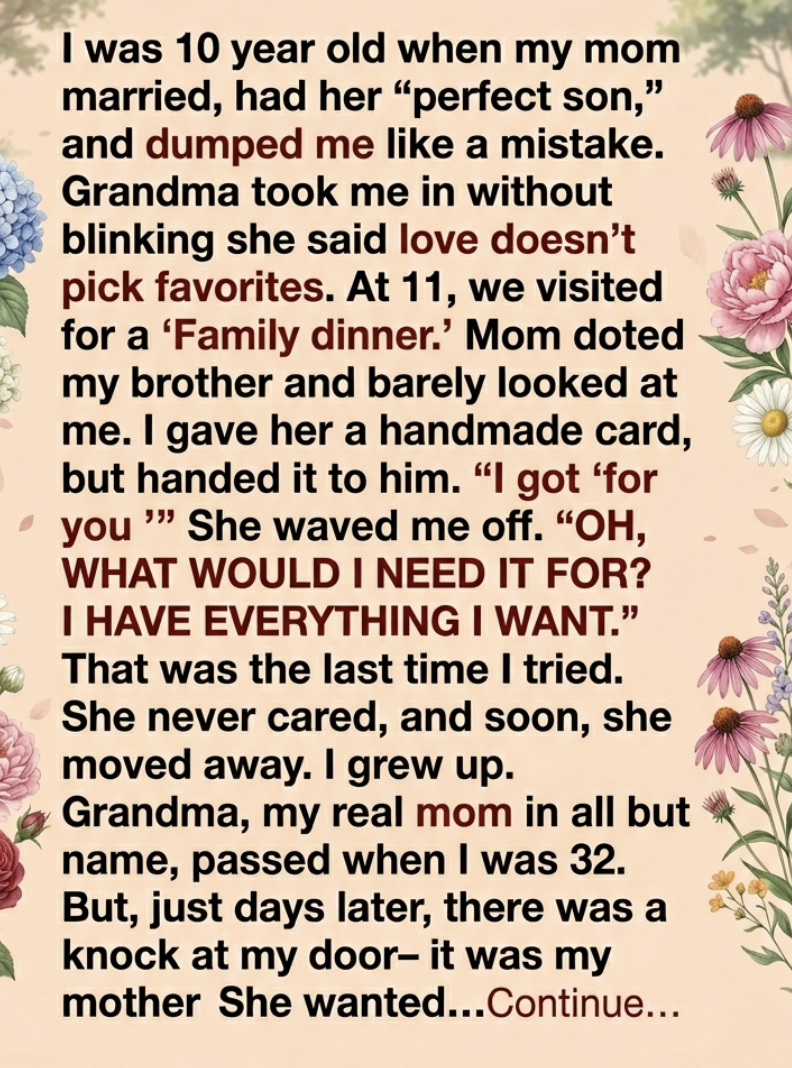
I was ten years old when my mother decided she had a new family.
That’s how it felt, anyway.
She got married.
Had a son.
And suddenly I became an afterthought.
My grandmother took me in without hesitation.
No discussions.
No conditions.
No complaints.
Just one sentence:
“Love doesn’t pick favorites.”
From that day forward, Grandma became the person who raised me.
The person who showed up.
The person who remembered.
The person who cared.
A year later, my mother invited us to what she called a family dinner.
I was eleven.
Still young enough to hope things might change.
Still young enough to think maybe she missed me.
I spent hours making her a card.
Colored pencils.
Careful handwriting.
Tiny hearts around the border.
When dinner started, she barely looked at me.
Everything revolved around my little brother.
His drawings.
His stories.
His jokes.
His future.
At one point, I handed her the card.
She glanced at it.
Then handed it directly to him.
I stared.
Confused.
“That’s for you.”
She waved her hand dismissively.
“Oh, what would I need it for?”
Then she smiled at him.
“I already have everything I want.”
The room went silent.
At least it felt that way.
Because something inside me broke.
I never made her another card.
Never chased her attention again.
Never asked why she loved him more.
I already knew the answer.
Or thought I did.
A few years later, she moved away.
And that was that.
Life continued.
Without her.
I graduated.
Started a career.
Bought a house.
Built a life.
Every major milestone belonged to Grandma.
Not my mother.
When I got my first promotion, I called Grandma.
When I bought my first car, Grandma came with me.
When I got engaged, Grandma cried harder than anyone.
She wasn’t my biological mother.
But she was my mom.
Then she died.
I was thirty-two.
And losing her nearly destroyed me.
The funeral felt like saying goodbye to the only parent I’d ever truly had.
Three days later, someone knocked on my door.
I opened it.
And froze.
My mother.
Older now.
Gray beginning to appear in her hair.
For several seconds, neither of us spoke.
Then she smiled awkwardly.
“Can we talk?”
Every instinct told me to close the door.
Instead, I stepped aside.
She sat in my living room looking around nervously.
Then she finally said it.
“I need your help.”
Of course she did.
I almost laughed.
Twenty-two years of silence.
Three days after Grandma’s funeral.
And suddenly she needed something.
“What kind of help?”
Her eyes dropped to the floor.
Then came the truth.
My brother.
The perfect son.
The child she’d chosen over me.
Had disappeared.
Not missing.
Just gone.
Moved away.
Changed numbers.
Stopped answering calls.
Stopped visiting.
Stopped caring.
The irony was painful.
For years she’d built her entire world around him.
Now she couldn’t reach him.
She started crying.
Real tears.
The kind that come from regret.
“I don’t know what I did wrong.”
The words stunned me.
Not because they were sad.
Because they were familiar.
I had asked myself that exact question for years.
Then I remembered the card.
The dinner.
The dismissal.
The feeling of being invisible.
Finally I asked:
“Do you really not know?”
She looked up.
Confused.
So I told her.
Everything.
The card.
The forgotten birthdays.
The phone calls she never returned.
The years she chose not to be my mother.
She cried harder with every memory.
Eventually she whispered:
“I thought you were stronger.”
I stared at her.
“What?”
She wiped her eyes.
“I thought you didn’t need me.”
The room went silent.
Because that was it.
Not hatred.
Not cruelty.
Something almost worse.
Assumption.
She looked at one child and saw independence.
She looked at the other and saw need.
And she gave all her attention to the one who needed her most.
Without realizing the other needed her too.
Years later, the damage remained.
We talked for hours.
Then days.
Then weeks.
Not because everything was fixed.
Because some things can’t be fixed.
Only understood.
Eventually she stood to leave.
Then stopped at the door.
And asked:
“Do you think Grandma ever hated me?”
I smiled sadly.
“No.”
Because Grandma never hated anyone.
Not even the people who deserved it.
My mother nodded.
Then started crying again.
As she walked away, I realized something.
The woman standing on my porch wasn’t the powerful parent from my childhood.
She was just another flawed human being carrying decades of mistakes.
The difference was that Grandma spent her life teaching love.
And my mother spent hers learning what happens without it.
Today, we’re slowly rebuilding a relationship.
Not mother and daughter.
Not yet.
Maybe never.
But two people trying to understand each other.
And every time I think about Grandma, I remember her words.
“Love doesn’t pick favorites.”
The tragedy is that some people don’t understand that lesson until it’s almost too late.