My five-year-old daughter told her kindergarten teacher something that made my blood run cold.
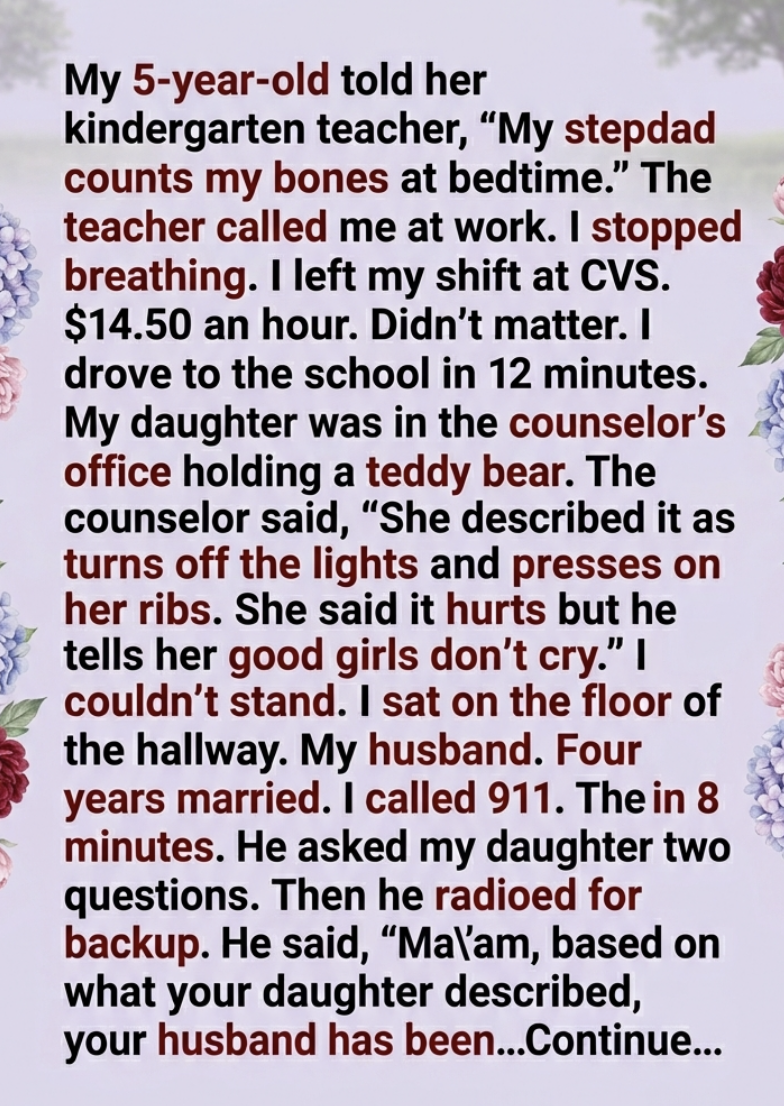
“My stepdad counts my bones at bedtime.”
The teacher called me immediately.
I was working a shift at CVS.
Fourteen dollars and fifty cents an hour.
Nothing special.
But the moment I heard those words, nothing else mattered.
I left work without even finishing my sentence.
The drive to the school normally took twenty-five minutes.
I made it in twelve.
When I arrived, my daughter was sitting in the counselor’s office hugging a teddy bear.
She looked calm.
Too calm.
The counselor didn’t.
Her face told me everything.
Something was wrong.
Very wrong.
She sat me down and carefully explained what my daughter had described.
Apparently it was a “game.”
At least, that’s what my daughter believed.
Every night, my husband would turn off the lights.
Then press on her ribs.
One by one.
Slowly.
Painfully.
When she cried, he’d tell her:
“Good girls don’t cry.”
The room started spinning.
I couldn’t stay standing.
I slid down the hallway wall and sat on the floor.
My husband.
The man I’d been married to for four years.
The man my daughter called Dad.
I felt sick.
The counselor gently squeezed my shoulder.
Then suggested I call the police.
I dialed 911 immediately.
An officer arrived within minutes.
He knelt beside my daughter and spoke softly.
Asked only a couple of simple questions.
Nothing aggressive.
Nothing leading.
Just questions.
Then his expression changed completely.
He stood up.
Picked up his radio.
And requested additional units.
My heart nearly stopped.
I pulled him aside.
“What is happening?”
He looked at me carefully.
Then said:
“Ma’am, based on what your daughter described, your husband has been conducting what sounds like repeated physical examinations.”
I frowned.
“What does that mean?”
His jaw tightened.
“It means this isn’t the first report like this we’ve seen.”
The words hit me like a truck.
Apparently my daughter’s description wasn’t random.
Children often describe inappropriate behavior using innocent language.
Games.
Secrets.
Special routines.
The officer explained that trained investigators needed to speak with her immediately.
Not because she was in trouble.
Because they were concerned.
Very concerned.
The next several hours blurred together.
Social workers arrived.
Specialized child interviewers arrived.
More officers arrived.
Meanwhile, my husband had no idea any of this was happening.
At least not yet.
That changed when police executed a search warrant later that evening.
What they found shocked everyone.
Including me.
Not because of what it proved.
Because of what it revealed.
Apparently my daughter wasn’t the first child who had described similar behavior involving him.
Years earlier, there had been complaints.
Questions.
Investigations that never produced enough evidence to move forward.
Until now.
Until a five-year-old told her teacher about a bedtime game.
That night, my daughter slept at my mother’s house.
Wrapped in blankets.
Holding the same teddy bear.
I barely slept at all.
I kept replaying every moment.
Every excuse.
Every time I ignored a feeling in my stomach.
Every time I convinced myself everything was fine.
The following weeks were filled with interviews, lawyers, therapy appointments, and difficult conversations.
Through it all, one thing stayed with me.
My daughter didn’t know she was exposing something terrible.
She wasn’t trying to start an investigation.
She wasn’t trying to get anyone in trouble.
She simply trusted her teacher enough to tell the truth.
And that truth changed everything.
Today, people sometimes ask how I found out.
They expect some dramatic discovery.
A hidden message.
A secret recording.
A confession.
The reality was much simpler.
A little girl said six words.
“My stepdad counts my bones.”
And because one teacher listened carefully instead of dismissing it, a child got help.
That’s the lesson I carry with me.
Children often tell the truth in ways adults don’t immediately understand.
The important thing isn’t whether the words make sense right away.
The important thing is listening.
Because sometimes the most important warning sign doesn’t sound like a warning at all.