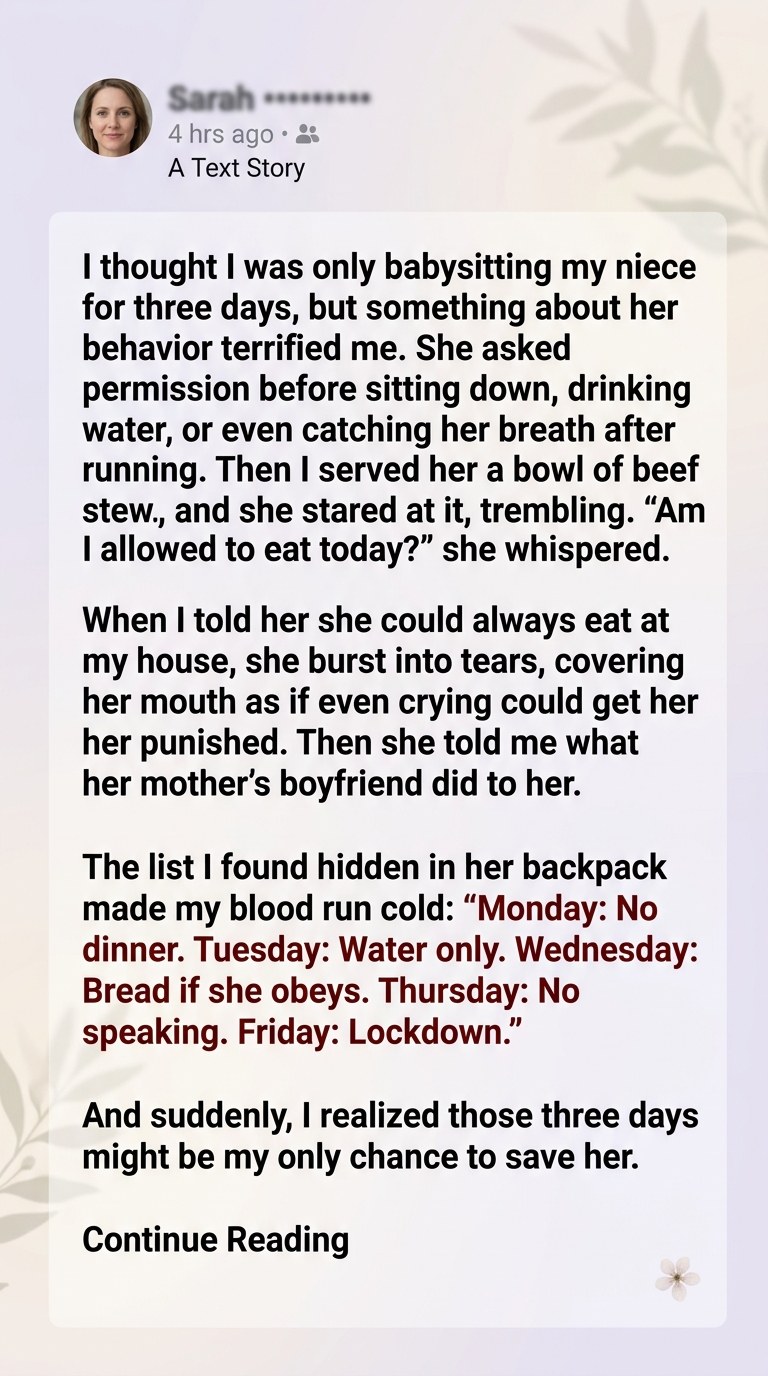
I thought I was only babysitting my eight-year-old niece, Lily, for three days.
Her mother, my younger sister, Vanessa, had called me on a Thursday morning, sounding unusually rushed. She said she needed to travel out of town for a few days and asked if Lily could stay with me.
“Of course,” I told her. “You don’t even have to ask.”
There was a strange silence on the other end of the phone.
“Just make sure she follows the rules,” Vanessa finally said.
I frowned. “What rules?”
“Nothing complicated. She can be difficult sometimes. Don’t let her get away with things.”
Before I could ask what she meant, Vanessa ended the call.
An hour later, she dropped Lily off at my front door.
My niece stepped out of the car carrying a small pink backpack. She wore a long-sleeved shirt despite the warm weather, and her dark hair hung over her face. When I opened my arms to hug her, she flinched.
It was so quick that I almost convinced myself I had imagined it.
“Hey, sweetheart,” I said gently. “I’ve missed you.”
She looked up at me, then glanced nervously toward her mother’s car.
“Am I supposed to hug you?”
The question stopped me cold.
“Only if you want to,” I answered.
Lily slowly wrapped her arms around my waist. Her body felt stiff, as though she were trying to perform a task correctly rather than hug someone she loved.
Vanessa lowered her window.
“Remember what I told you,” she called to her daughter. “Don’t make me regret leaving you here.”
Lily immediately lowered her eyes.
“I won’t, Mommy.”
Vanessa drove away without another word.
I watched the car disappear around the corner, then looked down at my niece.
“Come inside, honey. You must be hungry.”
She followed me into the house with tiny, careful steps.
At first, I thought she was simply shy. Children sometimes acted differently around relatives they didn’t see often. But as the morning passed, I began noticing things that made my stomach tighten.
When Lily wanted to sit on the couch, she stood beside it and looked at me.
“Can I sit down?”
I blinked. “Of course.”
A few minutes later, she went into the kitchen and stared at the water pitcher.
“Can I have some water?”
“Lily, sweetheart, you never have to ask me for water.”
She poured herself half a glass, took one small sip, and immediately put it back.
“That’s enough,” she whispered.
“Are you still thirsty?”
She shook her head too quickly.
Later, while playing in the backyard, Lily ran after a butterfly. For a few seconds, she looked like an ordinary little girl, laughing as the butterfly fluttered over the flowers.
Then she stopped suddenly.
She was breathing hard, her little chest rising and falling.
I walked toward her. “You okay?”
She pressed her lips together and looked frightened.
“I’m sorry.”
“For what?”
“I ran.”
I stared at her, unable to understand.
“Sweetheart, you’re allowed to run.”
She didn’t answer. Instead, she stood perfectly still, as if waiting for me to tell her what her punishment would be.
That was when I began to feel that something was terribly wrong.
At lunchtime, I made beef stew, the kind my own mother used to prepare when we were children. The smell of potatoes, carrots, and tender beef filled the kitchen.
I placed a bowl in front of Lily, along with a slice of warm bread.
“Here you go.”
She stared at the food.
Her hands began to tremble.
“What’s wrong?” I asked, pulling out the chair beside her.
She looked at the bowl, then at me.
“Am I allowed to eat today?”
For a moment, I couldn’t breathe.
“What do you mean, sweetheart?”
Her eyes filled with tears.
“Please don’t be mad. I can wait until tomorrow if I have to.”
I pulled my chair closer and knelt beside her.
“Lily, listen to me. You are allowed to eat every single day. You are allowed to eat when you’re hungry. No one in this house will ever punish you for needing food.”
Her face crumpled.
She covered her mouth with both hands, trying desperately to hold back her sobs.
That frightened me more than anything else.
She wasn’t crying like a child who had been told something sad. She was crying like someone who had spent so long being afraid that kindness itself had become unbearable.
I gently moved the bowl closer.
“You don’t have to finish it all at once. Take your time.”
Lily picked up her spoon with shaking fingers.
She ate one small bite.
Then another.
After the third bite, she looked at me again.
“Are you sure?”
I felt tears burning behind my eyes.
“I’m sure.”
She suddenly began eating faster, then stopped and stared at the doorway as if expecting someone to rush in and take the bowl away.
I moved beside her and placed a hand over hers.
“No one is going to take your food away.”
That was when she broke down completely.
Between sobs, she told me about her mother’s boyfriend, a man named Travis who had moved into their home six months earlier.
At first, she said, he had only yelled when she made mistakes. Then he began inventing rules.
She couldn’t eat unless he decided she had been good enough. She couldn’t drink too much water because he said she was being wasteful. She had to ask permission before sitting down, and she was expected to remain silent whenever he was in a bad mood.
If she disobeyed, he took away her meals.
Sometimes he locked her in a small storage room off the laundry area.
“Mommy says I make him angry,” Lily whispered. “She says if I behave better, he won’t have to punish me.”
I felt something inside me turn cold.
“Does he ever hurt you physically?”
Lily stared at the table.
“He says I’m bad when I cry.”
She pulled her sleeves down over her hands.
I wanted to ask a hundred questions. I wanted to call my sister and demand an explanation. I wanted to drive to their house and confront the man who had made an eight-year-old child afraid to drink a glass of water.
But Lily was watching me carefully.
I realized that if I reacted too quickly, she might believe she had done something wrong by telling me.
So I took a slow breath.
“Thank you for telling me, sweetheart. None of this is your fault. Not one bit of it.”
She looked at me with frightened eyes.
“Will you tell Travis?”
“No.”
“Will you tell Mommy?”
I hesitated.
I would not lie to her, but I also couldn’t promise to keep a dangerous secret.
“I won’t let him hurt you,” I said. “I’m going to find people who can help keep you safe.”
She lowered her head.
“Please don’t send me back yet.”
Those five words shattered my heart.
That evening, after Lily had fallen asleep on the couch with a blanket tucked beneath her chin, I carried her backpack into the guest room to put away her clothes.
The bag was almost empty.
There were two shirts, a pair of leggings, a toothbrush, and a small notebook wrapped inside a plastic grocery bag.
I didn’t want to invade her privacy. But when I lifted the notebook, several folded sheets of paper slipped onto the floor.
I picked one up.
At the top, in uneven handwriting, were the words:
MY WEEKLY RULES
Beneath them was a list.
Monday: No dinner.
Tuesday: Water only.
Wednesday: Bread if she obeys.
Thursday: No speaking.
Friday: Lockdown.
My hands began to shake.
There were check marks beside some of the days and angry red lines beside others. Several pages contained the same rules, repeated week after week.
At the bottom of one sheet, someone had written:
“Don’t tell anyone. She needs to learn.”
I sat on the edge of the bed, staring at the paper until the words blurred.
This wasn’t a misunderstanding.
This wasn’t a strict household or an overly harsh parenting style.
Someone had created a system for depriving a child of food, water, freedom, and the right to speak.
And someone had made Lily believe that she deserved it.
I photographed the pages and carefully placed them back where I had found them. Then I went to check on Lily.
She was curled on her side, one hand tucked beneath her cheek. Even asleep, her shoulders were tense.
I stood in the doorway and made a promise to myself.
Those three days would not end with me handing her back to the same nightmare.
The next morning, I contacted child protective services and explained what Lily had told me. I described the written rules, her fear of eating, and the possibility that she was being locked away as punishment.
I also contacted the appropriate authorities to report the suspected abuse and ask how to protect her without putting her at further risk.
The person I spoke with told me to preserve the evidence, avoid confronting Travis myself, and follow their instructions while they assessed the situation.
I agreed.
For the first time since Vanessa had dropped Lily off, I felt that I was doing something more useful than simply being afraid.
When Lily woke up, I had breakfast ready.
Scrambled eggs, toast, strawberries, and a glass of milk.
She stood in the kitchen doorway.
“Can I eat now?”
“Yes, sweetheart.”
She looked at the clock.
“What if it’s too early?”
“Then we can eat early.”
She looked down at her feet.
“What if Travis says I can’t?”
I knelt in front of her.
“Travis does not get to decide whether you deserve food. You deserve food because you’re a human being, Lily. Because you’re a child who needs to grow. Because you’re alive.”
She stared at me for a long moment.
Then she climbed into the chair.
She ate slowly, glancing at me every few bites. When she finished, she asked whether she could have another piece of toast.
I nearly cried.
“Of course.”
She ate the second piece, then sat quietly with her hands folded in her lap.
“You can go play now,” I told her.
She didn’t move.
“Am I in trouble?”
“No.”
“Even though I ate two pieces?”
I reached across the table and held her small hand.
“Especially because you ate two pieces. You were hungry, and you listened to your body. That’s a good thing.”
She studied my face, searching for some sign that I was lying.
Finally, she whispered, “I wish I lived here.”
I swallowed hard.
“I know, sweetheart.”
That afternoon, my phone rang.
It was Vanessa.
“Is Lily behaving?” she asked without saying hello.
I looked across the room. Lily was drawing at the kitchen table, carefully coloring a picture of a house with flowers in the garden.
“She’s safe,” I replied.
“That isn’t what I asked. Travis says she has been disrespectful lately. Don’t let her manipulate you.”
My grip tightened around the phone.
“Vanessa, why does your daughter think she needs permission to eat?”
Silence.
Then my sister laughed nervously.
“What are you talking about?”
“I found a list in her backpack. It says she isn’t allowed dinner on Mondays, water only on Tuesdays, and bread only if she obeys on Wednesdays.”
The silence that followed was so complete that I could hear the refrigerator humming.
Finally, Vanessa spoke.
“Those are Travis’s rules. You don’t understand what she’s like at home.”
“She is eight years old.”
“She lies. She cries to get attention. If you let her get away with everything, she’ll never learn discipline.”
“Discipline doesn’t mean starving a child.”
“Don’t you dare judge me!”
Her voice rose so sharply that Lily dropped her crayon.
I looked at my niece and lowered my voice.
“I’m not going to argue with you over the phone. The authorities have been contacted, and they will determine what happens next.”
Vanessa stopped shouting.
“What did you do?”
“I did what someone should have done a long time ago. I took her seriously.”
“You can’t keep my daughter from me!”
“I am not making that decision by myself. But I will not ignore what she told me.”
She began crying then, but I couldn’t tell whether it was fear, anger, or guilt.
“Travis says he’s only trying to help me raise her,” she whispered. “He says she’s difficult because I never had control over her.”
I closed my eyes.
“Vanessa, when was the last time you watched your daughter eat without being afraid?”
She didn’t answer.
“Have you ever asked yourself why she flinches when someone reaches toward her? Why she apologizes for breathing too loudly? Why she believes she has to earn a meal?”
My sister hung up.
I stood there for a long time, feeling both furious and heartbroken.
Vanessa was my sister. I remembered holding her when she was a baby, defending her when other children bullied her, and promising our mother that I would always look out for her.
But loving my sister did not mean pretending her daughter was safe.
That evening, Lily asked if she could sleep in my bedroom.
I made space beside me and turned on a small lamp.
She lay under the blanket, staring at the ceiling.
“Auntie?”
“I’m here.”
“If I tell the truth, will Mommy hate me?”
I turned toward her.
“I can’t promise how your mother will feel or what she’ll say. But telling the truth about someone hurting you is never wrong. You didn’t cause this, and you don’t have to protect the adults who hurt you.”
She was quiet for a moment.
“Travis says nobody will believe me.”
I reached for her hand.
“I believe you.”
Her fingers curled around mine.
“Even if Mommy says I’m lying?”
“Even then, you deserve to be listened to and protected.”
She moved closer until her head rested against my shoulder.
For the first time since arriving at my house, she fell asleep without asking whether she was allowed to.
The next day, a child protection worker and a police officer came to speak with me. I showed them the photographs of the notebook and explained everything Lily had told me.
They spoke with Lily in an age-appropriate, careful way, making sure she had time to answer without pressure. They also began taking steps to assess her safety and determine what needed to happen next.
I learned that protecting a child was not as simple as declaring that she could stay with me forever. There were procedures, assessments, and decisions that had to be made properly.
But I also learned that I didn’t have to face the situation alone.
The professionals took the written list seriously. They documented the concerns, discussed the next steps, and made arrangements to ensure Lily would not simply be sent back into a potentially dangerous situation without the necessary assessment.
When the worker left, Lily sat beside me on the porch.
“Are they going to take me away?”
“They’re here to help keep you safe,” I told her. “And I’ll keep working with them to make sure you’re cared for.”
She looked at the flowers along the walkway.
“Can I pick one?”
I smiled.
“You can pick as many as you like, as long as we leave some for the bees.”
She looked up at me.
“I don’t have to ask?”
“You just did ask,” I said softly. “And that’s okay. But you don’t need permission to enjoy being a child.”
She chose a small yellow flower and held it carefully in her palm.
For the rest of the afternoon, we baked cookies. She spilled flour on the counter, dropped a spoon, and laughed when a little dough stuck to her nose.
Each time something went wrong, she froze for a second.
Each time, I reminded her that accidents happened and nobody was going to punish her for them.
Little by little, her shoulders relaxed.
On the third evening, Vanessa appeared at my door.
She looked exhausted. Her eyes were red, and she held her purse against her chest as though it were a shield.
“Can I see Lily?” she asked.
I didn’t immediately move aside.
“Before anything happens, I need to know that you understand why she’s frightened.”
Vanessa looked past me into the living room, where Lily was sitting with a coloring book.
“I miss my daughter.”
“I believe you. But missing her isn’t the same as making her safe.”
My sister’s face crumpled.
“I thought Travis was helping me. I was tired all the time. He told me Lily needed stricter rules, and I believed him. I thought if I supported him, things would finally become easier.”
“Did you know he was withholding food?”
She shook her head, then stopped.
“I knew she sometimes went to bed without dinner. He said she had misbehaved. I didn’t ask enough questions.”
Her voice broke.
“I should have asked.”
“Yes,” I said quietly. “You should have.”
She began to cry.
“I didn’t want to believe that someone I loved could do this.”
I understood that feeling more than I wanted to.
But I also knew that Lily had been the one paying for the adults’ refusal to face the truth.
“Vanessa, you can love someone and still be wrong about them. But now you have to put Lily’s safety before your relationship with Travis. That means cooperating with the investigation, being honest about what happened, and accepting whatever steps are necessary to protect her.”
My sister nodded.
“I’ll do anything.”
“I hope you mean that.”
The authorities continued their work, and Travis was no longer allowed to treat the situation as a private family matter. His actions were investigated, and the adults involved had to answer questions about the rules, the withheld meals, and Lily’s fear.
Vanessa also had to confront the part she had played by accepting Travis’s explanations and failing to protect her daughter.
There were no instant miracles. Lily didn’t suddenly stop being afraid because three days had passed. She still asked permission to drink water. She still hid food in her pockets sometimes. And when someone raised their voice in another room, she sometimes went silent.
But now, the adults around her understood that these were signs of distress, not disobedience.
With professional support and a safe environment, Lily began learning things every child should have known from the beginning.
That hunger was a signal, not a sin.
That mistakes did not make her bad.
That she could speak without being punished for having a voice.
And that love was not something she had to earn by being perfectly quiet.
Several weeks later, I found her sitting at the kitchen table, eating a bowl of beef stew.
The same meal that had made her tremble the first day she arrived.
She had a piece of bread in one hand and a spoon in the other. A little broth had dripped onto her shirt, and she was laughing at a cartoon playing on the television.
When she noticed me watching, she smiled.
“Can I have more, Auntie?”
My eyes filled with tears, but this time I smiled too.
“You never have to be afraid to ask.”
She held out her empty bowl.
I filled it.
She began eating again, humming softly to herself.
I stood by the stove and thought about the list hidden in her backpack.
Monday: No dinner.
Tuesday: Water only.
Wednesday: Bread if she obeys.
Thursday: No speaking.
Friday: Lockdown.
Someone had written those words believing they could control a little girl’s entire world.
But they had overlooked one thing.
A child who has been taught to stay silent can still tell the truth when someone finally makes her feel safe enough to speak.
I had thought I was babysitting my niece for three days.
I hadn’t known that those three days would force our family to face a truth it had spent too long avoiding.
I hadn’t known that a bowl of stew could reveal the depth of a child’s fear.
And I hadn’t known that the most important thing I could offer Lily wasn’t a perfect home, an expensive gift, or a promise that life would never hurt her again.
It was the certainty that she would not have to face the truth alone.
The last time she went to bed at my house, she paused at the kitchen doorway.
“Auntie?”
“Yes, sweetheart?”
“Tomorrow, can I have breakfast when I wake up?”
I walked over and hugged her gently.
“Tomorrow, the next day, and every day after that, you deserve to eat.”
She wrapped her arms around me.
Then, for the first time, she didn’t ask whether she was allowed to hug me.
She simply held on.
And I held her back.
Because sometimes saving a child begins with recognizing that the things everyone else has dismissed as little problems are actually cries for help.
Sometimes it begins with a frightened question.
Sometimes it begins with a hidden list.
And sometimes, it begins when one person finally decides that a child’s suffering will no longer be kept a secret.