The attorney’s office smelled of polished wood, expensive leather, and the kind of money that could change a person’s life forever.
I sat quietly at the far end of the conference table, my hands folded in my lap, trying to understand how I had ended up in a room like this.
Across from me sat my younger sister, Vanessa.
She wore a black designer dress, diamond earrings, and a confident smile that made my stomach twist. Beside her sat her attorney, who had spent the entire morning whispering assurances into her ear.
At the head of the table sat Mr. Harrison, the lawyer who had handled Daniel’s affairs for nearly twenty years.
Daniel had been my husband once.
Before the private jets, the sprawling estates, and the headlines celebrating him as one of the country’s most successful businessmen, he had been an ambitious young man with a secondhand car and a dream he could barely afford to pursue.
I had loved him before the world knew his name.
I had stood beside him when his first company nearly collapsed. I had sold my jewelry to help cover our rent. I had spent nights sitting beside him in our tiny apartment, telling him that losing money didn’t mean he had failed as a person.
But success changed our marriage in ways neither of us knew how to repair.
Daniel became consumed by work. I became lonely. Our conversations turned into arguments, and eventually, after years of trying to save something that seemed to be disappearing between us, we divorced.
We parted without children and without a public battle over his growing fortune.
I walked away with a modest settlement because I wanted a peaceful life more than I wanted to spend years fighting over money.
Daniel never remarried.
Not until Vanessa entered his life.
My own sister.
She had always been drawn to expensive things. When Daniel began appearing at family gatherings with her, I told myself that he was free to love whomever he chose.
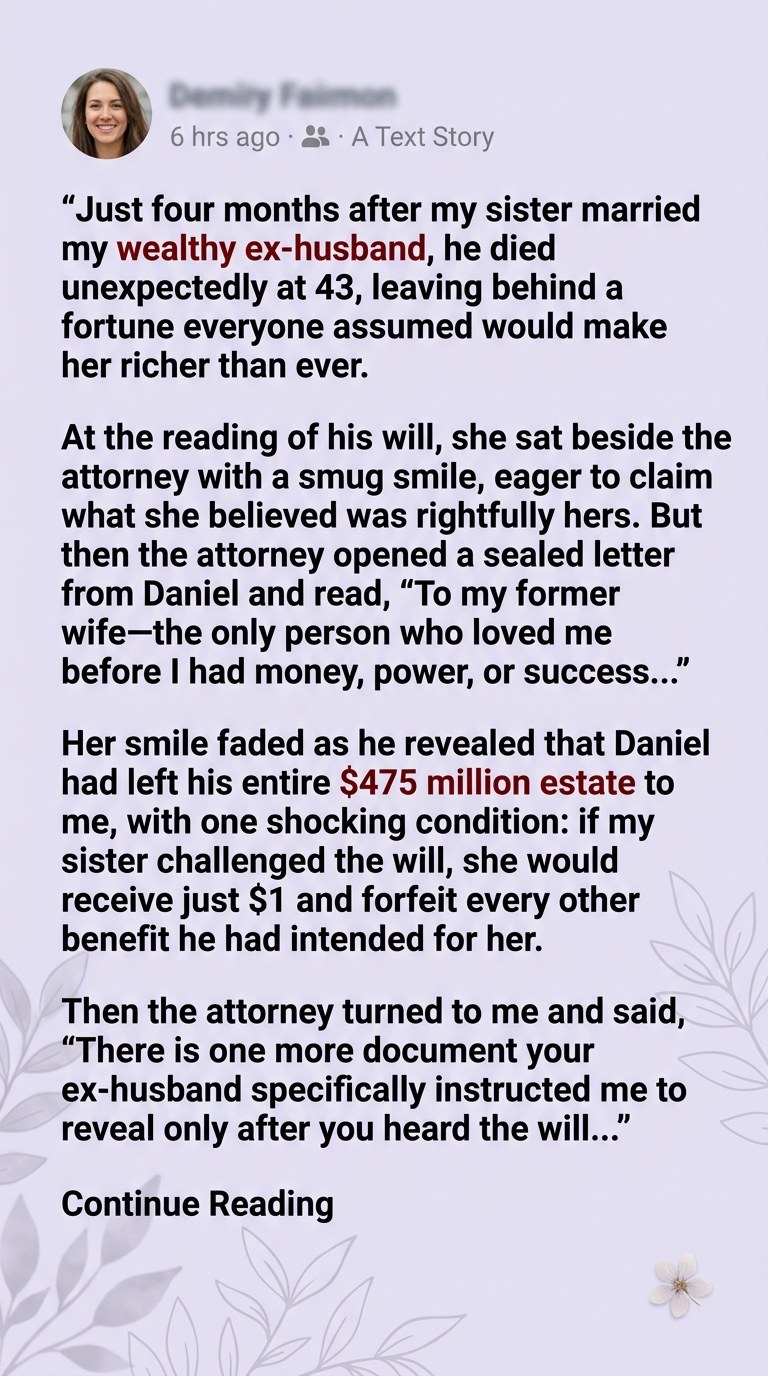
But four months before his death, Vanessa announced that they were married.
She called me personally.
“Isn’t it wonderful?” she said, her voice bright with excitement. “Imagine that. We really are family now.”
I remembered the way she laughed when I congratulated her.
I remembered the way she said Daniel had promised to take her everywhere she had ever dreamed of going.
And I remembered the last time I spoke to Daniel.
It was a quiet conversation. He sounded tired, though he insisted that he was fine.
“Take care of yourself,” he told me.
“You too, Daniel.”
There was a pause.
“I wish things had been different.”
I didn’t know what to say, so I told him goodbye.
Three weeks later, he died unexpectedly at forty-three.
The news arrived in the middle of an ordinary afternoon. I remember standing beside my kitchen sink, holding my phone, unable to understand the words coming through the speaker.
Daniel was gone.
And now, barely a month after his funeral, I was sitting in his lawyer’s office while his widow waited to discover what she had inherited.
Vanessa leaned toward me.
“I hope you understand that whatever Daniel left me is none of your business,” she whispered.
I looked at her.
“I didn’t come here to fight you.”
She gave a small, satisfied smile.
“Good. Because Daniel and I had plans. He wanted me to enjoy the life we were building together.”
Mr. Harrison cleared his throat.
“Shall we begin?”
Everyone fell silent.
He opened a thick folder and began reading the will. There were provisions for charitable foundations, several business trusts, employees who had served Daniel for decades, and family members who had remained close to him.
Vanessa listened patiently, occasionally glancing at her attorney.
Then Mr. Harrison reached the section concerning Daniel’s personal estate.
“To my wife, Vanessa, I leave the personal property specifically designated for her in the accompanying schedule, along with the benefits provided under the terms of our marital agreement.”
Vanessa’s smile tightened.
“Excuse me,” she interrupted. “What does that mean exactly?”
“It means that certain assets have been allocated to you under the agreement,” Mr. Harrison explained. “The remaining estate is distributed according to the provisions I am about to read.”
Her attorney leaned closer and whispered something to her.
She nodded, still looking confident.
Then Mr. Harrison removed a sealed envelope from the folder.
“This letter was written and signed by Daniel. He instructed me to read it aloud during the formal distribution of his estate.”
Vanessa sat straighter.
Mr. Harrison opened the envelope.
“To my former wife, Eleanor—the only person who loved me before I had money, power, or success.”
My heart stopped.
I recognized Daniel’s handwriting before the attorney read the next sentence.
“If you’re hearing these words, then I have left this world before I could tell you something I should have said years ago. You knew me when I had nothing worth inheriting. You saw my failures, my fears, and the parts of myself I tried to hide from everyone else. You loved me when I had no guarantee that I would ever become the man I wanted to be.”
I pressed my fingers against my lips.
Across the table, Vanessa’s smile began to disappear.
The attorney continued.
“I spent many years believing that success would solve every problem in my life. I thought wealth would protect me from regret. I was wrong. Money can buy comfort, but it cannot buy back the years you lose while chasing it.”
He paused, adjusted his glasses, and read the next paragraph.
“To Eleanor, I leave the entirety of my remaining personal estate, including my ownership interests, investment holdings, and other assets described in the attached schedules, with an estimated combined value of $475 million.”
The room erupted in whispers.
Vanessa shot to her feet.
“What?”
Her attorney grabbed her arm.
“Please sit down.”
“That’s impossible!” she cried. “I’m his wife! I married him! I was with him when he died!”
Mr. Harrison waited until the room quieted.
“The will has been prepared and executed in accordance with the applicable formalities. Any legal challenge must be handled through the proper process.”
Vanessa stared at me as though I had personally reached into her hands and stolen something.
“You knew about this!”
“I didn’t,” I whispered.
“You’re lying!”
“I didn’t know anything about it.”
She turned toward the attorney.
“How can he leave everything to her? What about me?”
Mr. Harrison opened another document.
“Daniel anticipated that this provision might be challenged. His will includes a clause stating that if a beneficiary contests the will in a manner covered by the applicable no-contest provision, that beneficiary may receive only one dollar from the estate and forfeit other testamentary benefits, to the extent the clause is enforceable under the governing law.”
Vanessa’s face went pale.
“One dollar?”
“That is what the document states.”
She sank into her chair.
For the first time that morning, she looked genuinely frightened.
Then Mr. Harrison turned toward me.
“Mrs. Eleanor, there is one more document your former husband specifically instructed me to reveal only after you heard the will.”
He reached into the folder and removed a smaller envelope.
My name was written across the front.
Underneath it, Daniel had added four words.
Read this alone, Eleanor.
The attorney placed it in front of me.
Vanessa leaned forward immediately.
“What is that?”
Mr. Harrison shook his head.
“Daniel’s instructions were explicit. This document is for Eleanor.”
I opened the envelope with trembling fingers.
Inside was a handwritten letter and a small brass key.
The letter began:
“My dearest Eleanor,
“If you’ve made it this far, then you know that I have left you the fortune I spent my life building. But before you decide what to do with it, you need to understand why.”
I swallowed hard and continued reading.
“For years, I told myself that our marriage ended because we wanted different things. That was partly true, but it was not the whole truth. I was so afraid of being unsuccessful that I made my work the center of my life. I let ambition turn me into a man who measured his worth by numbers on a screen.”
My eyes blurred with tears.
“I remember the winter our heating stopped working. You wrapped yourself in two blankets and gave me the warmer one because I was working late at the kitchen table. I remember the day my first investor rejected me, and you told me that one person’s refusal did not define my future. I remember how you smiled when we finally had enough money to buy groceries without checking every price.”
I had not thought about those memories in years.
Daniel had remembered every one of them.
“By the time I understood what I had lost, we had both become too hurt to know how to find our way back. I will not ask you to forgive me simply because I am gone. You owe me nothing.”
I stopped reading and wiped my face.
Across the table, Vanessa was watching me with a mixture of anger and curiosity.
“What does it say?” she demanded.
I folded the letter slightly, shielding it from her view.
“I need a moment.”
Mr. Harrison nodded.
“Of course.”
I continued.
“The key belongs to a small office I kept separate from the headquarters of my company. Inside, you will find records that explain certain decisions I made in the final year of my life. I have asked my attorney to preserve everything there and make sure you receive access.”
My pulse quickened.
“What decisions?” I whispered.
The letter continued.
“There is something else you must know. I did not leave you this money to punish Vanessa. I left it to you because I trust you to make decisions that are not driven by revenge, fear, or the desire to prove something to the world.”
I looked up at the attorney.
“Where is this office?”
“At Daniel’s private residence,” he answered. “A separate study on the ground floor. The key should open the door.”
Vanessa suddenly laughed, but the sound was brittle.
“Of course. He leaves her a fortune and a secret room. How romantic.”
Mr. Harrison closed the folder.
“The meeting is concluded for today. I suggest that everyone obtain independent legal advice before taking any further action.”
Vanessa stood so quickly that her chair scraped against the floor.
“You haven’t heard the last of this, Eleanor.”
I looked at my sister.
For a moment, I wanted to tell her that I had never asked Daniel for a single dollar. I wanted to remind her that I had congratulated her on her marriage even though the circumstances had hurt me.
Instead, I said, “I hope you get the help you need to understand what happened.”
She stared at me as if I had slapped her.
Then she walked out.
I stayed behind with Mr. Harrison.
“Did Daniel know he was going to die?” I asked.
The attorney considered his answer carefully.
“I cannot tell you what Daniel believed about his health or his future. What I can tell you is that he spent considerable time organizing his affairs. He wanted certain records preserved, and he was unusually specific about who should receive them.”
“Did he say anything about Vanessa?”
“He was concerned about several matters involving his marriage. But I believe it would be irresponsible for me to speculate about his motives before you have seen the documents he left.”
I nodded, though the answer only deepened my unease.
That afternoon, I drove to Daniel’s estate.
I had not visited the property since our divorce. The gates opened after the security staff confirmed my identity, and I followed the long driveway past carefully trimmed hedges and a fountain I remembered choosing with Daniel years earlier.
The house looked exactly as I remembered it.
Beautiful.
Impossibly quiet.
And full of things that belonged to a life I had once shared.
A member of the household staff led me to the study.
The brass key turned smoothly.
Inside, I found a desk, several filing cabinets, and a large safe built into the wall. On the desk sat a photograph of Daniel and me taken on the day we bought our first house.
We had been so young.
He was wearing an inexpensive suit. I was holding a paper bag filled with sandwiches because neither of us could afford to celebrate at a restaurant.
We were laughing.
I picked up the photograph and held it against my chest.
Then I noticed a second envelope beside the safe.
It was marked:
FOR ELEANOR — PRIVATE RECORDS
I opened it.
Inside was a list of file names and a brief instruction from Daniel.
“Start with the blue folder.”
I found it in the top drawer of the desk.
The first document was a timeline of Daniel’s financial decisions during the final year of his life. The next contained correspondence with his advisers. The third was a report concerning a business transaction that had been delayed shortly before his wedding to Vanessa.
I began reading.
At first, the papers seemed ordinary. There were company valuations, investment schedules, and notes from meetings.
Then I found a message from Daniel to his financial adviser.
“Do not transfer the controlling interest until the review is complete. I want the independent assessment finished before any further commitments are made.”
The message was dated two months before his death.
Behind it was a report identifying discrepancies in a proposed acquisition. Several figures did not match the supporting documents. The report did not establish who was responsible, but Daniel had written a note in the margin:
“Find out who authorized these changes.”
I sat down.
This was not simply a collection of sentimental memories.
Daniel had been investigating something.
I continued through the folder until I found a page containing the names of people who had been involved in the transaction.
Vanessa’s name appeared beside a meeting date.
I stared at it for a long time.
There was no accusation attached to it. The document merely recorded that she had attended a meeting with one of Daniel’s business associates before the acquisition was postponed.
Still, I could not ignore the timing.
I called Mr. Harrison.
“I found the blue folder,” I told him. “There are records about a business transaction Daniel was investigating. Vanessa’s name appears in one of them.”
The attorney became quiet.
“Please do not draw conclusions from a single document,” he said. “Keep everything exactly as you found it. I will arrange for the relevant records to be reviewed by the appropriate professionals.”
“Do you know what Daniel was investigating?”
“I know that he requested an independent review. I do not know the complete outcome. We should establish the facts before making accusations.”
I agreed.
For the next several days, the estate’s records were carefully inventoried. Daniel’s advisers reviewed the business documents, and his attorney coordinated with the professionals responsible for examining the disputed transaction.
Meanwhile, Vanessa hired another lawyer.
She sent me messages accusing me of manipulating Daniel, of turning his death into a financial opportunity, and of stealing the future she believed he had promised her.
I did not answer the insults.
I also did not assume that the will’s no-contest clause meant she had no legal rights. Mr. Harrison explained that the enforceability of such provisions depended on the governing law and the precise circumstances. Any dispute would have to be evaluated on its merits.
For the first time, I understood that inheriting a fortune did not mean inheriting certainty.
It meant inheriting responsibilities, questions, and decisions that could affect hundreds of people.
Then, a week later, Mr. Harrison called me back to his office.
“The initial review has identified serious inconsistencies in the acquisition records,” he said. “The advisers are still examining them, and no conclusion has been reached about who was responsible. But Daniel’s concerns were not imaginary.”
“What does that mean for Vanessa?”
“It means we need to establish what she knew, what she did, and whether any of her actions were improper. Her name appearing in a meeting record is not proof of wrongdoing.”
I appreciated his honesty.
“Why did Daniel leave everything to me?”
Mr. Harrison looked at the photograph I had brought from the study.
“Because he trusted you to distinguish between what you know and what you merely suspect.”
I looked down at the picture.
Daniel had not left me a fortune so I could humiliate my sister. He had left me a responsibility that demanded patience, fairness, and the courage to uncover the truth.
Over the following weeks, the financial review continued. Some of the questionable entries were traced to errors in the acquisition process, while other matters required further investigation. Nothing justified accusing Vanessa of a crime without evidence.
But the experience changed the way I saw her.
I had spent years believing my sister was simply selfish, someone who wanted the things I had lost. Now I understood that I could not know the full story without facts.
When she eventually agreed to meet me, we sat across from each other in a quiet café.
She looked exhausted.
“I thought Daniel was going to leave me everything,” she said.
“I know.”
“He told me we would never have to worry about money.”
“He may have believed that when he said it.”
She looked away.
“Did he ever talk about me to you?”
“Not in the way you’re imagining.”
“Did he still love you?”
I thought about the letter.
“I think he regretted how our marriage ended. But that doesn’t mean I know everything he felt.”
Vanessa’s eyes filled with tears.
“I wanted to be the person he chose.”
I reached across the table but stopped before touching her hand.
“You were his wife. That mattered. But being someone’s wife doesn’t automatically explain every decision they make.”
She looked at me for a long time.
“Are you going to keep all the money?”
“I haven’t decided what to do with everything yet. There are employees, charities, investments, and legal obligations to consider. I’m not going to make those decisions out of anger.”
“And what about me?”
“I won’t promise you something just because you ask. But I won’t use the will to punish you either. If you have legitimate rights under the law, you should have the opportunity to exercise them.”
Vanessa lowered her head.
For once, she had no sharp reply.
We left the café without resolving everything between us. Some wounds were too old to disappear in a single conversation.
But I no longer felt that I had to win against her.
Months passed.
The estate was administered under professional supervision, and the business review continued through the appropriate channels. Daniel’s employees kept their jobs while the company’s leadership worked to stabilize operations. The charitable commitments he had made were honored where legally and financially possible.
I established an independent oversight process to ensure that major decisions were made responsibly.
I also used part of the estate to create a fund supporting women who had been left financially vulnerable after divorce, helping them access legal guidance, employment training, and emergency assistance.
I did not name it after Daniel.
I named it the Second Beginning Fund.
Because that was what I wanted the money to represent.
Not revenge.
Not a victory over my sister.
A second beginning for people who had been forced to rebuild their lives when they thought they had nothing left.
One evening, nearly a year after Daniel’s death, I returned to the study and placed the old photograph back on the desk.
I read his letter one final time.
“I will not ask you to forgive me simply because I am gone. You owe me nothing.”
I finally understood the kindness in those words.
Daniel had not tried to purchase my forgiveness with $475 million. He had given me the freedom to choose what kind of person I wanted to be after he was gone.
I could have spent the rest of my life proving that I had been the woman who loved him first.
I could have used the fortune to make Vanessa regret every cruel thing she had said.
Instead, I chose to build something that would matter long after the inheritance had stopped being news.
I never learned every answer Daniel had hoped I would discover. Some records remained incomplete, and some questions could not be resolved with certainty.
But I learned enough to understand that money rarely tells the whole story of a person’s life.
Sometimes a fortune is not a reward.
Sometimes it is a responsibility.
And sometimes the final gift someone leaves behind is not the money itself, but the opportunity to decide what to do with it.
My sister had married my wealthy ex-husband believing she was entering a life of limitless security.
When he died four months later, she expected his fortune to make her richer than ever.
Instead, a letter revealed that he had remembered the woman I had been before money changed everything.
And the sealed document that followed gave me something more valuable than the chance to win a family argument.
It gave me a choice.
I could let the past define the rest of my life, or I could take what remained and turn it into something good.
For the first time in many years, I chose my own future.
And I did not need anyone’s permission to begin.