The teller’s fingers froze above her keyboard.
She looked at the screen, blinked twice, and then glanced at me with an expression that made my stomach tighten.
“Ma’am, I’m going to ask you to remain calm while I get the branch manager.”
I stared at her.
“Why? What’s wrong with my account?”
She lowered her voice.
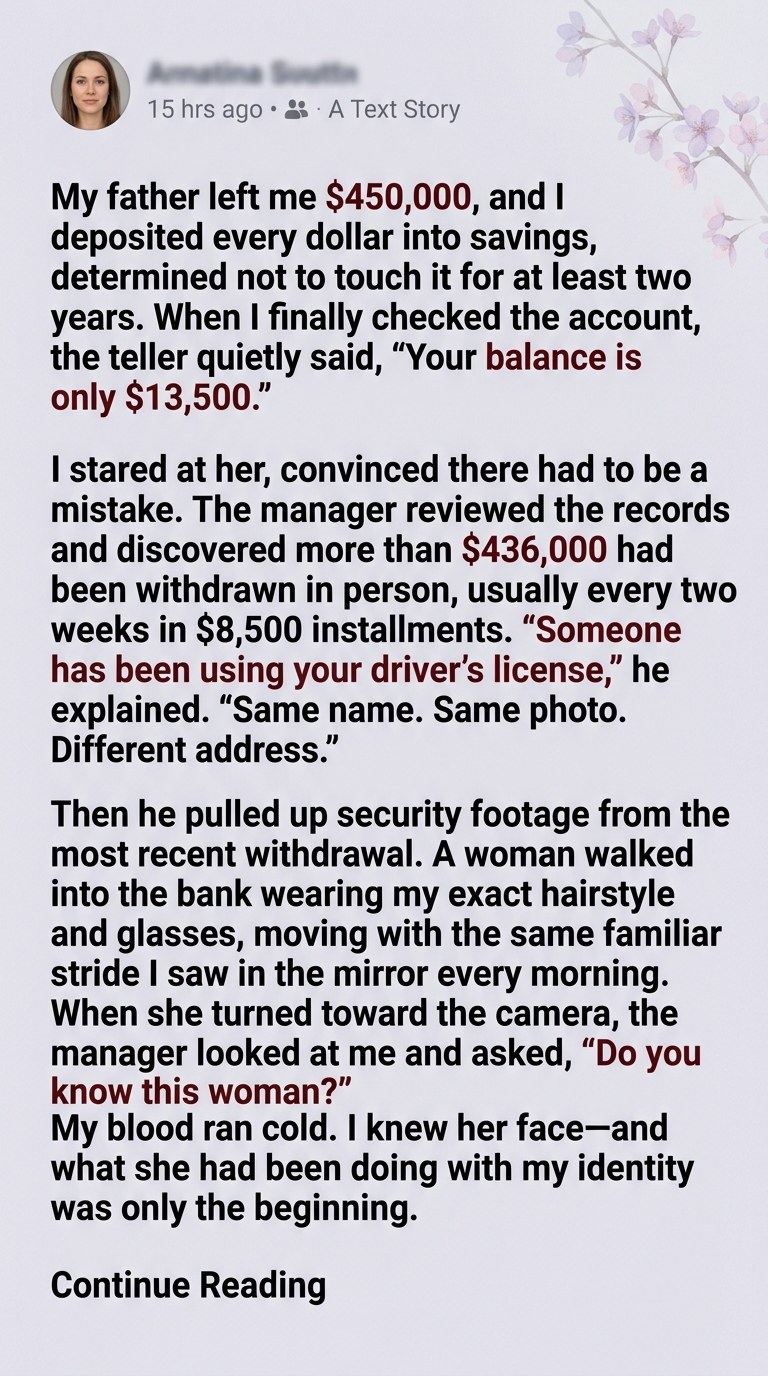
“Your balance is only thirteen thousand five hundred dollars.”
For several seconds, I couldn’t understand what she had said.
I had deposited $450,000 into that account almost two years earlier, every dollar inherited from my father, Robert Mitchell. I had promised myself that I wouldn’t touch it for at least two years. I wanted the money to remain untouched while I decided whether to buy a house, return to school, or start the small business I had always dreamed about.
I had worked hard my entire adult life. My father had worked even harder.
When he died, leaving me that money, I considered it more than an inheritance. It was the final thing he had done to protect my future.
And now, according to the teller, almost all of it was gone.
“That can’t be right,” I whispered. “I haven’t withdrawn anything.”
She turned the monitor slightly toward herself.
“I’m sorry. There have been numerous withdrawals.”
“Withdrawals by whom?”
She hesitated.
“That’s what the manager needs to investigate.”
Ten minutes later, I was sitting in a private office with the branch manager, a gray-haired man named Mr. Collins. He had printed several pages of account activity and spread them across his desk.
He studied me carefully.
“How long have you had this account?”
“Almost two years.”
“And have you ever requested a replacement driver’s license?”
“No.”
“Have you reported your identification stolen?”
“No. Why?”
He took a breath.
“Because someone has been making in-person withdrawals using identification associated with your account.”
I stared at him.
“Someone has been using my driver’s license?”
“That’s what the preliminary records suggest. Same name. Same photograph. Different address.”
My hands went cold.
He pointed to the transaction history.
The first withdrawal had occurred shortly after I opened the account. The next came two weeks later. Then another. And another.
Most were for $8,500.
Every other week, someone had walked into a bank branch, presented identification in my name, and walked out with thousands of dollars.
For nearly two years.
“How much?” I asked.
Mr. Collins looked down at the figures.
“Approximately $436,500 has been withdrawn. We’re reviewing the transactions to establish the exact amount and determine what happened.”
I pressed my fingers against my forehead.
“How could nobody notice? That’s my money. I never authorized any of this.”
He explained that the withdrawals had been processed at different branches and that the records were being reviewed. He would not promise an immediate resolution, but he assured me that the bank would preserve the available evidence and begin an investigation.
Then he turned his computer toward me.
“We have security footage from the most recent transaction. I think you need to see it.”
The video showed a woman walking through the entrance of a bank.
She wore a beige coat, dark trousers, black-framed glasses, and her hair was pulled into a low bun.
At first, I thought I was looking at myself.
She had the same height, the same narrow shoulders, and the same slight tilt of her head when she walked. Even the way she carried her handbag looked familiar.
Then she approached the teller.
She handed over her identification, signed a document, and waited while the employee counted a stack of cash.
Just before leaving, she turned toward the security camera.
I stopped breathing.
I knew that face.
I had seen it at family dinners, birthday parties, and Christmas gatherings. I had trusted it with the keys to my apartment. I had cried on its shoulder when my father was diagnosed with cancer.
The woman on the screen was my younger sister, Natalie.
“Do you know this woman?” Mr. Collins asked.
I couldn’t answer immediately.
My sister had been the person I trusted most in the world.
We had grown up sharing a bedroom, whispering secrets beneath blankets after our parents went to sleep. When our mother died, Natalie had held my hand at the funeral and promised that we would always look after each other.
And when our father became ill, she had helped me care for him.
Or at least, I had believed she had.
“That’s my sister,” I finally whispered.
Mr. Collins leaned back in his chair.
“Are you certain?”
“Yes.”
I watched the footage again.
There was no mistaking her face.
But the longer I watched, the more something else bothered me.
Natalie wasn’t simply wearing clothes similar to mine.
She was wearing my glasses.
My actual glasses.
The pair I had misplaced six months earlier and eventually replaced because I assumed I had left them in a taxi.
My heart began pounding.
I remembered the afternoon Natalie had visited my apartment while I was at work. She had called to ask if she could borrow my spare key because she wanted to drop off a box of our father’s belongings.
I had told her where to find it.
When I returned home, the box was on my kitchen table. Nothing appeared missing.
I had thanked her.
I had never questioned why she had been alone in my apartment.
Until that moment.
“Can you give me a copy of this footage?” I asked.
“We’ll preserve it for the investigation,” Mr. Collins replied. “We’ll explain the process for obtaining a copy through the appropriate channels.”
I stood up, feeling as though the room were moving around me.
“I need to call the police.”
He nodded.
“Given what you’ve described, I recommend reporting the suspected identity theft immediately. Please also contact the bank’s fraud department and secure your identification and account access.”
I thanked him, though I barely remembered walking out of the office.
Outside, the afternoon sunlight seemed painfully bright.
I sat in my car and stared at my phone.
Natalie’s name was near the top of my recent calls.
My thumb hovered over it.
I wanted to call her and demand an explanation. I wanted to scream until she admitted what she had done.
But something stopped me.
If she had been stealing from me for nearly two years, she had been doing it deliberately. She had planned each withdrawal, chosen the amounts, and returned to the bank again and again.
Confronting her without understanding what I was dealing with might only give her time to destroy evidence or disappear.
So I called the police instead.
I reported the suspicious withdrawals, explained that the security footage appeared to show my sister using my identity, and provided the information the bank had given me. I also asked how to document the missing funds and protect myself from further misuse of my personal information.
They advised me to preserve all records, avoid confronting the suspected person while the matter was being investigated, and report any additional suspicious activity.
Then I called the bank’s fraud department.
By the time I arrived home, I had taken the first steps toward protecting what remained of my account.
But I still had no idea why Natalie had done it.
That evening, my phone rang.
It was her.
“Hey, big sister!” she said cheerfully. “How was your day?”
The normality of her voice made me feel sick.
I looked at the wall, trying to steady my breathing.
“Fine. How was yours?”
“Busy. I had a few errands to run.”
I closed my eyes.
“Where were you today?”
There was a pause.
“Why?”
“No reason. Just asking.”
“I went shopping, then stopped by the bank.”
My stomach dropped.
“What bank?”
She laughed softly.
“The usual one. Why are you asking so many questions?”
I had not told her about the withdrawals. I had not mentioned the security footage or the missing money.
Yet something in her voice had changed.
She was no longer merely answering me.
She was testing me.
“I checked my savings account today,” I said.
Silence.
Then she asked, “Oh? Everything okay?”
“Not exactly. Someone has been withdrawing money without my permission.”
I heard a faint rustling sound on the other end.
“What?”
“Nearly all of it is gone.”
“Oh my God,” she said quickly. “That’s terrible.”
I waited.
“Do you know how it happened?” she asked.
“The bank has some security footage.”
Another pause.
Then Natalie spoke in a much quieter voice.
“What did you see?”
I stared at my phone.
There it was.
Not Who did it?
Not Have you called the police?
Not How can I help?
What did you see?
“I saw someone who looked very familiar,” I replied.
Natalie let out a nervous laugh.
“Well, you know how people can look alike.”
“Yes,” I said. “They can.”
We ended the call a few minutes later.
I sat in silence for nearly an hour.
The person who had stolen from me wasn’t a stranger who had found my wallet or hacked into my account.
She was someone who knew my routines, my habits, my personal information, and the way I moved through the world.
She knew where I kept my spare key.
She knew what my driver’s license looked like.
And she knew that I trusted her.
The next morning, I met with the bank’s fraud investigator and provided a detailed statement. I also made a list of every document, card, and piece of identification that might have been accessible to Natalie.
The investigator explained that the bank would need to examine the transactions, verify the identification procedures, and determine what evidence could establish responsibility. I was careful not to treat the video as the end of the investigation, even though I recognized the woman in it.
The police later asked me about my relationship with Natalie.
I told them everything I remembered, including the missing glasses, her visit to my apartment, and our phone call the previous evening.
Then they asked a question that I had been trying not to consider.
“Did your sister know how much money your father left you?”
“Yes,” I answered. “She was there when the inheritance was discussed.”
“Did she know you had deposited the entire amount into one account?”
I thought back to the weeks after the funeral.
Natalie had asked me where I planned to keep the money. She had offered to help me compare savings accounts. She had even suggested that I keep my banking information somewhere safe in case I needed assistance.
I had thought she was being thoughtful.
“Yes,” I said slowly. “She knew.”
The officer wrote something down.
“Did you ever give her access to your financial accounts?”
“No. Never.”
That answer mattered.
I had never authorized her to withdraw money, use my identification, or act on my behalf.
Over the next several days, I worked with the bank and the authorities to secure my remaining funds and document the suspected fraud. I changed my account access information, arranged additional safeguards, and began reviewing my credit records for other signs of misuse.
Then, while searching through a box of documents from my father’s estate, I found something unexpected.
A small envelope.
It was tucked inside the folder containing the paperwork for the inheritance.
My father’s handwriting was on the front.
For my eldest daughter, if you ever need to know the truth about your sister.
I sat down on the floor.
My father had been gone for nearly two years. I had opened every other document he left me, yet I had never seen this envelope.
My hands trembled as I opened it.
Inside was a single page.
“Eleanor,
“If you are reading this, something may have happened that I hoped you would never have to face. I love both of my daughters, but I have spent years worrying that Natalie believes the world owes her whatever she wants.
“I have tried to help her. I have paid debts she never told you about, settled bills she promised she would handle, and given her opportunities to begin again. Every time, she promised that things would be different.
“I wanted to believe her.
“Do not mistake my concern for proof that she will hurt you. I cannot know what she will choose to do in the future. But I want you to remember one thing: you are not responsible for rescuing someone from every consequence of their own decisions.
“If something happens to the money I leave you, do not let guilt stop you from protecting yourself.
“Love does not require you to surrender your future.
“Your loving father.”
I read the letter three times.
Then I began to cry.
My father had known that Natalie struggled with money. He had tried to help her, but he had never told me how serious the situation had become.
I had always thought he was simply being generous.
Now I wondered how much he had carried alone.
The letter did not prove that Natalie had stolen from me. It did not establish what she had done with the money or whether she had acted alone.
But it gave me something I desperately needed.
Permission to stop confusing love with blind trust.
That afternoon, I received a call from the investigator.
“We’ve identified additional records that may be relevant,” she told me. “We are continuing to examine the transactions and the identification used. We would also like to speak with your sister.”
I thanked her.
Then she added something that made me sit upright.
“One of the records suggests that an address associated with the identification was used repeatedly. We are trying to establish who provided that address and whether other documents were involved.”
I immediately thought of the different address Mr. Collins had mentioned.
“Does the address belong to Natalie?”
“We haven’t confirmed that yet. We need to verify it.”
After the call ended, I returned to my father’s letter.
I turned it over, wondering whether I had missed something.
That was when I noticed a faint line of writing near the bottom of the page.
It had been pressed into the paper, as though my father had written another note on a sheet placed above it.
I tilted the page toward the light.
The words were difficult to read, but I could make out a few of them.
“Ask about the apartment…”
Below that, another phrase.
“…before the wedding.”
I stared at the page.
Natalie had gotten married nearly three years earlier. Her husband, Michael, had always seemed pleasant enough, but he was quiet about his finances. I knew they had moved apartments twice, and I remembered my father helping them with a deposit for their first place.
What did my father know about their living arrangements?
And why had he written that I should ask about the apartment before the wedding?
I called Mr. Collins and asked whether the bank could provide the address shown on the suspicious identification through the investigation.
He explained that he could not simply disclose every detail of the bank’s records, but the fraud team was preserving the relevant information for the authorities.
I understood.
I had to let the investigation proceed.
That evening, Natalie sent me a text.
I heard you’ve been telling people I stole your money. How could you do this to me?
I stared at the message.
She had learned about the investigation.
I typed a response, deleted it, and typed another.
Finally, I sent only this:
I reported withdrawals I did not authorize. The bank and the authorities are investigating. If you have information that can clarify what happened, you should tell them the truth.
Her reply arrived almost immediately.
You have no idea what you’re getting yourself into.
I read it twice.
Then I saved the message and forwarded it to the investigator.
For the first time since discovering the missing money, I felt something other than shock.
I felt determined.
I did not know how the investigation would end. I did not know whether all the money could be recovered, what Natalie would say, or what other records might reveal.
But I knew what I would no longer do.
I would no longer protect someone from the consequences of actions that harmed me simply because we shared the same childhood.
I would no longer allow family loyalty to silence questions that deserved answers.
And I would no longer mistake a familiar face for proof of an honest heart.
The $450,000 my father left me had been intended to give me security. I had believed that keeping it untouched would protect it.
I had been wrong.
Money could be stolen. Documents could be copied. Trust could be abused.
But my father had left me something else, too: a warning that I did not have to sacrifice my own future to save someone who refused to take responsibility for theirs.
I folded his letter carefully and placed it in a secure folder beside the bank records.
Then I looked at the last message Natalie had sent.
You have no idea what you’re getting yourself into.
Maybe she was trying to frighten me.
Maybe she was afraid of what the investigation would uncover.
Or perhaps the missing money was only one part of a much larger story.
Whatever the truth turned out to be, I was ready to face it.
Because the woman in that security video had my face, my glasses, and my familiar walk.
But she did not get to decide who I was.
And she would not get to decide what happened to the rest of my life.