By the time I discovered what my ex-husband had been doing behind my back, I had already lost almost everything I thought I knew about my marriage.
My family questioned me. His family blamed me. Friends who had once celebrated our relationship suddenly treated me like a selfish woman who had chosen her career over her children.
And my three little ones were caught in the middle of a war they were too young to understand.
The worst part wasn’t that my marriage had ended.
It was that the man I had spent nine years building a life with had somehow convinced everyone that I was the reason it fell apart.
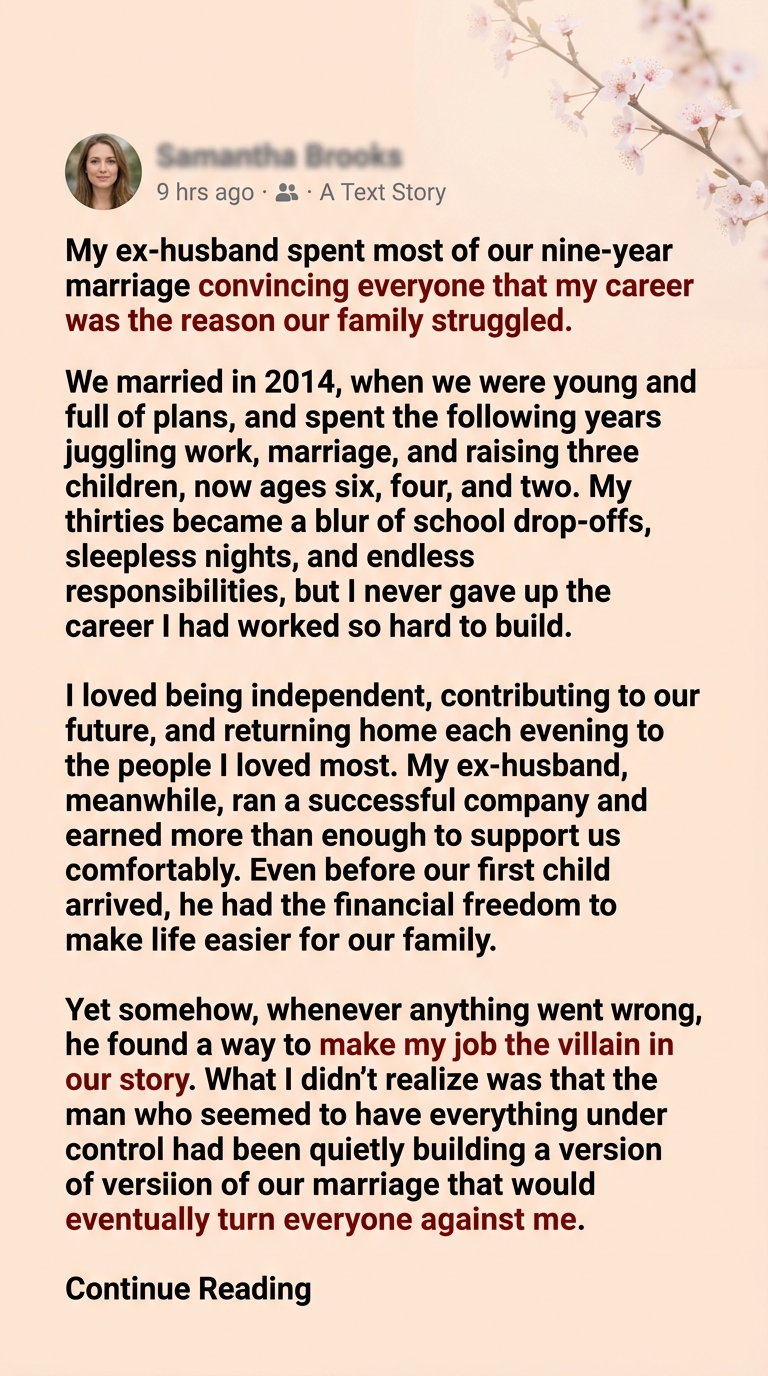
My name is Lauren Bennett, and when I married Michael in 2014, I believed we were building something lasting.
We were young, ambitious, and completely convinced that love could carry us through anything. We talked about buying a house, traveling with our future children, and growing old together. Michael had already started a business that showed enormous promise, while I was working toward a career I had spent years preparing for.
We admired each other’s ambition.
At least, that was what I believed.
When our first child arrived, I took maternity leave and learned how to function on two hours of sleep. When our second came along, I became an expert at managing schedules, preparing meals one-handed, and answering work emails while rocking a baby to sleep.
By the time our youngest was born, I could get three children dressed, fed, and out the door with a level of efficiency that would have impressed a military commander.
I was exhausted.
But I was proud of the life we were building.
Michael’s company continued to grow. He earned significantly more than I did, and we could afford childcare, a comfortable home, family vacations, and the occasional weekend away. Money wasn’t the problem people assumed it was.
Yet whenever our household became chaotic, Michael found a way to make my career the explanation.
If a child missed an appointment, it was because I was working.
If dinner was late, it was because I had stayed at the office.
If Michael had to take one of the children to daycare, he would later tell his mother that he had been forced to handle everything because I cared more about my job than my family.
I tried to explain that raising three young children required both of us to make sacrifices.
He would smile sadly and say, “Lauren, I’m not blaming you. I’m just saying the kids need their mother.”
It sounded reasonable enough when he said it quietly.
But he rarely said it quietly when other people were around.
At family dinners, he would joke about how he was practically a single father.
At birthday parties, he would tell relatives that he never knew when I would be home.
When friends asked how we managed three children, he would sigh and say, “Lauren has her career. Someone has to keep the household running.”
Everyone laughed sympathetically.
I would stand there holding a plate of food, wondering how a man who earned enough to hire help and had a wife who worked just as hard could make himself sound like the abandoned parent.
Still, I kept trying.
I arranged my work schedule around school events whenever possible. I attended pediatric appointments, managed school forms, organized birthdays, and spent evenings helping the children settle down after long days.
I made mistakes. I forgot things occasionally. There were days when I arrived home late and felt guilty for missing a small moment.
But I never stopped showing up.
And I never imagined that Michael was keeping a different kind of record.
He remembered every time I worked late.
He mentioned every business trip.
He told people about every dinner he had prepared, every school pickup he had handled, and every night he had stayed home with a sick child.
What he never mentioned were the things I did when nobody was watching.
He didn’t talk about the mornings I woke before dawn to finish reports so I could attend a school performance.
He didn’t mention the evenings I worked after the children fell asleep.
He never told anyone how often I used my own savings to cover household expenses when cash flow became unpredictable, even though his company was supposedly thriving.
And he certainly never told them that when I asked him to take more responsibility at home, he would accuse me of making him feel like an inadequate husband.
I thought we were having ordinary marital disagreements.
I didn’t realize he was building a case against me.
The first real warning came during our ninth anniversary dinner.
We had arranged for a babysitter, and I had spent the afternoon looking forward to an evening when we could talk without interruptions.
Instead, Michael barely touched his food.
Finally, he put down his fork and said, “I don’t think this is working anymore.”
I stared at him.
“What isn’t working?”
“Us.”
I felt as though the room had tilted.
“Michael, we’ve had difficult months. We have three small children. We need to talk about what isn’t working, not throw away nine years.”
He shook his head.
“I’m tired of being the only person who puts this family first.”
I almost laughed because the statement was so far removed from the life I knew.
“You run your company whenever you want. You take meetings during family weekends. You have a full-time assistant. I have a job, three children, and a household to help manage. How am I the only person who needs to change?”
His expression hardened.
“See? You always turn everything into an argument about work.”
That night, he slept in the guest room.
Within weeks, he was speaking to a divorce attorney.
I didn’t learn that immediately. At first, he told me he needed space to think. He said he wanted us to approach the situation maturely and keep the children out of it.
I believed him.
I continued preparing family meals. I continued taking the children to school. I continued asking whether he wanted to attend counseling.
He declined.
“I don’t think counseling can fix someone who doesn’t want to be present,” he said.
I was stunned by the accusation, but I still hoped that if I listened carefully enough, I could understand what he wanted.
Then his mother, Patricia, called me.
“Lauren, I need you to be honest with yourself,” she said. “Michael has been carrying this family for years. Maybe it’s time you admit that your career has become more important than your marriage.”
I gripped the phone.
“Patricia, I have never stopped caring for my children or my husband.”
“Then why is Michael always the one telling us how overwhelmed he is?”
Because he only told you the parts of the story that made him look good, I wanted to say.
Instead, I asked, “Have you ever asked me how I feel?”
She went silent.
Then she said, “This isn’t about your feelings. It’s about the children.”
That sentence followed me for weeks.
Soon, Michael’s sister stopped inviting me to family gatherings. A mutual friend told me that people were concerned I might fight to keep the children just to punish Michael.
I had never said anything like that.
I hadn’t even decided what custody arrangement I wanted.
But somehow, people who had never sat through a single conversation between Michael and me had already reached their conclusions.
Then came the meeting that changed everything.
Michael asked me to sit down with him at our kitchen table after the children were asleep.
He placed a folder in front of me.
“What is this?” I asked.
“An outline of how we’re going to handle the separation.”
I opened it.
Inside were proposed custody arrangements, financial summaries, and a statement describing the breakdown of our marriage.
According to the document, Michael had been the children’s primary caregiver for years. It claimed my demanding career had repeatedly prevented me from fulfilling my parental responsibilities. It described him as the parent who had maintained stability while I pursued professional advancement.
I read it twice.
Then I looked up.
“Did you write this?”
“My attorney helped me organize the facts.”
“These aren’t the facts, Michael.”
He leaned back in his chair.
“They’re my perspective.”
“You wrote that you have been the primary caregiver.”
“I’ve handled a lot.”
“So have I.”
“You were always working.”
“I was working because I have a career. A career you encouraged me to build when we got married.”
He looked away.
I turned another page and found a proposed schedule that gave him substantially more parenting time than I expected. It also included a financial arrangement that appeared to leave me responsible for several household expenses while limiting my access to accounts I had helped fund.
My hands began to shake.
“Why are you doing this?”
He folded his arms.
“Because someone needs to think about what’s best for the children.”
“And you believe what’s best for them is to make their mother look irresponsible?”
His voice became colder.
“I’m not making you look like anything. I’m describing the choices you’ve made.”
That was when I understood that he wasn’t trying to solve our problems.
He was preparing to tell a story about them.
And he intended to tell it before I even knew there was a battle.
The following week, I met with my own attorney.
I brought the folder, copies of our financial records, and a notebook where I had begun documenting the daily responsibilities I handled for our children.
My attorney listened without interrupting.
When I finished, she asked, “Do you have records of your involvement with the children?”
I nodded.
I had school emails, appointment confirmations, daycare receipts, photographs from school events, and messages discussing who would collect the children each day.
I also had work records showing that I had adjusted my schedule repeatedly to accommodate family responsibilities.
My attorney reviewed the documents.
“These will help establish a fuller picture of your parenting. Don’t respond emotionally to his allegations. Keep records, communicate in writing when appropriate, and let the evidence speak for itself.”
For the first time in weeks, I felt as though I could breathe.
I wasn’t trying to prove that Michael was a monster.
I was trying to ensure that our children wouldn’t lose time with their mother because their father had become better at telling a story.
The next few months were difficult.
Michael became increasingly careful about what he said in writing. He sent messages that sounded polite but often contained subtle accusations.
I assume you’ll be working late again.
I’ll handle the children since your schedule is unpredictable.
Please let me know if you can actually attend the school event this time.
Sometimes, I wanted to answer with every detail of my day.
Instead, I kept my replies brief and factual.
When I could attend an event, I attended. When I needed help with childcare, I arranged it. When we agreed on a schedule, I saved the messages.
I also made sure the children never heard me criticize their father.
They were six, four, and two. They didn’t need to carry the weight of our conflict.
They needed to know that both parents loved them and that the adults would handle the difficult decisions.
One evening, my oldest child climbed into my lap while I was reading a bedtime story.
“Mommy, Daddy says you have to work because you don’t want to be home.”
My heart broke.
I closed the book.
“Sweetheart, I work because I help take care of our family. Daddy works too. Sometimes grown-ups have to work, and sometimes they need help. But nothing you do, and nothing I do at work, changes how much I love you.”
The child rested their head against my chest.
“Will you still pick me up from school?”
“Whenever it’s my day, yes. And if something changes, I’ll tell you.”
I held that little body for a long time after the lights went out.
That night, I cried in the bathroom so the children wouldn’t hear me.
Then I washed my face and went back to work.
I wasn’t going to allow the fear of being misunderstood to make me abandon the life I had worked so hard to build.
The turning point came during the first formal custody meeting.
Michael arrived with his attorney and a thick folder of documents. He looked confident, almost relaxed.
He described his work schedule as flexible. He explained that he could attend school events, arrange activities, and provide the children with stability.
Then he began describing me.
He said I frequently prioritized work over family commitments. He said the children were accustomed to him being the dependable parent. He suggested that my desire to maintain my career showed I wasn’t prepared to make the sacrifices required of a full-time mother.
I listened, my hands folded in my lap.
When it was my turn, I didn’t accuse him of lying.
I opened my own folder.
I presented the school communications showing that I had handled enrollment and teacher meetings. I provided appointment records demonstrating that I had taken the children to medical visits. I showed messages in which Michael had asked me to rearrange my schedule because he was traveling for business.
I also produced records of childcare arrangements I had organized and paid for, along with calendar entries documenting my participation in the children’s daily routines.
One document was particularly revealing: a message Michael had sent me months before our separation.
I don’t know how you manage all of this and still keep your work going. I couldn’t do what you do.
The room became quiet as my attorney placed the message beside his written claim that I had been unwilling to make sacrifices for our family.
Michael stared at the page.
His attorney leaned toward him and whispered something.
For the first time, the confident expression on his face faltered.
But that wasn’t the most important moment.
The mediator asked Michael whether he had considered how the children would benefit from a parenting arrangement that preserved their relationship with both parents.
He replied that he had, and that he simply wanted to ensure they had a stable home.
Then the mediator asked him a question that seemed to catch him off guard.
“Mr. Bennett, if your former wife is as uninvolved as you describe, why do your own messages repeatedly rely on her to manage the children’s schedules, appointments, and childcare?”
Michael opened his mouth.
Then he closed it.
“I suppose we both did a lot,” he finally said.
It was the first time he had acknowledged that our family had depended on both of us.
It wasn’t an apology.
It wasn’t a confession.
But it was a crack in the story he had spent months building.
The custody process continued, and no single meeting settled everything. There were further discussions about schedules, expenses, and how we would communicate about the children.
Eventually, we reached an arrangement that gave the children meaningful time with both parents and established clearer responsibilities for each of us.
The final agreement was based on the children’s needs, the available evidence, and the legal advice we received—not on which parent had the more convincing family narrative.
The financial matters took longer.
When our attorneys reviewed the records, several expenses Michael had attributed entirely to his business were found to involve personal and household spending as well. Other figures needed clarification because our accounts and obligations had been intertwined for years.
The review did not prove that every accusation against him was true. It did, however, show that the financial story he had presented was incomplete.
We worked through those issues with our attorneys, and the final financial arrangements reflected the records rather than the version of events he had initially offered.
During that period, something unexpected happened.
Patricia called me.
I almost didn’t answer.
When I finally did, she sounded different from the woman who had once told me that my feelings didn’t matter.
“Lauren, I owe you an apology.”
I sat down.
She explained that Michael had told the family I was considering abandoning my career and moving away with the children. He had also suggested that I was refusing to cooperate with him.
She had believed him because he was her son and because he sounded so certain.
Then she had seen some of the messages and learned that the situation was more complicated than she had been told.
“I should have spoken to you before judging you,” she said. “I thought I was protecting my grandchildren, but I never asked what their mother was actually doing for them.”
I looked out the window at the afternoon light.
“Your opinion hurt me,” I said. “But what hurt most was that you never gave me a chance to tell my side.”
“I know.”
I didn’t offer instant forgiveness.
Trust, once damaged, doesn’t return simply because someone finally understands what they did.
But I accepted her apology.
For the sake of the children, I wanted the adults around them to learn how to speak honestly, even when the truth was uncomfortable.
Nearly a year after Michael first announced he wanted a divorce, I found myself standing in the kitchen of a smaller home I had chosen for myself and the children.
It wasn’t the house we had shared during our marriage. The rooms were smaller, the backyard needed work, and I still had boxes waiting to be unpacked.
But it was peaceful.
I had framed a photograph of the three children and placed it on the kitchen shelf. Their laughter filled the house whenever they were with me, and their drawings covered the refrigerator.
My career had survived.
In fact, I had received a promotion during the separation. My manager had recognized the work I had continued to deliver despite the upheaval in my personal life.
I had worried that maintaining my career would somehow prove Michael right.
Instead, it reminded me that I was capable of being a professional, a mother, and a person with dreams of her own.
Those identities did not cancel one another out.
I still had difficult days.
There were mornings when I missed having another adult in the house to help get the children dressed. There were evenings when I felt guilty about being at work. There were school holidays when arranging childcare required more planning than I had energy for.
But I no longer interpreted every difficulty as proof that I was failing.
I learned to ask for help without apologizing for needing it.
I learned to set boundaries without writing a speech to justify them.
And I learned that being a good mother did not require me to disappear as a person.
One Saturday, I took the children to a park near our new home. My oldest ran ahead, my middle child collected leaves, and my youngest insisted on holding both my hands at once.
As we walked beneath the trees, my oldest looked up at me.
“Mommy, are you happy now?”
The question stopped me.
I knelt beside the child.
“I’m learning how to be happy again.”
“Because you don’t live with Daddy?”
I took a moment before answering.
“Sometimes grown-ups discover they can’t be happy living together anymore. That doesn’t mean the children did anything wrong. And it doesn’t mean either of you has to choose between us.”
The child nodded thoughtfully.
Then came the question that mattered most.
“Do you still love us when you’re working?”
I pulled my little one close.
“Every second. Even when I’m not in the same room, I love you. Even when I’m tired, even when I make mistakes, even when I’m busy. My love for you doesn’t disappear because I’m doing my job.”
My child wrapped both arms around my neck.
I held on tightly.
For months, Michael had tried to turn my career into evidence that I was a bad mother.
But the children were slowly learning something more important from the life we were building: love wasn’t measured by how completely a person erased themselves for someone else.
It was measured by care, consistency, honesty, and the willingness to show up.
Michael and I eventually reached a more functional co-parenting relationship. We still disagreed about some things, and there were moments when old resentments surfaced. But our communication became more focused on the children, and I stopped trying to convince him that I had always been worthy of respect.
I no longer needed his agreement to know what kind of mother I was.
I also stopped trying to correct every relative who had believed his version of our marriage.
Some people apologized.
Some quietly changed their opinions.
Others never admitted they had been wrong.
I learned that I could not control what everyone believed, and I didn’t need to spend the rest of my life defending myself to people who had never bothered to ask me a question.
My marriage had ended, but my life had not.
And the truth I carried away from those nine years was not that ambition destroys families or that one parent is always the villain.
It was that a relationship becomes deeply unfair when one person’s sacrifices are treated as invisible while the other’s are turned into proof of their virtue.
Michael had built a version of our marriage in which he was the exhausted hero and I was the selfish wife.
For a while, people believed him.
But the records, the messages, the calendars, and the ordinary evidence of a mother’s daily life told a more complete story.
I didn’t need to destroy his reputation to reclaim my own.
I simply needed to stop letting his version of me become the truth I believed about myself.
Today, when I walk into my office, I no longer feel the same guilt I once carried. I know that my children need my presence, but they also need to see that their mother is allowed to have goals, independence, and a life beyond the demands of other people.
I want them to grow up understanding that partnership is not a competition over who sacrifices more.
I want them to know that love does not require one person to become smaller so the other can feel important.
And most of all, I want them to remember that when life became difficult, their mother did not disappear.
She kept showing up.
She kept loving them.
And when someone tried to convince the world that her ambition made her unworthy of being a good mother, she found the courage to stand beside the truth.
Because my career was never the enemy of my family.
The real problem was the belief that I should have to surrender a part of myself to prove that I loved them.
I had spent nine years trying to prove that I could be everything to everyone.
Now, I was learning that I could love my children deeply, build a meaningful career, and still deserve a life in which I was treated with respect.
And that was the future I chose—not because I had stopped caring about my family, but because I had finally started caring about myself, too.