The pounding on my front door was so violent that Maya stopped singing.
“Mommy?” she whispered, sitting in the bathtub with pink bubbles gathered around her shoulders. “Who’s making that noise?”
I forced myself to smile, even though my hands had begun to shake.
“It’s okay, sweetheart. Stay right here while Mommy checks.”
I wrapped her in a towel, carried her to her bedroom, and dressed her as quickly as I could. Then I told her to stay in her room with her favorite stuffed rabbit.
The pounding came again.
“Police! Open the door!”
When I finally opened it, two uniformed officers stood on my porch beside two women holding identification badges. One of them introduced herself as a child protective services investigator.
“Are you the mother of Maya Bennett?”
“Yes. What’s going on?”
“We have a court order authorizing us to enter your home and assess your daughter’s safety. We need you to cooperate with us.”
My stomach dropped.
“Why? Who made a report?”
The investigator glanced at her paperwork.
“Your sister, Clare.”
For a moment, I couldn’t speak.
Clare was the person I called when Maya had a fever. She was the person who had held my hand at our mother’s funeral. She was the aunt who brought Maya birthday presents and promised she would always protect her.
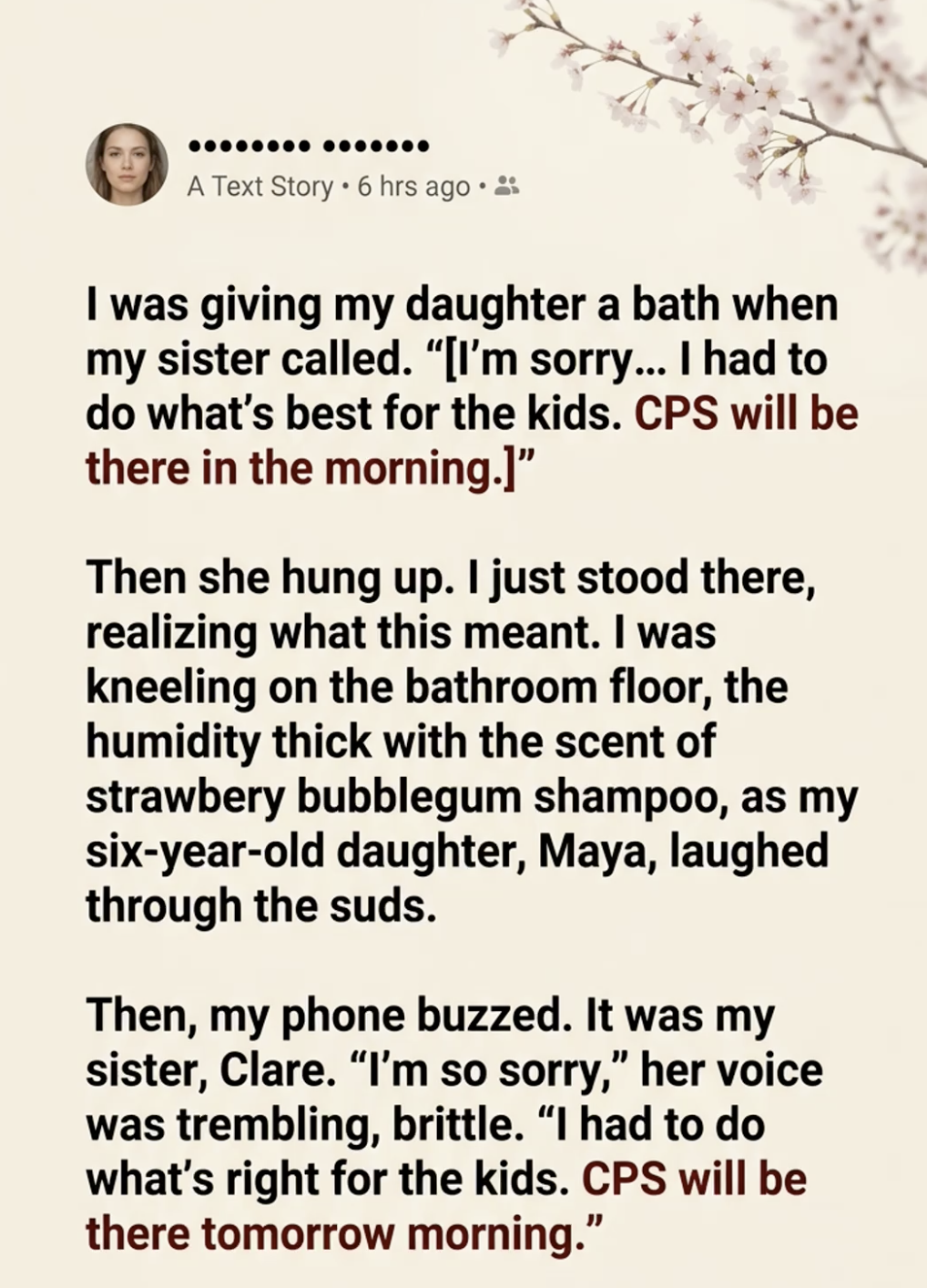
And just hours earlier, she had called me while I was bathing my daughter.
“I’m sorry,” she’d said, her voice trembling. “I had to do what’s best for the kids. CPS will be there in the morning.”
Then she’d hung up.
I had spent the entire night trying to understand what she meant. Now, standing in my own doorway while strangers prepared to inspect my home, I finally understood the scale of what she had done.
Clare hadn’t simply accused me of being a bad mother.
She had taken the first step toward having my daughter taken away from me.
“May I see the report?” I asked.
“We can explain the allegations as we proceed,” the investigator replied. “For now, we need to make sure Maya is safe.”
I stepped aside.
They examined the kitchen, checked the refrigerator, looked through Maya’s bedroom, and asked about her school, medical appointments, and daily routine. I answered every question. I showed them her pediatrician’s information, her school records, and the folder where I kept her vaccination records.
Then one investigator noticed the small purple bruise on Maya’s left arm.
“Can you tell me how she got this?”
My heart lurched.
“She fell at the playground on Saturday. Her teacher saw it happen, and I reported it to the school nurse.”
“Do you have documentation?”
I opened the school app on my phone and showed her the message from Maya’s teacher.
The investigator read it carefully, then made a note.
I wanted to scream that a bruise did not make me an abusive mother. I wanted to demand that someone explain why my own sister had put us through this.
Instead, I concentrated on breathing.
I knew that anger, however justified, would not help me protect my child.
When they finished inspecting the house, one of the women asked to speak with Maya privately, in a place where she could feel comfortable.
I watched my daughter walk toward the living room, clutching her stuffed rabbit.
She turned back once.
“Mommy, am I in trouble?”
The question nearly broke me.
“No, baby,” I said, kneeling to look her in the eyes. “You haven’t done anything wrong. These people just need to talk to us and make sure you’re okay.”
She nodded, but her little fingers tightened around the rabbit’s ears.
I stood in the hallway while the investigator spoke with her. I couldn’t hear every word, but I could hear Maya’s voice.
She talked about school, her favorite cartoons, and the strawberry shampoo she insisted on using every night.
Then the investigator asked whether anyone had ever hurt her.
There was a pause.
“No,” Maya answered. “Mommy takes care of me.”
I covered my mouth.
I had spent the night imagining the worst possible outcome. Hearing those simple words from my daughter’s mouth was the first time I felt the ground beneath me again.
But the investigation wasn’t over.
When the women returned, the lead investigator closed her folder.
“Based on what we’ve observed today, we have not identified an immediate safety concern requiring Maya’s removal from your care. The allegations will still need to be assessed, and we may need additional information.”
I nodded, struggling to process the relief.
“Can you tell me what my sister actually reported?”
The investigator hesitated before answering.
“The report alleges that you leave Maya unsupervised, that she frequently lacks appropriate food and care, and that there may be an adult in the home who presents a risk to her.”
I stared at her.
“What adult?”
“The report doesn’t identify that person clearly. We’ll need to clarify that.”
There was no unfamiliar adult living with us. I had been raising Maya alone since her father left when she was two.
But something about that final allegation bothered me.
Clare knew my home. She knew my routine. She knew that no man had moved in, and she knew I never left Maya alone.
If she had made this report, she had either misunderstood something or deliberately invented it.
And I knew my sister well enough to understand that she rarely did anything without a reason.
When the investigators left, I locked the door and sank onto the couch.
Maya climbed into my lap.
“Is Auntie Clare mad at us?”
I stroked her hair.
“I don’t know, sweetheart.”
“Did I do something bad?”
“No.” I held her closer. “Nothing you did caused this. Not one thing.”
That was the promise I could make her, even if I couldn’t yet explain what was happening.
After Maya went to school, I called Clare.
She answered on the fourth ring.
“Are they gone?” she asked.
Not hello.
Not How is Maya?
Just, “Are they gone?”
I felt something inside me turn cold.
“They came with police and a court order, Clare. They searched my home. They questioned my daughter. She thought she was in trouble.”
“I know this is hard—”
“No. You don’t get to tell me what this is. You made a report that could have taken my child away from me. Why?”
She began to cry.
“I was trying to protect the kids.”
“What kids?”
Silence.
“Clare, you keep saying that. Which kids are you talking about?”
Finally, she whispered, “You know exactly what I mean.”
I didn’t.
And that frightened me more than anything else she had said.
Then she added, “You should ask Daniel about the money.”
The call ended.
I sat motionless, staring at my phone.
Daniel was my former partner, Maya’s father. We hadn’t spoken in almost a year except for the occasional message about child support. He lived two states away and had never expressed concern about my parenting.
What did he have to do with Clare’s accusation?
And what money?
I opened my laptop and searched through my email. I found the child support records, the bank statements, and the messages I’d exchanged with Daniel. Nothing seemed unusual until I found an email from six weeks earlier.
It was from Clare.
The subject line read: We need to talk about Maya’s future.
I’d missed it because I’d been working overtime that week, trying to cover an unexpected medical bill.
I opened it.
The message was short.
I’ve been thinking about what happens if something ever happens to you. Maya needs family who can provide stability. We should discuss a plan before it’s too late.
At the time, I’d assumed she meant an emergency contact or a backup caregiver.
Now, after the morning I’d just survived, the words felt different.
I searched my messages for the phrase “Maya’s future.”
Three results appeared.
One was a message I’d sent Clare about Maya’s school.
The other two were conversations I’d never seen before—because they weren’t mine.
They were screenshots attached to an email from an unfamiliar address, sent to me at 2:13 that morning.
I opened the first screenshot.
It showed a conversation between Clare and Daniel.
Clare: She doesn’t know what you’re planning, does she?
Daniel: Not yet. I need to know the arrangement will be approved first.
Clare: If we do this, Maya has to come first.
Daniel: That’s why I’m asking you to help.
My hands went numb.
I opened the second screenshot.
Clare: What if she fights it?
Daniel: Then we’ll have to show that she can’t provide what Maya needs.
I read that sentence over and over.
Show that she can’t provide what Maya needs.
The message had been sent three weeks earlier.
Three weeks before Clare called child protective services.
Three weeks before the police arrived at my door.
Three weeks before my six-year-old daughter asked me whether she had done something wrong.
I forwarded both screenshots to a private folder and called the number listed on Daniel’s last message.
He answered immediately.
“Did Clare talk to you?” he asked.
My breath caught.
“Why did you tell my sister you wanted to show that I couldn’t take care of our daughter?”
Silence.
Then Daniel said something that changed the entire situation.
“Because Clare told me you were planning to leave the country with Maya.”
I stood up so quickly that my chair scraped across the floor.
“What?”
“She said you were talking about moving overseas. She told me you’d already started making arrangements and that if I wanted to keep seeing Maya, I had to act now.”
“That is a lie.”
“I know that now.”
“Then why did you go along with it?”
“Because I panicked.”
His answer was so small, so inadequate, that I almost laughed.
“You panicked? Daniel, you helped arrange an investigation into your own daughter’s home!”
“I didn’t know she’d make the report that way. Clare said she’d spoken to someone who could help us establish a custody arrangement. She said it was about getting Maya somewhere stable.”
“Somewhere stable? She’s six! She has a home, a school, friends, a doctor, and a mother who loves her. What exactly did you think was missing?”
He didn’t answer.
I pressed my fingers against my forehead.
“Tell me about the money.”
Another silence.
Then he admitted that Clare had approached him about becoming Maya’s primary caregiver. She had suggested that Daniel could pursue custody while she helped him manage the practical arrangements. In exchange, he had agreed to cover certain expenses for her and help her move into a larger apartment.
He insisted that he had never intended for Maya to be taken away permanently.
But his messages said otherwise.
He had agreed to build a case against me before ever asking me a single question about my plans, my finances, or my daughter’s welfare.
And Clare had been willing to use child protective services to make that case stronger.
I ended the call.
For several minutes, I couldn’t move.
The truth was worse than a simple family disagreement. My sister and my daughter’s father had made decisions about Maya’s future behind my back, then treated my home as an obstacle they needed to remove.
I wanted to confront Clare immediately.
Instead, I called an attorney.
I needed someone who understood custody disputes, false allegations, and the importance of keeping a child out of the middle of adult conflict. I gave the attorney the court order, the screenshots, the email, and the names of everyone involved.
She listened carefully.
“Don’t delete anything,” she advised. “Keep every message, every document, and every record of contact. Continue cooperating with the investigators, and don’t attempt to resolve this through an angry confrontation. We’ll address the allegations through the appropriate process.”
Then she asked me a question I hadn’t expected.
“Has your sister ever tried to become Maya’s legal guardian before?”
I thought about Clare’s email. Her sudden questions about emergency plans. Her repeated comments that Maya deserved a more stable future.
“No,” I said slowly. “But lately, she’s been talking as if she should have a say in every decision I make.”
“Has anything changed in her own life recently?”
I remembered the apartment she had been trying to afford. The debts she’d mentioned. The way she’d started asking our mother for money before our mother died.
I told the attorney what I knew.
She didn’t jump to conclusions. She simply added the information to her notes and asked me to preserve anything that might help establish the timeline.
That afternoon, the CPS investigator called me back.
She had spoken with Clare and Daniel.
Their stories didn’t match.
Clare had claimed that Daniel was worried about Maya’s living conditions. Daniel had claimed that Clare was the one who insisted there was an immediate danger. Neither could provide a credible explanation for the allegation about an unidentified adult in my home.
The investigator asked me to send the screenshots and supporting records through the proper channel.
I did.
For the first time since the phone call, I felt that the truth might have a chance to stand on its own.
But the hardest part was still waiting for me at home.
That evening, Maya asked whether Auntie Clare would be coming to her birthday party next month.
I sat beside her on the bed.
“I don’t know, sweetheart.”
“Can I still love her?”
The question took my breath away.
I had spent the entire day thinking about what Clare had done to me. I hadn’t fully considered what it meant to Maya—a little girl who had done nothing but love her aunt.
“Yes,” I told her gently. “You can love someone and still need space from them. And you never have to choose between loving someone and telling the truth.”
Maya thought about that for a moment.
Then she leaned against me.
“Okay, Mommy.”
I held her until she fell asleep.
Over the next several weeks, the investigation continued. I cooperated with every request, attended every meeting, and kept detailed records. My attorney helped me respond through the appropriate legal channels.
The allegations were eventually closed without a finding that I had neglected or abused Maya. The investigators had found no evidence supporting the claims that triggered the report.
That did not erase what had happened.
A report could be closed. A record could be corrected. But I could not erase the fear in Maya’s eyes when strangers walked into our home, or the way she had asked whether she was in trouble for something she hadn’t done.
Daniel eventually admitted that he had been wrong to believe Clare without speaking to me. He began communicating through the formal custody process, and any future arrangements would have to be based on Maya’s needs rather than a plan made in secret.
Clare sent me a long message explaining that she had been overwhelmed, that she believed she was protecting the children, and that she never thought the situation would become so serious.
She asked me to forgive her.
I read the message twice.
Then I replied.
You don’t get to decide what’s best for my daughter by secretly trying to take her away from me. If you were worried, you could have called me. You could have asked questions. You could have offered help. Instead, you made allegations you couldn’t support and involved her father in a plan that neither of you had the courage to discuss with me.
I hope someday you understand what you did. But I will not pretend it was harmless just because the investigation is over.
I did not block her immediately. I simply stopped allowing her access to the parts of our lives she had shown she could not respect.
Months passed.
Maya returned to her ordinary routines. She laughed at breakfast, complained about homework, and insisted that I use strawberry shampoo when I washed her hair.
Sometimes, when a car stopped outside the house, she still looked toward the window.
Each time, I reminded her that she was safe, that she could ask me anything, and that grown-up problems were never her fault.
One night, as I tucked her into bed, she reached for my hand.
“Mommy?”
“Yes, baby?”
“Are the police coming back?”
I swallowed the ache in my throat.
“No, sweetheart. There’s nothing you need to be afraid of. And if anyone ever has a question about you, I’ll be right here to help you through it.”
She smiled sleepily and closed her eyes.
After she fell asleep, I went to the bathroom and sat on the same floor where I’d been kneeling the night Clare called.
I could still remember the warm steam, the strawberry shampoo, and the sound of my daughter laughing in the bath.
I remembered the exact moment my phone buzzed and my sister’s voice changed everything.
For a long time, I’d believed that family meant people who would always protect you. I had thought shared history was enough to make trust permanent.
Now I understood something harder.
Family is not proven by the promises people make when everything is easy. It is proven by the choices they make when they believe they can get what they want by betraying someone who trusts them.
Clare had called her decision protection.
Daniel had called his decision panic.
Neither word changed the consequences.
I couldn’t control what they chose to do, and I couldn’t force them to understand the damage they had caused. But I could decide what happened next.
I could protect my daughter without teaching her to hate.
I could tell the truth without turning her into a weapon.
And I could build a home where she never had to wonder whether the people who loved her were secretly plotting to take her away.
The night my sister called CPS, I thought I was about to lose everything.
In the end, I learned that protecting my daughter didn’t mean fighting to keep every person in our lives.
Sometimes, it meant having the courage to close the door on the people who had already decided that our trust was theirs to spend.
And when Maya laughed again in the bathtub, surrounded by strawberry-scented bubbles, I finally understood what mattered most.
She was home.
She was safe.
And no one would ever make her believe she was the one who had done something wrong.