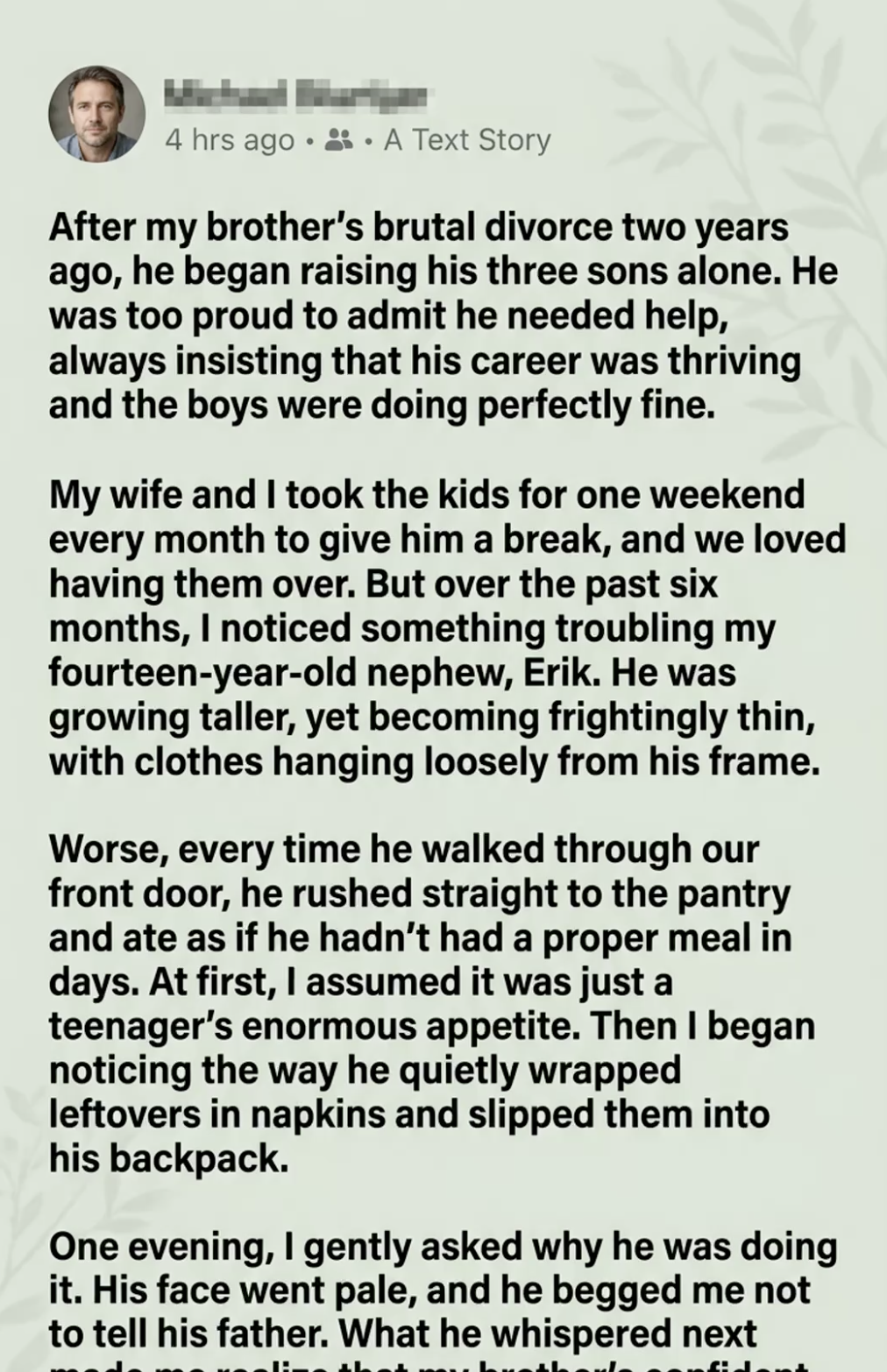
After my brother’s brutal divorce two years ago, he became the kind of man who smiled hardest when life was falling apart.
He had three sons to raise, a demanding career, and a house that suddenly felt too quiet whenever the boys were with their mother. Whenever anyone asked how he was managing, he gave the same answer.
“Everything’s fine. I’ve got it under control.”
My wife, Rachel, and I wanted to believe him.
Every month, we invited his three boys to spend a weekend at our house. We filled the refrigerator with their favorite snacks, ordered pizza on Friday nights, watched movies until someone fell asleep on the couch, and let them stay up later than their father would have allowed.
Those weekends became the highlight of our month.
But over the past six months, I began noticing something about Erik, my fourteen-year-old nephew.
He was getting taller, but his face was becoming thinner. His wrists looked too small for his sleeves, and his jeans hung loosely around his waist. Whenever the boys arrived, Erik would barely say hello before heading straight to the kitchen.
At first, I laughed about it.
“Growing boy,” I told Rachel. “We might need to buy groceries in bulk.”
She smiled, but I noticed she was watching him, too.
Erik didn’t just eat a lot. He ate with an urgency that made me uncomfortable.
He would finish a sandwich while standing at the counter, then open the refrigerator and search for something else. Sometimes, he would eat two dinners. Other times, he would quietly ask if he could have the food nobody else wanted.
And then I noticed the napkins.
One Sunday afternoon, while Rachel was helping the younger boys get their shoes on, I saw Erik standing near the kitchen counter. He thought nobody was watching.
He took two dinner rolls, a banana, and a handful of crackers, wrapped them in paper napkins, and slipped them into the front pocket of his backpack.
He did it carefully, almost mechanically, as if he’d practiced the routine many times.
My stomach tightened.
“Hey, buddy,” I said gently.
He froze.
I tried to keep my voice casual. “You know you don’t have to hide food here, right? If you’re hungry, just ask.”
His face went completely pale.
“I wasn’t stealing it.”
“I know you weren’t.”
“I was going to eat it later.”
“That’s okay, Erik. You can take food with you whenever you need it.”
He stared at the floor.
Then he whispered, “Please don’t tell Dad.”
Those five words changed the way I saw everything.
I pulled out a chair and sat down, giving him room to decide whether he wanted to sit with me.
“Why would your dad be upset about you taking food?”
Erik shook his head quickly.
“He wouldn’t understand.”
“Help me understand, then.”
For several seconds, he said nothing. His fingers twisted the straps of his backpack until his knuckles turned white.
Finally, he looked up at me.
“Sometimes, we don’t have enough food at home.”
I felt as if someone had punched me in the chest.
“What do you mean, not enough food?”
He swallowed hard.
“Dad says we have to be careful with money. He says groceries are expensive and we need to stop wasting things. So we eat smaller portions. Sometimes, he says we can have cereal for dinner because it’s cheaper.”
I tried to find an explanation that would make the situation less frightening.
“Does your dad know you’re going hungry?”
“He says we’re not hungry. He says we’re just used to eating too much.”
Erik’s eyes filled with tears.
“But at night, my stomach hurts. Sometimes, I wake up because I’m so hungry I can’t sleep.”
I had to look away for a moment.
This was my nephew. A child who should have been worrying about homework, basketball, and whether a girl in his class liked him.
Instead, he was calculating how much food he could hide in a backpack.
“Does this happen to your brothers, too?” I asked.
He nodded.
“Lucas gives his food to Noah sometimes. Noah’s only seven, so he cries when he’s hungry. Dad gets mad when we complain.”
“Mad how?”
“He says we’re making his life harder. He says he works all day for us, and we should be grateful.”
Erik wiped his face with his sleeve.
“He’s always tired. Sometimes he falls asleep on the couch before dinner. I know he works hard. I don’t want him to feel like we’re another problem.”
That was the moment my anger began to mix with something much sadder.
My brother wasn’t simply a father struggling to make ends meet. He had somehow convinced his children that their hunger was a burden they needed to hide from him.
And Erik, at fourteen, had accepted the responsibility of protecting his father’s pride.
I put a hand on his shoulder.
“You are not a problem, Erik. None of you are.”
He started crying then, quietly at first, then so hard that he could barely catch his breath.
I let him cry.
When he finally calmed down, I asked him a question I already dreaded knowing the answer to.
“When was the last time you ate a proper dinner at home?”
He thought about it.
“Maybe Tuesday.”
It was Sunday.
Rachel had been standing in the doorway for several minutes. I hadn’t heard her approach, but when I looked up, tears were running down her face.
She didn’t say anything. She simply walked over, wrapped Erik in her arms, and held him.
Then she asked him if he wanted something to eat.
He nodded.
Rachel made him a grilled cheese sandwich, scrambled eggs, and a bowl of soup. He ate slowly at first, glancing at us as if he expected someone to tell him he’d had enough.
When nobody did, he relaxed.
Afterward, he asked whether he could take another sandwich home.
“Of course,” Rachel told him.
She packed enough food for all three boys to eat that evening and breakfast the next morning.
Erik hugged her before leaving.
“Thank you,” he whispered.
Rachel held him a little tighter.
“You never have to thank us for feeding you.”
That night, after the boys had gone home, Rachel and I sat at the kitchen table in silence.
We had always known my brother was proud. Even before his divorce, he hated accepting help. If his car broke down, he’d spend hours fixing it himself rather than borrow money. If he was sick, he’d insist he was fine until someone practically forced him to see a doctor.
After the divorce, that pride became a wall.
He stopped joining family dinners. He declined invitations, canceled plans, and brushed off every offer of assistance.
Whenever I suggested we help with the boys, he said the same thing.
“They’re my responsibility. I can handle it.”
We had respected his wishes because we thought we were respecting his dignity.
Now I wondered whether our silence had allowed his children to suffer.
“We have to talk to him,” Rachel said.
“I know.”
“Not tomorrow. Tonight.”
I called my brother, Daniel, as soon as I could gather my thoughts.
He answered on the fourth ring.
“What’s up?”
“Can we talk about the boys?”
A sigh came through the phone.
“If this is about me working too much, I don’t want another lecture.”
“It’s not a lecture.”
“Then what is it?”
I took a breath.
“Erik told me there isn’t enough food at home.”
The silence that followed was so complete I thought the call had dropped.
Then Daniel’s voice turned cold.
“What exactly did he tell you?”
I explained what Erik had said. I told him about the hidden food, the skipped dinners, and the hunger that kept his son awake at night.
Daniel interrupted before I finished.
“He shouldn’t have told you that.”
“He’s fourteen, Daniel. He shouldn’t have to hide food in his backpack.”
“You don’t know what things are like here.”
“Then tell me.”
“I don’t need you judging my parenting.”
“I’m not judging you. I’m worried about your children.”
“They have food. We eat every day.”
“Daniel, Erik is frighteningly thin. He told me he sometimes goes to bed hungry.”
“He exaggerates. All teenagers do.”
I gripped the edge of the table.
“Would you rather I pretend I didn’t hear him?”
“No. I’d rather you stop making me look like a failure.”
His voice cracked on the last word.
For the first time, I heard something beneath his anger.
Shame.
Then he hung up.
Rachel and I barely slept that night.
The next morning, I sent Daniel a message telling him we loved him and weren’t interested in humiliating him. I offered to bring groceries over, help with bills, or take the boys more often.
He replied with a single sentence.
We don’t need charity.
I stared at those words for a long time.
Then I decided that protecting my brother’s pride could no longer come before protecting his children.
I called Erik’s school counselor and explained what he had told me. I didn’t want to make accusations or assume I understood everything happening in Daniel’s house. I simply wanted someone qualified to help assess the boys’ situation and make sure they were safe.
The counselor took my concerns seriously and explained that the school could help connect the family with appropriate food resources and support.
I also contacted our local family services office to ask what steps were available when a child might not be getting enough food. I learned that I needed to be honest about what I had observed rather than trying to investigate everything myself.
It wasn’t about punishing Daniel.
It was about making sure three children had what they needed.
Two days later, Daniel showed up at my house.
He looked exhausted. His shirt was wrinkled, his eyes were bloodshot, and he had the expression of a man who had spent the entire drive rehearsing an argument.
“You went behind my back,” he said.
I invited him inside.
He refused to sit.
“You called the school. You talked to people about my family.”
“I asked for help because Erik told me he was going hungry.”
“You had no right.”
“I have a responsibility to care about those boys.”
“They’re my sons!”
“I know. That’s why I’m talking to you instead of turning away.”
For a moment, I thought he might leave.
Then he sat down heavily and covered his face with both hands.
“I lost everything,” he whispered.
I pulled out the chair across from him.
“Tell me.”
For the first time since his divorce, Daniel stopped pretending.
He told me that when his marriage ended, he had assumed the hardest part would be learning to live without his wife.
He hadn’t understood how much of their household income had depended on her work, or how many small expenses she had quietly managed. When she moved out, the bills didn’t disappear. Neither did the mortgage, the car payments, the childcare costs, or the legal fees.
His salary was decent, but after taxes, debts, and the expenses of raising three children, there was barely enough left.
At first, he used his savings.
Then his savings ran out.
He took on extra shifts and accepted projects that kept him away from home late into the evening. He bought cheaper groceries, canceled subscriptions, and stopped spending money on anything he considered unnecessary.
Eventually, even that wasn’t enough.
He had fallen behind on several bills and was afraid that one more financial setback would cost him his house.
“Every morning, I wake up thinking today is the day I finally get ahead,” he said. “Then another bill comes in.”
His eyes were wet.
“I can’t tell the boys. Their mother left, and I promised myself I wouldn’t let them feel like their whole world was falling apart.”
I listened without interrupting.
“I thought if I worked harder, I could fix it before anyone noticed.”
“Daniel,” I said quietly, “they noticed.”
He flinched.
“Erik has been trying to make sure his little brothers eat. He’s hiding food because he’s afraid there won’t be any later. He thinks asking for dinner makes him a burden.”
Daniel began to cry.
Not the quiet, controlled tears of someone trying to maintain appearances.
He cried like a man who had finally run out of strength to keep holding everything together.
“I didn’t know it had gotten that bad,” he said. “I thought they were eating enough. I thought cereal and sandwiches would get us through until payday.”
“Maybe you didn’t understand how hungry they were. But now you do.”
He nodded, pressing his palms against his eyes.
“I’ve failed them.”
“No,” I said. “You’re struggling. But you need help, and you need to let people help you.”
For a long time, neither of us spoke.
Then I told him what Rachel and I could offer.
We would buy groceries for the boys each week while he worked through his finances. The children could stay with us on nights when his schedule made meals difficult. We could help him review his expenses and find out whether he qualified for assistance.
We wouldn’t give him money without understanding what would actually help, and we wouldn’t pretend that one grocery delivery could solve every problem.
But we would make sure the boys had food.
Daniel stared at me.
“Why would you do all that?”
I almost laughed, but the look on his face stopped me.
“Because you’re my brother. Because they’re my nephews. And because nobody should have to choose between keeping their pride and feeding their children.”
He bowed his head.
“I don’t know how to do this.”
“You don’t have to figure it out alone.”
That afternoon, Daniel agreed to sit down with us and make a plan.
It wasn’t an instant transformation.
He still felt embarrassed when we brought groceries. He still tried to refuse help sometimes. On bad days, he became defensive and insisted he could manage everything himself.
But little by little, he began accepting that asking for help wasn’t the same as abandoning responsibility.
We worked through his bills together. He contacted his lenders to discuss payment arrangements, spoke with a financial counselor, and adjusted his work schedule so he could spend more evenings at home. With help from the school and local support services, he found resources that could keep the boys’ meals consistent while he got back on his feet.
Rachel and I also changed our monthly visits.
Instead of simply taking the boys for a fun weekend, we started sharing practical support. We stocked Daniel’s kitchen with groceries, prepared meals he could freeze, and helped him organize a weekly food budget.
Most importantly, we stopped treating his pride as a boundary we could never cross.
We treated it as something we could respect without letting it endanger his children.
A few weeks later, I received a message from Erik.
It was short.
Uncle, Dad made spaghetti tonight. There was enough for seconds.
I read it twice.
Then I showed Rachel.
She put her hand over her mouth and began to cry.
It was such a small thing. A pot of spaghetti. Enough food for everyone to eat twice.
But to us, it felt like the first sign that something inside that house was beginning to heal.
About two months later, Daniel invited us over for dinner.
He had cleaned the house, set the table, and made roasted chicken with potatoes and vegetables. The boys were laughing, arguing about a video game, and reaching across the table for more food.
Erik looked different.
He wasn’t suddenly healthy overnight, and we continued making sure he received appropriate support. But the constant tension in his face had eased. He no longer rushed into the kitchen as if every meal might be his last.
At one point, I noticed him packing a small container of leftovers.
For a second, my heart tightened.
Then he turned toward his father.
“Dad, can I save some of this for lunch tomorrow?”
Daniel looked at the container.
Then he smiled.
“Of course. There’s plenty.”
Erik nodded and placed the container in the refrigerator.
He didn’t hide it in his backpack.
He didn’t look around to see whether anyone was watching.
He simply put his food away, knowing it would be there when he needed it.
I looked at my brother across the table.
His eyes met mine, and he gave me a small, grateful nod.
After dinner, while the boys were playing in the living room, Daniel stepped outside with me.
“I owe you an apology,” he said.
“You don’t owe me anything.”
“Yes, I do. I was so busy trying to prove I could raise those boys alone that I almost convinced them they had to survive alone, too.”
He looked through the window at his sons.
“I thought being a good father meant making sure they never saw me struggle. Now I think it means making sure they know what to do when life gets hard.”
I put my hand on his shoulder.
“That sounds like a pretty good definition to me.”
He smiled sadly.
“I wish I’d understood it sooner.”
“Me too.”
We stood there for a while, listening to the boys laugh inside.
Daniel still had a long way to go. His finances weren’t magically fixed, and the divorce had left wounds that would take years to heal. But he was no longer trying to carry every burden in silence.
He had learned to ask for help.
And his sons were learning something just as important.
They were learning that food wasn’t something they had to earn by being quiet. That needing help didn’t make them selfish. That adults could struggle without making children responsible for hiding the struggle.
A few months later, Erik came over for another weekend.
He walked through our front door, dropped his backpack by the stairs, and headed straight into the kitchen.
For a moment, I remembered the frightened boy who used to wrap crackers in napkins and hide them as if he were doing something wrong.
This time, he opened the refrigerator, took out a container of fruit, and called toward the living room.
“Uncle! Can I have some of this?”
I smiled.
“You don’t even have to ask.”
He grinned, grabbed a piece of fruit, and ran off to join his brothers.
Rachel came up beside me and slipped her hand into mine.
Neither of us said anything.
We didn’t need to.
We had learned that sometimes the most heartbreaking words a child can whisper are not about monsters, bullying, or nightmares.
Sometimes they are simply these:
Please don’t tell my dad.
Because behind those words may be a child who loves a struggling parent so deeply that he has started hiding his own pain to protect them.
And sometimes the greatest gift a family can give isn’t money, advice, or even a solution.
It’s a safe place where a child can finally stop being afraid of needing something.
A place where the refrigerator is full, the table has room for everyone, and no one has to apologize for being hungry.
Because children should never have to carry the weight of an adult’s pride.
And no parent should have to face life’s hardest seasons believing that accepting help makes them less worthy of love.