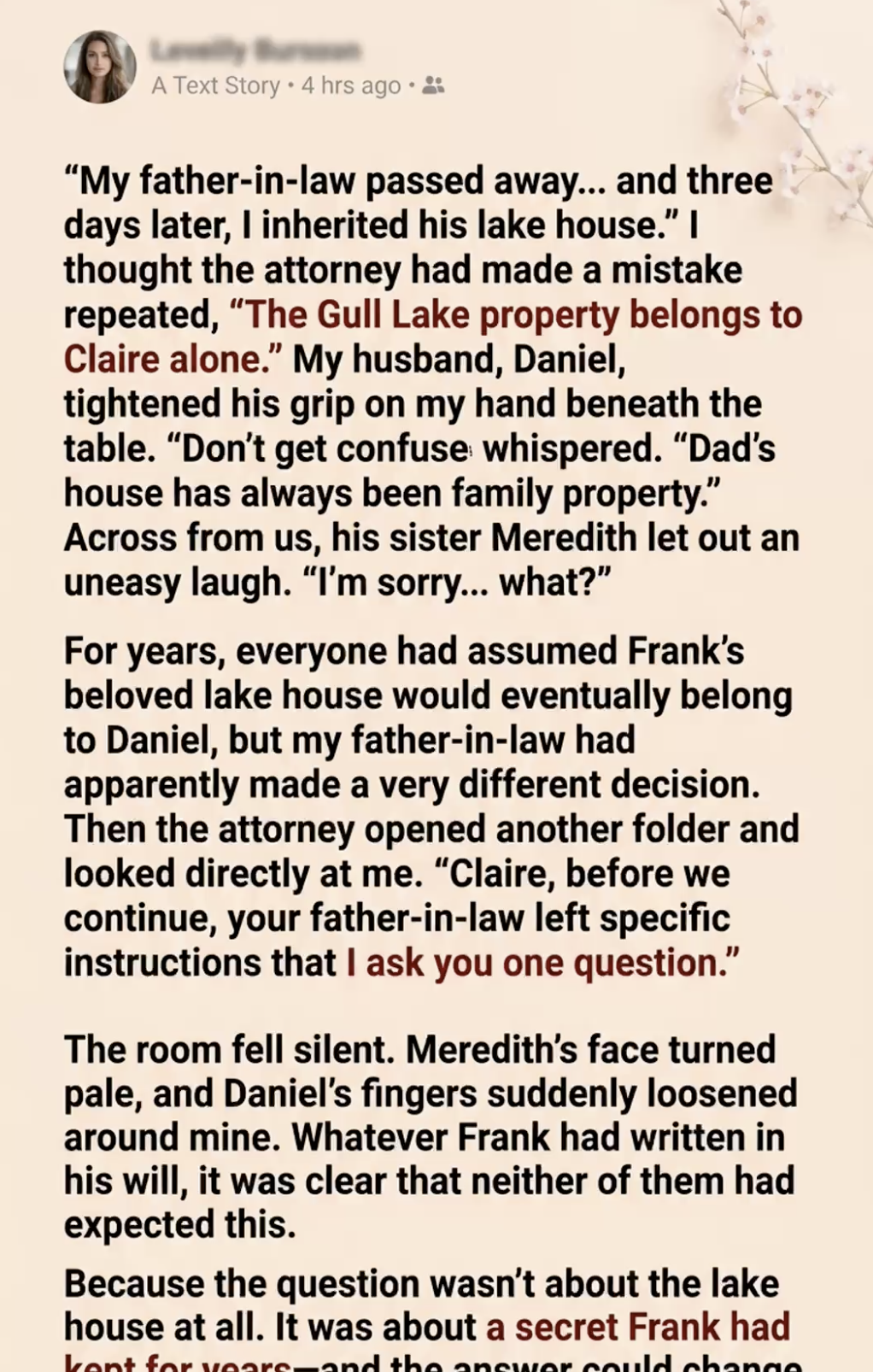
The attorney’s question hung in the air.
“Claire, did Frank ever tell you that Daniel had a brother?”
I blinked.
For a moment, I genuinely thought I had misheard him.
Daniel turned toward the attorney so quickly that his chair scraped against the floor.
“What kind of question is that?” he demanded.
Meredith’s face had gone almost white.
I looked from one of them to the other.
“No,” I said slowly. “Daniel told me he was an only child.”
The attorney, Mr. Whitmore, folded his hands on the table.
“Then I believe you deserve to hear the rest of what your father-in-law wanted you to know.”
Daniel stood.
“This is ridiculous. My father was grieving near the end. He was taking medication. Whatever he wrote, we need to have it reviewed before anyone starts making accusations.”
“Your father’s will was properly executed,” Mr. Whitmore replied. “The inheritance has been reviewed. And the question I asked Claire was included in a separate letter Frank instructed me to read under these circumstances.”
“Under what circumstances?” Meredith whispered.
The attorney looked directly at her.
“Under the circumstances that Claire inherited the lake house and neither of you could explain why.”
My husband’s face hardened.
I had been married to Daniel for eleven years. I knew the difference between his ordinary irritation and the kind of anger that frightened him into silence.
This was the second kind.
And I suddenly understood that the lake house was only the beginning.
Three days earlier, Frank had died peacefully in his sleep at the age of seventy-eight.
He had been a quiet man, a retired high school history teacher who preferred fishing before sunrise to expensive restaurants and handwritten letters to text messages. He had lived alone for several years after his wife died, spending most weekends at his beloved property on Gull Lake.
The house was modest, with weathered cedar siding, a green front door, and a long wooden dock that extended into the water.
To Daniel, it was an inheritance he had always considered inevitable.
He spoke about it casually, as though the property had already been promised to him.
“One day, we’ll spend summers there,” he used to tell me. “The kids can swim all afternoon. I’ll teach them to fish. Dad won’t be around forever, so we need to think about what happens next.”
I never questioned him.
Frank had welcomed me into the family when Daniel and I first married. He attended our wedding, helped us move into our first apartment, and sent thoughtful birthday cards to our children.
When I lost my mother, he was the one who sat beside me in the hospital cafeteria and listened while I cried.
He never told me what to do.
He simply made sure I knew I didn’t have to pretend to be strong.
Over the years, our relationship grew closer.
I visited him at the lake house when Daniel was traveling for work. I helped him organize old photographs, brought him groceries when the roads became icy, and listened to stories about his childhood.
Sometimes, we sat on the dock for hours without saying much.
Frank once told me that the lake was the only place where he could hear himself think.
I understood what he meant.
What I didn’t understand was why he had chosen me, rather than his own son, to inherit it.
When Mr. Whitmore called me about the will, I assumed there had been a clerical mistake.
I even told him so.
“Perhaps Frank intended to leave it to Daniel,” I said. “I’m his daughter-in-law. Surely something was entered incorrectly.”
The attorney asked me to attend the reading before making assumptions.
Daniel insisted on coming with me.
He seemed confident during the drive to the law office, even joking that his father must have wanted to surprise us.
But when Mr. Whitmore announced that the Gull Lake property belonged to me alone, Daniel’s confidence vanished.
Now, sitting across from the attorney, I watched my husband attempt to regain control of a situation he had never expected.
“Whatever Dad intended,” Daniel said, “the house is a family asset. Claire and I are married. It makes no sense for her to own it separately.”
Mr. Whitmore glanced at the will.
“Frank’s instructions are quite clear.”
Meredith finally spoke.
“Why would he do this? Daniel has always been the one who was supposed to get the house.”
The attorney opened the second folder.
“Your father anticipated that question.”
He removed a sealed envelope bearing Frank’s handwriting.
I recognized it immediately.
Frank had written my name on the front.
Not Daniel’s.
Not Meredith’s.
Mine.
Mr. Whitmore broke the seal and began reading.
Claire, if you are hearing this, then I have finally done something I should have done many years ago.
My throat tightened.
You may be wondering why I chose you. You may think I made this decision because you were kind to an old man, or because you visited when others were busy.
Those things mattered, but they are not the real reason.
The real reason is that you were the only person in this family who asked me what I wanted instead of telling me what I owed.
I felt tears gather in my eyes.
Daniel looked away.
The attorney continued.
There is something about my family that I kept hidden for too long. I told myself I was protecting my son. In truth, I was protecting myself from the consequences of a decision I made when I was young.
Before Daniel was born, I had another son.
Meredith covered her mouth.
Daniel stared at the table.
I felt as though the room had tilted beneath me.
Frank’s letter explained that, decades earlier, he had been engaged to a woman named Elaine. They were young and struggling financially when Elaine became pregnant.
Frank’s parents strongly disapproved of the relationship. They believed Elaine would prevent him from finishing college and building the life they expected for him.
Under enormous family pressure, Frank ended the relationship.
Elaine moved away and gave birth to a boy named Thomas.
Frank knew about the child.
He had even visited them once, when Thomas was a baby.
But instead of fighting for a place in his son’s life, Frank allowed his parents to convince him that staying away would be better for everyone.
He sent money occasionally through an intermediary, then stopped when his father threatened to cut him off financially.
Years later, Frank married Daniel’s mother.
He never told her the truth.
When Thomas was a teenager, he attempted to contact Frank. Frank received the letter but was afraid that acknowledging his first son would destroy the family he had built.
He never replied.
The years passed.
Thomas grew up knowing his father had chosen not to be part of his life.
And Frank carried the knowledge that he had helped create that wound.
Then, in his early sixties, Frank received a phone call.
Thomas had died unexpectedly, leaving behind a daughter named Sophie.
She was twenty-four years old.
Frank had a granddaughter he had never met.
He had spent years wondering whether he had a son who hated him.
Now he discovered there was a young woman who had inherited the consequences of his silence.
The letter fell silent for a moment as Mr. Whitmore turned the page.
I glanced at Daniel.
He looked furious, but beneath the anger I saw something else.
Fear.
“Did you know?” I asked him.
He didn’t answer.
“Daniel, did you know your father had another son?”
He rubbed his forehead.
“I knew there had been someone before Mom.”
“That isn’t what I asked.”
His jaw tightened.
“I found some letters when I was cleaning out Dad’s desk a few years ago. I didn’t know the whole story.”
“Did you know Thomas had a daughter?”
He said nothing.
The silence was an answer.
Meredith turned toward him.
“You knew?”
“I didn’t know what to do with it!” Daniel snapped. “Dad was already old. Mom was dead. What was I supposed to do, drag all this into the open?”
“Tell the truth,” I said.
He looked at me sharply.
“You don’t understand.”
“No,” I replied. “I don’t understand how you could know another person existed and decide that person didn’t matter.”
Mr. Whitmore cleared his throat.
“There is more.”
The letter explained that Frank had eventually located Sophie through a lawyer who had handled Thomas’s estate.
He learned that she worked as a nurse in a nearby town and had spent much of her childhood moving between relatives after her father’s death.
Frank had written to her.
She replied cautiously.
Over the following year, they exchanged several letters and spoke on the phone. They never became close enough to erase the decades they had lost, but Frank finally began answering the questions he had avoided for most of his life.
He told her about Elaine.
He told her about the letters he had never answered.
And he apologized.
Sophie did not immediately forgive him.
Frank wrote that he understood why.
In one of her letters, she had told him that an apology could not give her father back the years he had spent wondering why his own father did not want him.
But she was willing to meet Frank if he could accept that forgiveness was not something he could demand.
They met at the lake house.
Frank described that afternoon in his letter as one of the most painful and meaningful days of his life.
He showed Sophie the dock, the old fishing boat, and the bedroom he had kept unchanged since his wife died.
They sat by the water until sunset.
Before she left, Sophie asked him one question.
“Did your other family know about my father?”
Frank told her the truth.
Daniel had discovered the letters years earlier.
He had known there was a half-brother.
And he had decided to keep it secret.
I turned toward my husband.
He had gone very still.
Meredith’s eyes filled with tears.
“You told me Dad had been confused about some old documents,” she said. “You told me there was nothing important.”
Daniel’s face flushed.
“I was trying to protect the family.”
“From what?” I asked.
He looked at me.
“From a situation that could have destroyed everything.”
“Whose everything?”
He had no answer.
Mr. Whitmore continued reading.
Frank explained that he had initially considered dividing the lake property among Daniel, Meredith, and Sophie.
But he had changed his mind after realizing that the house had become a symbol of entitlement for his children.
Daniel had treated the property as something he was owed.
Meredith had assumed it would remain in the family without asking what Frank wanted.
Neither had asked why he spent so much time alone there.
Neither had asked whether the house held memories he wanted to preserve or whether there was someone he wished he could welcome into it.
Claire had.
Frank wrote that he had chosen me because I had never tried to control what he did with the property. I had never asked him to promise it to my children. I had never treated his final years as a countdown to an inheritance.
He wanted the house to belong to someone who would understand that its value was not measured by its market price.
Then came the final paragraph.
Claire, I am leaving you the Gull Lake property because I trust you to make the next decision with an open heart. I am not asking you to surrender it to Daniel, and I am not asking you to give it to Sophie. It is yours.
But I hope you will consider inviting her there.
She deserves to know that the family that existed before her father was not a story someone was ashamed to tell. She deserves a place where she can ask questions without being treated as a threat.
I cannot repair the past. I can only stop pretending it never happened.
When Mr. Whitmore finished, nobody spoke.
I looked down at the letter.
I had expected an inheritance dispute.
I had expected Daniel to be angry about losing the house.
I had not expected to discover that my father-in-law had spent decades hiding an entire branch of his family.
And I had not expected my husband to be part of that silence.
The meeting ended shortly afterward.
Meredith left first, crying quietly as she walked toward the elevator.
Daniel remained seated while Mr. Whitmore gathered the documents.
“You can’t seriously believe Dad made the right decision,” Daniel said to me.
I folded the letter carefully.
“I believe he had the right to decide what happened to his property.”
“What about our family?”
I stared at him.
“What about Sophie?”
Daniel stood and pushed his chair back.
“You’re acting like I’m some kind of villain. I didn’t abandon anyone. Dad did.”
“You knew she existed.”
“I was a teenager when I found the letters.”
“You were an adult when you kept the secret.”
He looked away.
Then he said something that hurt more than his anger.
“Dad was going to leave me that house. Everyone knew it. You have no idea how much that property meant to me.”
I understood then.
He wasn’t grieving only for his father.
He was grieving for the future he had assumed was his.
And in his mind, my inheritance was an injustice because it interrupted the story he had already written for himself.
I drove home alone.
For the next several days, Daniel barely spoke to me. He said he needed time to process everything. He slept in the guest room and took long walks without explaining where he was going.
I did not push him.
I was still trying to understand how much of our marriage had been built on assumptions I had never questioned.
Daniel had always portrayed his father as a difficult but honorable man. He said Frank could be stubborn, that he disliked confrontation, and that he had always expected too much from his children.
Now I wondered how many times Daniel had used his father’s silence as permission to keep his own secrets.
A week later, Meredith came to my house.
She carried a small cardboard box.
“I found these in Dad’s study,” she said.
Inside were copies of letters between Frank and Sophie, along with photographs of the lake house and a handwritten note Sophie had sent after their first meeting.
Meredith sat at my kitchen table and cried.
“I keep thinking about how many years we wasted,” she said. “Dad was right there, and we never asked him what he was afraid of.”
I took her hand.
“What are you going to do?”
She wiped her eyes.
“I want to meet Sophie.”
I nodded.
“So do I.”
We contacted Mr. Whitmore, who passed along a message asking whether Sophie would be willing to speak with us.
She agreed to a phone call.
Her voice was gentle but guarded.
She asked questions about Frank’s final months, his health, and the people who had been around him. She wanted to know whether he had suffered and whether he had been alone.
I answered honestly.
I told her about the mornings he spent fishing, the old photographs we sorted, and the way he always made tea too strong.
I told her he had spoken about her with regret, but also with a quiet hope that she might someday feel welcome.
Then Sophie asked about Daniel.
I hesitated.
“He knew about your father,” I said. “He didn’t tell you or the rest of the family.”
There was a long silence.
Finally, Sophie said, “I think that hurts more than I expected.”
“I understand.”
“No,” she replied softly. “I don’t think anyone can fully understand what it feels like to discover that people knew you existed and decided you were easier to leave out.”
I had no answer that could make that pain smaller.
So I did the only thing I could.
I listened.
We spoke for nearly an hour.
Before ending the call, I asked if she would consider visiting Gull Lake.
“I don’t know if I’m ready,” she said.
“You don’t have to decide now.”
That seemed to surprise her.
“Your husband might not like it.”
“This is my property,” I replied. “But more importantly, you don’t have to earn the right to ask questions about your own family.”
She was quiet for a moment.
Then she agreed to come the following month.
When I told Daniel, he reacted exactly as I had expected.
“You invited her to the lake house?”
“I asked whether she wanted to visit.”
“You had no right to involve her in our lives without discussing it with me.”
I looked at him.
“She is part of your family.”
“She is a stranger.”
“She is your niece.”
He laughed bitterly.
“You’re going to turn Dad’s mistake into our problem.”
“No,” I said. “I’m refusing to pretend it never happened.”
For a moment, I thought he might shout.
Instead, he shook his head and walked out.
He didn’t come to the lake house that weekend.
Meredith did.
We arrived on a cool Friday afternoon, carrying groceries and clean sheets. The house smelled of cedar and the faint mustiness of a place that had been closed for several weeks.
I opened the windows.
Meredith swept the kitchen while I made the beds. Neither of us said much.
At sunset, we sat on the dock.
“Dad loved this place,” she said.
“He did.”
“I wish I’d asked him more questions.”
I looked out across the water.
“I think he wished that too.”
Sophie arrived the next morning.
She stood beside her car for several seconds, looking at the house as though she were afraid it might disappear if she moved too quickly.
She was tall, with dark hair and a small scar near her left eyebrow. She carried a canvas bag and wore a simple gray jacket.
When I approached, she looked nervous.
“Hi,” she said.
“Hi, Sophie. I’m glad you came.”
She glanced at the house.
“I’ve seen pictures. Dad kept one of this place on his desk.”
Her voice caught on the word Dad.
I didn’t correct her or tell her how to grieve.
I simply walked beside her toward the front door.
Inside, she moved slowly from room to room. She stopped at the fireplace, touched the old wooden banister, and stood for a long time in the small bedroom overlooking the lake.
Frank had left several photographs there.
One showed him and Sophie sitting on the dock, both smiling awkwardly at the camera.
She picked it up with trembling fingers.
“He sent this to me after we met,” she whispered. “I never thought I’d be standing here.”
Meredith joined us in the doorway.
For several seconds, the two women looked at each other without speaking.
Then Meredith stepped forward.
“I’m sorry,” she said. “I didn’t know about you until recently. But I should have asked more questions. I should have listened to Dad instead of assuming I understood everything.”
Sophie looked at her carefully.
“I don’t know what to say.”
“You don’t have to say anything.”
Meredith began to cry.
Sophie reached for her hand.
It wasn’t forgiveness for everything that had happened. It was simply a beginning.
We spent the afternoon looking through Frank’s photographs and letters. Sophie told us about her father, Thomas, who had loved old movies and repaired bicycles in their garage. She showed us a picture of him standing beside a fishing boat that looked remarkably like Frank’s.
For the first time, the lake house felt less like an inheritance and more like a place where two halves of a family could begin to recognize each other.
Daniel still refused to come.
He sent messages saying that I was making decisions without considering the consequences. He told me I was allowing guilt to dictate what happened to the property.
I replied once.
“I am making decisions about my own property. I am also choosing not to punish Sophie for something she didn’t do.”
He did not respond.
Over the next few months, Sophie visited several more times. She never demanded ownership of the house. She never asked me for money. She brought photographs of Thomas, helped me repair a loose railing, and learned to make Frank’s terrible, overly strong tea.
Sometimes we talked about him.
Sometimes we talked about nothing important at all.
The relationship grew slowly, without the pressure to become a perfect family overnight.
Daniel and I eventually began discussing what his father’s secret had revealed about our marriage. Those conversations were difficult.
He admitted that he had feared losing his place in the family if he challenged his father’s decisions. When he found the letters, he told himself he was protecting his mother and sister from unnecessary pain.
But over time, protecting them had become an excuse for protecting himself.
“I thought if we never talked about it, it couldn’t hurt anyone,” he told me one evening.
I looked at him.
“Silence doesn’t erase the truth, Daniel. It only decides who has to live without it.”
He lowered his eyes.
For the first time, he did not argue.
He eventually agreed to meet Sophie, though it took months before she felt ready. Their first conversation was brief and awkward. Sophie asked him why he had never told her he existed.
Daniel struggled to answer.
“I thought it would make everything worse,” he finally said.
“For whom?” Sophie asked.
He stared at his hands.
“For me,” he admitted.
It was the first honest answer he had given her.
She did not embrace him. She did not tell him everything was forgiven.
She simply said, “I appreciate you telling me the truth now.”
It was not a happy ending in the way people imagine one.
Years of absence could not be repaired with a single conversation. Frank’s regret could not give Thomas back the father he had never known. Daniel could not undo the choice he had made to remain silent.
But the truth was finally out in the open.
And once it was, we could begin making different choices.
I still own the Gull Lake house.
I kept it because Frank left it to me freely, not because I needed to defeat Daniel or prove that I deserved it. I have never regretted honoring his decision.
But I have also never treated the house as something that should keep Sophie at a distance.
She has a key.
Meredith visits with her.
And every summer, we gather on the dock to remember the man who loved the lake but spent too many years afraid of what the truth might cost him.
Sometimes Sophie brings Thomas’s photographs.
Sometimes I tell stories about Frank that she never had the chance to hear.
And sometimes we simply sit beside the water, listening to the wind move through the trees.
I used to think inheritance was about what someone left behind.
A house. A bank account. A collection of old photographs.
Frank taught me something different.
What we inherit is also the truth people were too afraid to tell us, the mistakes they leave for us to confront, and the chance to decide whether we will repeat them.
My father-in-law left me his lake house.
But the greatest gift he gave me was the opportunity to stop a family secret from becoming another generation’s burden.
And every time I open that green front door, I remember his final words to me.
The house was mine.
What I chose to do with the truth was up to me.